

The Week Across the South
The data center backlash reaches Texas and Northern Virginia, the Fed signals more to come and Southern inflation runs below the nation.
At a Glance
- Texas’s environmental regulator stopped issuing data center permits on September 21 at the governor’s direction, and Prince William County, Virginia ended by-right development a day later, carrying the backlash from county boards to two of the industry’s biggest Southern hosts.
- Applied Digital’s $3.2 billion Tuscaloosa County campus and Eli Lilly’s $6.5 billion Houston groundbreaking led the week’s Southern investment news.
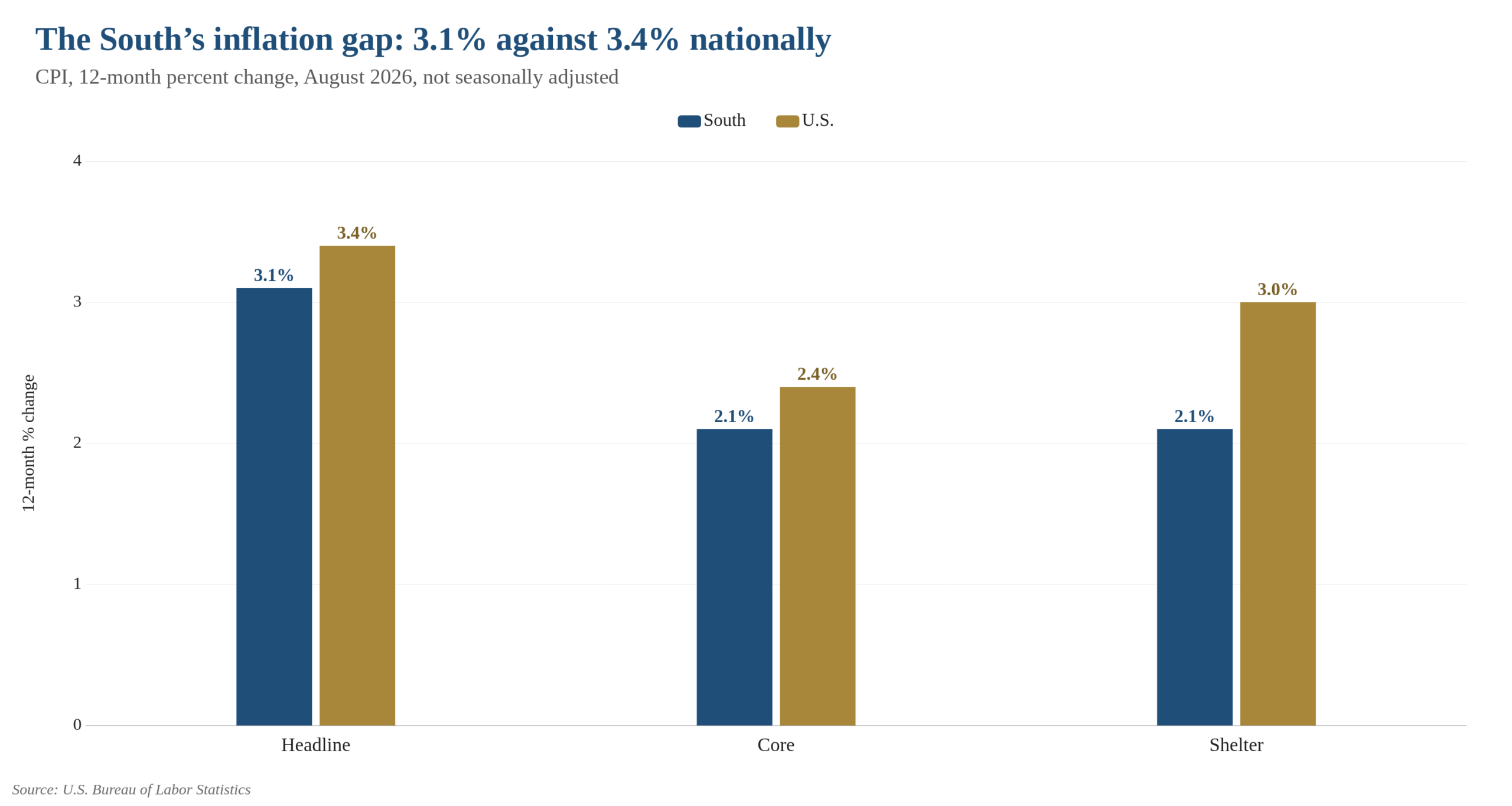
- Consumer prices in the South rose 3.1% over the year through August against 3.4% nationally, with the widest gap in shelter (2.1% against 3.0%).
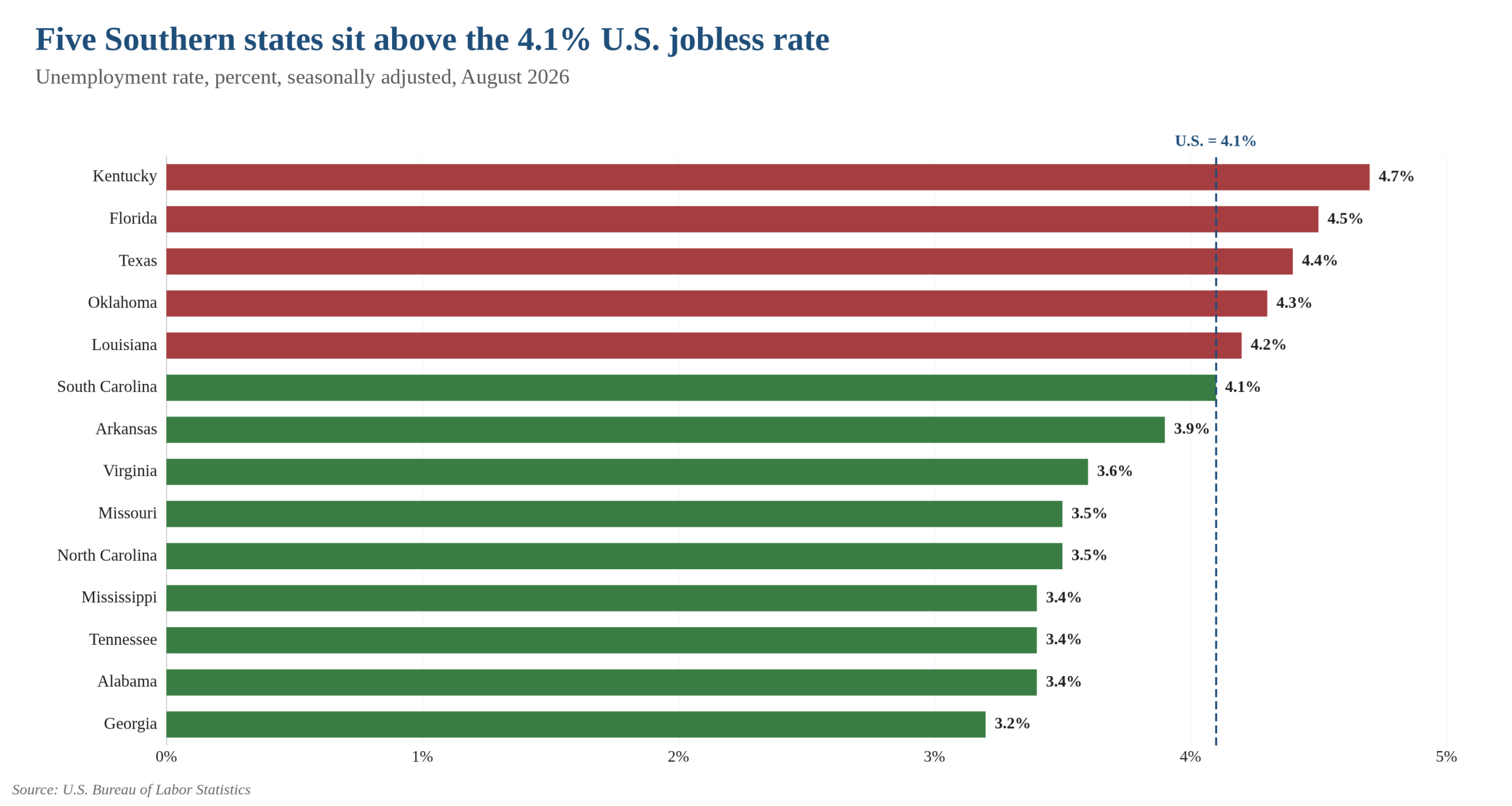
- Five Southern states sit above the 4.1% national jobless rate; Georgia runs lowest in the region at 3.2%.
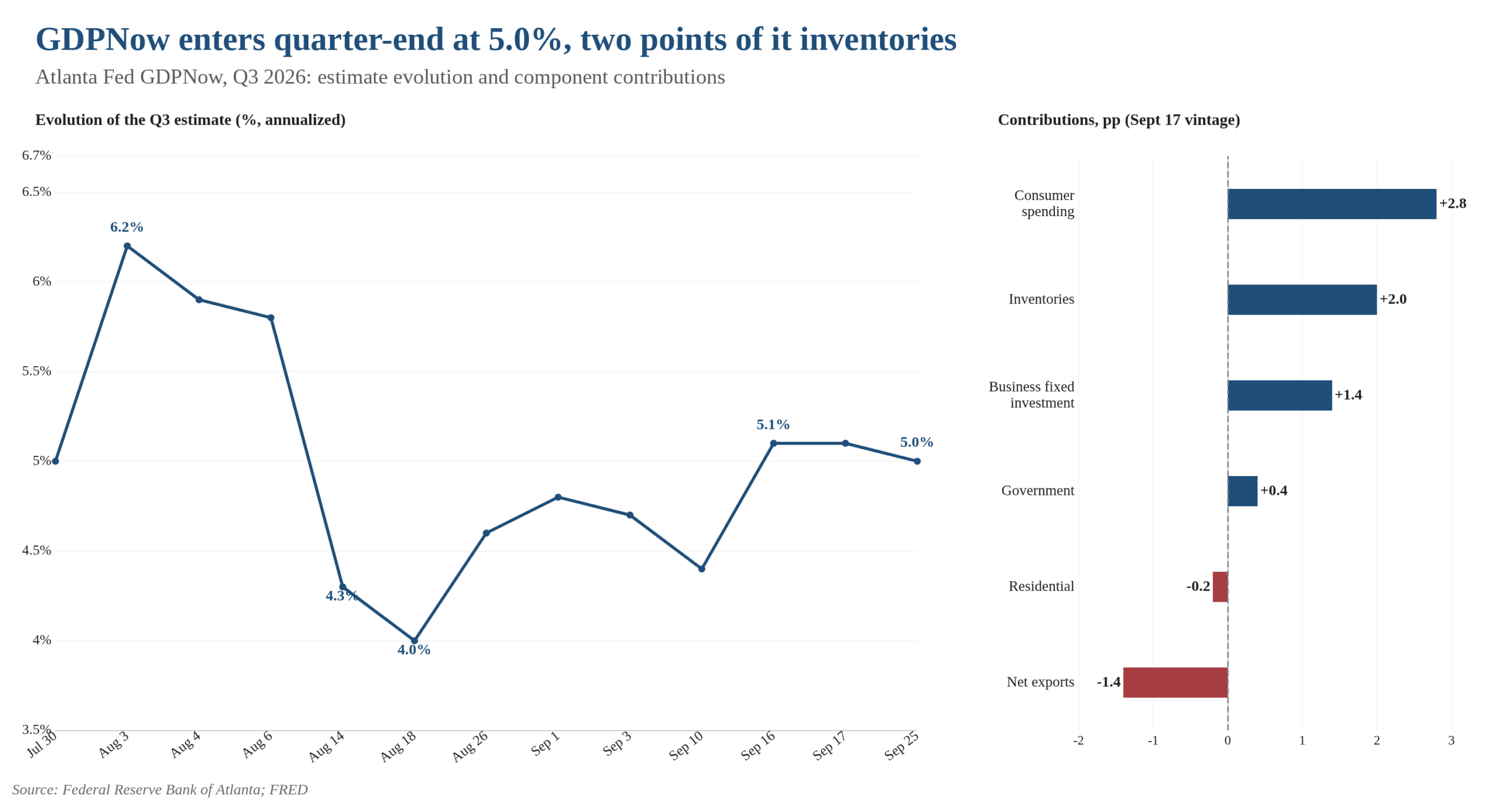
- The Atlanta Fed’s GDPNow model enters quarter-end at 5.0% for the third quarter, with about two points of that coming from inventories.
- We look for another quarter-point Fed increase before year-end, most likely October 28; a soft September jobs report on Friday is what would change that.
Seven Key Themes for the South
All seven of the forces we have organized our research around this year showed up again this week. We track the AI buildout, the energy infrastructure upgrade, defense replenishment, civilian aerospace expansion alongside the next generation defense buildup, the reshoring of critical industries and materials, a new era of pharmaceutical investment and Peak 65’s drain on labor supply. The scoreboard below pairs each with the week’s evidence.
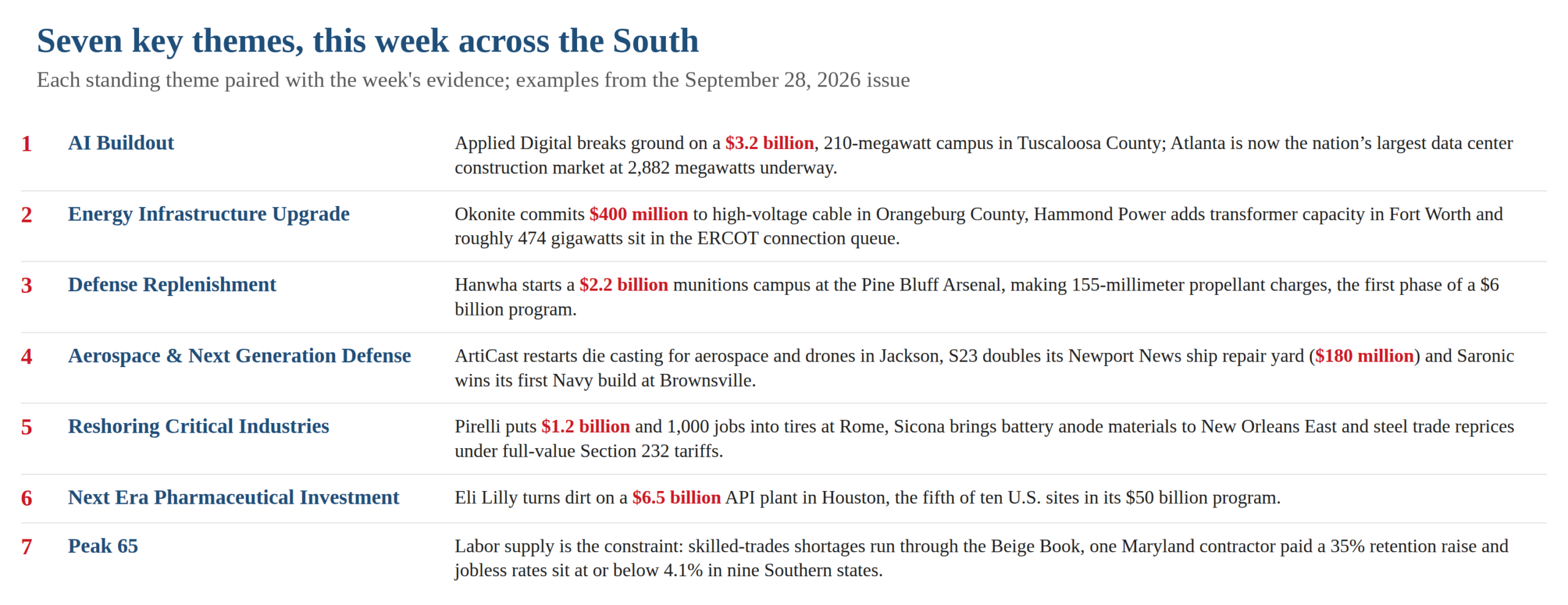
Examples drawn from announcements and data covered in this issue. Source: state and company announcements; Federal Reserve Beige Book; Southeast Economic Advisors.
The data center backlash reached the industry’s two biggest Southern hosts in the same week. Governor Greg Abbott directed the Texas Commission on Environmental Quality on September 21 to halt permits for data centers while four state agencies complete a power and water audit that ERCOT says will run at least into December. The next day, supervisors in Prince William County, Virginia, home to some 140 data centers built, underway or planned, voted unanimously to end by-right data center development, shrinking the county’s overlay district from about 9,700 acres to 3,500 and routing every new project through a special use permit. The queue behind those decisions explains them (ERCOT has fielded some 474 gigawatts of connection requests, close to 90% of them from data centers). We have argued all year that the binding constraint on the buildout would shift from capital to power, water and local consent, and this week moved all three to the front page.
Smaller jurisdictions spent the week reaching for the same brake. Memphis sends a revised 12-month moratorium to a final vote on October 6. Kershaw County, South Carolina gave final approval to a one-year pause on September 23, Wakulla County, Florida banned data centers outright in its unincorporated areas and Guilford County, North Carolina began a moratorium of up to 180 days. Pulaski County, Arkansas passed the state’s most sweeping data center ordinance 11-4 on September 23, only to see the county judge veto it two days later with an override attempt expected. In Georgia, five Effingham County residents and a coastal nonprofit sued over OpenAI’s planned $20 billion campus west of Savannah, arguing the vote that committed about 1,440 acres and a 50% property tax break was taken without proper notice. The list of Southern jurisdictions with data center restrictions in force or pending now runs past a dozen by our count.
The capital keeps arriving anyway, and it lands in prepared places. Applied Digital announced its $3.2 billion Delta Forge 2 campus near Brookwood in Tuscaloosa County, Alabama on September 25 (210 megawatts, about 1,000 construction jobs, 100 permanent positions and $270 million in community benefit payments over 20 years). CBRE’s mid-year census shows Atlanta overtaking Northern Virginia as the country’s largest data center construction market, with 2,882 megawatts underway, up 52% from a year earlier, and four-fifths of the nation’s under-construction capacity already preleased. The arithmetic on the Alabama project is familiar. One hundred permanent jobs against $3.2 billion of capital works out to $32 million per job, which makes a data center a tax-base strategy, not an employment strategy, and the counties that understand the difference are negotiating better terms.
The macro backdrop ran hotter while the region argued about power. The Atlanta Fed’s GDPNow model put third-quarter growth at 5.0% as of September 25, with a final reading due Wednesday as the quarter closes; initial jobless claims fell to 197,000 and August payrolls rose 162,000 with 55,000 of upward revision to June and July, confirming our view that the summer soft patch was a calendar artifact. The bond market is treating strength as the problem; the 10-year Treasury ended Friday at 5.17%, up 16 basis points on the week and a level press accounts place at the highest since 2007; November Brent settled at $104.32. We look for the FOMC to raise the funds rate another quarter point before year-end, most likely on October 28, and for the long end to carry more of the tightening either way; a soft September employment report on Friday is the one release this week with the weight to change that calculus.
Inflation in the South
The South is doing more than its share of the disinflationary work. Headline CPI rose 3.4% nationally over the 12 months through August while the South region came in at 3.1%. Core inflation ran 2.4% nationally against 2.1% in the South, and the widest gap is in shelter, 3.0% nationally against 2.1% across the region. The mechanism is the apartment supply the Sun Belt built from 2022 through 2024, which is still working its way into measured rents. Houston posted headline inflation of 1.3%, with core prices down 0.2% and shelter down 0.6% over the year, outright deflation in the core of Texas’s largest metro.
Energy is the offset. Gasoline prices across the South rose 28.5% over the year through August and the region’s energy index rose 15.8%, which is what a $100-plus barrel of Brent does to a driving region. AAA put the national average at $4.48 a gallon over the weekend, $1.34 above a year ago, so September’s crude rally will show up in the next report. Food at home rose a comparatively tame 1.9%. Among the metros, Atlanta ran 2.9% with shelter up just 1.3%, Miami ran 3.7% and the Washington area ran 4.0% through July, the highest reading in the Southern tables. September CPI arrives October 14. We look for the South’s shelter advantage to hold through year-end; the risk to that view is energy costs bleeding into core services, where airline fares and freight surcharges land first.
Labor Markets
Nonfarm payrolls, not the unemployment rate, are the best real-time reading on a state’s economy. Texas added 159,400 jobs over the year through August, the largest gain of any state, North Carolina added 65,600 (1.3%) and South Carolina and Louisiana tied for the national lead in percentage terms at 1.6% each. South Carolina’s August gain of 10,800 was one of only four statistically significant monthly increases in the country. The losses cluster around the federal government. The District of Columbia shed 27,000 jobs over the year (3.6%) and Virginia fell 0.9%, while Georgia and Kentucky each slipped 0.1%.
Unemployment remains low across most of the South, with five states now above the national rate. Georgia leads the region at 3.2%, with Alabama, Tennessee and Mississippi at 3.4%. Kentucky (4.7%), Florida (4.5%), Texas (4.4%), Oklahoma (4.3%) and Louisiana (4.2%) sit above the 4.1% national rate. Florida stands apart. Its rate is up from 4.0% a year ago and payroll growth has decelerated to 0.6%, well below the state’s own recent pace, though the state is still adding jobs. Kentucky’s move pairs with the largest mid-September rise in unadjusted jobless claims in the country (up 1,041, tied to manufacturing layoffs). Nationally, August was strong (payrolls up 162,000, unemployment steady at 4.1% and average hourly earnings up 3.1% over the year). We look for another solid report on Friday; a sustained break in weekly claims above 220,000 is what would change our mind.
Policy Watch
The Federal Reserve raised the funds rate a quarter point on September 16, to a range of 3.75% to 4.00%, the first increase since July 2023, and the committee does not sound finished. The September projections showed a median of one more increase this year. Governor Michael Barr said on September 23 that further adjustments are "likely to be needed" to bring inflation down in a timely fashion, and New York Fed President John Williams called another increase before year-end "a reasonable way of thinking about it" a day later. Futures markets moved from even odds of an October move at midweek to about three chances in four by Thursday. Our call sits a quarter point above the committee’s median: at least two more quarter-point increases, one before year-end and at least one in 2027, which puts the funds rate at 4.25% to 4.50% or higher by the end of next year.
The Beige Book describes a two-track economy. The September 2 edition had ten of twelve districts growing at a slight to moderate pace, with price pressures intensifying in eight of them. Atlanta’s report singled out suppliers to data center construction as nearly the only firms in the district with pricing power, while Richmond flagged skilled-trades shortages acute enough that one Maryland contractor granted a 35% raise to keep data center construction workers on the payroll. Dallas reported drought damage to cotton and wheat alongside strength in machinery, energy and industrial leasing. The next edition arrives October 14, the same day as the September CPI and two weeks ahead of the FOMC meeting.
Trade policy handed the South a split decision. China announced it will cut retaliatory tariffs on most American farm products, corn, wheat, sorghum, meat and dairy among them, while leaving soybeans under an additional 10% duty that traders describe as prohibitive for private buyers. Savannah handled 529,523 TEUs in August, off less than 1% from a year earlier with loaded exports up 4.2%, and is expanding through the cycle; the nearly $1.6 billion conversion of Ocean Terminal into a container facility is past its halfway point, with the new gate complex due in November and capacity at that terminal set to reach 1.75 million TEUs when the yard finishes in 2028. Charleston is the mirror image; the port’s own tally shows June volume of 199,694 TEUs, down 3.5% from a year earlier, and press accounts of the August results describe nearly a year of monthly declines on softer consumer cargo and late-season shifts to the West Coast. Houston edged up 1% as steel imports surged 54% under the full-value Section 232 tariff regime. We look for farm-state export volumes to improve into the fall on the tariff relief; the call hinges on soybeans staying excluded through harvest, which is what matters most for the Mississippi River trade.
Commercial Real Estate Across the South
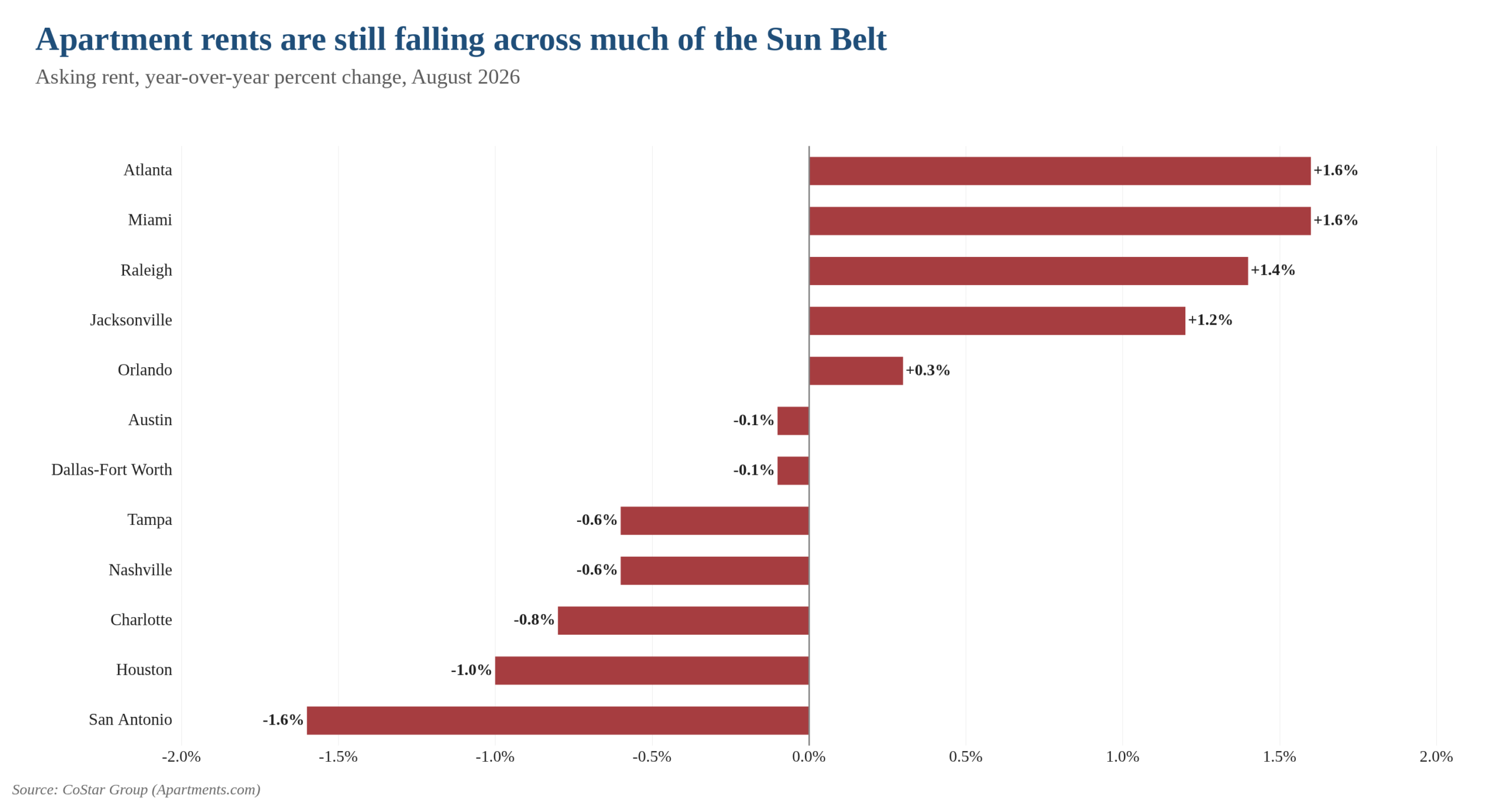
Multifamily. The rent correction is aging into a recovery, everywhere but here. National asking rents rose 0.8% over the year through August on CoStar’s count, and RealPage puts effective rents up 0.9% with occupancy at 95.5%, yet the South is the only region where rents are still falling. San Antonio (down 1.6%), Houston (down 1.0%) and Charlotte (down 0.8%) anchor the bottom of the metro table while Atlanta and Miami (up 1.6% each) have turned positive. The turn is coming from supply; annual deliveries fell to 340,200 units in the year ending in June, below the decade average for the first time in about three years and down from a peak near 588,000.
Industrial. National vacancy slipped back below 7% in the second quarter (6.9%) as leasing ran at its strongest pace since mid-2022, with Dallas-Fort Worth the national leader. The port-adjacent Southeast is still digesting its buildout; Savannah’s vacancy sits at 10.5% with slightly negative second-quarter absorption and Charleston’s at 12.9%. Primary-market data center vacancy, at a record-low 1.4%, is pulling on the same land and power.
Office. The market is dividing by quality more than by geography. National leasing reached a post-pandemic high in the second quarter (JLL puts it 27% above the trailing five-year average) and new construction fell to a 14-year low. Atlanta’s vacancy still runs 26.4%, yet asking rents set a record at $33.52 a square foot because trophy space is scarce; Washington lags on federal downsizing.
Retail. Availability held at 4.9% in the second quarter, near a record low, with asking rents up 2.4% over the year, and what little construction is underway concentrates in Sun Belt markets.
Capital markets. Transaction volume rose 9% from a year earlier to $113.7 billion in the second quarter, a third straight quarterly gain, led by industrial (up 27%). Office still carries the stress; the CMBS delinquency rate was 7.85% in August, with office loans at 12.0%. Cap rates held broadly flat through mid-year against a 10-year Treasury near 4.7%, and the move to 5.17% since is the test. We look for sales volume to keep recovering into year-end; a 10-year that holds above 5% through November would stall the bid.
Development Wins of the Week
Carolinas. The Okonite Company, the American high-voltage cable maker, will invest $400 million and add 105 jobs at a new 552,000-square-foot plant in Orangeburg County, South Carolina (September 22), one more entry in the grid-equipment boom. Devro, the Scottish-founded collagen casings maker, will add a production line and 19 jobs in Calhoun County (September 23). North Carolina’s win was institutional; the Women’s Tennis Association is moving its headquarters to Charlotte and bringing the WTA Finals with it (September 16).
Georgia & Florida. Pirelli will invest $1.2 billion and create 1,000 jobs expanding its Rome, Georgia plant, the Italian tiremaker’s U.S. headquarters site, with hiring building toward full operation early next decade (September 22). Florida’s file was thin outside the data center docket.
Alabama, Mississippi & Louisiana. Applied Digital’s $3.2 billion Tuscaloosa County campus (September 25) leads and is covered above. SubSea Craft, the British maker of components for autonomous surface vessels, chose Port Bienville in Hancock County, Mississippi for its U.S. production hub ($6.1 million, 56 jobs, September 24), Raybern Foods will add 70 jobs in Shannon (September 25) and A&W Custom Furniture adds a fourth line and 20 jobs in Okolona (reported September 27). New Orleans booked two: nuclear startup Applied Atomics will put an $8.2 million headquarters and 41 jobs in Bywater (September 25), and Australia’s Sicona Battery Technologies picked New Orleans East for its first U.S. facility ($10.3 million, 32 jobs, September 15).
Tennessee & Kentucky. ArtiCast Jackson, part of Michigan’s ArtiFlex Manufacturing family, will restart the former Pace Industries die-casting plant in Jackson, Tennessee for aerospace, drone and defense components ($10.3 million, 100 jobs, September 15). Medvantx cut the ribbon on its completed Louisville pharmacy distribution expansion ($26.8 million, 122 jobs, September 16).
Texas, Oklahoma & Arkansas. The groundbreaking of the week belongs to Eli Lilly, which turned dirt September 21 on a $6.5 billion active pharmaceutical ingredient plant at Generation Park in Houston, the fifth of ten U.S. sites in the company’s $50 billion reshoring program, with more than 600 permanent positions, some 4,000 construction jobs and a $12.5 million training partnership with San Jacinto College. Hanwha Defense USA, the American arm of South Korea’s Hanwha, will build a $2.2 billion munitions campus at the Pine Bluff Arsenal in Jefferson County, Arkansas, making propellant charges for 155-millimeter artillery rounds with about 400 jobs paying $50 an hour, the first of a planned four-project, $6 billion buildout (September 21). Canada’s Hammond Power Solutions will make large custom transformers in Fort Worth ($35.4 million, reported September 26), another direct read on grid demand.
Virginia, Maryland & DC. S23 Holdings’ East Coast Repair & Fabrication will more than double its Newport News ship repair footprint ($180 million, 414 jobs, September 22), and Holly Poultry will open an 80,000-square-foot processing and distribution plant in Hanover, Maryland (140 jobs, reported September 19).
The Week Ahead
| Date | Release |
|---|---|
| Tue., Sept. 29 | JOLTS job openings (August); Conference Board consumer confidence (September) |
| Wed., Sept. 30 | Second-quarter GDP, third estimate; personal income & outlays, including August PCE inflation; GDPNow update |
| Thu., Oct. 1 | ISM Manufacturing (September); construction spending (August); weekly jobless claims |
| Fri., Oct. 2 | Employment Situation, September (8:30 a.m.) |
| Mon., Oct. 5 | ISM Services (September) |
| Wed., Oct. 14 | CPI (September), 8:30 a.m.; Beige Book, 2:00 p.m. |
| Tue.-Wed., Oct. 27-28 | FOMC meeting, with the press conference October 28 |
Recent Research
The Catawba County and Hickory Metro Economic Outlook leads the research page, with its companion essay "My Hickory Story" alongside it. The seventh annual Economics of College Football series continues with weekly game previews through the season. All of it posts at southeasteconomy.com. Our surprise team of the year call was the University of Florida, and the Gators have made that prediction appear prescient, easily defeating Ole Miss in the Swamp this past Saturday and vaulting into a top ten AP ranking. This week we look at the Auburn-Tennessee game and review the compelling economic stories playing out in both states.
Mark Vitner
Chief Economist, Piedmont Crescent Capital / Southeast Economic Advisors
southeasteconomy.com
Sources & Notes
Sources: U.S. Bureau of Labor Statistics; U.S. Bureau of Economic Analysis; U.S. Department of Labor; Federal Reserve Board (Beige Book, September 2); Federal Reserve Bank of Atlanta (GDPNow); U.S. Treasury; AAA; CoStar Group; RealPage; Cushman & Wakefield; CBRE; JLL; MSCI; Trepp; state commerce and economic development agencies; Georgia Ports Authority; South Carolina Ports Authority; Port Houston; company and local government announcements.
Notes: CPI figures are for August 2026; metro CPIs publish bimonthly, and the Washington figure reflects July. State employment data are August 2026, seasonally adjusted and preliminary. Apartment rent figures are CoStar asking rents through August; RealPage effective-rent measures run somewhat lower in several Sun Belt metros. Quarterly brokerage data cover the second quarter of 2026. Market levels are as of the September 25 close. We define the South as every state that competes in the Southeastern Conference along with the South Atlantic states, extending up to Maryland and West Virginia.