
Auburn Travels to Knoxville to Take on the Volunteers
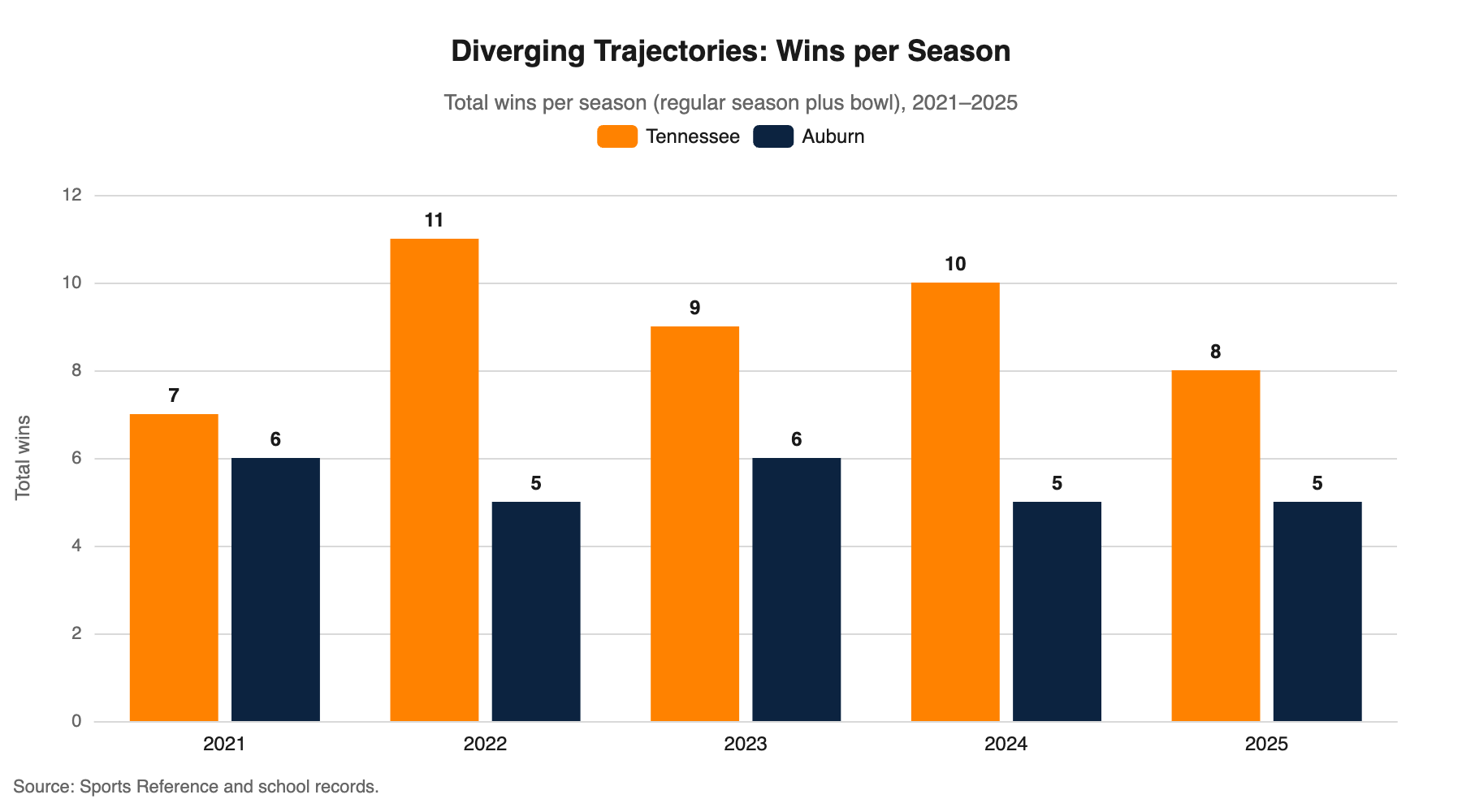
Auburn visits Tennessee on Saturday, October 3, 2026, at Neyland Stadium in Knoxville, with kickoff at 3:30 p.m. ET on ESPN. It is a Southeastern Conference game and the first meeting between these two longtime SEC rivals since 2020, when Auburn won 30-17 at Jordan-Hare Stadium, and Auburn's first visit to Knoxville since a 55-23 win in 2013. Both teams arrive at 3-1. Tennessee, which reached the first expanded College Football Playoff in 2024 before a bruising 2025, is ranked 17th after a 20-17 loss to top-ranked Texas. Auburn has not put together a winning season since 2020 and is on its third head coach in five years, yet it is one of the early season's genuine surprises, and this Saturday will show us how much the Tigers have really improved.
There is a personal storyline running underneath this one. Auburn walks into Knoxville led by a first-year head coach who knows the building intimately. Alex Golesh spent the 2021 and 2022 seasons as Tennessee's offensive coordinator, helping design the fast-paced attack that revived the Volunteers under Josh Heupel, before leaving to build his own program at South Florida, where he went 23-15 over three years. Auburn hired him in late 2025 on a six-year deal. He returns to the place where he made his name, now standing on the opposite sideline from the coach who once handed him the play sheet. Last Saturday he collected his first SEC win as Auburn's head coach, a 21-15 decision over Vanderbilt.
This report is part of our series on the economies of areas that college football connects, and these two college towns sit in very different local economies. Knoxville is a research-and-energy hub anchored by a flagship university and a pair of national laboratories. Auburn is the fastest-growing metro in Alabama, a college town riding a wave of advanced manufacturing investment. As we do each week, we review the prior week's key results, tour each school, including its alumni and football history, profile the local economies, update the respective state economies, and preview the game.
- Last week. Top-ranked Texas escaped Neyland Stadium with a 20-17 win over Tennessee, a game that turned on a dropkicked onside kick the SEC has since said was illegal. Florida overwhelmed fourth-ranked Ole Miss 52-28, and Stanford erased a 10-point halftime deficit to beat Georgia Tech, the game we previewed last week.
- The game. Auburn visits Tennessee on Saturday, October 3, at 3:30 p.m. Eastern on ESPN, the first meeting since 2020 and Auburn's first trip to Neyland Stadium since 2013.
- The records. Both teams are 3-1. Tennessee, No. 17 in the AP poll, beat Furman, Georgia Tech and Kennesaw State before losing to Texas. Auburn, unranked, beat Baylor, Southern Miss and Vanderbilt and lost 44-39 to Florida.
- The line. Tennessee is favored by 7.5 points at DraftKings and FanDuel, with a total between 53.5 and 56.5 and a moneyline between -260 and -285.
- The history. Auburn leads the all-time series 29-22-3 and won the last meeting in 2020, 30-17. Its last game in Knoxville was a 55-23 win in 2013.
- The economies. Alabama's unemployment rate is 3.4 percent, up from 2.8 percent a year ago, but the state added 22,100 jobs and Auburn-Opelika keeps landing new manufacturers. Tennessee's rate is 3.4 percent, down from 3.5 percent, and Knoxville rests on health care, the university and Oak Ridge.
- Our call. Tennessee at home, in a close, physical game, though 7.5 points is a lot to lay with a team that just gave up ten sacks.
Week Four in Review: Texas Escapes Knoxville, Florida Rolls
Week Four was the SEC's best showcase of the young season, and the headline game was in Knoxville. Top-ranked Texas left Neyland Stadium with a 20-17 win over Tennessee, but not before the Volunteers made it uncomfortable. Arch Manning completed his first seven passes for 120 yards and Raleek Brown scored twice on the ground, and the Longhorns' defense sacked Tennessee freshman quarterback Faizon Brandon ten times. Yet Texas also committed 11 penalties, surrendered a 57-yard punt-return touchdown to Qua Moss, and had to survive a late rally. Brandon hit Mike Matthews for a 30-yard touchdown to cut the deficit to three, Tennessee's dropkicked onside kick (which we now know was prohibited under SEC rule) was recovered by Arion Carter with just over a minute left, and Jelani McDonald broke up the final pass. A crowd of 101,915 watched the Vols fall to 3-1 and 0-1 in the SEC.
The bigger surprise was the size of Florida's win over Ole Miss. The 21st-ranked Gators came into the game slightly favored and then beat fourth-ranked Ole Miss 52-28, running for 302 yards as a team behind Jadan Baugh, who had 142 yards and three touchdowns, and Duke Clark, who added 126. Trinidad Chambliss threw for 298 yards in a losing effort, but Ole Miss never found an answer for the ground game. Florida had already beaten Auburn 44-39 the week before, and the AP poll rewarded it with a 13-spot jump to No. 8, while Ole Miss fell five places to No. 9.
The game we featured last week also produced an upset. Stanford, picked to finish last in the ACC, erased a 20-10 halftime deficit with 24 unanswered points and beat Georgia Tech 34-27. Davis Warren threw for 396 yards and three touchdowns, and the loss dropped the Yellow Jackets to 1-3. It also takes some of the shine off Tennessee's 45-24 win in Atlanta on September 12, which had been the Vols' best result of the year.
The AP poll reflects the conference's depth. Texas is No. 1, followed by Georgia, Notre Dame, Miami and Ohio State. Alabama is seventh at 4-0, Florida eighth and Ole Miss ninth, and ten of the 25 ranked teams are from the SEC. Tennessee slipped from 14th to 17th. Auburn is not ranked.
Sources: ESPN; CBS Sports; Yahoo Sports; the Associated Press; the Southeastern Conference; Tennessee, Florida, Stanford and Auburn athletics; FanDuel Research.
Where Auburn and Tennessee Stand Entering Week Five
Auburn is the early-season surprise. The Tigers are coming off a 5-7 season, yet they open 3-1 with a first-year coach and a senior quarterback, Byrum Brown, who followed Alex Golesh from South Florida. They beat Baylor 17-16 in the Aflac Kickoff Game in Atlanta, routed Southern Miss 43-8, lost a 44-39 shootout at home to Florida, and last Saturday beat Vanderbilt 21-15. A blocked punt that Cade Carlson returned for a touchdown put Auburn up 14-3 in that game, and Brown accounted for two scores. The defense is the encouraging part of the story. It gave up 495 yards and 44 points to Florida and then held Vanderbilt to 311 yards and 15 points. Two of the three wins were one-score games, so there is not much cushion in the record.
Tennessee won its first three games by wide margins over Furman (56-9), at Georgia Tech (45-24) and Kennesaw State (42-9) before meeting Texas. Brandon, a freshman and former five-star recruit, has settled in as the starter, and the Texas game showed both sides of that. He threw for 145 yards and a touchdown, but the pass protection collapsed, and coach Josh Heupel has pointed to offensive line play and quarterback decision-making as the issues to fix before Auburn arrives.
| Auburn Tigers | Tennessee Volunteers | |
|---|---|---|
| Week 1 (Sept. 5) | W 17-16 vs. Baylor (Atlanta) | W 56-9 vs. Furman |
| Week 2 (Sept. 12) | W 43-8 vs. Southern Miss | W 45-24 at Georgia Tech |
| Week 3 (Sept. 19) | L 39-44 vs. Florida | W 42-9 vs. Kennesaw State |
| Week 4 (Sept. 26) | W 21-15 vs. Vanderbilt | L 17-20 vs. Texas |
| 2026 record | 3-1 (1-1 SEC) | 3-1 (0-1 SEC) |
| AP Top 25 (Sept. 27) | Unranked | No. 17 |
| Points scored | 120 | 160 |
| Points allowed | 78 | 62 |
| Point differential | +42 | +98 |
Table 2. 2026 results through Week Four. Sources: school athletics sites, ESPN and the Associated Press poll of September 27, 2026.
Auburn University
Auburn University was chartered in 1856 as the East Alabama Male College, a small private school affiliated with the Methodist Church. Its course changed in 1872, when, under the Morrill Act, it became the first land-grant college in the South and was renamed the Agricultural and Mechanical College of Alabama. The land-grant mission, practical education in agriculture, engineering and the sciences, still defines the place. It took the name Auburn University in 1960, after the town that grew up around it. Today Auburn is booming. The university set a fall enrollment record for the seventh straight year in 2025, reaching 35,172 students, and drew a record 59,128 freshman applications. It is the second-largest university in Alabama and remains strongest in engineering, agriculture, aviation and the applied sciences.
For a school known for nuts-and-bolts disciplines, Auburn has produced an outsized share of people who shaped the wider world. The most prominent is Tim Cook, who earned an industrial engineering degree in 1982, joined Apple in 1998, and ran the company from 2011 until stepping down as chief executive in September 2026, having built it into one of the most valuable companies on earth; he remains Apple’s executive chairman. He was elected to the National Academy of Engineering in 2026 and has poured resources back into his old department. The roster reaches well beyond him. Academy Award winner Octavia Spencer studied here, as did Olympic swimming champion Rowdy Gaines and NBA Hall of Famer Charles Barkley. The university also has a deep bench in aerospace, having sent a long line of engineers and astronauts into the national space program.
On the field, Auburn has played football since 1892 and was a charter member of the SEC in 1932. With more than 800 wins, the Tigers rank among the dozen or so winningest programs in the country, and they claim nine national championships, two of which, 1957 and 2010, are recognized by the major polls. Three Auburn players have won the Heisman Trophy: Pat Sullivan in 1971, Bo Jackson in 1985, and Cam Newton in 2010, who carried an undefeated team to the BCS title with a 22-19 win over Oregon. The Tigers play at Jordan-Hare Stadium, which seats 88,043 and fills for the Iron Bowl against in-state rival Alabama, a series that produced the unforgettable 2013 “Kick Six.” Game days come wrapped in tradition, from the battle cry of “War Eagle” and the eagle's pregame flight around the stadium to the rolling of Toomer's Corner in toilet paper after a big win.
Auburn and the Alabama Boom
Where many college towns simply hold steady, Auburn is growing as fast as almost anywhere in the country. The Auburn-Opelika metro, home to roughly 206,000 people as of 2024, is one of the fastest-growing in Alabama and has ranked among the fastest-growing in the nation for three decades. The city of Auburn has expanded by about a quarter since 2019 and is now about 85,000 residents. The labor market is exceptionally tight, with metro unemployment of 3.3 percent in August, below both Alabama's 3.4 percent and the national rate of 4.1 percent, and metro payrolls of 83,700 are up 2,000 from a year ago.
The university is the anchor, employing well over 13,000 people and supplying the steady stream of students, researchers and graduates the local economy is built around. But the story increasingly runs through manufacturing and logistics. Auburn has cultivated a cluster of technology-driven manufacturers serving the aerospace, automotive and pharmaceutical industries, and the region sits squarely in the Southern auto corridor that stretches across Alabama and into Georgia. The investment pipeline has been remarkable. Over recent years, the Auburn-Opelika area has landed more than $2.6 billion in capital investment and 5,700 new jobs, and the area has now earned back-to-back Mac Conway Awards for economic development excellence, in 2025 and 2026.
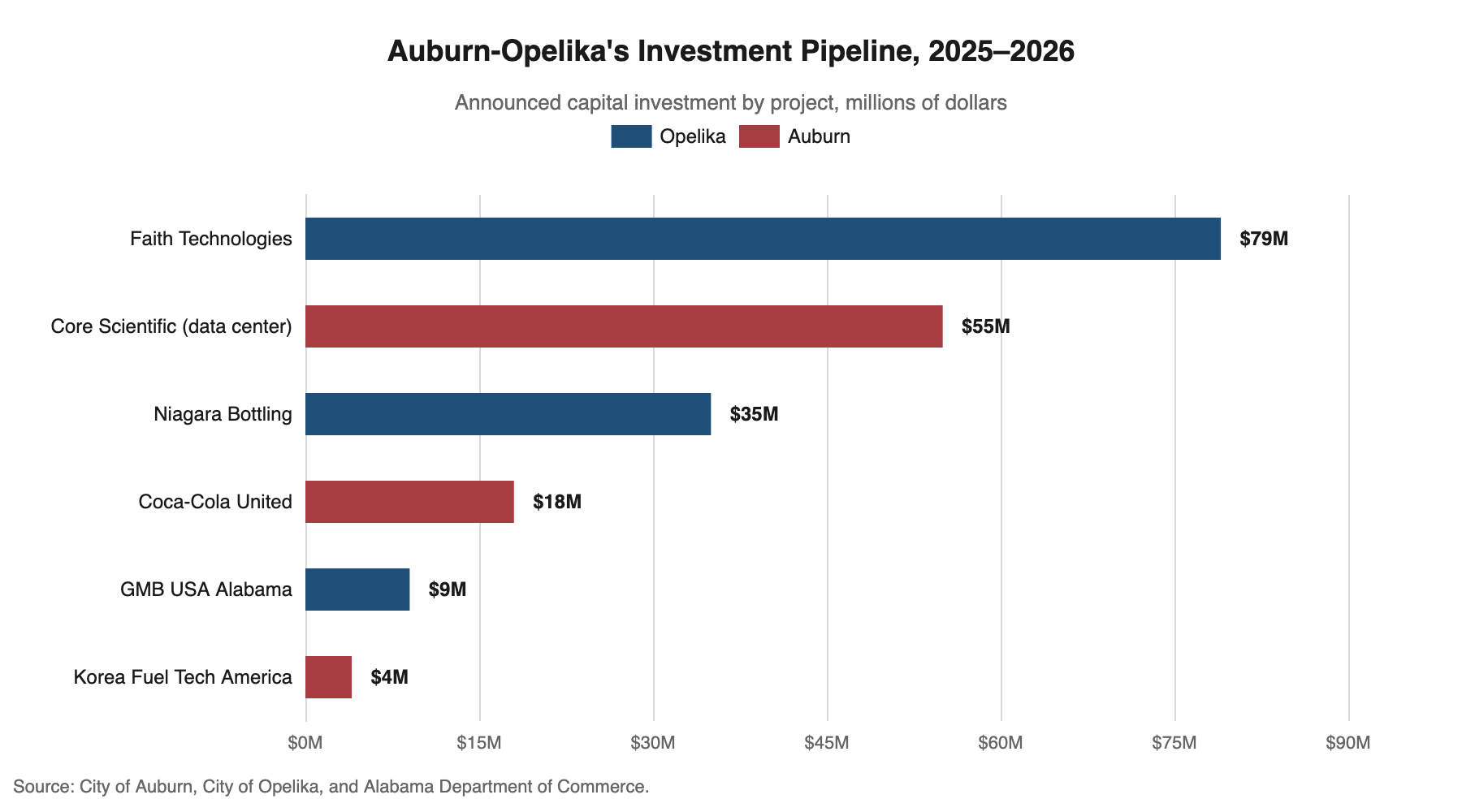
Notable projects reflect a broad assortment of industries. Faith Technologies, a Wisconsin engineering firm, is investing $79 million to convert a former distribution center in Opelika. Core Scientific pulled a $55 million permit for a new data center in Auburn. Coca-Cola United opened an $18 million sales center and warehouse in Auburn, Niagara Bottling is putting $35 million into its Opelika plant, and automotive supplier GMB USA Alabama is adding a new facility with 75 jobs. Miele, the German maker of premium home appliances, has begun production at its first U.S. manufacturing plant in neighboring Opelika. The pace has continued this summer. Vulcaflex, an Italian maker of synthetic leather for automotive interiors, chose Auburn for its first U.S. plant, an investment of nearly $70 million and 130 jobs, and on August 12 2A USA, an Italian aluminum die caster serving the heavy truck industry, announced a $32 million expansion in Auburn that will add 50 jobs. The city says it has worked on nine new or expansion projects since January, representing $227 million of capital investment and an estimated 424 jobs at full production. That diversified base, education alongside advanced manufacturing, helps the metro weather a downturn in any one sector.
The University of Tennessee and Knoxville
The University of Tennessee traces its roots to 1794 and Blount College, founded two years before Tennessee became a state. After early financial struggles, it reopened as East Tennessee College in 1820, gained federal land-grant support through the Morrill Act, and took its current name in 1879. The twentieth century brought rapid growth, most consequentially a deep partnership with nearby Oak Ridge, the wartime atomic site that became one of the nation's premier centers for nuclear science, advanced manufacturing and supercomputing. That relationship still gives Knoxville an unusual concentration of engineering and research talent for a city its size. The university itself is at record scale, enrolling 40,421 students in the fall of 2025, an all-time high, after drawing nearly 63,000 freshman applications.
The university's reach extends across American life. Pro Football Hall of Famers Peyton Manning and Reggie White came through Knoxville, but so did a wide range of leaders in business, science and public service drawn by the school's engineering and agricultural programs. The checkerboard end zones and the wall of orange on a fall Saturday are a familiar part of the region's identity.
Tennessee has played football since 1891 and grew into a national power under coach Robert Neyland, whose name now adorns the stadium and who delivered the program's first national title in 1938. The nickname “Volunteers” honors Tennessee's reputation, dating to the War of 1812, for answering the call to serve in large numbers. A charter member of the SEC, Tennessee has won 13 conference championships, third-most in league history behind Alabama and Georgia, and Tennessee claims six national titles. Neyland Stadium holds 101,915 and ranks among the largest stadiums in the country, a real home-field advantage on a loud fall night.
Knoxville's Steady Engine
Knoxville rose first as a river-and-rail town, a distribution hub on the Tennessee River that became one of the South's larger wholesale centers after the Civil War. When the iron and textile industries faded, the university and the laboratories provided ballast. That combination of “eds and meds” plus federal research has made for a notably stable economy. The metro is home to nearly 960,000 residents, part of a broader region topping 1.2 million, and Knox County's population is among the fastest-growing in the state. Metro unemployment was 3.2 percent in July (not seasonally adjusted, preliminary), well below the national rate of 4.1 percent.
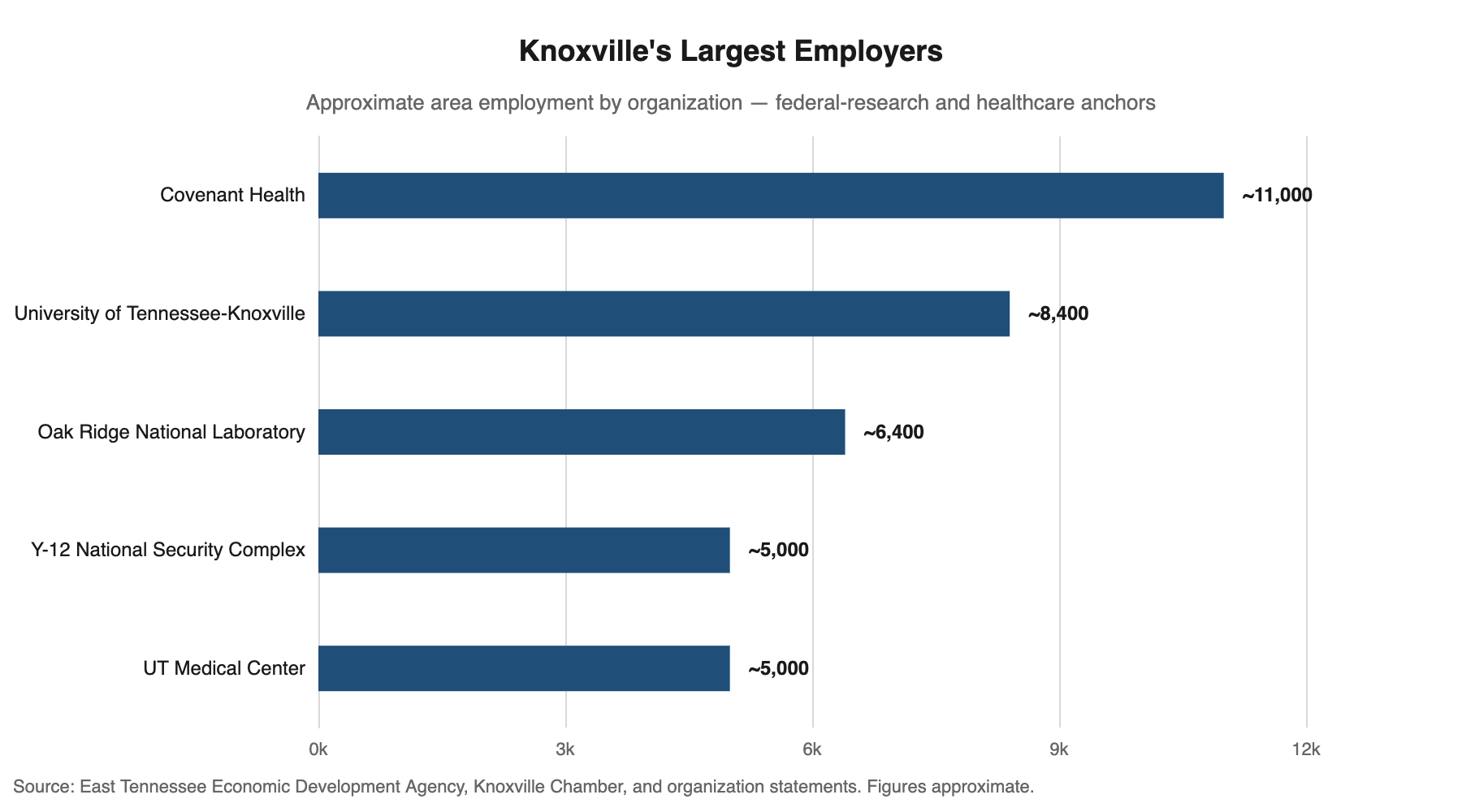
The base is unusually deep. Covenant Health, the region's largest private employer, runs a sprawling network of hospitals and clinics across East Tennessee. The University of Tennessee and its medical center anchor education and healthcare. And the federal research complex is enormous: the Y-12 National Security Complex employs roughly 5,000 people through its operating contractor, while Oak Ridge National Laboratory employs more than 6,000. Together with the Department of Energy’s other Oak Ridge operations, that federal complex drove an estimated $7.2 billion in economic impact across Tennessee in a 2020 study. Headquarters names such as Pilot Flying J, the travel-center giant, and Clayton Homes, the country's largest builder of manufactured housing, round out the picture. The investment keeps coming, from a $50 million university technology push to a $530 million housing and retail redevelopment near campus. Oak Ridge is also drawing a fresh wave of nuclear investment: a 2026 Department of Energy land transfer opened the reservation to a cluster of advanced-reactor and fuel-cycle companies, from LIS Technologies’ planned $1.38 billion laser-enrichment plant to a Centrus expansion of more than $560 million. More recently, Kyoto Fusioneering, a Japanese fusion technology developer, said on August 11 that it will move its U.S. headquarters to Oak Ridge, investing $46.9 million and adding 51 jobs to build a fusion test facility at Oak Ridge National Laboratory, and on September 9 Siemens Healthineers announced a $43.6 million expansion of its PET detector operation in Rockford, in Blount County, adding more than 90 jobs over five years. The Great Smoky Mountains National Park, the most-visited national park in the country, draws a steady stream of tourists right past Knoxville's doorstep, and the University of Tennessee fills Neyland Stadium six or seven Saturdays a year, each one a meaningful boost to area hotels, restaurants and shops.
Alabama and Tennessee: A State-Level Update
Both states are still adding jobs, but the labor-market signals point in different directions. Alabama's unemployment rate was 3.4 percent in August, unchanged from July but up from 2.8 percent a year earlier. Tennessee's was also 3.4 percent, matching its lowest reading of 2026 and down from 3.5 percent a year ago. Both are well below the national rate of 4.1 percent.
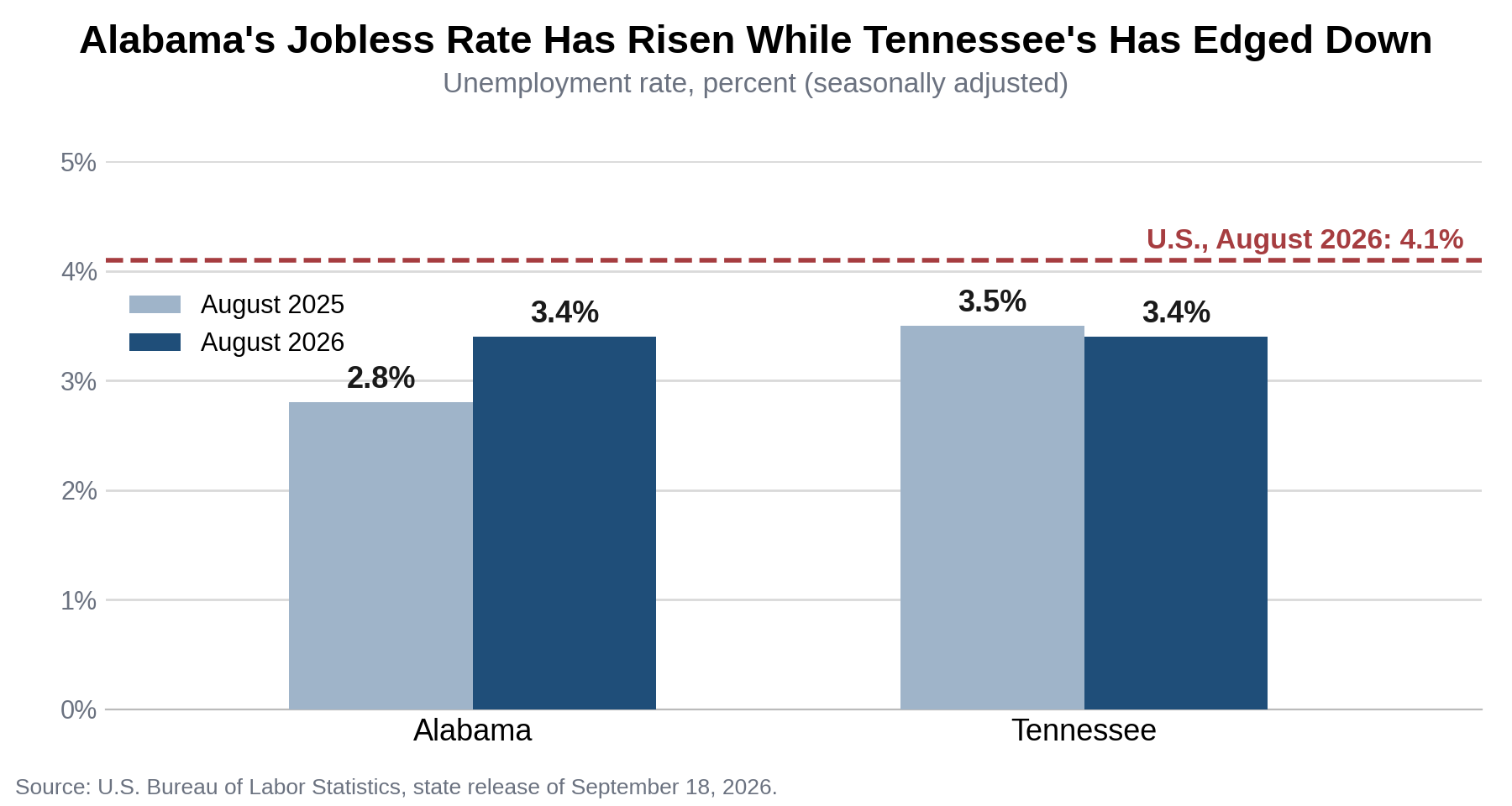
Alabama's higher jobless rate comes with faster job growth. Nonfarm payrolls rose by 22,100 jobs, or about 1.0 percent, over the 12 months ended in August, including 5,800 in August alone. Leisure and hospitality added 11,100 jobs, professional and business services 6,000, private education and health services 5,100 and government 4,700, while trade, transportation and utilities gave back 5,000 and financial activities 2,500. Pay is rising as well. Average weekly wages reached $1,487 in construction and $1,415 in manufacturing in August, both up from July, and private-sector weekly earnings averaged $1,187.71. A rising jobless rate alongside growing payrolls usually points to labor force growth outpacing hiring rather than to layoffs. Among the state's metros, Decatur (2.9 percent) and Huntsville (3.0 percent) post the lowest rates, Auburn-Opelika at 3.3 percent also sits below the state average, and Mobile (4.4 percent) and Anniston-Oxford (4.0 percent) are the softest.
Tennessee added 16,400 jobs over the year, with health care and social assistance the largest source of gains, followed by administrative and support services and leisure and hospitality. Payrolls rose by 1,800 between July and August, led by leisure and hospitality, government and construction. That is a smaller gain than Alabama's, in a larger economy, and it fits the picture from the University of Tennessee's Boyd Center, which in its 2026 outlook called for positive but slow growth and projected that job creation slowed to about 24,000 in 2025, well below the typical pace of roughly 60,000 a year. That forecast appears right to us, and we suspect that reported job growth is currently slightly understated. New investment continues to arrive. On September 29, Ultium Cells, the General Motors and LG Energy Solution venture, announced a $1 billion investment at its Spring Hill plant to mass produce a new lithium manganese-rich battery cell, with modifications beginning late this year and completion expected in 2028.
For the two college towns, the state pictures fit the local ones. Auburn sits in a faster-moving labor market that is being reshaped by manufacturing investment, while Knoxville's is steadier, anchored by health care, the university and the federal research complex at Oak Ridge.
Sources: U.S. Bureau of Labor Statistics; Alabama Department of Workforce; Tennessee Department of Labor and Workforce Development; University of Tennessee Boyd Center; Governor of Alabama; Tennessee Department of Economic and Community Development; City of Auburn; City of Opelika; FRED.
Auburn-Opelika and Knoxville, Side by Side
| Indicator | Auburn-Opelika, AL | Knoxville, TN |
|---|---|---|
| Metro population (2024) | About 206,000 | About 958,000 |
| Metro unemployment rate | 3.3% (August 2026) | 3.2% (July 2026, not seasonally adjusted, preliminary) |
| Anchor university enrollment | 35,172 (Auburn, fall 2025) | 40,421 (Tennessee, fall 2025) |
| State unemployment rate (August 2026) | 3.4% (Alabama), up from 2.8% a year earlier | 3.4% (Tennessee), down from 3.5% a year earlier |
| Statewide employment trend | +22,100 jobs (August, year over year) | +16,400 jobs (August, year over year) |
| Recent announcements | Vulcaflex, nearly $70 million and 130 jobs (June); 2A USA, $32 million and 50 jobs (August) | Kyoto Fusioneering, $46.9 million and 51 jobs (August); Siemens Healthineers, $43.6 million and 90 jobs (September) |
| A note on comparability. The two metro unemployment readings cover different months and may differ in seasonal adjustment, and the state figures describe far larger, more diverse economies than the two metro areas, so they are included to show direction, not to be read as metro-level comparisons. | ||
Table 3. Auburn-Opelika and Knoxville, side by side. Sources: U.S. Census Bureau; U.S. Bureau of Labor Statistics; Alabama Department of Workforce; FRED; university enrollment reports; state economic development agencies.
Previewing the Game
This is a meeting of two 3-1 teams that arrived by different roads, which makes it harder to handicap than the records suggest. Tennessee is the home team and the more established operation. Josh Heupel is in his sixth season, and his body of work, including an 11-win Orange Bowl team in 2022 and a College Football Playoff berth in 2024, is the best sustained stretch the program has enjoyed in two decades. But 2025 was a clear step back. The Vols finished 8-5 and lost the Music City Bowl to Illinois, their quietest season under Heupel. This year they have beaten Furman, Georgia Tech and Kennesaw State comfortably and lost to the top-ranked team in the country by three points, at home, with the ball in the closing minute. That is a respectable résumé, and it also leaves them needing a response.
| Auburn Tigers | Tennessee Volunteers | |
|---|---|---|
| Head coach (2026) | Alex Golesh (1st season) | Josh Heupel (6th season) |
| 2025 record | 5-7 | 8-5, lost Music City Bowl |
| 2026 starting QB | Byrum Brown (South Florida transfer) | Faizon Brandon (freshman) |
| 2026 record | 3-1 (1-1 SEC) | 3-1 (0-1 SEC) |
| AP Top 25 (Sept. 27) | Unranked | No. 17 |
| Home stadium | Jordan-Hare Stadium (88,043) | Neyland Stadium (101,915) |
| Last meeting | Nov. 21, 2020 (won 30-17) | Nov. 21, 2020 (lost 17-30) |
| All-time series | Leads, 29-22-3 | Trails, 22-29-3 |
| Saturday | Road team, underdog | Home team, favorite |
Table 4. Auburn vs. Tennessee, by the numbers. Sources: ESPN, the Associated Press, school athletics sites and Sports Reference.
The reason for last year's slide traces to one of the offseason's biggest national stories. Quarterback Nico Iamaleava, who as a redshirt freshman led Tennessee to the 2024 Playoff, sat out spring practice in a contract dispute, with his camp seeking a raise to around $4 million, and then transferred to UCLA. Tennessee pivoted quickly, swapping in Joey Aguilar, who responded with one of the better statistical seasons in school history, more than 3,500 passing yards and 24 touchdowns, third on the single-season passing list behind only Peyton Manning and Tyler Bray. Aguilar has since moved on to the professional ranks, and the job has gone to Faizon Brandon, a freshman and former five-star recruit. Brandon threw for 178 yards and a touchdown and ran for another against Kennesaw State, then threw for 145 yards and a touchdown against Texas while being sacked ten times. Heupel pointed afterward to offensive line play and quarterback decision-making. It is a prove-it year in Knoxville, and the protection problems are the first thing Auburn will test.
Auburn arrives with fresh energy, and the results have backed it up so far. The Tigers have not finished above .500 since 2020 and have churned through coaches, parting ways with Hugh Freeze after nine games of a 5-7 2025 season, his record at the school a disappointing 15-19, before handing the program to Alex Golesh. Golesh knows how to score points, but the offense has been more efficient than explosive. Byrum Brown threw for 140 yards and a touchdown and ran for another against Vanderbilt, and the game turned on a blocked punt. The defense is the bigger change, allowing 15 points to Vanderbilt a week after allowing 44 to Florida. Two of the three wins were one-score games, and the loss to Florida showed how quickly the margin for error disappears against a team that can run the ball. A stadium holding 101,915 is a different kind of test than Jordan-Hare against Southern Miss.
The market has already weighed in. Tennessee is a 7.5-point favorite at both DraftKings and FanDuel, with a total between 53.5 and 56.5 points and the Vols' moneyline between -260 and -285, depending on the book. Those numbers were posted early this week and will move with the injury reports.
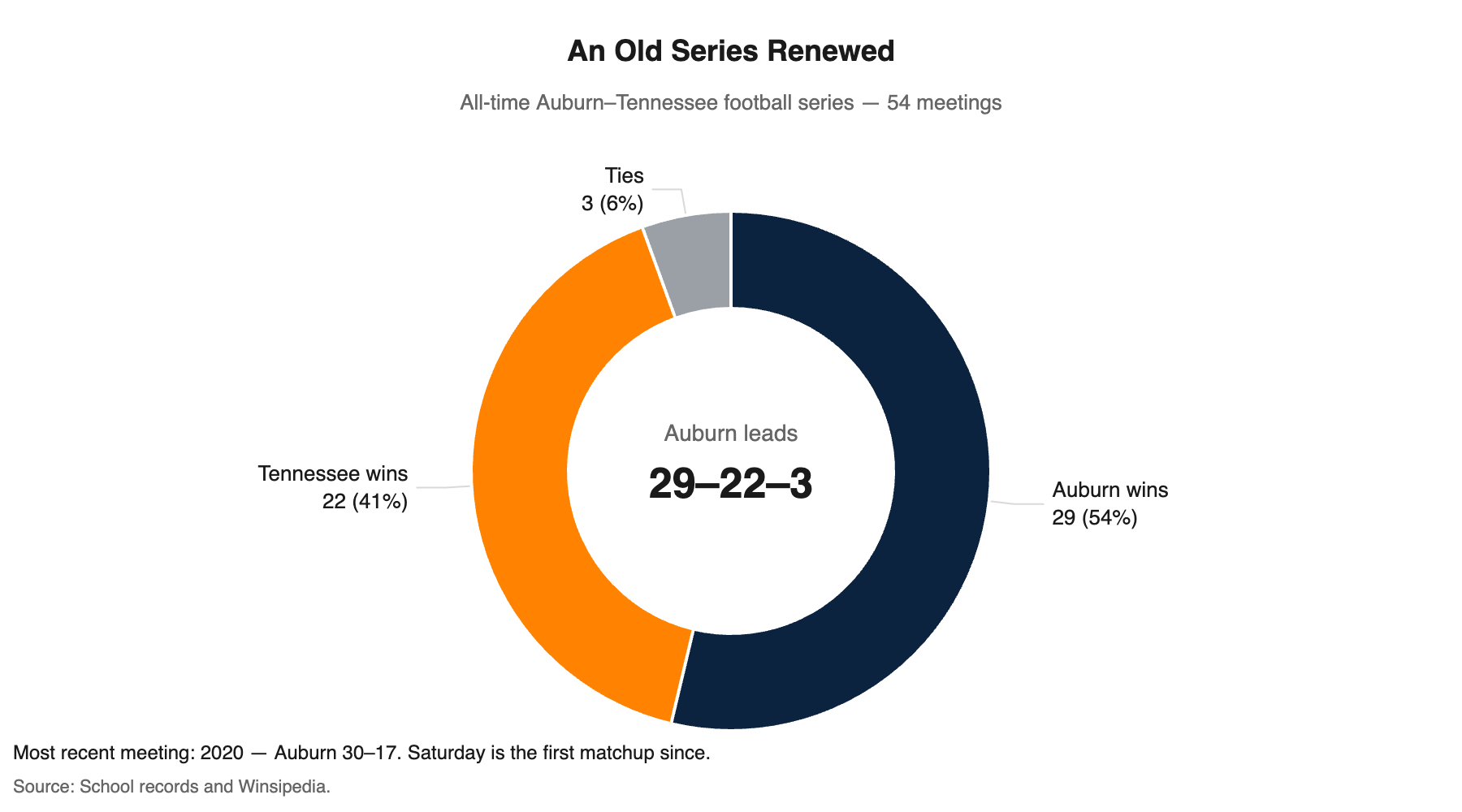
Auburn leads the all-time series 29-22-3 and won the last meeting in 2020, and the Tigers have not played in Knoxville since a 55-23 win in 2013. History, however, counts for less than usual here.
The Bottom Line
We still lean Tennessee, at home, coming off a loss it will want to answer, with the more established system and the louder building, and we expect a close, physical game. But 7.5 points is a lot to lay with a team that just gave up ten sacks, and Auburn has been competitive in every game it has played this season. If Golesh's offense travels well, the man who once called plays for the Volunteers could keep it close or even spoil the reunion. Saturday will tell us how much of Auburn's improvement is real, even if the Tigers fall short of a win.
Mark Vitner
Chief Economist, Southeast Economic Advisors
About this report
This Week Five preview is published by Southeast Economic Advisors and pairs an on-field preview with an economic outlook for the two communities that host the participating universities. Economic figures come from the U.S. Bureau of Labor Statistics, the Alabama Department of Workforce, the Tennessee Department of Labor and Workforce Development, the U.S. Census Bureau, FRED and the sources cited in each section, and are subject to revision. State unemployment rates are seasonally adjusted; the Knoxville metro rate is not. Football statistics reflect the completed 2025 season and the first four weeks of 2026. Odds and totals were retrieved on September 29, 2026 and move daily. The Associated Press poll cited is from Sunday, September 27, 2026.
This material is provided for informational and educational purposes only and does not constitute investment, legal, or financial advice. Betting lines and win probabilities are sourced from third-party market data and models and are subject to change.
© 2026 Southeast Economic Advisors. All rights reserved.