
One Conference, Three Time Zones
Georgia Tech travels to Stanford Stadium on Saturday, a 2,127-mile trip across three time zones for a 10:30 p.m. Eastern kickoff on ESPN. It is the first meeting between the two programs as conference opponents, the ACC having absorbed Stanford in 2024, and only the third meeting overall. Georgia Tech won both of the earlier ones, the 1991 Aloha Bowl 18-17 and the 2001 Seattle Bowl 24-14. Both teams arrive at 1-2, still introducing themselves to their own fan bases under a fourth-year coach in Atlanta and a first-year one in Palo Alto.
Stanford and Georgia Tech both anchor the tech sector in their respective metro areas, Stanford at the center of Silicon Valley and Georgia Tech in the middle of Atlanta's own Tech Square innovation district. Both campuses are in the middle of unusual investment cycles in their home cities right now, Atlanta's Tech Square adding its largest expansion in two decades and the Bay Area drawing a historic wave of AI capital. We take up the history behind both programs and the economies built around them later in this issue; our focus for now is Saturday's game.
Closing the Book on Week Three
Our call favored Alabama by two scores, and the final score, Alabama 50, Florida State 36, was a 14-point margin, almost exactly what we expected on paper. The game itself did not cooperate with that framing. Florida State led 14-3 after the first quarter behind quarterback Ashton Daniels, who finished with 377 passing yards and four total touchdowns, and receiver Duce Robinson, who caught a 20-yard touchdown on the opening drive en route to 135 yards, before Alabama scored 20 unanswered points late in the second quarter to lead 26-21 at halftime. Alabama outscored the Seminoles 24-15 in the second half to pull away.
The two programs, side by side, before Saturday's kickoff.
| Georgia Tech Yellow Jackets | Stanford Cardinal | |
|---|---|---|
| Conference (2026) | ACC | ACC |
| Head coach (2026) | Brent Key (4th season) | Tavita Pritchard (1st season) |
| 2025 record | 9-4, lost Pop-Tarts Bowl | 4-8 (3-5 ACC) |
| 2026 starting QB | Alberto Mendoza (Indiana transfer) | Davis Warren (Michigan transfer) |
| 2026 record | 1-2 (0-0 ACC) | 1-2 (0-2 ACC) |
| Home stadium | Bobby Dodd Stadium (52,113) | Stanford Stadium (50,424) |
| Last meeting | Dec. 27, 2001 (won 24-14, neutral) | Dec. 27, 2001 (lost 14-24, neutral) |
| All-time series | Leads Stanford, 2-0 | Trails Georgia Tech, 0-2 |
| Saturday | Road team, favorite | Home team, underdog |
Table 2. Georgia Tech vs. Stanford, by the numbers. Sources: ESPN, the Associated Press, school athletics, VegasInsider, Dimers.
One Conference, Two Tech Capitals
Saturday's game sits inside a broader story about the conference itself. Of the ACC's 17 football-playing members, seven (Boston College, Duke, Miami, SMU, Stanford, Syracuse and Wake Forest) are private universities, more than double the next-highest Power Four conference, the Big 12's three. By U.S. News & World Report's national university rankings, roughly seven ACC schools place among the top 50 nationally, more than the Big Ten's five or six, the SEC's three and the Big 12's none, a distinction the conference's 2024 expansion, adding Stanford, California and SMU, only reinforced.
Georgia Tech: An Engineering School Building a Football Power
Georgia Tech was founded in 1885 to train engineers for a South rebuilding its industrial base after the Civil War, and its football program is nearly as old as the school itself. The Yellow Jackets first took the field in 1892. John Heisman arrived as coach in 1904 and delivered the program's first national title in 1917; in 1916, his team produced the most lopsided outcome in the sport's history, a 222-0 win over Cumberland College, in which Georgia Tech scored on almost every offensive play and Cumberland failed to record a single first down. Georgia Tech has claimed four national championships in all, 1917, 1928, 1952 and 1990, and its home field, now Bobby Dodd Stadium, has hosted football on the same site since 1905, making it the oldest stadium in the FBS. The program competed in the SEC until 1964, when longtime coach Bobby Dodd, the stadium's namesake and the program's all-time winningest coach, grew frustrated with what he viewed as over-recruiting by conference rivals; Georgia Tech went independent for sixteen years before joining the ACC in 1980. That founding engineering mission still defines the school. Georgia Tech ranked No. 6 among public universities in the 2026 U.S. News rankings, and its Wallace H. Coulter Department of Biomedical Engineering, a joint program with Emory University, tied for No. 1 in the nation for graduate programs this year, up from No. 2 last year, and ranked No. 1 for undergraduates.
Stanford: From "Pop" Warner to the Birthplace of Silicon Valley
Stanford's own history runs almost as deep, and its imprint on the region around it runs deeper still. The university was founded in 1885 and opened its doors in 1891, the same year its football team first took the field, and the Cardinal has since recorded more than 670 wins and two national titles, 1926 and 1940. Stanford's engineering school, built around the emerging technologies of each era, became the seedbed for the region around it. Frederick Terman, an engineering dean and later provost, incubated Hewlett-Packard in the 1930s and later championed Stanford Research Park, one of the first university-owned research parks in the country, earning him the informal title "the Father of Silicon Valley." Terman's research park model helped give rise to the semiconductor industry and, decades later, to Google, itself born out of Stanford research.
Atlanta, the Economic Hub of the Southeast
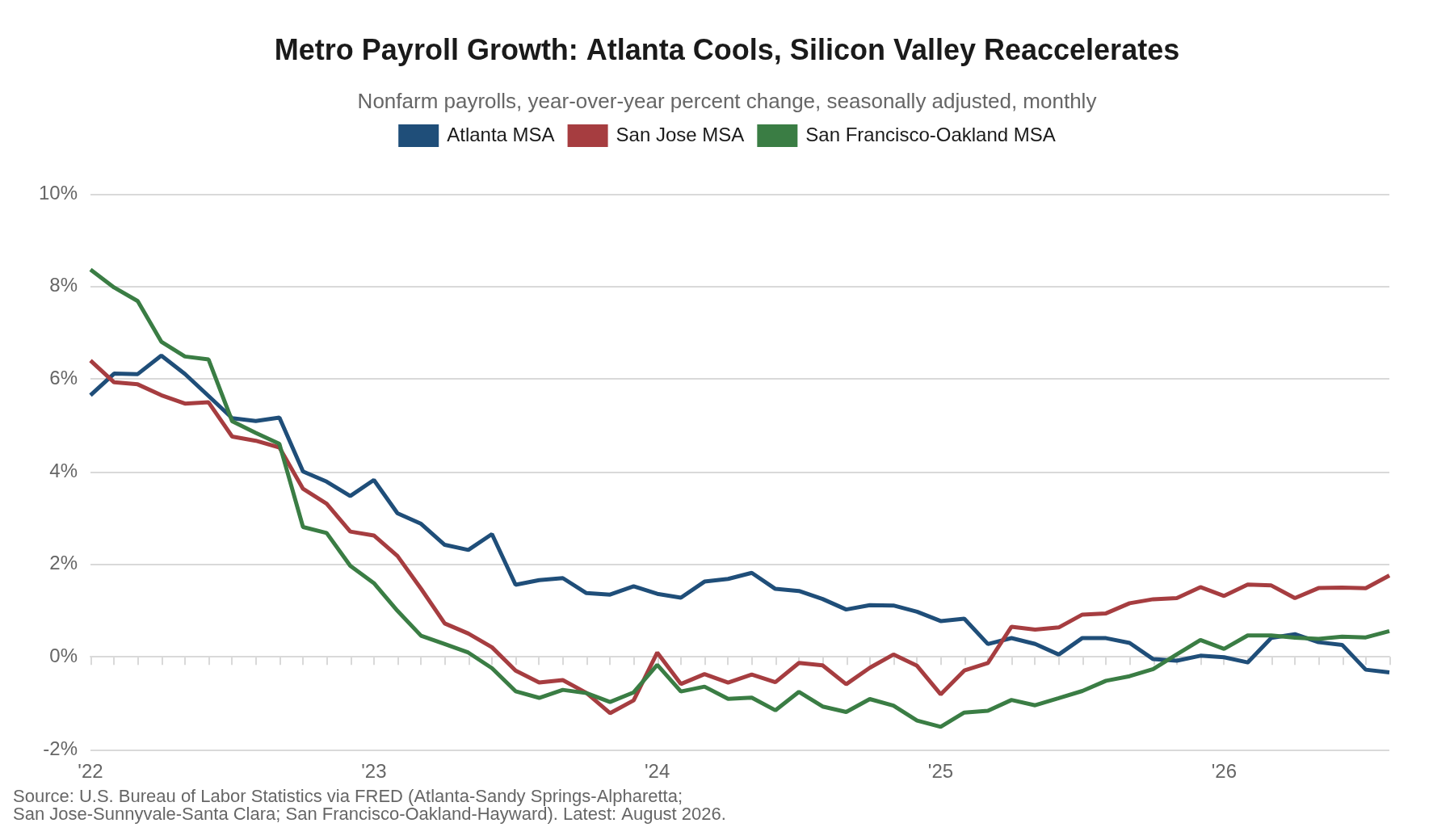
Atlanta has been the economic hub of the Southeast for more than a century, moving from a rail and textile center to a hub for trade, logistics, technology and entertainment. Hartsfield-Jackson Atlanta International Airport, employing more than 60,000 people and serving more than 220 nonstop destinations, again ranked the world's busiest airport by passenger traffic in 2025, and the city's distribution and logistics base is increasingly tied to the ports of Savannah and Charleston. Georgia's broader port complex, including the Port of Brunswick and inland ports at Chatsworth and Gainesville, the second of which opened this May, is itself a major driver of industrial development across Georgia and neighboring states. Atlanta has grown its own corporate headquarters, Coca-Cola, Home Depot, Delta, Equifax, Genuine Parts and Chick-fil-A among them, while drawing others, including UPS, NCR, the U.S. headquarters of Mercedes-Benz and Norfolk Southern, to relocate there. The 1996 Summer Olympics left a lasting mark on the city. The Olympic Village became campus housing for Georgia Tech, the Olympic Stadium was converted into Turner Field, home of the Atlanta Braves until 2016, and then in 2017 into what is now Georgia State University's football stadium, and Centennial Olympic Park still anchors large gatherings downtown, ringed by the Georgia Aquarium, the World of Coca-Cola and the Chick-fil-A College Football Hall of Fame. Georgia Tech's own research has fed that growth directly, spinning off companies such as Scientific Atlanta, later sold to Cisco Systems; Internet Security Systems, sold to IBM in 2006 and still headquartered in Atlanta's Perimeter Center; and Pindrop, a voice-security firm built on a licensed Georgia Tech patent and incubated at ATDC, the state-chartered startup incubator that has operated on campus since 1980, a lineage that runs straight through to Tech Square's building boom today. Atlanta's metro-area payrolls, at 3.11 million in August, are down about three-tenths of a percent from a year earlier, and the unemployment rate stood at 3.2 percent in July.
A Second Anchor: Atlanta's Biomedical and Public-Health Cluster
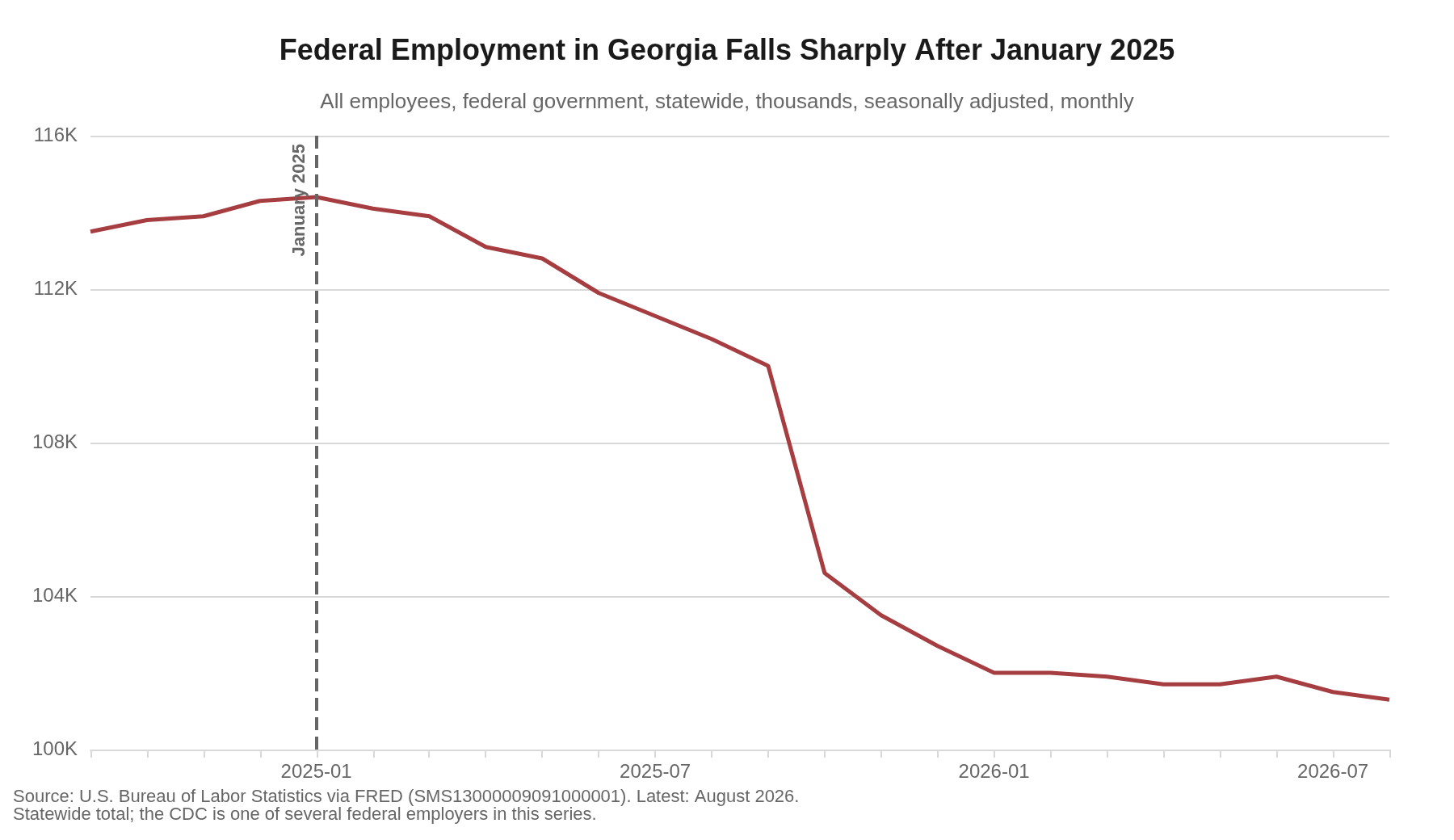
Atlanta's other major research anchor sits along the Clifton Corridor northeast of downtown, where the Centers for Disease Control and Prevention, the American Cancer Society and Emory University cluster within a few miles of each other. The CDC, founded in 1946, has been headquartered on Clifton Road since 1960 and is among the region's largest federal employers, though the agency has lost roughly a quarter of its staff since January 2025 amid federal workforce cuts, a real drag on the public-health side of the cluster even as the university side keeps growing. The American Cancer Society moved its international headquarters to downtown Atlanta in 2006. Emory, Georgia Tech's partner on the Coulter biomedical engineering program, anchors the university side; per Georgia Bio, the state's life-sciences trade group, life-sciences employment growth in Georgia has outpaced the state's overall private-sector growth by more than two times since 2015, and a Georgia Power industry snapshot counts more than 26,000 life-sciences professionals in the state. Bioengineering is a genuine growth area on the research and education side, while the federal side of Atlanta's public-health cluster is currently shrinking.
Palo Alto Is Not San Francisco: Placing Stanford on the Map
Stanford's campus sits in Palo Alto, which is not part of the San Francisco metro area. Santa Clara County, and Palo Alto with it, falls inside the San Jose-Sunnyvale-Santa Clara metropolitan area, the formal boundary underneath what most people simply call Silicon Valley, or, more locally, the Peninsula. The two metro areas still combine into a single San Jose-San Francisco-Oakland Combined Statistical Area in the Census Bureau's broader geography. The San Francisco 49ers have played home games at Levi's Stadium in Santa Clara, inside the San Jose metro area, since 2014. San Jose-area nonfarm payrolls have grown 1.8 percent over the past year to 1.18 million in August, with an unemployment rate of 3.9 percent in July, while payrolls in the San Francisco-Oakland-Hayward metro area to its north grew a slower 0.6 percent over the same period, to 2.43 million in August, with unemployment a point higher at 4.1 percent in July. The gap traces back to Stanford itself. Leland Stanford wanted his university to build the West's own industrial base, and its engineering school obliged, developing coursework around the technologies of the moment, electronics, then integrated circuits, then software, and spawning thousands of startups in the process. Roughly 40 percent of all U.S. venture capital funding still flows to the region the university helped build, and the AI-driven investment wave now reshaping the region's office and data-center markets is the latest chapter in that same story, concentrated specifically in Santa Clara County rather than the Bay Area as a whole.
| Atlanta CSA | San Jose-S.F.-Oakland CSA | |
|---|---|---|
| CSA population (2025) | 7,426,769 | 9,140,485 |
| Core metro(s) covered below | Atlanta MSA + Athens MSA | San Jose MSA + S.F.-Oakland MSA |
| Share of CSA population | 90% | 72% |
| Nonfarm payrolls (Aug. 2026) | 3.22 million | 3.61 million |
| Payroll growth, year-over-year | -0.2% | +1.0% |
| Unemployment rate (July 2026) | 3.2% / 2.9% | 3.9% / 4.1% |
Table 3. Metro economic snapshot, Atlanta and San Jose-San Francisco-Oakland Combined Statistical Areas.
Sources: Georgia Tech Athletics; Stanford Athletics; program win totals and national championships current through the 2025 season; U.S. News & World Report, 2026 Best Colleges and Best Graduate Schools rankings; OAG, "World's Busiest Airports 2025"; Georgia Ports Authority facility and economic-impact data; U.S. Bureau of Labor Statistics via FRED (Atlanta-Sandy Springs-Alpharetta, GA; Athens-Clarke County, GA; San Jose-Sunnyvale-Santa Clara, CA; and San Francisco-Oakland-Hayward, CA metropolitan area employment and unemployment, August and July 2026); Refinitiv (LSEG); ACC, SEC, Big Ten and Big 12 conference membership, current through the 2026 season; U.S. Census Bureau, Vintage 2025 population estimates for combined statistical areas; Georgia Tech Enterprise Innovation Institute (ATDC, Pindrop Security); Georgia Bio and Georgia Power life-sciences industry data; Government Executive and Georgia Public Broadcasting reporting on CDC staffing, 2025-2026; program and metro-area history drawn in part from the author's own prior published research. In Table 3, unemployment rates are shown as core metro / secondary metro: Atlanta / Athens-Clarke County for the Atlanta CSA, San Jose / San Francisco-Oakland for the Bay Area CSA; the "share of CSA population" row reflects only the core metro area(s) shown, since BLS does not publish payroll employment for the smaller metro and micropolitan areas that make up the balance of each CSA.
A Coast-to-Coast Trip for Two Teams Still Introducing Themselves
Georgia Tech's season opened with as much promise as pain. The Yellow Jackets led Colorado before a blocked field goal on the final play sealed a 14-13 loss, then fell 45-24 to Tennessee in a game that got away in an 11-minute second-quarter stretch. Coach Brent Key, now in his fourth season, called the run defense "a major work in progress" after Georgia Tech's 44-11 win over Mercer on September 19, a game in which transfer quarterback Alberto Mendoza, who backed up his brother Fernando at Indiana a year ago, threw for a career-high 249 yards and three touchdowns.
Stanford enters its home game under a new coach with a familiar name. Tavita Pritchard, the Cardinal's own quarterback when Stanford upset No. 1 USC 24-23 in 2007, one of the biggest upsets in college football history, was hired away from the Washington Commanders' coaching staff last November after Frank Reich's one interim season followed Troy Taylor's firing. His Cardinal opened with a win over Hawai'i before lopsided losses to No. 7 Miami (45-6) and Duke (35-7). Transfer quarterback Davis Warren, who won a national championship as a backup at Michigan before a torn ACL and a medical redshirt, has not thrown an interception in his first 107 attempts, and Stanford has not lost the turnover battle in any of its three games, a rare bright spot on a team that has been outscored 80-13 in its two losses.
The line has settled at Georgia Tech by roughly 3.5 to 4.5 points with the total near 48, and the computer models lean further toward the Yellow Jackets than the market does. ESPN's SP+ projects a 30-20 Georgia Tech win, and Dimers puts Georgia Tech's win probability at 61 percent. Stanford will induct its 2026 Hall of Fame class, including former quarterback Kevin Hogan, at Saturday's game, and Georgia Tech's own bowl-eligibility math is tight enough after the 1-2 start that this is close to a must-win in a conference schedule that still includes Clemson and Georgia.
The Outlook for Saturday
Georgia Tech should be favored for reasons that go beyond the three-time-zone trip. The Yellow Jackets have scored more points and allowed fewer than Stanford has across three games, and Justice Haynes's 141-yard performance against Mercer suggests a run game capable of controlling the clock against a Stanford defense that has now allowed 80 points in two losses. Stanford's own path runs through Davis Warren's turnover-free start, which has kept the Cardinal competitive in a way their scoring margin does not show, and a home crowd for a Hall of Fame weekend that will not be short on energy. We expect Georgia Tech to win by a field goal or less, closer than the spread suggests, in a game where the travel and the Pacific time zone matter more than either team's record does.
The Bottom Line
Two 1-2 teams meet for the first time as ACC opponents, three time zones and 2,127 miles apart, each still introducing itself to its own fan base under a new-ish coaching staff. We expect Georgia Tech to win a close game, closer than the roughly four-point spread suggests, decided by which defense holds up rather than which offense wins the day. Both programs sit at the center of unusual investment cycles in their home metro areas right now, Atlanta's Tech Square building program and the Bay Area's AI-driven office boom among them, a history and an economic comparison we cover in full above.
Elsewhere in the Top 25 This Week
No. 1 Texas travels to No. 14 Tennessee at noon Eastern on ABC, the day's earliest kickoff among six ranked-versus-ranked games nationally. Both teams are unbeaten at 3-0, and Texas is favored by 5.5 points at Neyland Stadium with the total set at 55.5, a number that reflects two offenses playing at a high level three weeks into the season.
No. 2 Georgia hosts Oklahoma at 3:30 p.m. Eastern on ESPN in the Sooners' first trip to Athens in program history. Oklahoma enters 2-1 and unranked, having dropped out of the AP poll this week after an unconvincing 14-6 win over New Mexico, while Georgia is favored by 13.5 points with the total at 45.5. The Sooners still drew the fourth-most votes of any unranked team, evidence that voters see the offense, not the roster, as the problem.
Four more ranked pairings round out Saturday's slate. No. 4 Ole Miss visits No. 21 Florida, No. 23 Texas A&M is at No. 10 LSU, No. 19 Missouri travels to No. 24 Mississippi State, and No. 17 Iowa is at No. 18 Michigan, while No. 20 Oregon plays at No. 12 Southern Cal in prime time. Four of the six ranked-versus-ranked games this week are SEC matchups.
| Matchup | Line / Total | Kickoff (ET) / TV |
|---|---|---|
| No. 1 Texas at No. 14 Tennessee | Texas -5.5, O/U 55.5 | Noon, ABC |
| No. 17 Iowa at No. 18 Michigan | Michigan -5.5, O/U 38.5 | 3:30 p.m., CBS |
| No. 4 Ole Miss at No. 21 Florida | Florida -3.5, O/U 58.5 | 3:30 p.m., ABC |
| Oklahoma at No. 2 Georgia | Georgia -13.5, O/U 45.5 | 3:30 p.m., ESPN |
| No. 23 Texas A&M at No. 10 LSU | LSU -9.5, O/U 52.5 | 7:30 p.m., ABC |
| No. 19 Missouri at No. 24 Mississippi State | Miss. State -6.5, O/U 58.5 | 7:45 p.m., SECN |
| No. 20 Oregon at No. 12 Southern Cal | Oregon -2.5, O/U 61.5 | 7:30 p.m., NBC |
Table 4. This week's ranked-vs-ranked (or otherwise notable) Top 25 matchups.
Sources: The Associated Press; ESPN; fbschedules.com; CBS Sports; Covers.com; FanDuel via SportsGrid market previews. Rankings from the September 20, 2026 AP poll; lines and totals as of September 24-25, 2026 and move daily.
About this report
This Week Four preview is published by Southeast Economic Advisors and previews Saturday's game between Georgia Tech and Stanford. Football statistics reflect the completed 2025 season and the first three weeks of 2026. Odds and totals are as of September 24-25, 2026 and move daily. The Associated Press poll cited is from Sunday, September 20, 2026. Metro-area employment and unemployment figures for Atlanta, San Jose and San Francisco are seasonally adjusted, from the Bureau of Labor Statistics via FRED, as of the August 2026 payroll count and the July 2026 unemployment rate, the most recent available at publication.
This material is provided for informational and educational purposes only and does not constitute investment, legal, or financial advice. Betting lines and win probabilities are sourced from third-party market data and models and are subject to change.
© 2026 Southeast Economic Advisors. All rights reserved.