
The Week Across the South
Weekly scan for July 27 to August 2, 2026: six growth themes keep driving the expansion, and nowhere is their impact more pronounced than across the Southeast
Mark Vitner, Chief Economist | Monday, August 3, 2026
The Macro Week: Growth Slower but AI-Led, and the Fed Splits Three Ways
We continue to see growth driven by six themes, and their impact is particularly pronounced in the Southeast. The AI buildout, electrification, reshoring & the manufacturing reorientation, defense replenishment, the aerospace reboot & private space program and Peak 65 all added evidence this week, and each gets its own section below. The macro data frame them.
The Fed held at 3.50% to 3.75% on Wednesday, but the 9-3 vote was the story. Hammack, Kashkari and Logan all dissented in favor of a quarter-point hike, the statement kept its supply-shock framing on energy, and Chair Warsh described the posture as “watchful thinking, not watchful waiting” while insisting there is only one inflation target. Markets ended the week priced for a strong chance of a September hike, with the 10-year Treasury at 4.75% Friday even as WTI settled at $82.09 and Brent at $88.00 (both still up roughly 20% for July).
Second-quarter GDP (+1.5% annualized, versus about 2.1% expected) validates the K-shaped, AI-led growth story at the center of our six themes. The composition matters more than the headline: equipment and intellectual-property investment led, with information-processing equipment and software strong (one tally puts computer and communications equipment up 61% annualized) while nonresidential structures fell for a tenth straight quarter and inventories and trade dragged. June PCE inflation cooled (down 0.1% in the month, 3.7% over the year, core 3.3%), the Q2 employment cost index rose 0.9% (3.4% over the year, with real wages down 0.3%), and claims stayed near 57-year lows at 197,000.
The hyperscalers reaffirmed the capex supercycle. Microsoft spent $41 billion in the quarter (up 70%) and held its 2026 guidance near $175 billion, Meta raised its range to $130 to $145 billion, and Amazon lifted its plan to roughly $220 billion from $200 billion as AWS growth accelerated to 36.7%, its fastest in 18 quarters. The market punished Meta’s spending and rewarded Amazon’s, which is the discipline story we flagged last week playing out in real time.
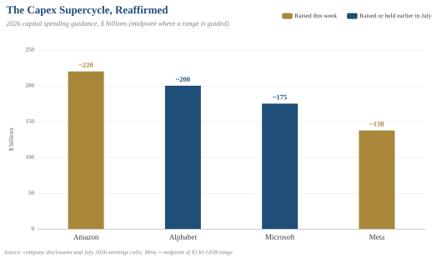
Combined 2026 guidance for the four largest hyperscalers now tops $730 billion.
Theme 1 | AI Buildout: Bigger Contracts, Louder Politics
The utilities are now the best window on the buildout, and both big Southern names raised the stakes this week. Southern Company’s Thursday call disclosed 6 gigawatts of new large-load contracts signed in the second quarter alone, including the OpenAI Effingham County deal: 3.2 gigawatts on a 25-year contract, service beginning 2028, with 1 gigawatt of flexible demand response. Data-center load served rose 55% from a year ago, and contracted large load reaches 17 gigawatts by the mid-2030s. Dominion, on Friday, cited more than 53 gigawatts of data-center capacity in contracting stages in Virginia, 12 gigawatts under signed agreements.
New projects kept landing across the region. Meta and BlackRock unveiled a roughly 1-gigawatt, $10 billion-plus campus in El Paso on July 28 (BlackRock funding 80%), Google filed for a $1 billion, 470,000-square-foot expansion at its LaGrange, Georgia campus, and a developer group pitched a claimed $100 billion “American Energy Hub” data center for Paducah, Kentucky. Treat Paducah with care: the figure is developer-claimed, and Governor Beshear said Friday he had not been briefed, which tells you how far ahead of the states some of this capital is running.
The backlash matched it, vote for vote. Montgomery County, Maryland’s council passed its 18-month moratorium unanimously on Tuesday and paired it with a zoning amendment prohibiting hyperscale facilities. Loudoun County, Virginia, the capital of Data Center Alley, rejected the 3.25 million-square-foot Spring Valley campus and is studying a moratorium of its own (report due September 15). DeSoto County, Florida adopted a one-year pause. The other direction matters too: Pulaski County, Arkansas rejected a moratorium 10-3 with AVAIO’s campus exempted, evidence for our argument that communities that stay open will be sought out. Watch Monday’s final vote in Lakeland, Tuesday’s Effingham County meetings, an August 11 vote in Harrison County, Kentucky and congressional scrutiny of xAI’s Memphis turbines (information demanded by August 11).
Theme 2 | Electrification: The Grid Supply Chain Is Moving South
Trench Group’s HSP opened its Charlotte plant on Thursday, and the details confirm the theme. The $60 million, 170,000-square-foot facility on Westinghouse Boulevard is the first in the country able to produce 765-kilovolt dry-type transformer bushings, with initial capacity of 3,500 bushings a year expandable to 10,000, about 50 employees today heading toward 140 by 2030, and first deliveries by year-end. The company cites ERCOT’s commitment to the state’s first 765-kilovolt lines. It chose Charlotte over seven other Southeastern sites for workforce and proximity to Duke, Dominion and NextEra.
The rest of the grid supply chain backs the theme. Virginia Transformer broke ground in May on its 400-job “Georgia Transformer” expansion in Rincon (Effingham County, the same county OpenAI just picked) and has announced an 1,100-job greenfield plant for Muscle Shoals, Alabama. Siemens Energy’s $1 billion U.S. plan runs through the South: large power transformers in Charlotte with production starting this year, a U.S. headquarters and AI-focused grid lab at Lake Nona in Orlando, switchgear in Richland, Mississippi and components in Fort Payne, Alabama. GE Vernova’s $160 million, 650-job Greenville, South Carolina turbine expansion (announced January 2025) is the installed base. Georgia Power is also reported to be adding 1,482 megawatts of gas and 500 megawatts of storage at Plant Bowen.
Theme 3 | Reshoring & the Manufacturing Reorientation
Octapharma’s Rock Hill announcement is the week’s biggest win and the cleanest reshoring data point. The Swiss plasma-therapy maker picked York County, South Carolina for its first U.S. manufacturing site on Wednesday: $1.5 billion and more than 1,500 jobs at Palmetto Research Park, with operations by the mid-2030s and a $65 million state closing-fund grant. One nuance worth noting: plasma-derived products are exempt from the new pharmaceutical tariffs, so this is supply-security onshoring rather than tariff avoidance, which arguably makes it the more durable kind. The Section 232 pharma tariffs themselves began phasing in Friday (100% on patented drugs for large firms, a reduced 20% rate for companies with approved U.S. onshoring plans, generics exempt).
Steel and the broader factory economy carried the theme. Nucor, the Charlotte-based bellwether, reported second-quarter net earnings of $1.16 billion on Monday (up 92% from a year ago) on a second consecutive record for steel-mill shipments (7.1 million tons) and guided the third quarter higher, crediting investment across key U.S. sectors and “supportive federal trade policies.” Smaller wins fit the same pattern: Medacta’s $85 million U.S. manufacturing hub and headquarters relocation to Spring Hill, Tennessee (200-plus jobs, Friday), ISCO Industries’ $12.75 million, 50-job Louisville piping plant (Monday), Epsilon Industries’ $15 million Tuscaloosa expansion (Friday) and $5.2 million of Kentucky site-development awards across eight counties. The counterpoint: Georgia outlets report 300-plus job cuts across five foreign-owned automotive suppliers in Bartow, Hall and Warren counties as tariffs bite.
Theme 4 | Defense Replenishment: The Arsenal Contracts Arrive
L3Harris signed the week’s defining defense deals on Monday, and they run straight through the South. Two seven-year framework agreements with the Pentagon and Lockheed Martin will nearly triple PAC-3 MSE propulsion production, centered in Camden, Arkansas, and quadruple THAAD boost-motor output built in Huntsville, Alabama and Camden. The company says it is investing billions across roughly 60 facilities and a million square feet of new or upgraded space in Alabama, Virginia and Arkansas. (The $1.3 billion propulsion campus in Orange County, Virginia was announced in April.) The drone belt added an entrant the same day: Ukraine’s Skyeton, whose Raybird reconnaissance aircraft has logged more than 350,000 combat flight hours, picked Fayetteville, North Carolina on July 27 for its first U.S. plant ($3.1 million, 162 jobs at an average wage near $71,000, a $500,000 One North Carolina grant), putting production a short drive from Fort Bragg after beating bids from Nevada and Oklahoma. The $1.15 trillion NDAA has passed the House and awaits the Senate. The churn cuts both ways; COLSA, a defense contractor at Eglin Air Force Base, filed a 97-worker WARN notice Monday.
Theme 5 | The Aerospace Reboot & the Private Space Program
The aerospace ramp is running through the Carolinas. Boeing’s Tuesday call confirmed it: 787 production, all built in North Charleston, rises from 8 to 10 a month later this year with 90 to 100 deliveries targeted for 2026. JetZero is the forward bet. The blended-wing maker broke ground June 15 on its $4.7 billion, 14,500-job campus at Piedmont Triad International Airport in Greensboro, the largest jobs commitment in North Carolina history, and at Farnborough on July 20 it signed a letter of interest with the Export-Import Bank to explore up to $3 billion in financing while adding a Gulf Air commitment and a Japan Airlines development partnership. A letter of interest is not yet a loan, but it puts federal export credit behind the project as the Z4 demonstrator points toward a 2027 first flight.
Starship Flight 13 (July 24) is the program’s cleanest test yet and sets up the propellant-transfer demonstration later this year. The Starbase, Texas launch deployed next-generation Starlink satellites and ended in what SpaceX called its softest splashdown to date. On the Space Coast, Blue Origin is still rebuilding Launch Complex 36 after the May static-fire loss of a New Glenn booster, with return to flight targeted by year-end, while Relativity Space’s expanded Terran R production at Cape Canaveral (announced July 21 with up to $134 million in state spaceport support) keeps Florida’s pipeline filling. Spillover employment in Alabama (Redwire’s 150-job Huntsville expansion) and Mississippi rounds out the regional story.
Theme 6 | Peak 65 & the Travel Economy: The Upper K Keeps Spending
The World Cup numbers confirm what the retiree-and-travel economy looks like when it surges. Baselane’s analysis released Monday puts short-term rental income up 60% from a year ago across the 11 U.S. host markets in June, led by Miami (up 709%), Dallas-Fort Worth (up 587%), Atlanta (up 219%) and Houston (up 214%), with regulation-heavy markets capturing far less (note the data reflect Baselane’s customer base). The hotel pipeline tells the same upper-K story: Lodging Econometrics counts the total U.S. pipeline down 4.9% from a year ago, yet luxury (a record 103 projects) and upper-upscale (a record 367) keep growing, and four of the five biggest market pipelines are Southern: Dallas (183 projects), Atlanta (157), Nashville (122) and Austin (116). Q2 GDP’s service-spending gains were led by food services and accommodations, which is exactly where retiree cash flows show up.
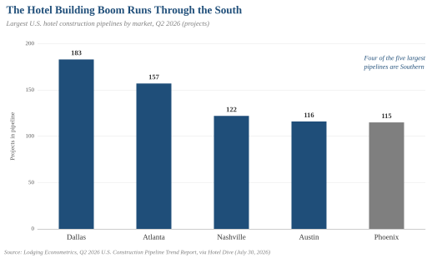
Dallas, Atlanta, Nashville and Austin hold four of the five largest hotel pipelines.
Two Federal-Corridor Megaprojects
The infrastructure theme got two concrete markers this week. The administration announced a $22.5 billion bonded overhaul of Dulles International (up from a previously planned $7 billion), financed through MWAA municipal bonds with United and public-private slots, and Amtrak updated its $6 billion Frederick Douglass Tunnel program in Baltimore, trimming scope, raising the alignment and reporting the first boring machine half-built. Both are demand for exactly the steel, switchgear and heavy-civil capacity the region is adding.
June MSA Employment: The South Owns the Fastest-Growth Podium
The metro jobs report released Wednesday puts Southern metros first, second and tied for third on the national fastest-growth list. Athens-Clarke County, Georgia led the country at +4.1%, Auburn-Opelika, Alabama was second at +3.3% and Fayetteville-Springdale-Rogers, Arkansas tied Las Vegas at +2.9%. On absolute gains, Dallas-Fort Worth’s +54,600 was the largest statistically significant increase in the nation (New York’s +69,100 was larger but not significant). The other side of the ledger: Washington’s metro area lost 83,500 jobs over the year (down 2.4%), the worst decline in the country, with Baltimore, Richmond, Virginia Beach and Louisville also down and Florida’s big metros (Miami, Tampa, Jacksonville) nearly flat at +0.2% to +0.3%.
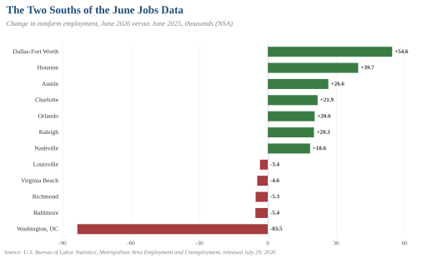
Texas and Carolina metros power ahead while the federal corridor gives back jobs.
| # | Largest y/y gains, Southern metros | Jobs (000s) | % chg |
|---|---|---|---|
| 1 | Dallas-Fort Worth-Arlington, TX | +54.6 | +1.3 |
| 2 | Houston-Pasadena-The Woodlands, TX | +39.7 | +1.1 |
| 3 | Austin-Round Rock-San Marcos, TX | +26.6 | +1.9 |
| 4 | Charlotte-Concord-Gastonia, NC-SC | +21.9 | +1.6 |
| 5 | Orlando-Kissimmee-Sanford, FL | +20.6 | +1.4 |
| 6 | Raleigh-Cary, NC | +20.3 | +2.6 |
| 7 | Nashville-Davidson-Murfreesboro, TN | +18.6 | +1.6 |
| 8 | Atlanta-Sandy Springs-Roswell, GA | +12.7 | +0.4 |
| 9 | Kansas City, MO-KS | +9.9 | +0.8 |
| T10 | Greenville-Anderson-Greer, SC | +9.5 | +2.0 |
| T10 | Baton Rouge, LA | +9.5 | +2.2 |
June 2026 versus June 2025, total nonfarm, not seasonally adjusted. Source: BLS Metropolitan Area Employment and Unemployment, released July 29, 2026.
| # | Fastest y/y growth, Southern metros | % chg | Jobs (000s) |
|---|---|---|---|
| 1 | Athens-Clarke County, GA (#1 in U.S.) | +4.1 | +4.2 |
| 2 | Auburn-Opelika, AL (#2 in U.S.) | +3.3 | +2.7 |
| 3 | Eagle Pass, TX* | +3.2 | +0.6 |
| 4 | Fayetteville-Springdale-Rogers, AR | +2.9 | +8.6 |
| 5 | Abilene, TX* | +2.8 | +2.2 |
| 6 | Raleigh-Cary, NC | +2.6 | +20.3 |
| 7 | Charlottesville, VA* | +2.3 | +2.9 |
| 8 | Baton Rouge, LA | +2.2 | +9.5 |
| 9 | Greenville-Anderson-Greer, SC | +2.0 | +9.5 |
*Not named as statistically significant in the BLS release. Same source and basis as above.
Layoff Watch
A quiet WARN week, with two Florida filings worth noting. MV Transportation filed for 151 workers in Naples on Thursday (separations effective September 30) and COLSA filed for 97 at Eglin Air Force Base on Monday; both were filed with FloridaCommerce this week. Georgia outlets report 300-plus cuts across five foreign-owned auto suppliers (Bartow, Hall and Warren counties), which we have not yet confirmed with the state.
The Week Ahead: What We Are Watching
Monday, Aug. 3. Lakeland, FL final moratorium vote (9 a.m.); ISM Manufacturing (July).
Tuesday, Aug. 4. Effingham County, GA meetings on the OpenAI campus.
Wednesday, Aug. 5. Duke Energy Q2 results (data-center pipeline update expected).
Thursday, Aug. 6. Football returns: the Hall of Fame Game in Canton, the Carolina Panthers against the Arizona Cardinals (8 p.m. ET, NBC).
Friday, Aug. 7. July employment report.
Tuesday, Aug. 11. Harrison County, KY moratorium vote; xAI Memphis information deadline.
Wednesday, Aug. 12. July CPI; metro CPI for Dallas, Tampa and Washington.
Mid-August. FERC show-cause responses due from all six grid operators.
Thursday night also kicks off our favorite season. Look for our football series to launch later this month, featuring a key game across the South each week and the local economies behind the rivalries. Football in the South sits somewhere between religion, country, family and professional life, and faith in your alma mater runs strongest in the first few weeks of the season, before the standings have their say.
Sources & Notes
Sources: Federal Reserve and Chair Warsh press conference; BEA (Q2 GDP advance, June PCE); BLS (metro employment July 29, ECI); DOL claims; company releases and earnings calls (the hyperscalers, Southern Company, Dominion, Nucor, Boeing, L3Harris, Trench Group); state commerce and governors’ releases; Hotel Dive; Construction Dive; Manufacturing Dive; Charlotte Business Journal; Lodging Econometrics; Baselane; local and trade press.
Notes: Metro employment figures are June 2026 twelve-month changes, not seasonally adjusted, from the BLS release of July 29. Utility figures reflect second-quarter earnings-call disclosures. The Paducah project figures are developer-claimed and not yet confirmed by state officials. Our definition of the South is more expansive than most: it includes every state that competes in the Southeastern Conference along with the South Atlantic states, extending up to Maryland and West Virginia. Items drawn from public reporting through August 2, 2026. © 2026 Southeast Economic Advisors / Piedmont Crescent Capital.