
SOUTHEAST ECONOMIC ADVISORS
Weekly Regional Scan · Charlotte, North Carolina
The Week Across the South
A Calendar Story, Not a Cycle Story
Weekly scan for August 3 to August 9, 2026: a softer headline payroll print has people asking whether the economy is weakening. We do not believe it is, and the calendar explains most of it.
The Week at a Glance
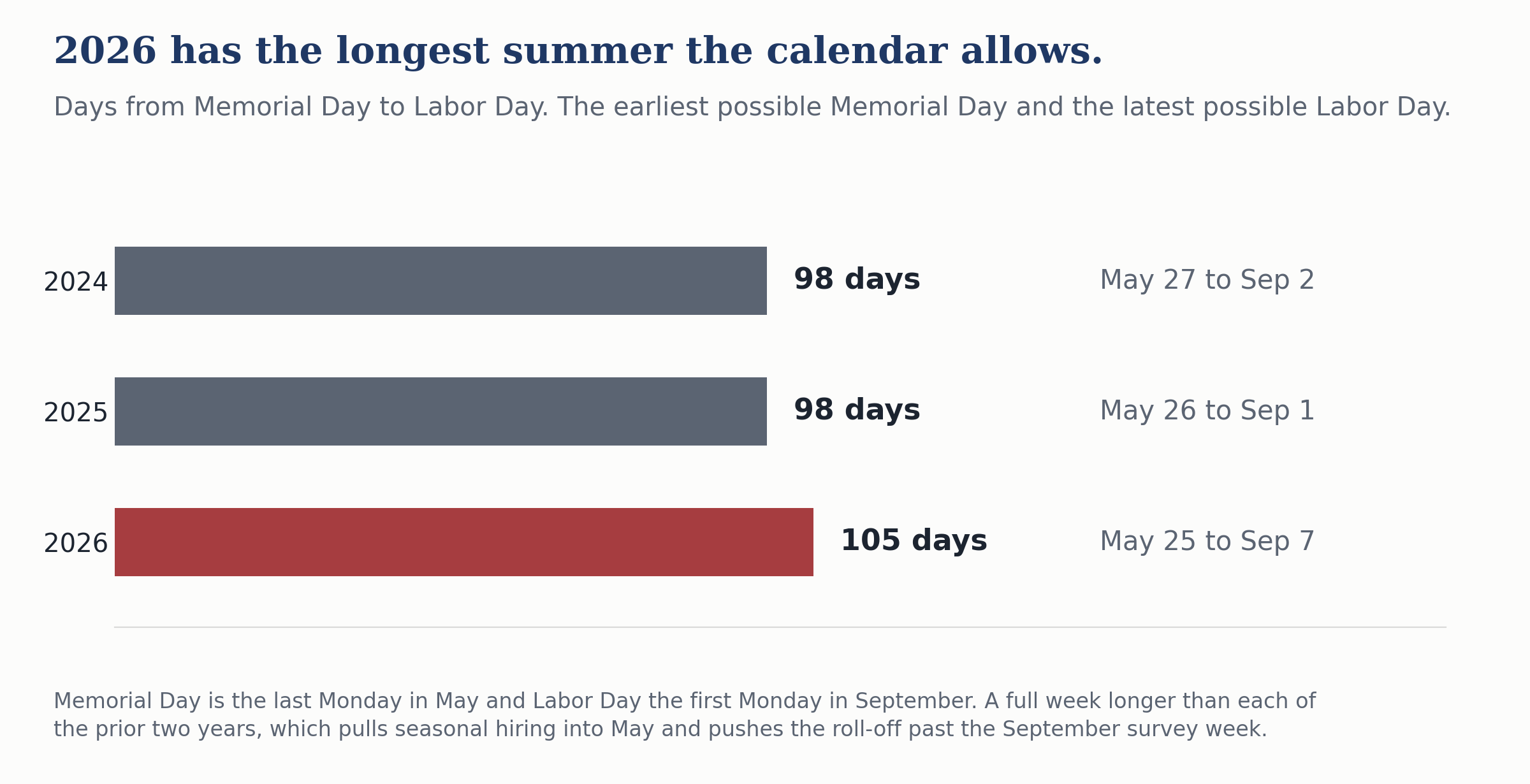
- The July payroll print is a calendar story, not a cycle story. Payrolls fell 23,000 and the two prior months lost another 103,000, but the earliest possible Memorial Day and the latest possible Labor Day give 2026 a 105-day summer against 98 in each of the prior two years. We expect a surprisingly strong report in one or both of August and September.
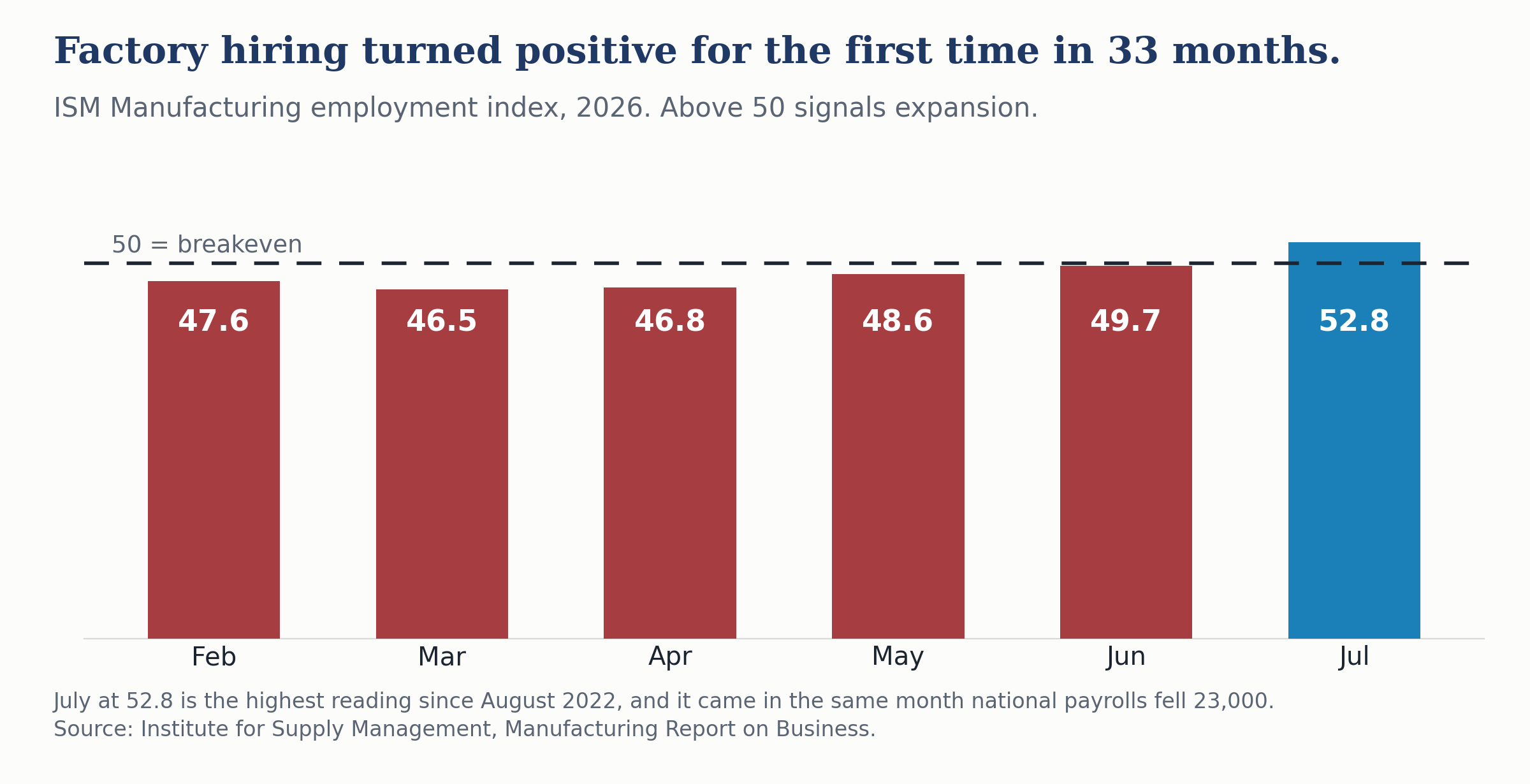
- Factory hiring turned positive for the first time in 33 months. The ISM Manufacturing employment index reached 52.8 in July, its highest since August 2022, in the same month national payrolls fell.
- Entitlement risk is now the binding constraint on the AI buildout. Eleven Southern jurisdictions acted on data centers in five business days, and a 1.25 gigawatt campus at Lovejoy in Clayton County, Georgia withdrew altogether.
- Four states are solving the large-load problem four different ways, and every one of them is moving cost onto the data centers. Virginia has an order, Florida a statute, Georgia a contested case and Texas an audit.
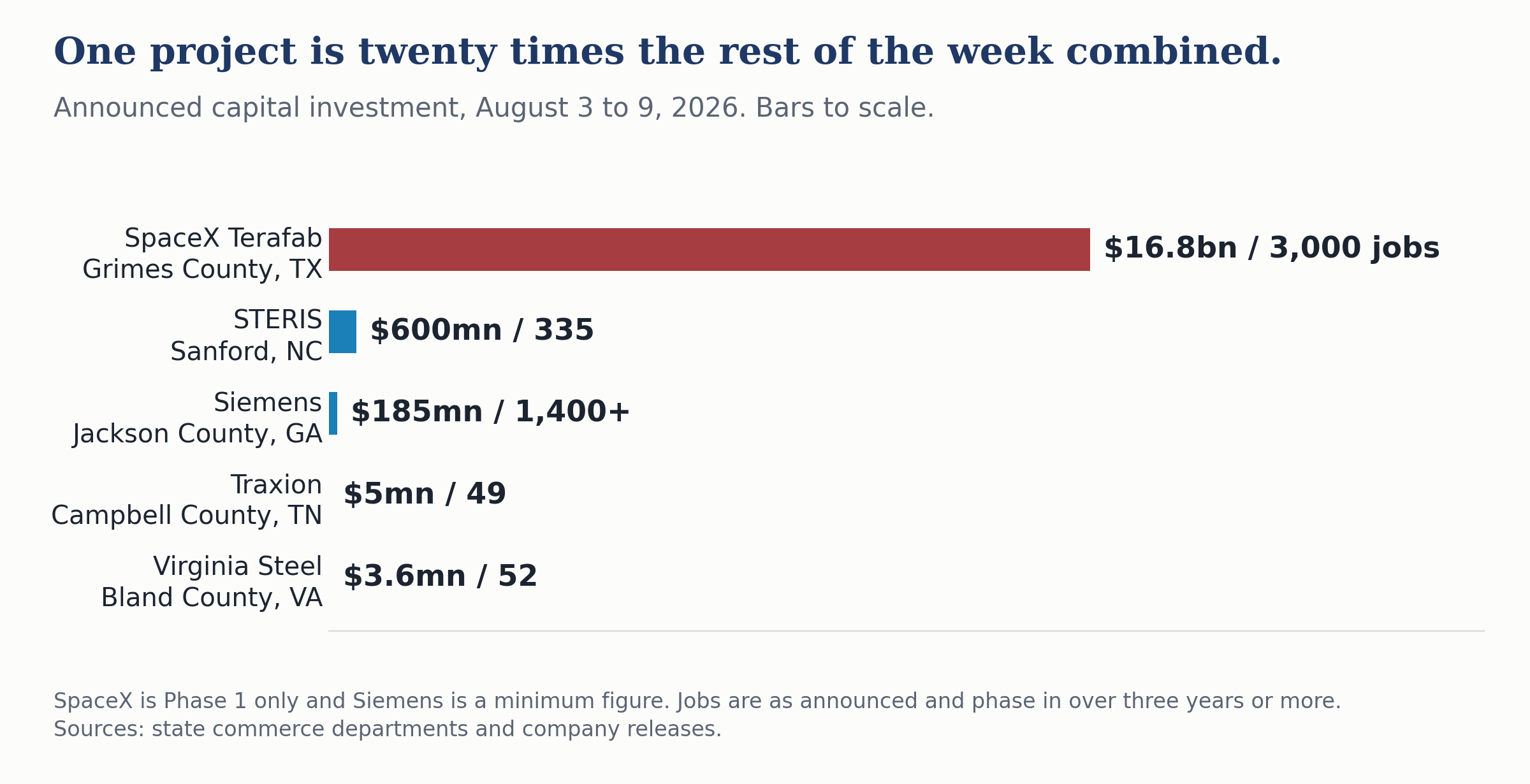
- The reshoring wave reached the national data. STERIS committed $600 million and 335 jobs to Sanford, North Carolina, and Siemens will build the switchgear the buildout depends on in Jackson County, Georgia.
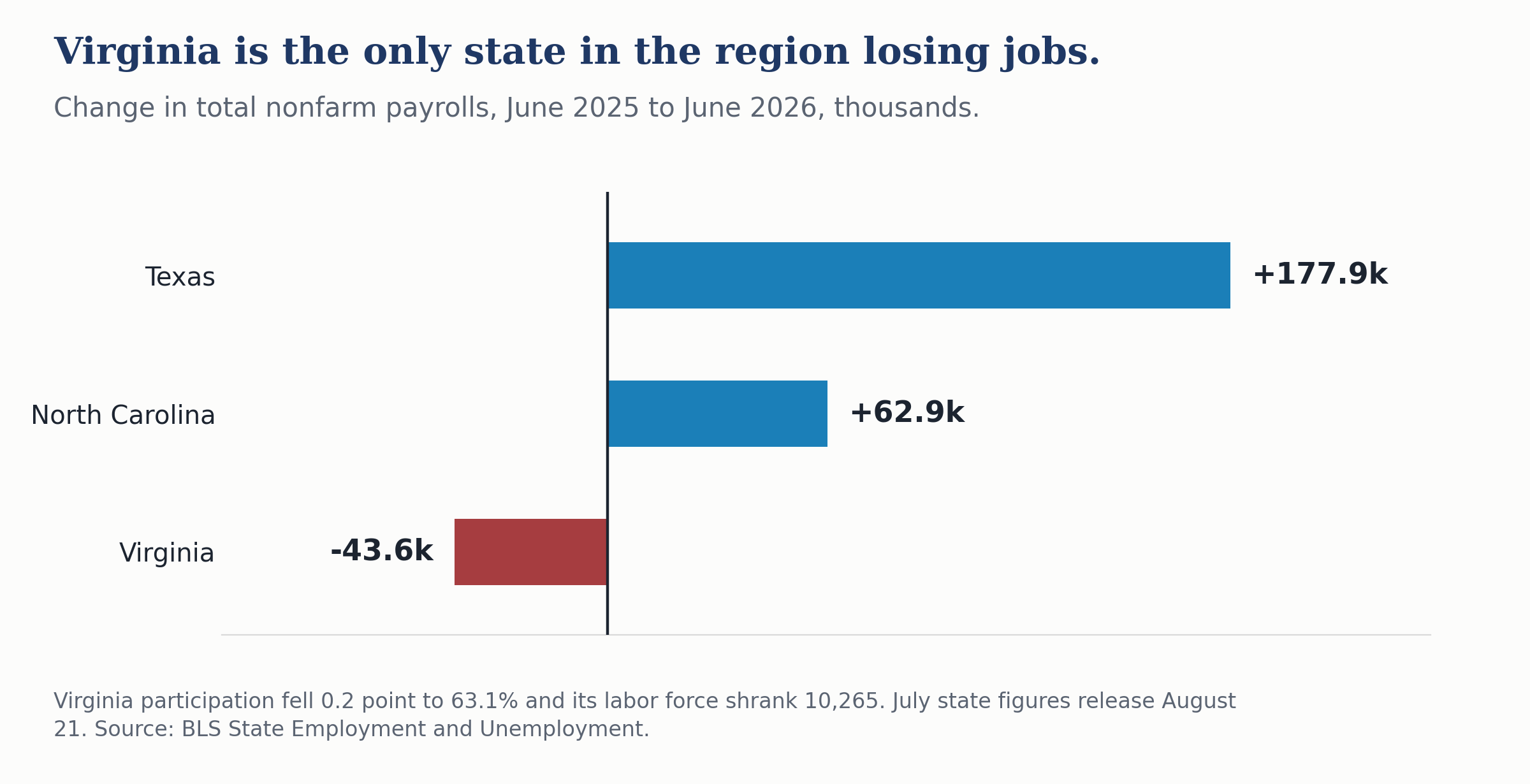
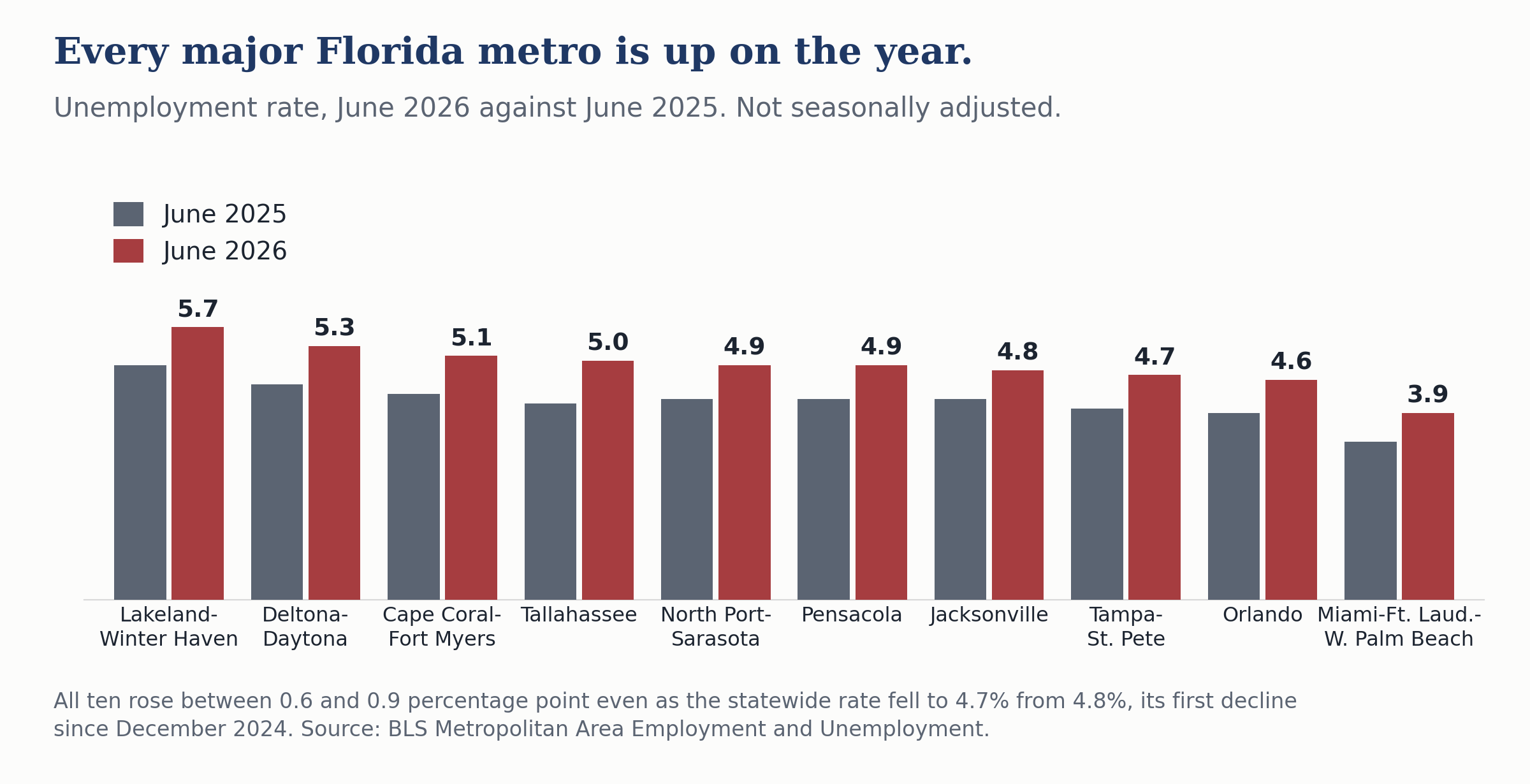
- Virginia is the only state in the region losing jobs, down 43,600 over the year, while every one of ten major Florida metros saw unemployment rise between 0.6 and 0.9 percentage point.
The Macro Week: A Calendar Story, Not a Cycle Story
We continue to see growth driven by six themes, and their impact is particularly pronounced in the Southeast. The AI buildout, electrification, reshoring and the manufacturing reorientation, defense replenishment, the aerospace reboot and private space program, and Peak 65 all added evidence this week, and each gets its own section below. The themes did not change this week. A softer headline employment report has a good many people asking whether the economy is weakening. We do not believe it is.
July payrolls fell 23,000 and the two prior months lost another 103,000 between them. Consensus was plus 80,000 to plus 83,000, with the published range running from plus 18,000 to plus 130,000, so the print landed 41,000 below the bottom of the range. May has been revised down twice and has surrendered 109,000 jobs since its first print of plus 172,000. The trailing twelve-month average is plus 34,000 a month. The unemployment rate nonetheless fell to 4.1% from 4.2%, on a labor force that shrank 264,000. Those are the facts, and we do not dispute any of them.
The summer almost always produces one surprising employment report, and this one was overdue. The end of the school year and the seasonal hiring that follows it produce the largest swings on the calendar, and the seasonal factors that adjust for them assume a normal year. Any year that is not normal on those margins generates a print that looks like news and is mostly arithmetic. We would say plainly that this is one of those prints, and we would not build a forecast on it.
This summer was distorted at both ends, and in the same direction. Memorial Day fell on May 25, the earliest date the calendar permits, which started the season a week early and pulled seasonal hiring forward into the May survey week. The World Cup then added a second pull, lifting hiring in the eleven host markets and in bars and restaurants well beyond them, earlier in the summer than that hiring normally arrives. May came in stronger and June and July weaker. Leisure and hospitality rose 42,000 in May, fell 43,000 in June and fell another 40,000 in July. The sector did its hiring in May.
And that is not the end of the story, because the same arithmetic runs the other way from here. Restaurants and bars did not hire as many people as they usually do in June and July. They therefore have far fewer people to let go as the summer winds down in August and September. The seasonal factors for leisure and hospitality jobs in August and September compensate for jobs that are expected to decline. Since fewer jobs were added during the prior two months, the end-of-summer decline will be less than usual, resulting in a larger seasonally adjusted job gain. Labor Day compounds it. September 7 is the latest date the calendar permits, which leaves the summer workforce on payrolls through the September survey week rather than off it. Taken together, 2026 runs 105 days from Memorial Day to Labor Day against 98 in each of the prior two years, the longest span the calendar allows. We expect a surprisingly strong employment report in one or both of August and September, and we would position for that rather than extrapolate weak July data.
Factory hiring turned positive in July for the first time since September 2023. The ISM Manufacturing employment index reached 52.8, up 3.1 points and the highest reading since August 2022. The headline index rose to 55.6 from 53.3, its fastest in more than four years against a 54.0 consensus, with production up 6.3 points to 58.5 and backlogs up 4.5 points to 55.0. ISM reads July as consistent with 2.8% annualized real GDP growth. Factories shed workers for 33 straight months and began adding them in the same month national payrolls fell 23,000.
The pipeline behind it is deep, and this region holds much of it. The projects in this issue are not a list of announcements; they are a construction and hiring schedule extending years out. SpaceX at $16.8 billion in Grimes County. Siemens at $185 million and more than 1,400 jobs in Jackson County. STERIS at $600 million in Lee County. JetZero's 14,500-job campus in Greensboro, the largest jobs commitment in North Carolina history. Octapharma's $1.5 billion in York County a week ago. Those payrolls arrive over the next several years regardless of what the seasonal factors do to a single summer month, and they arrive disproportionately here.
Markets read the print as dovish and the long end declined to agree. The two-year fell six basis points on the day and nine on the week, but the thirty-year fell only three and the thirty-year real yield was essentially unchanged at 2.96%. September hike odds fell to about 44% from 55% on fed funds futures, and no cut is priced for September. Our house call is unchanged: no cut in 2026, the next move is more likely a hike, and we remain cautious on duration. Monday gave much of it back. Crude rose more than 4% after Iran hardened its terms for reopening the Strait of Hormuz, and the whole curve followed: the two-year returned to 4.25%, the ten-year to 4.72%, the thirty-year to 5.25% and the thirty-year real yield closed at 3.00%, its first three-handle of this cycle. September hike odds edged back to about 46%. Note also that the July meeting was a 9 to 3 hold, with Hammack, Kashkari and Logan all dissenting in favor of a hike. Three standing hawkish dissents and a 4% oil day is the setup into Wednesday's CPI. For every utility, municipality and developer in this region planning capital, the operative point is that a weak labor report did not lower the cost of long money, and two trading days later it had raised it.
One loop from last week, now closed. We flagged four items to watch. Lakeland voted Monday and the moratorium passed 4 to 3. Effingham County held its regular meetings on the OpenAI campus but has not yet set the dedicated public forum, which commissioners are weighing for August 22 or August 29. The Harrison County, Kentucky vote and the xAI Memphis information deadline both fall on August 11 and remain open.
Theme 1 | AI Buildout: Five Governments, Five Instruments, One Week
The politics of large load stopped being local this week. Five governments reached for five different instruments inside five business days, and the choice of instrument is what determines whether load arrives at all or merely arrives more expensively. An intervention is a legal posture. A tariff is a price. A moratorium is a clock. An ordinance is a design standard. A resolution against incentives is a change in the political weather.
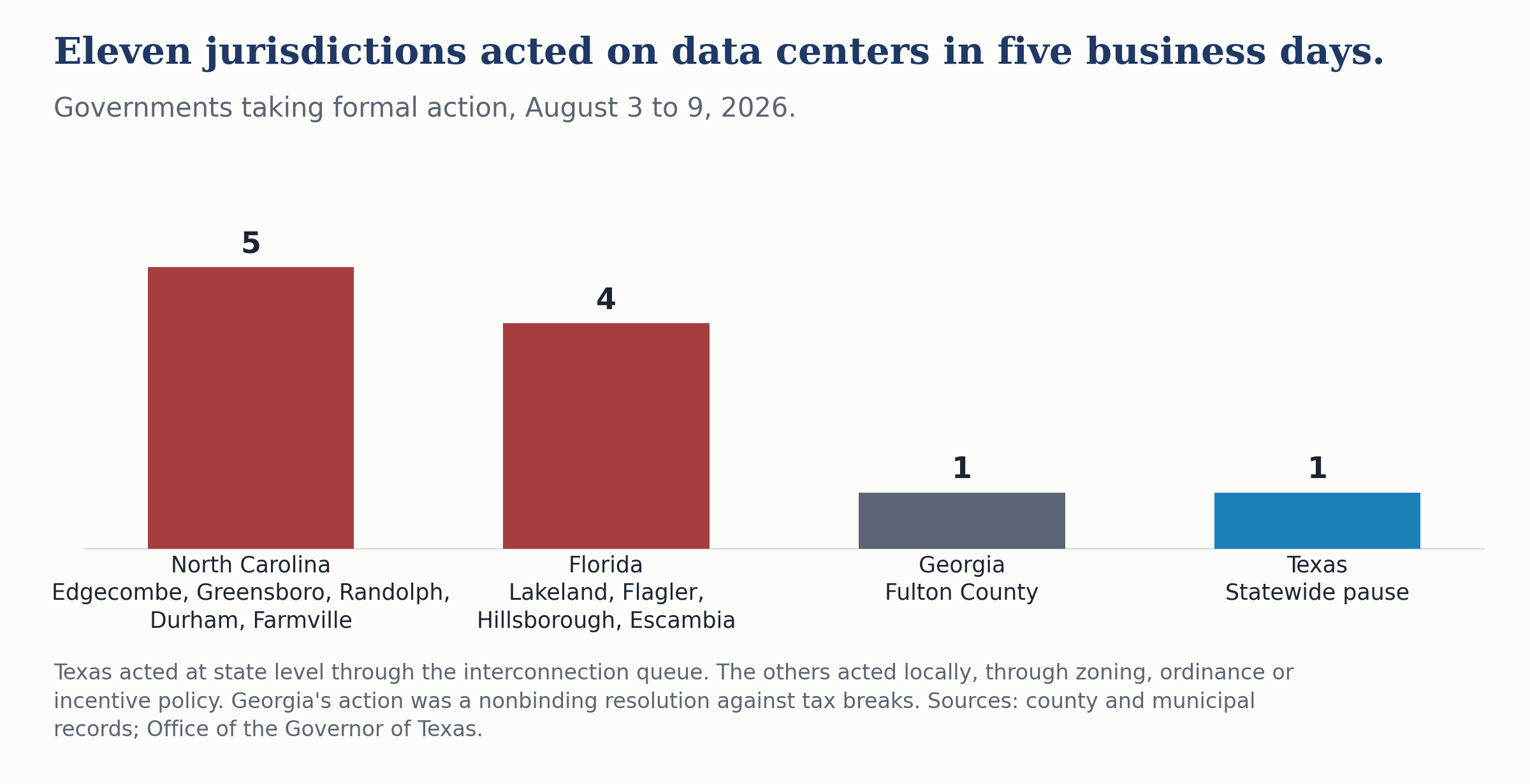
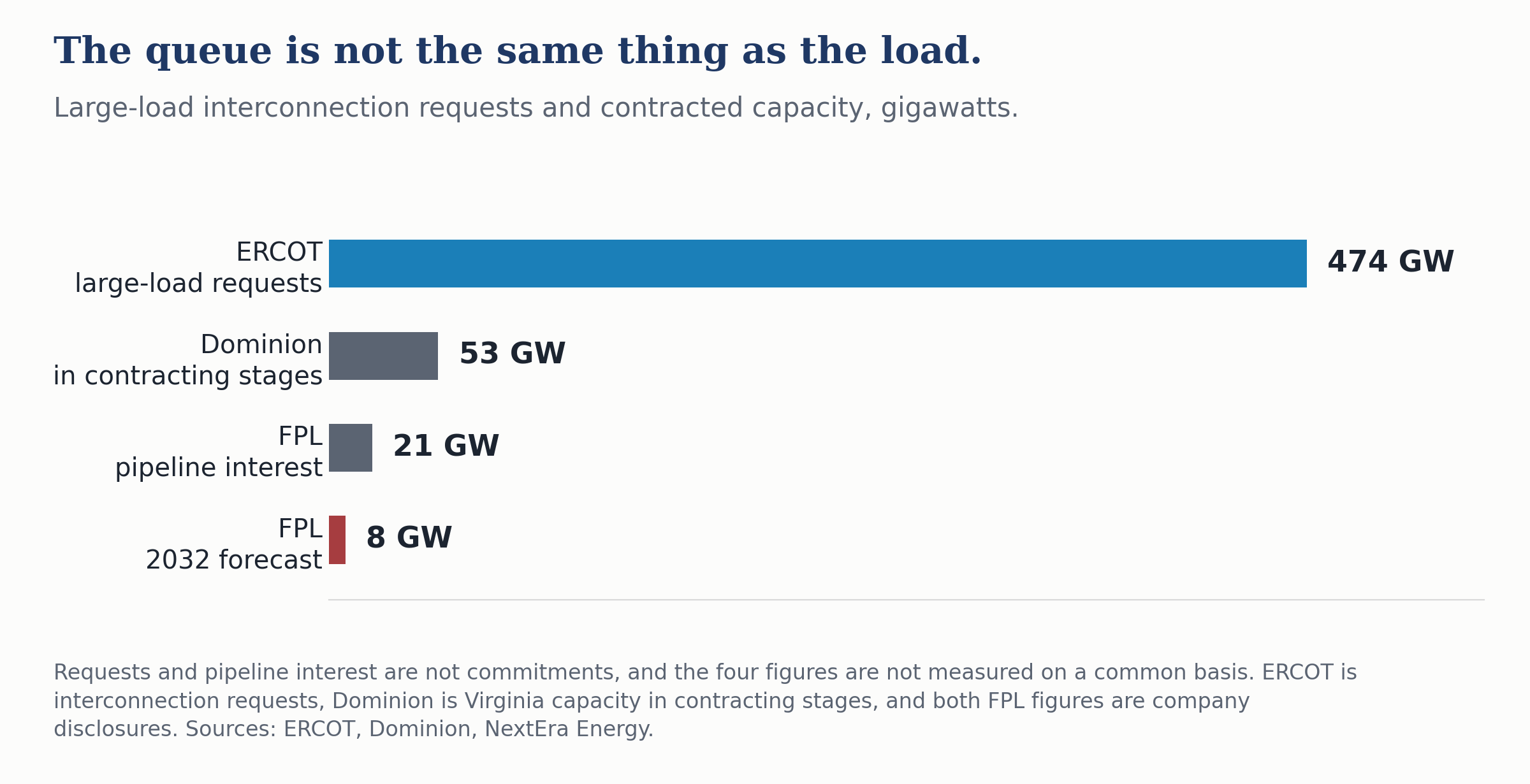
Texas reached for the sharpest tool available, the interconnection queue itself. Governor Abbott ordered a statewide pause on data center approvals on Monday, August 3, pending a Public Utility Commission and ERCOT audit requiring developers to disclose the tax breaks they will receive, their power use and generation, water use and cooling operations, community impact and facility ownership. Projects failing the audit should be denied grid connection. ERCOT faces roughly 474 gigawatts of large-load interconnection requests, and the PUCT approved ERCOT's \“Batch Zero\” large-load connection process only on June 18, so the pause lands on a queue process weeks old. The order stops short of a ban. A governor asking developers to state their water use and ownership is conceding the state does not currently know these things about facilities already drawing on its grid.
North Carolina answered with zoning, in four jurisdictions on a single Monday. Edgecombe County, adjacent to Rocky Mount and about 60 miles east of Raleigh, moved on a 24-month moratorium on Monday, which would be the longest in the state, after a $19.2 billion project proposed by Robersonville-based Energy Storage Solutions withdrew from the Kingsboro Megasite. Greensboro City Council voted unanimously on Monday to hold a public hearing on a 120-day moratorium covering data centers drawing more than 10 megawatts, reversing its own July 21 rejection; the hearing is August 17. Randolph County, south of Greensboro, declined a moratorium and instead amended its ordinance to require closed-loop cooling and noise impact studies, which is the more sophisticated response and already in effect. Durham County's board took no vote at a Monday work session where roughly fifteen residents spoke, most demanding a pause without loopholes; staff outlined a nine-month moratorium with an exemption below roughly 80,000 to 100,000 square feet, with a hearing and possible vote August 24. Farmville, in Pitt County about 15 miles west of Greenville, adopted twelve months the same day.
Florida is now the most active state in the region on this question. Five local governments acted in ten days. DeSoto County, about 45 miles east of Sarasota, adopted a one-year moratorium on July 29 aimed at DCIP Group's request for 1,300 acres and more than a dozen gas-powered hyperscale buildings, although the ordinance exempts DCIP's pending rezonings, so the project that prompted it can still advance. Water estimates presented to that commission ranged from zero to 3 million gallons a day. Lakeland, in Polk County, passed one year on August 3 by 4 to 3, covering any load at or above 50 megawatts including projects outside city limits seeking service from Lakeland Electric. The number that matters came from the municipal utility's assistant general manager, Willem Strauss: Lakeland Electric's largest single-meter customer, a Publix complex, draws about 18 megawatts. A single 50-megawatt facility would be nearly three times the biggest load on the system. Flagler County approved a one-year pause the same day. Hillsborough County, containing Tampa, voted unanimously on August 5 to draft a moratorium ordinance and study restrictions on potable water for cooling, with the ordinance to take effect after October 1, 2027, when the preemption in SB 180 expires, because the county is legally constrained from acting sooner. And Escambia County, around Pensacola, went furthest on August 7, voting 4 to 1 to prohibit large-scale data centers outright in unincorporated areas, citing power demand \“without meaningful job creation.\” Sarasota, Pasco, Manatee, Zephyrhills and Palm Beach County all acted earlier in the summer.
Escambia did two things on the same night, and only one of them has been reported. It approved an ordinance banning large-scale data centers in unincorporated Escambia County outside Pensacola and Century. Separately it began a distinct legal moratorium process on top of the ban, which the county attorney said requires two noticed public hearings before any vote; no dates are set. A county that believes it has already prohibited the use is building a second legal instrument anyway. That is what a jurisdiction does when it expects to be litigated. WEAR-TV put the vote at 4 to 1 and WKRG called it unanimous; we have not reconciled the two.
The first real test of Florida's new law comes later this month. The Public Service Commission on July 8 let Duke Energy Florida's large-load data center rate proposal advance and denied a motion to dismiss, but the bench was openly skeptical; Commissioner Gary Clark told the company, \“I think you're on real shaky ground, if you ask me.\” A two-day hearing is set for late August to determine whether the proposal complies with SB 484. Under Duke's plan, base rates exclude data center costs through 2027, with shareholders absorbing any shortfall before then. Every other state in this region is still arguing about the principle. Florida is about to litigate the mechanics.
Georgia opened a fiscal front. Fulton County commissioners, in the state's largest county, passed a nonbinding resolution on August 5 opposing local tax breaks for data centers, introduced by Republican commissioners Bridget Thorne and Bob Ellis.
And the projects kept landing anyway, including in North Carolina. WhiteFiber's NC-1 campus in Madison, Rockingham County, about 30 miles north of Greensboro, is planned for up to 200 megawatts and more than $1 billion of total investment against a $45 million purchase price, with 60 or so jobs. The site is the former Unifi factory; Unifi is the Greensboro synthetic yarn maker that announced the shutdown. A textile plant becoming a multibillion-dollar data center is a single address showing what is replacing what in the Piedmont. Nashville's council, separately, approved an eminent domain takeover of a zoo-area data center site.
Monday brought the counterweight, and it is the largest single subtraction we have recorded. Stillwater Development withdrew its rezoning application for a 15-building, 3.5 million square foot, 1.25 gigawatt campus on 400 acres at Lovejoy in Clayton County, Georgia, about 24 miles south of Atlanta, and is pursuing residential development on the site instead. Central Georgia EMC had been slated to serve it. A gigawatt and a quarter leaving the metro Atlanta interconnection picture is material on its own, and the developer conceded the entitlement fight rather than shopping the load to a friendlier county. Alabama supplied the other direction. Prichard, in Mobile County, has a resolution before it for a 480-day moratorium aimed at Edged's Project Gateway, a $93 million, 8-megawatt interconnection hub on Telegraph Road. Eight megawatts is not a hyperscale campus, and a $93 million taxable investment is large against Prichard's base. The signal is that opposition machinery built for gigawatt projects is now being aimed at sub-ten-megawatt ones.
And the load is learning to route around the queue. Energy Vault announced Monday that it will supply 1.25 gigawatts of battery storage, grid-forming power conversion and controls to an unnamed hyperscale developer in Texas, its largest contract ever, with first deployments in four to twelve months. Read that against Governor Abbott's interconnection pause a week earlier. If developers respond to a frozen ERCOT queue by buying generation and storage behind the meter, the pause moves load off the interconnection queue rather than deferring it, which is a very different outcome for ERCOT planning than a genuine slowdown. It is also the same logic behind the gas-engine orders now running through the region.
The binding constraint on this buildout has moved, and the planning assumption should move with it. It is no longer capital and it is not yet power. It is entitlement risk, and that risk is now being priced in the public and private markets. We count moratoriums, ordinances or pauses in at least a dozen Southern jurisdictions since late July, and Monday delivered both the largest single withdrawal we have recorded and the smallest project yet to draw one. We expect the count to keep climbing into the fall, and we expect the instrument to shift away from the moratorium, which is only a clock, toward the tariff and the ordinance, which are a price and a standard and which survive litigation better. Two dates will tell us more than any single vote: the PUCT open meeting on August 20, where ERCOT seeks its good-cause exemption, and the Florida commission hearing late this month, the first real test of SB 484. Our expectation is unchanged. The load arrives, it arrives more slowly than the announcements imply, and it lands disproportionately in the counties that wrote rules early rather than the ones that wrote none.
Theme 2 | Electrification: A $67 Billion Merger, and the Company That Sells the Shovels
Governor Spanberger moved to intervene in the NextEra-Dominion merger on Thursday, and no Virginia governor has done this before. She said so directly: \“The action of actually formally intervening, it is an unprecedented one as a governor, I do acknowledge that.\” The deal is $67 billion, all stock, with NextEra shareholders holding 74.5% and Dominion shareholders 25.5%. The combined company would be the largest electric utility in the country, serving about 10 million customers across Virginia, Florida, North Carolina and South Carolina. Intervenor status is not a veto; it lets her administration pose questions, obtain documents and press for conditions, with approval staying at the State Corporation Commission, which has roughly six months to rule. The deal also needs North Carolina and South Carolina regulators plus FERC and the NRC. Dominion has offered $2.25 billion in shareholder-funded bill credits over two years. Senator Suetterlein and Delegate McNamara called it \“improvised and constitutionally uncertain\” and want a special session to extend the review window.
The day before, the same commission ordered Dominion to build a large-load tariff. The SCC directed the utility on August 5 to develop a new GS-5 high-load class carrying an 85% transmission demand rate, assigning transmission costs directly to data centers, against Dominion's $1.5 billion recovery request. A merger review and a rate case are now running in front of the same commission at the same time, and the merger review reaches into two more states in this region. Watch whether the North Carolina filing collides with the Duke settlement, on which the Utilities Commission has still issued no order.
Siemens chose Georgia to build the gear the data center buildout depends on. Governor Kemp announced Friday that Siemens will build a 550,000 square foot low-voltage electrical components plant at 580 Raco Parkway in Pendergrass, Jackson County, about 50 miles northeast of Atlanta. The investment is at least $185 million with more than 1,400 jobs over three years in engineering, fabrication, assembly and testing. Siemens AG is German; the investing entity is US subsidiary Siemens Corp, which already runs two plants and six offices in Georgia with more than 1,700 employees. Buildout starts in November with hiring in 2027. In the same week that five governments moved to constrain the buildout, the company that manufactures the electrical equipment the buildout requires committed to expanding its Southern footprint. The plant will still be hiring in 2029.
Elsewhere on the grid. Georgia EPD's order halting construction of VoltaGrid's 90-megawatt Covington gas plant still stands after the Texas company installed six of 33 gas engines before securing Clean Air Act permits; EPD warned the company on July 2 that it may have been operating in violation of state law, and issued a separate notice to Serverfarm, which had installed 36 of 37 diesel backup generators at the same site. The larger question sits at the PSC, which is weighing whether privately operated plants can serve data centers at all under Georgia's Territorial Electric Service Act. For any utility watching load walk behind the meter, that is the case to follow.
And Florida legislated the answer the others are still litigating. SB 484 took effect July 1, requiring utilities to charge data centers the full cost of service rather than shifting it to residential ratepayers. Meanwhile NextEra raised Florida Power and Light's large-load forecast to 8 gigawatts by 2032, up from 6, on its second-quarter call, with 21 gigawatts of total pipeline interest and 12 in advanced discussions. Chief Executive John Ketchum told investors, \“We continue to see a lot of interest in Florida and feel good about our ability to announce a large load transaction there by the end of the year.\” The utility is planning for a third more load than it was three months ago while its counties vote to keep it out. NextEra is the acquirer in the Dominion deal and is headquartered in Juno Beach, but the $2.25 billion in bill credits is committed to Virginia, North Carolina and South Carolina customers only.
Four states are now solving one problem four different ways, and every one of them is moving cost onto large load. Virginia has an order, Florida has a statute, Georgia has a contested case and Texas has an audit. We expect a large-load tariff to be standard across the region within eighteen months, and we expect the argument to move from whether to how much, which in practice means the minimum take, the contract term and the collateral behind it. The merger is the wild card. A combined Dominion and NextEra would be setting terms in Virginia, the Carolinas and Florida at the same time, and the South Carolina schedule now runs to a December 8 hearing and a final order at the end of January. For the industrial base the more durable point is Siemens. Whoever wins the tariff argument, the switchgear still has to be built, and it is increasingly being built here.
Theme 3 | Reshoring & the Manufacturing Reorientation
STERIS is the week's largest reshoring win and it landed in a mid-size North Carolina county. The company will invest $600 million and create 335 jobs in Sanford, in Lee County about 40 miles southwest of Raleigh and inside both the Raleigh and Fayetteville labor sheds. STERIS plc is Ireland-domiciled with operational headquarters in Mentor, Ohio, trades on the NYSE as STE and employs more than 18,000 people in over 35 countries; the business is infection prevention and healthcare products and services. The Sanford site will be a 600,000 square foot Chemistries Manufacturing Center of Excellence combining advanced manufacturing, research and development, laboratory space, warehousing and distribution, producing the detergents, sterilants and process chemicals used in surgical instrument reprocessing. Average salary is $68,704 against a Lee County average of $59,903, with a Job Development Investment Grant of up to $3.2 million over twelve years. Set beside Octapharma in Rock Hill, South Carolina; Medacta in Spring Hill and Bridgetown in Lebanon, Tennessee; that is four pharmaceutical and life sciences projects across three Southern states in two weeks.
The smaller win is the better illustration of what tariffs are actually doing. Icons America, owned by the Singapore private equity firm ShawKwei & Partners, is planning an expansion that could add hundreds of jobs at its plant in Dallas, in Gaston County about 20 miles west of Charlotte. The company makes custom plastic tube packaging for cosmetics brands including Clinique, Joico, Australian Gold and L'Oreal-owned Color Wow. ShawKwei acquired the plant in 2023 with its purchase of Ctlpack US. The 175,000 square foot building sits on 63 acres with modular walls making it expandable to 350,000 square feet, built in 2012 and then largely idle for a decade. About 100 employees use a quarter of the production space today. Chief Executive Scott Lingren, hired in late 2025 from Schunk Group, moved the headquarters to Gastonia from Taiwan. Wages run 37% above the Gaston County average and a Gaston College partnership will supply process technicians and engineers. Lingren puts the demand driver on the record: tariff policy and continuing supply chain disruption, because customers no longer want product sitting on a boat for three months. That is onshoring showing up in a mid-size Piedmont county rather than in a megaproject headline.
Two smaller items fit the pattern. Traxion Materials will invest $5 million and add 49 jobs in Jacksboro, Campbell County, Tennessee, about 40 miles north of Knoxville, expanding tire shredding and Tire Derived Fuel production; the company is LaFollette-based, US-owned and private. Virginia Steel and Fabrication will invest $3.6 million and add 52 jobs in Bastian, Bland County, in far southwest Virginia between Roanoke and Bluefield, taking headcount from 19 to 71 as it automates and expands the plant, with a $200,000 Commonwealth's Opportunity Fund grant behind it.
Monday added one more, and it is a cluster story. Kyoto Fusioneering will move its US headquarters to Oak Ridge, Tennessee and build fusion operations there, $46.9 million and 51 jobs, anchored on a first-of-its-kind fusion nuclear test facility at Oak Ridge National Laboratory to validate tritium breeding, with TVA a named partner. Fifty-one jobs is small. Inbound Japanese capital attaching itself to the Oak Ridge nuclear complex is not, and this is the second fusion company to put a US headquarters there.
The reshoring theme is now visible in the national data, not just the announcements. The ISM manufacturing employment index turned positive in July for the first time in 33 months, at 52.8 and its highest since August 2022. We have argued for a year that the reshoring wave would show up in factory payrolls before it showed up in the headline, and that the Southeast would carry a disproportionate share of it. July is the first month a national series agrees, though it is a survey of purchasing managers rather than a payroll count: factory payrolls rose only 5,000 in July, following an 11,000-job gain the prior month.
South Carolina and Alabama had relatively quiet weeks. South Carolina Commerce's most recent announcement remains Octapharma on July 29. Alabama's most recent are Epsilon Industries in Tuscaloosa and Doncasters in Auburn, both in July.
Announcements lead payrolls by about two years, so judge this theme on commitments rather than on the employment report. The boost to construction comes a bit earlier, with ground breaks twelve to eighteen months after an announcement and permanent hiring runs a year behind that, which puts the STERIS and Siemens commitments of this month in the 2028 employment data rather than this year's. What changed in July is that a national series finally moved the same way, even if it is more apparent in the survey of purchasing managers rather than the actual job count. We expect factory payrolls in this region to outpace the nation for the balance of the year without either series looking impressive, and we expect tariff attribution to spread from packaging and consumer goods into components. The constraint on that call is labor. The electricians, pipefitters and millwrights needed to build these plants are the same ones the data centers are bidding for, in the same counties and in the same quarters.
Theme 4 | Defense Replenishment: Steel, Superalloys and a Contract Loss
The defense supply chain in this region is running through structural steel and castings rather than through primes. SteelFab, announced July 16, will invest $38.9 million and add 108 jobs in Florence, South Carolina, about 80 miles east of Columbia. The company is a family-owned structural steel fabricator headquartered in Charlotte with 35 US locations, and this is the largest capital expansion of the Florence facility since it opened in 1988, oriented to fabricated steel for US naval defense with operations expected around September 2027. Doncasters will invest $50 million and create about 70 jobs in Auburn, Alabama, in Lee County about 55 miles northeast of Montgomery. The company is a precision superalloy and titanium castings maker founded in Sheffield, England in 1778 and listed on the NYSE as DPC; this is its second Alabama plant, producing vacuum master-melt superalloys for aerospace and industrial gas turbine engines, announced at the Farnborough airshow. Both are the physical layer underneath the ISM machinery respondent who reported defense demand at an all-time high.
The churn runs the other way too. COLSA Corporation filed a WARN notice for 97 workers at Eglin Air Force Base in Florida, and Silentium Defence, the Australian passive radar firm, selected Apex, North Carolina for its North American headquarters with hiring plans attached.
This region sits one tier below the primes, which is the better place to be in a replenishment cycle. The wins arrive as $40 million and $50 million plants in structural steel, castings, superalloys and secure engineering space rather than as program awards, and that tier feeds every prime rather than one. It cuts both ways, and the COLSA notice at Eglin is the reminder that services contracts recompete on a schedule no local economy controls. We expect the steel and castings tier to keep expanding through 2027 on shipbuilding and munitions demand, and we expect services employment around the large installations, particularly Eglin, Huntsville and Hampton Roads, to stay choppy regardless as contracts rollover and employees shift to different firms. Redstone contracting shows where replenishment money is actually going, into missiles, space and missile defense, and we watch it monthly.
Theme 5 | The Aerospace Reboot & the Private Space Program
SpaceX confirmed the largest single industrial commitment in years. Governor Abbott confirmed on Thursday that Tesla and SpaceX will jointly build \“Terafab,\” a semiconductor fabrication complex at the Gibbons Creek site in Grimes County, Texas, a former coal plant site roughly between Houston and Bryan-College Station. Phase 1 is $16.8 billion from the two companies, with 3,000 jobs and roughly 100 million square feet, consolidating logic, memory and advanced packaging for AI chips under one roof. Both companies are US-owned and SpaceX is privately held. Incentives include a $30 million Texas Enterprise Fund grant, JETI qualified-project designation and school district tax agreements with Iola ISD and Anderson-Shiro CISD. This is a launch company building its own chip fab, on a retired coal site, in a state that paused data center interconnections three days earlier. The vertical integration of the AI supply chain and the constraint on its power are now happening in the same jurisdiction.
Northrop Grumman opened 300,000 square feet of secure engineering space on the Space Coast. The facility, announced Monday in Melbourne, in Brevard County within the Palm Bay-Melbourne-Titusville metro, contains seventeen secure laboratories with capacity for more than 1,200 engineers, supporting sixth-generation airpower aircraft design and development. Northrop Grumman is US-owned and publicly traded on the NYSE as NOC. The existing Melbourne campus runs about 5,000 workers across two million square feet, and the company cites roughly 8,000 Florida employees, more than 500 supplier partners and about $10 billion in annual Florida economic output. No investment figure, net new job count or incentives were disclosed. Set it beside Blue Origin's $600 million, 500-job upper-stage plant at Cape Canaveral announced in May at an average wage above $98,000, and Relativity Space's expanded Terran R production, and the Space Coast is running two distinct pipelines at once: launch and defense airframes.
North Carolina is recruiting the aerospace tier. State records surfaced this week point to an active aerospace recruitment effort, and Boeing's 787 line in North Charleston continues its ramp. JetZero's $4.7 billion, 14,500-job campus at Piedmont Triad International Airport in Greensboro, the largest jobs commitment in North Carolina history, is now feeding into the Triad's housing math, with local brokers publicly flagging supply pressure.
Terafab changes the scale of this theme rather than extending it. A launch company and a car company building a chip fab together, on a retired coal site, in the state that had just frozen data center interconnections, is clear evidence that the AI supply chain is integrating vertically and siting itself around power rather than around labor. On the Atlantic side the pattern is densification rather than arrival, with Northrop and Blue Origin both adding to campuses that already exist. We expect the Space Coast to keep compounding while Texas takes the headlines, and we expect North Carolina to convert at least one more aerospace tier supplier this year on the strength of the JetZero anchor. The binding constraint is the one running through every theme in this letter, which is firm power and the trades to build it.
Theme 6 | Peak 65 & the Travel Economy: The Denominator Is the Story
Peak 65 stopped being a savings story this month and became a labor supply story. The July employment report showed the civilian labor force contracting 264,000 with participation at 61.4%, down seven tenths of a point since January. Two independent forces are draining the labor force at once: immigration, where the Dallas Fed puts net unauthorized flows at negative 55,000 a month and the breakeven payroll pace near zero, and Peak 65, the largest cohort of Americans ever to turn 65 in a single stretch, running through 2027. Neither is cyclical. For Southern employers competing for workers against in-migration from higher-cost states, the practical implication is that labor supply will not loosen when demand cools the way it did for forty years.
The travel and leisure economy showed the strain and the split. Six Flags reported a net loss of $202.6 million on revenue of $864.9 million, although same-park attendance rose 4% and the reported 7% decline reflects divested parks rather than softening demand. The company agreed in March to sell seven parks to EPR Properties for $331 million, including Six Flags St. Louis, Worlds of Fun in Kansas City and Schlitterbahn Galveston, and it closed Six Flags America in Maryland last November. What remains is disproportionately Southern, and so is the company: Six Flags is headquartered in Charlotte. It operates Carowinds there, Six Flags Over Georgia in Austell and White Water in Marietta outside Atlanta, Six Flags Over Texas and Hurricane Harbor in Arlington, Fiesta Texas in San Antonio, Hurricane Harbor Splashtown north of Houston, Schlitterbahn in New Braunfels, Kentucky Kingdom in Louisville, Kings Dominion at Doswell north of Richmond, and Frontier City and Hurricane Harbor in Oklahoma City. When this company's attendance and per-capita spending move, they are largely driven by the performance in the South.
Disney posted a record Experiences quarter against falling Orange County tourist tax receipts. Fiscal third-quarter results released Wednesday put Experiences revenue near $10 billion, up 10%, with segment operating income above $3 billion, up 20%. Domestic parks attendance rose 3% and global attendance 4%, with per-capita ticket revenue up 5% and guest spending up 4%. Management named Walt Disney World a standout. Against that, Orange County tourist development tax collections for June came in at $33.5 million, down about $140,000 from a year earlier, which ends a fourteen-month streak of consecutive growth. We flag it because tourism tax receipts turn before attendance does.
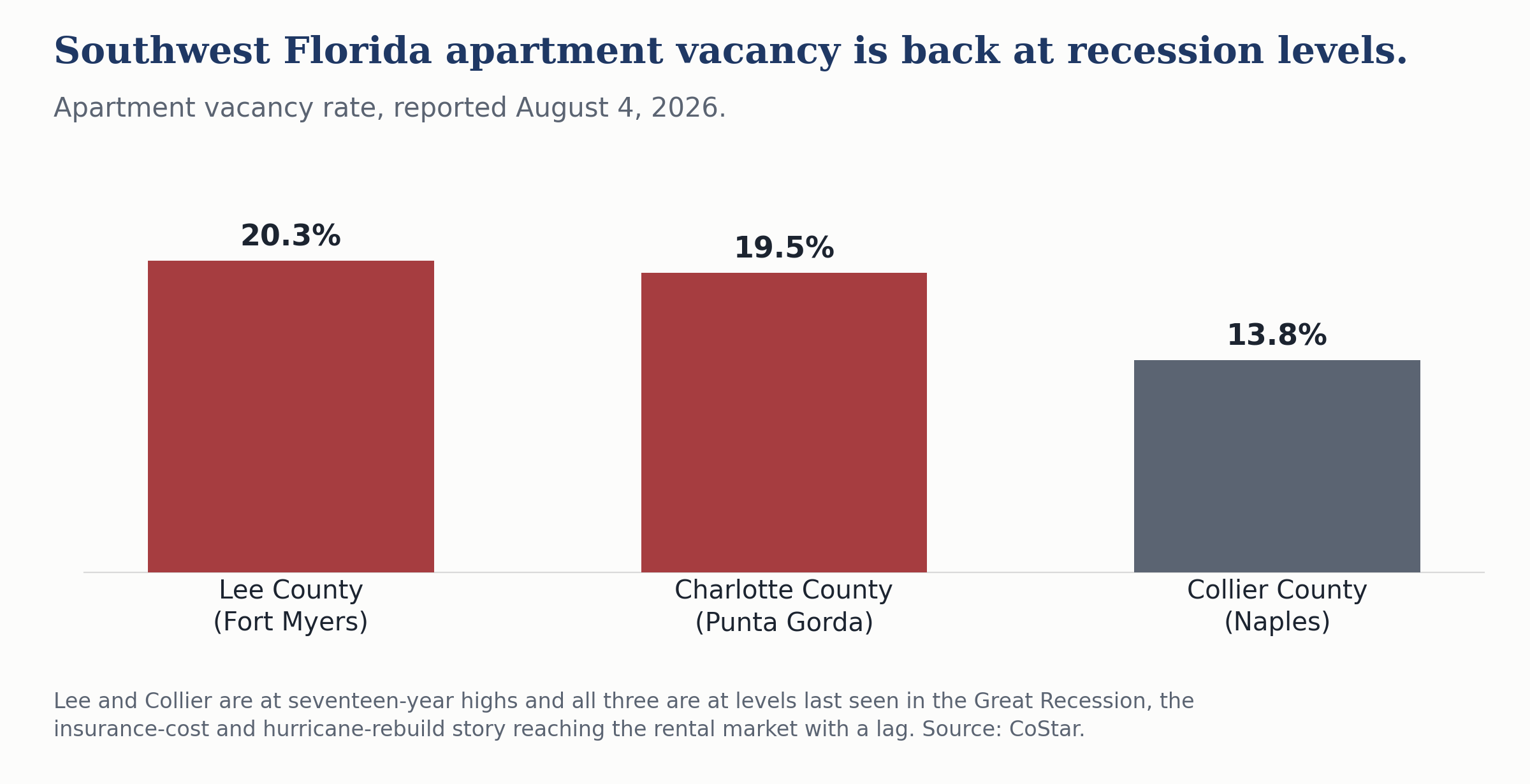
Southwest Florida is the region's clearest soft spot. Apartment vacancy reached 20.3% in Lee County, 19.5% in Charlotte County and 13.8% in Collier County, levels not seen since the Great Recession and, in Lee and Collier, seventeen-year highs. Cape Coral-Fort Myers unemployment at 5.1% is among the highest in the state. This is the hurricane-rebuild and insurance-cost story arriving in the rental market with a lag, and it is a useful counterweight to the Charlotte concession numbers below: two very different Southern apartment markets, one soft on supply and one soft on affordability and insurance.
Charlotte MSA apartments are the softest large market in MAA's portfolio. MAA called its two Charlotte lease-ups the most challenged in its portfolio in the near term on its second-quarter call, with eight to ten weeks of free rent on some floor plans against four to five weeks portfolio-wide. Revenue fell 0.3% year over year with average rent at $1,688 and occupancy at 95.3%. Norfolk, Richmond, Charleston, Greenville and Atlanta beat the portfolio average, as did Dallas; Charlotte, Raleigh, Savannah and Nashville lag, as does Phoenix. Supply is doing that. Capital bought in anyway, twice on the same day. Tishman Speyer paid $76.3 million on August 5 for Berkshire Dilworth, 296 units at 97% occupancy and about $257,500 a unit, its first Charlotte deal, and Stonemont Financial paid $87.3 million for two Charlotte-area industrial buildings. Metro Charlotte has 24,927 units under construction and roughly 96,000 more in planning. The Charlotte region adds about 140 people a day, on net, but the apartment market is incredibly competitive.
Watch the labor force and the tax receipts. A labor force shrinking through retirement flatters the unemployment rate while payrolls appear to stall, which is precisely what July delivered, and we expect that combination often enough over the balance of the year that the jobless rate stops being a useful signal of labor market health. On the consumption side the split is holding. Disney's per-capita spending rose while Six Flags pruned its portfolio, and Orange County's tourist tax receipts turned before attendance did. In housing and rental the region has moved further and faster than the national narrative allows, with only two of 42 Southern metros still favoring sellers and landlords. We do not expect that to reverse before the middle of 2027. Completions have to fall first, and in Florida the insurance and assessment overhang has to clear on top of that.
State Employment: Virginia Is the Only State in the Region Losing Jobs
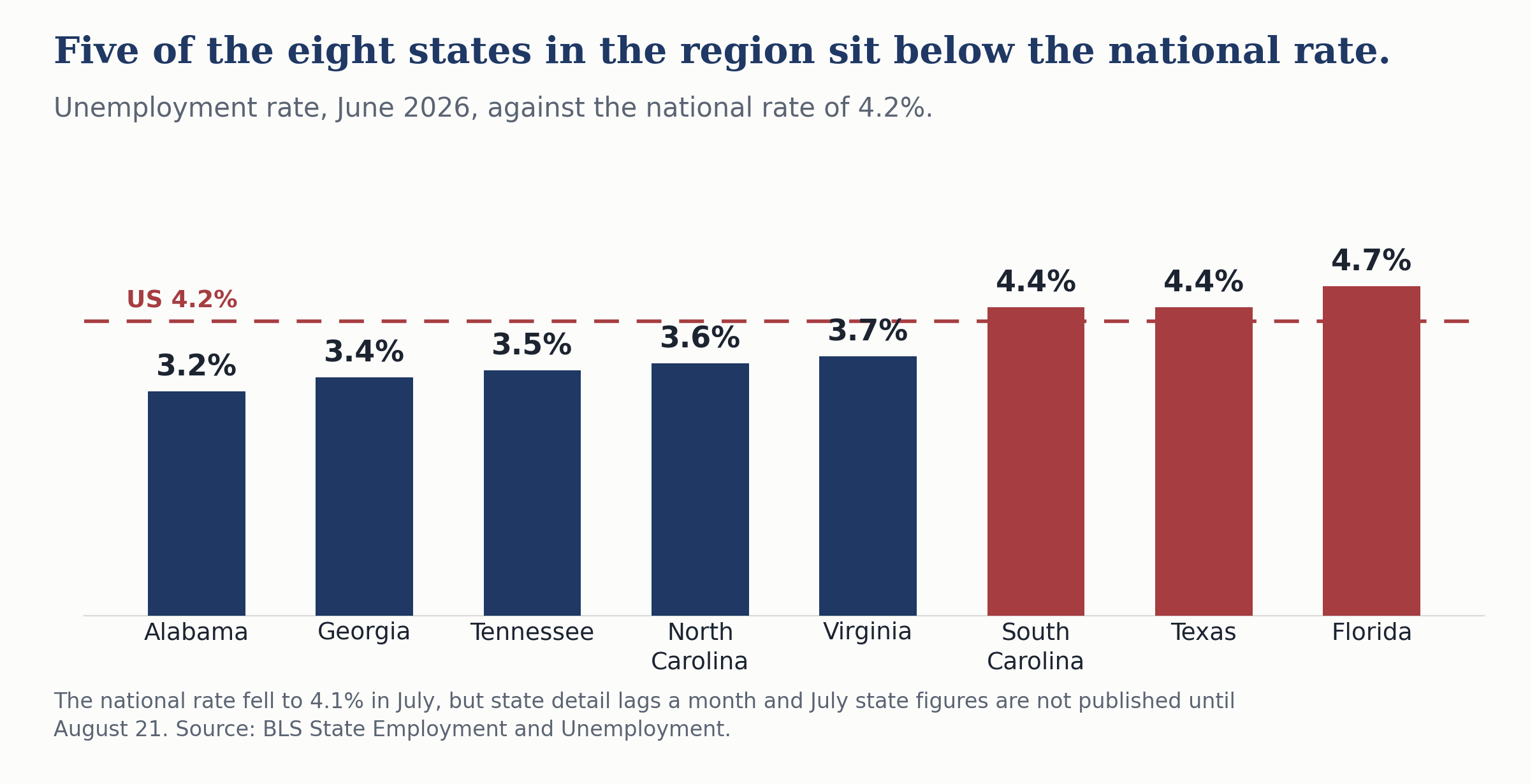
July state figures are not out; BLS publishes them Friday, August 21. June remains the latest read for every state in the region. The June unemployment rates: Alabama 3.2%, Georgia 3.4%, Tennessee 3.5%, North Carolina 3.6%, Virginia 3.7%, South Carolina 4.4%, Texas 4.4% and Florida 4.7%.
Virginia is the outlier. Payrolls rose 5,200 on the month to 4,243,700 but are down 43,600 over the year, a decline of 1.0%, the only state in the region losing jobs. Participation fell 0.2 point to 63.1% and the labor force shrank 10,265. This is the federal workforce contraction showing up in state data, and it sits directly alongside a governor intervening in a utility merger on jobs grounds. When Spanberger lists protecting Dominion's Richmond headquarters workforce among her three priorities, that is the context.
Florida is the exception that needs stating carefully. The state unemployment rate fell to 4.7% in June from 4.8%, the first decline since December 2024, and payrolls rose 11,100 after falling 4,100 in May. That reads well until you look underneath. The rate is up 0.9 percentage point from 3.8% a year ago. The number of unemployed rose 107,000 over twelve months while the labor force grew only 56,000. Participation is flat at 57.6%, which ranks 46th nationally. Financial activities has shed 12,900 jobs over the year and federal government 7,700. And every one of ten major Florida metros is up between 0.6 and 0.9 percentage point, year over year, on the unemployment rate, with Lakeland-Winter Haven highest at 5.7%, Deltona-Daytona Beach at 5.3%, Cape Coral-Fort Myers at 5.1% and Miami-Fort Lauderdale-West Palm Beach lowest at 3.9%. The Fort Lauderdale division posted one of the largest increases in the country at 0.8 point, which sits oddly beside South Florida's low headline rate.
Florida housing is running two markets. Florida Realtors' June data show single-family closed sales up 9.3% and condo and townhouse sales up 14%, a tenth consecutive month of growth, with median prices at $432,000 and $305,000. Months of supply runs 4.5 for single-family against 8.1 months for condos. The condo overhang is roughly double, which is the insurance and assessment story showing up in inventory. Florida now accounts for roughly one of every seven homes for sale in the United States.
And the flip is no longer just Florida. Realtor.com's second-quarter market clock, published August 4, finds that of 42 Southern metros only two remain seller's markets. Eighteen are buyer's markets and 22 are balanced, and roughly 57% saw price per square foot decline. Florida supplies ten of the eighteen, including Cape Coral, Jacksonville, Lakeland, Miami, Orlando and Tampa, joined by Nashville, Augusta, Baton Rouge, New Orleans, Jackson, Columbia and Greenville. Atlanta, Austin, Dallas, Houston and Charlotte are balanced but loosening. The cause is the new-home construction boom in Florida, Tennessee and Texas finally catching up to the migration that justified it. With the thirty-year mortgage at 6.69% and the thirty-year real yield at 3.00%, we see no obvious relief valve for that supply in the second half.
The rest of the region held up. Texas gained 43,400 jobs in June, up 0.3%, the only statistically significant monthly gain in the set, and is up 177,900 over the year. North Carolina added 62,900 over the year, up 1.2%, with construction up 2,900 and trade, transportation and utilities down 3,800. Georgia set records for both labor force, at 5,477,859, and employment, at 5,294,229. South Carolina's rate fell for a fourth straight month with a record 2,554,577 employed.
The Richmond Fed on AI: Adoption Without Capital
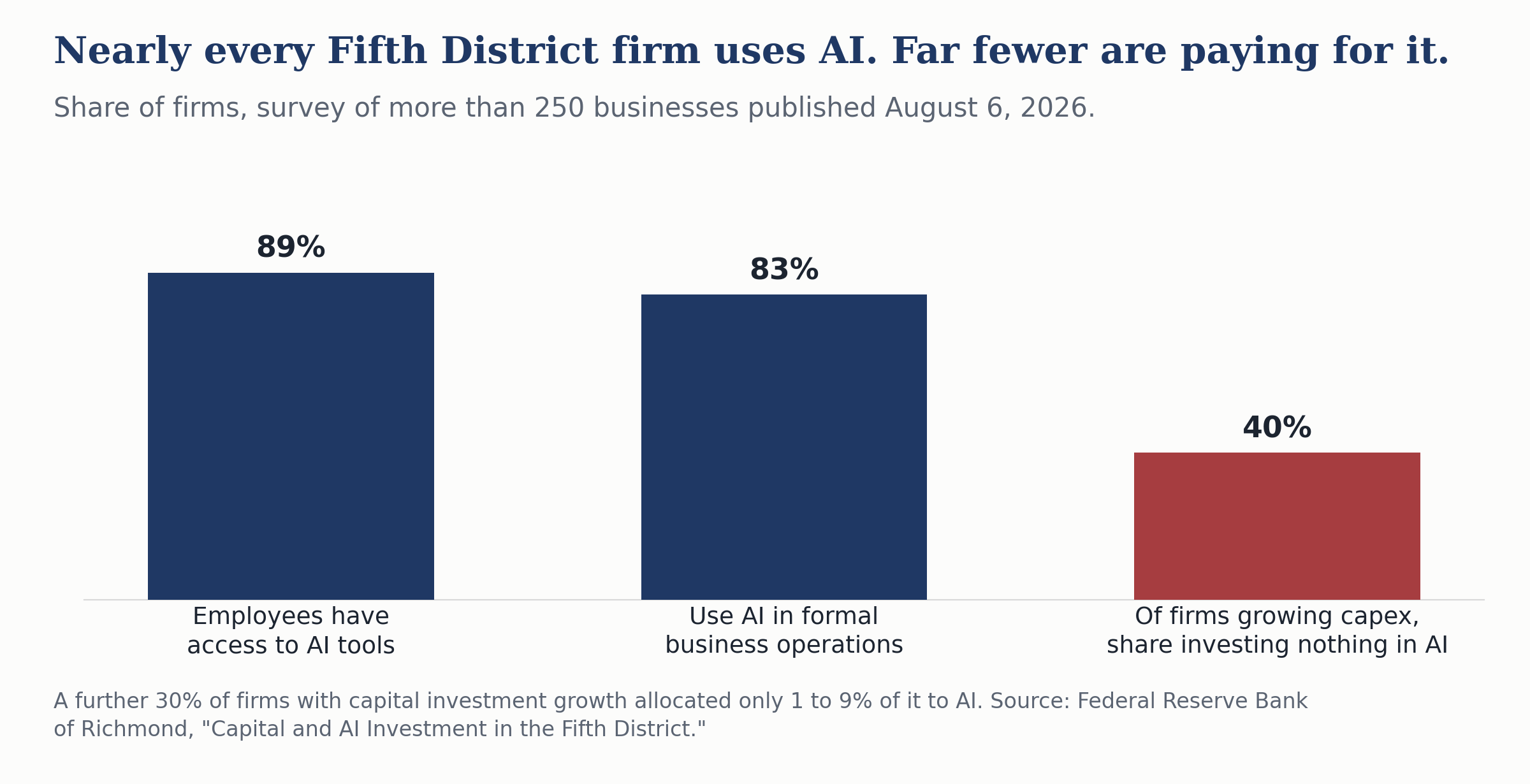
The Richmond Fed's Fifth District survey cuts against the announcement flow. The Richmond Fed published \“Capital and AI Investment in the Fifth District\” on Thursday, by Drew Ngo and Sonya Ravindranath Waddell. Across more than 250 firms, 89% say employees have access to AI tools and 83% use AI in formal business operations. Capital investment growth was positive in every sector over twelve months, led by construction at 5.5% and professional and management services at 4.0%. But among firms with capital investment growth, 40% invested nothing at all in AI and another 30% allocated only 1 to 9% of it. A South Carolina computer services firm captured the gap: \“Our AI investments consist of license costs\... Our AI spend doesn't reflect the significant investment in time we're making to develop those tools.\” An earlier July 31 piece found firms holding headcounts flat through the end of 2026.
Hold that against the buildout. Adoption is near universal and capital commitment is not. What shows up in the Fifth District data is a software license, not a capital program, which puts the regional AI capex story in a small number of very large actors rather than the broad business base. That is a different economy from the one the announcement flow describes.
Layoff Watch
Tennessee had the region's heaviest week. State WARN notices now cover 5,982 workers year to date, up from 5,001 on June 22. Three landed in this window: TikTok's USDS joint venture in Davidson County at 250, with the Nashville office closing October 5; Wellpath in Shelby County at 119, a jail healthcare contract lost rather than a business failing; and Resource Label in Williamson County at 68.
Florida filings covered 328 workers. West Marine's Fort Lauderdale support center at 80, filed August 6 and independently confirmed; MV Transportation in Naples at 151 effective September 30, on the loss of the Collier Area Transit contract; and COLSA at Eglin Air Force Base at 97. As with Wellpath, the Naples notice is a contract changing hands, which reads worse in a headline than it is in fact.
Elsewhere. BioCryst Pharmaceuticals will shutter its Hoover discovery center outside Birmingham, affecting 47 workers beginning October 7.
The Week Ahead: What We Are Watching
Monday, Aug. 10. Fayetteville, North Carolina city council takes up a data center ordinance.
Tuesday, Aug. 11. EIA weekly gasoline and diesel survey, which now lands Tuesday rather than Monday; Harrison County, Kentucky moratorium vote; the xAI Memphis congressional document deadline; Silentium Defence opens in Apex; NFIB small business optimism; existing home sales; $58 billion three-year note.
Wednesday, Aug. 12. July CPI, the release that decides September. Consensus looks for headline up 0.1% on the month and 3.4% over the year, with core up about 0.3% and 2.5%. That split, a soft headline against a firm core, implies an energy drag in July that gets paid back in the August and September prints. Metro CPI for Dallas, Tampa and Washington lands the same morning, and the $42 billion ten-year note follows four hours later.
Thursday, Aug. 13. Freddie Mac PMMS, which stood at 6.69% on August 6 and should tick higher after Monday. July PPI and claims in the morning, and the $25 billion thirty-year bond in the afternoon, which with the real yield at 3.00% is the week's most informative event for duration.
Friday, Aug. 14. Atlanta Fed GDPNow update. Q3 currently tracks 5.8%, a figure driven substantially by trade-deficit arithmetic rather than underlying demand.
Monday, Aug. 17. Greensboro public hearing on the 120-day data center moratorium.
Wednesday, Aug. 19. Canada's Section 338 tariffs of 50%, covering somewhere between $18 billion and $22 billion of trade depending on the estimate, nineteen of every twenty dollars of it motor vehicles, with no USMCA exemption. Roughly $2.5 billion of auto parts escape only because Section 232 steel and aluminum duties already reach them.
Friday, Aug. 21. BLS State Employment and Unemployment for July, the first look at state-level labor data since the national print turned negative.
Monday, Aug. 24. Durham County public hearing and possible vote on the nine-month data center moratorium.
Tuesday, Aug. 25. Richmond Fed Fifth District manufacturing and service sector surveys, with state-level detail the following Thursday.
Late August, date to be set. Florida Public Service Commission two-day hearing on whether Duke Energy Florida's large-load data center rate proposal complies with SB 484. The first real test of the only statute in the region that already requires full cost of service.
Our football series launches this month. We will write on a key game across the South each week, with insight into the local economies behind the rivalries. Our coverage kicks off next week with the Economics of College Football, and the week after that with week zero and the North Carolina Tar Heels against Texas Christian at Aviva Stadium in Dublin on August 29. The traditional season opens September 5 with Clemson at LSU in Baton Rouge, the first meeting of any kind between those two in Tiger Stadium and only the second regular-season meeting in a series that dates to the 1959 Sugar Bowl.
Sources & Notes
Sources: BLS; BEA; Census; DOL; ISM; ADP; US Treasury; EIA; Federal Reserve Board; Atlanta, Dallas and Richmond Federal Reserve Banks; Virginia State Corporation Commission and the Office of the Governor of Virginia; Georgia Public Service Commission and Environmental Protection Division; Office of the Governor of Georgia; Texas Public Utility Commission and ERCOT; North Carolina Department of Commerce and Department of Justice; Tennessee Department of Economic and Community Development; South Carolina Department of Commerce; Virginia Economic Development Partnership; Georgia Ports Authority and Port Houston; county and municipal records across eleven jurisdictions; company releases and earnings calls (MAA, NextEra, Siemens, STERIS, SpaceX, Six Flags); Florida Trend Daily Pulse; VISIT FLORIDA; Florida Realtors; Florida Public Service Commission; Connect CRE; NorthEscambia, WKRG and WEAR-TV; Northrop Grumman; The Walt Disney Company; Virginia Mercury; Cardinal News; WUNC; WSMV; REBusinessOnline; Utility Dive; Inside Climate News; and local and trade press.
Notes: Our definition of the South is more expansive than most: it includes every state that competes in the Southeastern Conference along with the South Atlantic states, extending up to Maryland and West Virginia. State and metro labor data are June 2026, the latest published; BLS releases July state figures on August 21. Metro unemployment rates are not seasonally adjusted.
© 2026 Southeast Economic Advisors / Piedmont Crescent Capital.
Mark P. Vitner – Chief Economist, Southeast Economic Advisors
About Southeast Economic Advisors. Southeast Economic Advisors provides economic research and advisory services covering the economy of the U.S. South, financial markets, housing and commercial real estate. The Week Across the South is published every Monday and covers the prior Monday-to-Sunday week. Chart sources appear beneath each exhibit; the full source list is above. This commentary is for informational purposes only and does not constitute investment advice. © 2026 Southeast Economic Advisors / Piedmont Crescent Capital. All rights reserved.