
SOUTHEAST ECONOMIC ADVISORS
Economic research and advisory for the South and Mountain West
Regional Economic Report · August 2026
Beyond the Beltlines
The Carolinas’ Economy Outside the Major Metros
This report was prepared ahead of our presentation to the 2026 ElectriCities Annual Conference in Hot Springs, Virginia.
Key Takeaways
- Growth has jumped the beltline. The Census Bureau's Vintage 2025 estimates confirm that the fastest population growth in the Carolinas is now occurring in midsized cities and smaller counties beyond the major metro cores. Charlotte added 20,731 residents, more than any city in the country, yet ranked only seventh for growth among cities of 20,000 or more within its own metro area. South Carolina was the fastest-growing state in the nation, expanding 1.5%.
- Affordability is the engine. Households priced out of Charlotte, Raleigh, Greenville and Charleston are relocating to communities where housing remains attainable. Fort Mill, Greer, Leland, Wendell and Woodruff are the destinations, and the frontier keeps rolling outward as yesterday's escape valves become today's expensive suburbs.
- Capital is following people, and in some cases leading them. Toyota's $13.9 billion battery plant in Liberty, Scout Motors' assembly complex in Blythewood, Novo Nordisk's $4.1 billion Clayton expansion and Wolfspeed's Siler City materials plant have placed generational investments in small towns and frontier counties, extending our capital-led expansion thesis well beyond the metro map, and the same wave now runs north across the state line into Southside Virginia. Not every announcement survives contact with reality, however, and VinFast's collapse in Chatham County is a reminder that announced dollars are not the same as invested ones.
- Tourism is the frontier's quiet second engine, and it is two-speed as well. North Carolina visitor spending set a record $37.2 billion in 2025 and Charleston posted a record year, while Myrtle Beach's economy-tier hotels slumped as middle-income families pulled back. The Catawba Two Kings Casino Resort in Kings Mountain, a project of more than $1 billion, adds a new tourism anchor beyond the metros.
- The story is two-speed. Twelve North Carolina counties lost population over the past year, concentrated in the rural northeast, and Buncombe County declined in Hurricane Helene's aftermath. Outperformance beyond the metros is a statement about the growth frontier, not about every small community. The fight over who pays for data center load is now the region's most consequential policy question, and at least a dozen Southern jurisdictions have answered it with a moratorium or an ordinance since late July.
1. Growth Has Jumped the Beltline
The Carolinas' growth story is usually told from the skylines of Charlotte and Raleigh, but the most rapid growth is no longer happening there. The Census Bureau's Vintage 2025 population estimates, released this spring, show big-city growth slowing nationally while midsized cities in the outer portions of the same metro areas pull ahead. The Carolinas are the cleanest illustration of that pattern anywhere in the country. Charlotte gained 20,731 residents between July 2024 and July 2025, the largest numeric gain of any American city, lifting its population to 964,784 and its national rank to 14th largest. Measured by percentage growth among cities of 20,000 or more, however, Charlotte placed just seventh within its own metro area.
The communities that outgrew Charlotte were all midsized, and one of them sits across the state line. Fort Mill, S.C., roughly 20 miles from Uptown along U.S. 21, grew 6.8% to 38,673 residents, the 20th fastest pace in the nation. Fort Mill has now expanded nearly 58% since April 2020, a five-year pace that ranks sixth among all U.S. cities and towns. The town's rise is the clearest example of housing arbitrage jumping the state line, as Charlotte's cost pressure spills into York County and the town of York itself, which posted roughly 8% growth over the past year, the fastest of any community under 20,000 residents in the Charlotte region.
The same dynamic is playing out around every major metro in both states. In the Upstate, Greer grew 7.3% to 50,007 residents, the fastest pace of any South Carolina city of 20,000 or more and the 17th fastest in the nation, while tiny Woodruff, 20 miles to the south, expanded 16.8% in a single year. Around Raleigh, Wendell posted 17.8% growth, one of the fastest single-year gains of any community in the country, as growth pushes east along U.S. 64 into eastern Wake and Johnston counties. On the coast, Leland has grown nearly 53% since 2020, ninth fastest in the nation, as Wilmington's growth spills across the Cape Fear River into Brunswick County.
Charlotte still adds the most people, but its suburbs set the pace
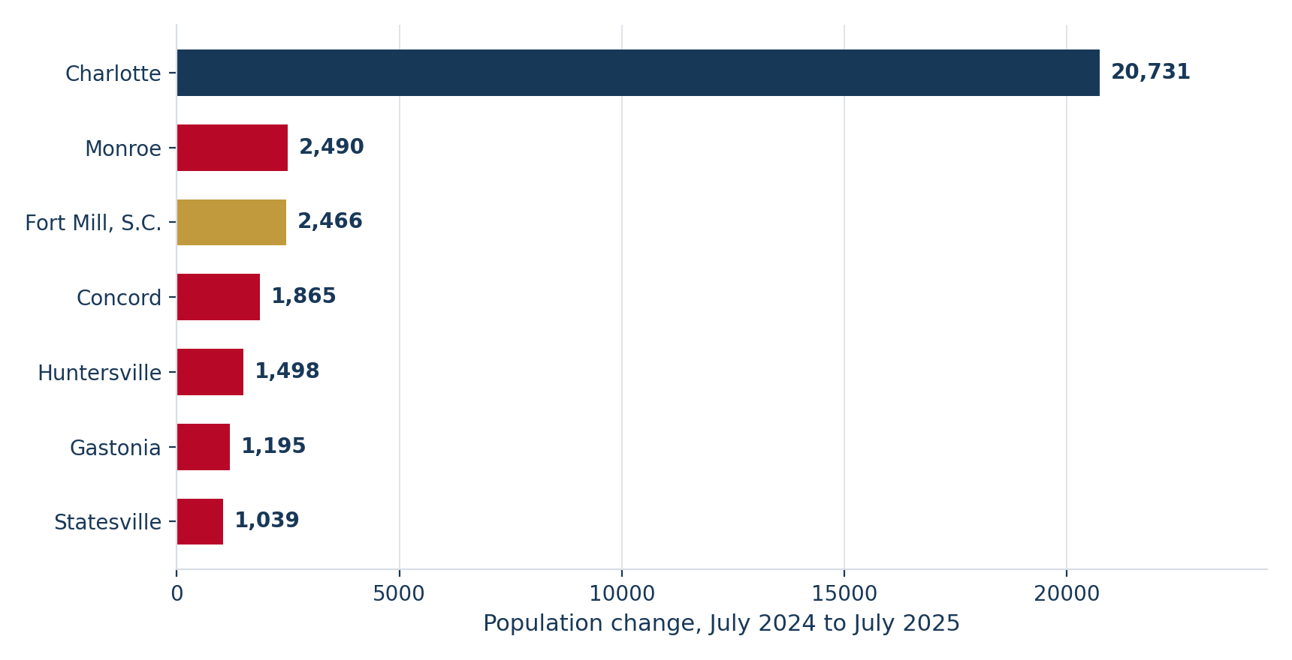
Population change, July 2024 to July 2025. Source: U.S. Census Bureau, Vintage 2025 Population Estimates; Southeast Economic Advisors.
The Census Bureau itself has taken note of the shift. The Bureau's statisticians describe midsized suburbs as occupying a sweet spot where domestic migration, international migration and new housing supply combine to sustain growth even as the largest cities and the smallest towns slow. We would add a simpler explanation: these are the places where a household earning the region's median income can still buy a home. Everything that follows is detail on that one point.
2. The Rolling Affordability Frontier
Affordability migration is not a new phenomenon; it is a familiar national pattern arriving in the Carolinas on schedule. Denver's boom in the first half of the 2010s pushed households out along the Front Range and eventually across the Mountain West. Dallas and Austin created rings of the fastest-growing cities in America, with Celina, Fulshear, Princeton, Melissa and Anna, all Texas suburbs, holding the top five spots in this spring's national rankings. Atlanta's growth has rolled north into Forsyth, Hall and Jackson counties and northwest toward Chattanooga. The Carolinas are now running the same play, and the receiving communities are following a predictable script.
The frontier does not stand still; it rolls outward as each ring of suburbs loses its affordability advantage. Apex and Wake Forest were the affordable escape valves of the Raleigh area a decade ago and are now expensive in their own right, which pushes the frontier further out to Wendell, Zebulon, Clayton, Benson and Smithfield. In the Charlotte region, the early beneficiaries in Union and Cabarrus counties are giving way to gains in Lancaster County, S.C., Lincoln County and the Statesville corridor along Interstate 77. Each ring inherits the last ring's growth and, eventually, its price pressure.
The arithmetic behind the frontier is a price-to-income problem, and it has moved quickly. Since 2019 the FHFA house price index has risen 82% in Charleston, 78% in Charlotte, 76% in Greenville and 69% in Raleigh, against 61% nationally, while median household incomes in the core counties of those metros rose 26% to 31%. Prices have outrun incomes by roughly three to one. Raleigh, Columbia and Greenville still price below the national ratio of home value to income, Charlotte has converged to it and Charleston has passed it. That ordering is the frontier's itinerary. The metros that have used up their affordability advantage are the ones whose households are already moving, which is why the Lowcountry frontier now reaches as far inland as Jasper County.
The edge towns have lapped the core city since 2020
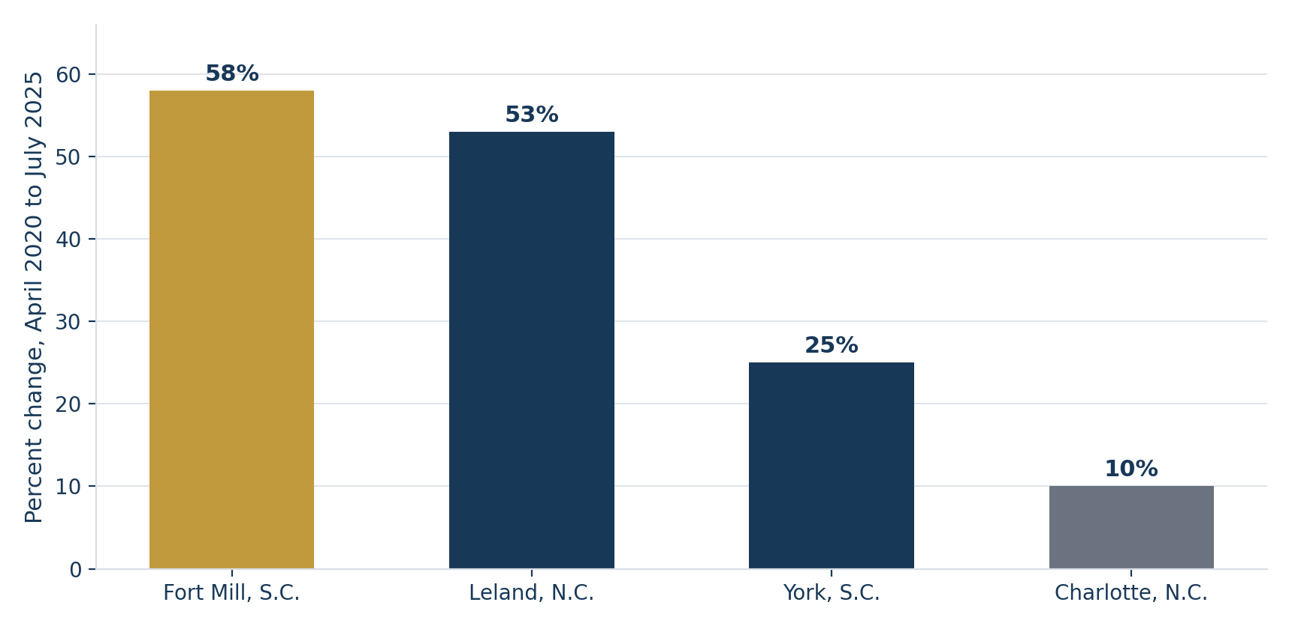
Percent change in population, April 2020 to July 2025. Source: U.S. Census Bureau, Vintage 2025 Population Estimates; Southeast Economic Advisors.
Housing supply is what separates the Carolinas' version of this story from the ones that came before it. South Carolina expanded its housing stock 1.9% over the past year, the third fastest pace in the nation behind only Idaho and Arizona, and North Carolina has consistently ranked near the top of the national tables for housing unit growth. Markets that can build can sustain growth. The Texas suburbs at the top of the national rankings all share that trait, and so do Fort Mill, Greer, Leland and Clayton. Where the frontier towns permit aggressively, they capture the migration wave rather than merely repricing it.
Two things have changed since the spring, and both argue for watching the supply side closely. Single-family permits in the Charlotte metro fell 28.7% in the first half of the year, a steeper decline than Orlando, Phoenix or Atlanta, and Raleigh issued 6,253 permits against Charlotte's 6,762. The frontier towns are still growing, but the machinery that lets them absorb growth without repricing has downshifted. The resale market has also turned faster than the population data will show for another year. Realtor.com's second-quarter market clock, published August 4, finds that of 42 Southern metros only two remain seller's markets, with Columbia and Greenville now buyer's markets and Charlotte balanced and loosening. A frontier that keeps growing into a softer resale market is a better place to buy a house and a harder place to underwrite a subdivision.
3. The County Scorecard
The county-level estimates tell the same story at a different altitude, and the coast steals the show. Jasper County, S.C., tucked behind Hilton Head at the foot of Interstate 95, was the fastest-growing county of 20,000 or more in the nation over the past year, expanding 6% to 38,533 residents as retirees and port-related workers pour into Hardeeville and Ridgeland. Brunswick County, N.C. grew 4.7%, the fastest pace in North Carolina and among the top ten counties nationally, while the Wilmington metro ranked seventh among all U.S. metro areas for percentage growth. South Carolina was the fastest-growing state in the country over the same period, expanding 1.5% and adding roughly 80,000 residents, of which 66,622 came from net domestic migration. Nearly every county in the nation that grew 4% or more did so on the strength of domestic in-migration.
Small coastal and frontier counties lead the nation
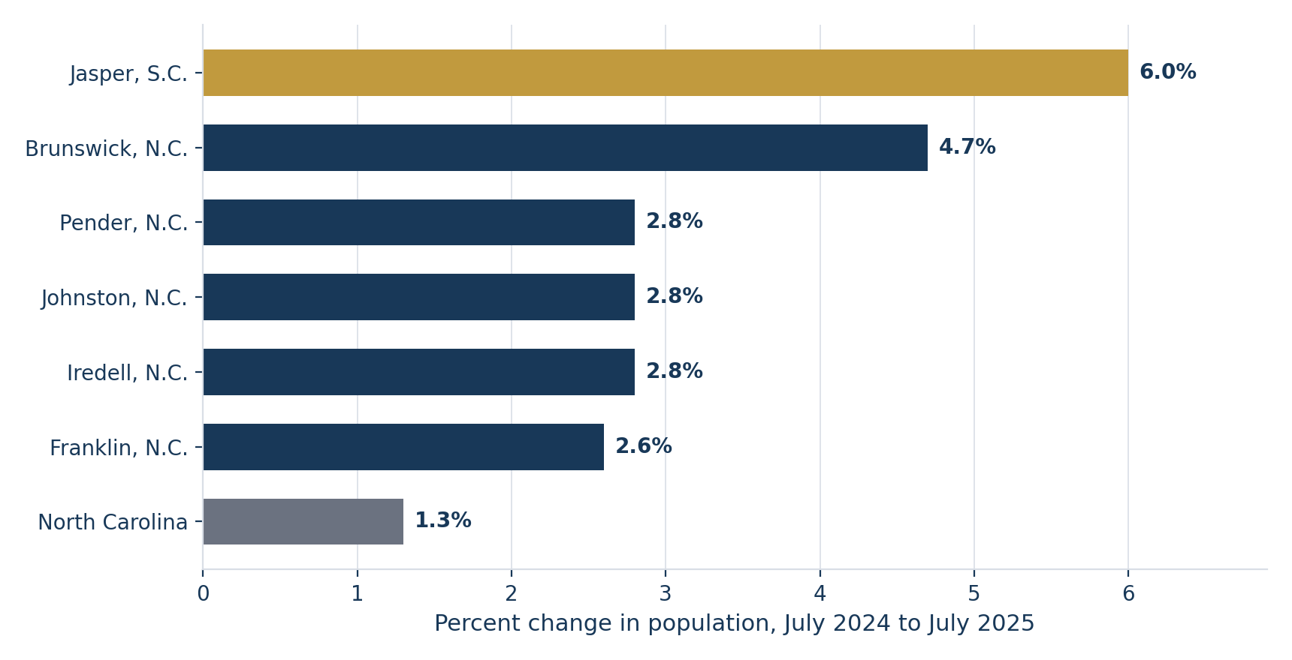
Percent change in population, July 2024 to July 2025. North Carolina statewide shown for reference. Source: U.S. Census Bureau, Vintage 2025 Population Estimates; Carolina Demography; Southeast Economic Advisors.
Beyond the coast, the fastest-growing counties ring the major metros rather than sit inside them. Pender, Johnston and Iredell counties each grew 2.8% and Franklin County grew 2.6%, all more than double North Carolina's statewide pace of 1.3%. Each of these counties sits one ring beyond a major employment center: Pender above Wilmington, Johnston southeast of Raleigh along Interstate 40, Iredell north of Charlotte along Interstate 77 and Franklin northeast of Raleigh along U.S. 401. North Carolina as a whole attracted roughly 84,000 net domestic migrants over the past year, more than any other state, and these frontier counties are where those households are landing.
The migration mix matters as much as the totals. Brunswick County would have lost population without in-migration, as deaths exceed births in a county whose growth is driven substantially by retirees. That demographic profile supports home construction, health care and consumer services today, but it also means the county's growth depends entirely on the migration pipeline remaining open. U-Haul's midyear migration report, published in late July, found six of the seven largest net-gain states for Baby Boomers to be Southeastern, led by South Carolina and North Carolina, which suggests that pipeline is still filling. Counties whose gains rest on working-age families, such as Johnston and Iredell, carry a more durable growth base into the next decade.
4. Capital Comes to the Countryside
The most important economic development in the Carolinas beyond the metros is not demographic; it is industrial. Our capital-led expansion thesis holds that this cycle is being driven by business investment in plants, equipment and technology rather than by consumer borrowing, protein rather than carbohydrates. What is remarkable about the Carolinas' version is where the capital is landing. The largest single investments in both states' histories are rising in small towns and rural counties, not in the metro cores.
Toyota's Liberty campus is the anchor tenant of rural North Carolina's industrial revival. The company began production in June 2025 at its $13.9 billion battery complex on an 1,850-acre site in Randolph County, its first battery plant outside Japan, with 14 production lines planned and up to 5,100 jobs at full ramp. Liberty had fewer than 3,000 residents when the project was announced. The plant sits within commuting range of Greensboro, Asheboro and Siler City, and its supplier network, including Fujihatsu and Toyotsu nearby, is already seeding secondary investment across the Piedmont Triad's rural fringe.
South Carolina's counterpart is rising in Blythewood, 20 minutes northeast of Columbia. Scout Motors is investing more than $2 billion in an assembly complex on 1,100 acres, with capacity for 200,000 vehicles annually and more than 4,000 permanent jobs, and last fall added a $300 million supplier park expected to support roughly 1,000 additional supplier jobs. Together with BMW's long-established Greer complex, which anchored the Upstate's transformation and explains much of why Greer is now the fastest-growing city in the state, the Interstate 77 and Interstate 85 corridors are becoming a continuous advanced-manufacturing belt that runs mostly through smaller communities. Pharmaceutical onshoring is now landing on the same corridor. Octapharma completed final approvals in late July for a $1.5 billion critical-care plant in York County, the same county whose town of Fort Mill opens this report.
Generational investments are landing beyond the metro cores
| Project | Location | Investment | Jobs | Status |
|---|---|---|---|---|
| Toyota Battery Mfg. N.C. | Liberty (Randolph Co.) | $13.9B | 5,100 | Producing since June 2025 |
| Amazon Web Services | Richmond County, N.C. | $10.0B | TBD | Under construction |
| Novo Nordisk fill-finish | Clayton (Johnston Co.) | $4.1B | 1,000 | Under construction; 2027-29 |
| Johnson & Johnson biologics | Wilson, N.C. | $2.0B | 500 | Under construction |
| Octapharma critical care | Rock Hill (York Co.), S.C. | $1.5B | 1,500 | Confirmed July 2026 |
| Scout Motors | Blythewood, S.C. | $2.3B | 5,000+ | Under construction |
| Catawba Two Kings Casino Resort | Kings Mountain, N.C. | $1.0B | 2,200+ | Phase one open; hotel 2027 |
| Wolfspeed materials plant | Siler City (Chatham Co.) | $5.0B | 1,800* | Operating; slower ramp |
| Albemarle (lithium restart) | Kings Mountain, N.C. | TBD | TBD | Federal permits cleared; state and local pending |
| Epsilon Adv. Materials | Brunswick County, N.C. | $0.65B | 500 | Permitted; timeline on hold |
| BMW Plant Spartanburg | Greer, S.C. | $1.7B | 11,000 | Investment completed July 2026 |
Selected major announced and active projects, verified as of August 2026. Investment and job figures as announced by the companies and state commerce departments; totals include announced expansions. *Wolfspeed's long-term hiring commitment; the company says growth toward that figure will occur more slowly than initially projected. Source: Company announcements; N.C. and S.C. Departments of Commerce; Southeast Economic Advisors.
The data center wave is now reaching the counties the manufacturing map missed. Amazon Web Services broke ground last October on a $10 billion campus in Richmond County, a rural Tier 1 county along U.S. 74 that has spent decades losing textile employment, with as many as 20 buildings planned at full buildout beside Duke Energy's Smith Energy Complex. Google announced a fresh $1 billion expansion of its long-running Lenoir campus in Caldwell County this year, and Microsoft continues building out its $1 billion, four-building campus in Catawba County. The July employment report showed construction adding 22,000 jobs nationally, nearly all of it nonresidential, which is what data centers, power projects and manufacturing plants look like in the payroll data while housing treads water. Data centers bring fewer permanent jobs than factories, but they bring enormous tax base to counties that need it most, and the site-selection logic, inexpensive land plus available power, points them squarely at the rural Carolinas. Greensboro's JetZero announcement, with plans for nearly 15,000 jobs building blended-wing aircraft, would be the largest of them all, though as a pre-revenue startup it belongs in the announced column rather than the underwritten one.
Where a data center lands inside the rural map matters more than how large it is. New research from Georgia Tech, by Daniel Yue and Yiyang Zeng, compares counties that landed a data center against otherwise similar counties that did not, and finds the benefits are conditional on geography in a way the announcement flow never conveys. Across all host counties, employment rises about 3.5% over the longer run, wages about 5%, business establishments 4.7%, household income 1.9% and building permits 16.1%. Split the sample and those averages come apart. Metropolitan counties see employment rise 4.1% and wages 5.5%. In less populous counties the job and wage spillovers are negligible, and the only measurable gain is a small decline in the unemployment rate. The mechanism is agglomeration: indirect spending cascades only where a deep labor market and a supplier base already exist to catch it, and the study finds that location rather than facility size is the decisive variable.
That finding sharpens rather than contradicts the site-selection logic, and it explains where this region's campuses have actually gone. A rural county inside a metropolitan statistical area, or on its commuting edge, has the labor market and supplier base the study identifies as the precondition. A remote county does not, even with an identical facility on identical acreage. Most of the Carolinas campuses sit on the near side of that line. Caldwell County, where Google has run a campus since 2010, and Catawba County, home to Apple's Maiden campus and Microsoft's buildout, are both inside the Hickory metro area. Kings Mountain sits in Cleveland County, inside the Charlotte metro. Richmond County, where Amazon Web Services is building on 1,200 acres, is the genuine outlier and the one to watch, because it is the test of whether a Tier 1 county well outside a metro commuting shed can capture more than the tax base. We would treat the outer-ring advantage as a well-founded inference from the study's mechanism rather than a separately measured effect, since the published split is metropolitan against non-metropolitan and not by distance.
One result in the same study deserves separate attention in this room. Retail electricity prices rose roughly 5% in the areas studied after a data center became operational. For a municipal electric system that single number is both the revenue opportunity and the ratepayer problem, and it is the empirical version of the argument now running in front of every utility commission in the region, which we take up in Section 7. It is also the strongest available case for writing a large-load tariff before the load arrives instead of after.
The same corridor runs north across the state line, and Southside Virginia is now absorbing the tier of investment the Piedmont's larger metros no longer have room to sell. Pittsylvania County has landed Microporous with 2,015 jobs at the Southern Virginia Megasite at Berry Hill, the Italian rocket maker Avio with 1,500 jobs at Hurt, and a data center buyer projecting 2,050 more. Those three total 5,565 jobs, more than every job the county lost over the previous 25 years. Halifax County has Hitachi Energy's 825-job expansion, South Boston has IperionX in titanium and Henry County has taken auto parts and tin production. Danville has posted net in-migration of 2,261 since 2020 after three decades of decline. The pattern matches the Carolinas frontier almost exactly: available land, interstate or rail access, a workforce with manufacturing memory and firm power. Danville and Martinsville are ElectriCities Virginia associate members, and Rockingham County sits directly between them and the Triad, which is where WhiteFiber has bought the former Unifi plant in Madison for $45 million and proposed a campus of up to 200 megawatts and more than $1 billion of investment. A synthetic yarn plant becoming a data center on the Virginia line is the clearest single address for what is replacing what in this part of the Piedmont.
Reshoring is the structural force behind the map. The relocation of production to the American Southeast predates the pandemic and reflects shrinking labor content in manufacturing and a repricing of supply-chain risk. Small-town Carolinas sites offer what reshoring manufacturers need: large parcels, interstate and rail access, industrial power and a trainable workforce within a 45-minute commute shed. Chatham County, with roughly 76,000 residents at the last census, illustrates both the promise and the discipline the trend demands. Wolfspeed's Siler City materials plant, the largest silicon carbide materials facility in the world, is complete and operating, even after the company's 2025 restructuring slowed its hiring ramp.
The same county also supplies the cycle's most important cautionary tale. VinFast's planned $4 billion assembly plant at the Moncure megasite never materialized. The site has been largely inactive since late 2024, and in May the state sued to reclaim the 1,765-acre property after the company missed its July 2026 operational deadline and its year-end hiring commitments. Epsilon Advanced Materials' permitted graphite plant in Brunswick County has likewise paused its timeline pending policy clarity, and Albemarle's Kings Mountain lithium restart, though it cleared its federal permits this spring, still awaits state and local approvals with no firm production date. The pattern is instructive: the projects that have stumbled are concentrated in the EV supply chain, where demand has fallen short of the 2022 forecasts, while the projects anchored by established manufacturers with committed product lines, Toyota, BMW and Scout, are the ones pouring concrete. We would build fiscal plans around the projects that are meeting payroll and treat the rest as a forecast until they do.
5. Healthcare, Life Sciences and the Eds-and-Meds Anchor
Pharmaceutical manufacturing is the life sciences wing of the capital-led story, and it is landing in the same frontier counties the migration data highlight. North Carolina attracted $10.8 billion in life sciences manufacturing investment in 2024 alone, one of the largest concentrated pharmaceutical buildouts in U.S. history, and the map of that money reads like the county scorecard in Section 3. Novo Nordisk is investing $4.1 billion in a second fill-finish facility in Clayton, in fast-growing Johnston County, adding 1.4 million square feet and 1,000 jobs to the roughly 2,500 the company already employs in the region, with construction finishing between 2027 and 2029. Eli Lilly doubled its commitment in Concord to $2 billion, with roughly 600 jobs at capacity, and FUJIFILM Diosynth's $3.2 billion Holly Springs campus began operations in 2025 with Johnson & Johnson as its first large-scale tenant. The GLP-1 boom is, quite literally, being bottled beyond the beltlines.
South Carolina now has an entry of its own, and it landed in York County. Octapharma, the Swiss plasma-products maker, confirmed in late July that it will build a $1.5 billion critical care manufacturing facility on a 50-acre campus at Palmetto Research Park in Rock Hill, with 1,500 full-time jobs. It is the company's first manufacturing plant in the United States. The facility will produce plasma-derived therapies and trauma and bleeding-management medicines, and Octapharma frames it explicitly as reducing dependence on overseas supply chains, which places it in the same reshoring category as the microchip and rare earth projects, not in ordinary capacity expansion. Two things make it more than another announcement. The company cited Rock Hill's advanced manufacturing base, deep-water port access and the technical college pipeline, which is the frontier's recruiting argument stated by a buyer instead of by a commerce department. And it lands in the same county as Fort Mill, the town whose growth opens this report. The affordability migration and the reshoring wave have now arrived in the same county, which is this report's argument reduced to a single map. Rock Hill is an ElectriCities associate member, so both the load and the payroll land on a municipal system.
Wilson is the purest test of whether pharma capital can transform a small eastern city. Johnson & Johnson's $2 billion biologics campus is rising in Wilson, a city of roughly 47,000 east of Interstate 95 that built its earlier economy on tobacco and textiles, and the company announced a further expansion this year expected to create up to 500 jobs. Wilson sits at the edge of the lagging eastern counties we discuss in Section 8, which makes the project a live experiment in whether advanced manufacturing can pull the growth frontier further east than housing migration alone has managed. Wilson County's Gig East fiber network, one of the first municipal gigabit buildouts in the state, is part of why the city won the site.
Healthcare itself is becoming the anchor institution strategy for smaller cities, and Belmont is the cleanest new example. CaroMont Health opened its 54-bed CaroMont Regional Medical Center - Belmont in January 2025 on 28 acres leased from the Benedictine monks of Belmont Abbey, an investment of more than $300 million including a 100,000-square-foot medical office building, visible from Interstate 85 and employing roughly 350 people. The land deal came with a condition that is the real story: CaroMont helped Belmont Abbey College launch a nursing program, which enrolled its first students in 2022 and graduated its first bachelor's class in May 2025, alongside new degrees in health administration and health informatics. A 1,700-student liberal arts college and an independent community health system built each other a workforce pipeline and a teaching hospital at the same time, a template any small city with a college and a hospital should study.
In the east, East Carolina University is the counterweight holding the region's economy together. ECU and ECU Health together generate an estimated $6.9 billion in annual economic impact and support more than 57,000 jobs across a 29-county region, making the combined enterprise the largest employer and the central economic institution of eastern North Carolina. The state has reinforced that role with a $265 million investment in the new Brody Center for Medical Education, a seven-story, 195,000-square-foot building that topped out in June and will expand the medical school's class size from 80 to 120 when it opens for the 2027-28 academic year. Brody is nationally recognized for sending more than half of its graduates into primary care, many of whom stay in the rural east. The system's own leadership has been candid that several of its rural hospitals survived the post-pandemic years only with state-directed Medicaid payments, which is precisely the point: in the counties the growth frontier has not reached, eds and meds are the load-bearing wall rather than one sector among many.
6. Tourism: The Frontier's Second Engine
Tourism is the largest service export of the Carolinas beyond the metros, and it just posted a record year with a two-speed asterisk. North Carolina visitor spending reached a record $37.2 billion in 2025, up 1.3% from the prior record, supporting nearly 231,000 jobs and generating more than $2.7 billion in state and local tax revenue, better than $101 million in spending every day. South Carolina's roughly $30 billion tourism industry also recorded a statewide record. The gains, however, were not evenly distributed, and the pattern will look familiar to readers of our work on the two-speed consumer. Charleston posted a record $14 billion in economic impact on 7.8 million visitors, while Myrtle Beach, where economy-tier properties make up half the hotel inventory, saw occupancy fall to 65.5% and accommodations tax receipts drop 10.8% as middle-income families cut back on discretionary travel. The split between high earners and middle-income households shows up on vacation as clearly as it does in the national spending data.
The Catawba Two Kings Casino Resort gives the region a tourism anchor of a scale the interior Carolinas have never had. The Catawba Nation's project of more than $1 billion sits along Interstate 85 at Kings Mountain, 35 miles west of Charlotte and five miles from the South Carolina line. The introductory casino opened in late May inside the permanent six-story complex, and at completion in spring 2027 the resort will offer 4,300 slot machines, 100 live table games, 11 dining outlets and a connected 24-story, 385-room hotel. Roughly 800 people work there today, with employment expected to reach about 2,200 or more at full buildout, and Cleveland County gains a destination that draws from the entire Charlotte region and the casino-free markets of upstate South Carolina. Kings Mountain now holds an unusual portfolio for a city of 11,000: one of the state's largest data center campuses, a proposed lithium mine and a resort casino, all within a few exits of Interstate 85.
Western North Carolina's recovery is the tourism story we are watching most closely. Buncombe County's population decline in the wake of Hurricane Helene has a revenue counterpart in the mountain tourism economy, and the state has responded with rebuilding funds and a dedicated campaign to bring visitors back to the region. The statewide spending record set in 2025 despite Helene's disruption suggests the demand is intact; the constraint is capacity and perception, both of which improve with each rebuilt mile of the Blue Ridge Parkway corridor. We expect western North Carolina to recapture its share of a growing pie through 2027, which would also help reverse Buncombe's population loss.
7. The Public Power Map
The public power map of the Carolinas is very nearly a tracing of the geography this report describes. ElectriCities represents more than 90 cities, towns and universities across the Carolinas and Virginia that own their electric distribution systems, and North Carolina's public power communities alone serve 1.2 million people, more than the populations of Raleigh and Charlotte combined. The membership divides into two clusters that mirror this report's structure: the 19 piedmont and western members of N.C. Municipal Power Agency Number 1, arrayed along the Interstate 85 and U.S. 321 manufacturing corridors, and the 32 eastern members of the N.C. Eastern Municipal Power Agency, running from the Raleigh frontier to the coastal plain. Associate members across upstate South Carolina, including Greer, Rock Hill, Easley, Gaffney, Greenwood and Newberry, extend the map into the fastest-growing corner of the Palmetto State. Read back through the preceding sections and a pattern emerges: a remarkable share of the communities driving the beyond-the-metro story run their own electric systems.
The western cluster is the manufacturing belt, and the capital wave is breaking directly on its territory. Monroe added 2,490 residents last year and Statesville 1,039, two of the largest gains in the Charlotte region, and both are NCMPA1 members. Gastonia, the agency's largest member city, is home base for the CaroMont system whose Belmont expansion we profiled in Section 5. Maiden, a town of fewer than 4,000, hosts Apple's long-running data center campus, and Microsoft's $1 billion Catawba County buildout sits in the same public power footprint. Concord, a non-power-agency member, landed Eli Lilly's $2 billion plant, and Kings Mountain, another, holds the casino, the proposed lithium mine and one of the state's largest data center campuses. Morganton, Drexel, Granite Falls, Newton, Lexington and High Point trace the furniture belt, with High Point Market still the world's largest home furnishings trade show, while Albemarle, Shelby, Cherryville and Lincolnton form the next ring of the affordability frontier. Behind all of it sits NCMPA1's 75% ownership of Catawba Nuclear Station Unit 2, which lets these communities offer manufacturers a roughly 90% carbon-free power supply, an increasingly valuable card in industrial recruitment.
The eastern cluster contains the entire two-speed expansion in a single membership roster. At one end sit Apex and Wake Forest, the former escape valves now grown expensive; Clayton, where Novo Nordisk is spending $4.1 billion on a public power system's territory; Benson and Smithfield on the current frontier; Wilson, whose municipally built Gig East fiber network helped win Johnson & Johnson's $2 billion campus; and Greenville, where the Greenville Utilities Commission serves the ECU enterprise that anchors the entire region. In the middle are the repositioning legacy cities: Rocky Mount and Tarboro near Pfizer's sterile injectables complex, one of the largest in the world, and Kinston with its aerospace cluster at the N.C. Global TransPark. At the other end are Laurinburg, seat of Scotland County and its 0.9% population decline, and small eastern members such as Belhaven, Enfield and Hamilton that sit squarely in the lagging counties of Section 8. No organization in the state has a more direct financial stake in closing that gap: for a municipal electric system, load growth is revenue, and its absence is a ratepayer problem.
Load growth has also become a ratepayer question in its own right, and the fight over who pays for it is now the most consequential regional policy story of 2026. Duke Energy Carolinas cut its original 18% residential rate request roughly in half in a July settlement, to a phased 5.9% increase in 2027 and 3.6% in 2028, with its allowed return on equity trimmed to 9.8%. North Carolina's attorney general refused to sign, calling the cumulative 9.5% too high, and he and the governor are separately pressing the Utilities Commission to convert Duke's voluntary data center pledge into a binding large-load tariff so that hyperscale customers pay full freight rather than shifting costs onto households. At least ten North Carolina counties and municipalities have paused or restricted data center permitting this year. The same argument is running in three neighboring states: Georgia's Public Service Commission opened an investigation into fuel-cost allocation after its own staff found large industrial customers pushing average fuel costs up 5% to 11% a month for everyone, the Tennessee Valley Authority has proposed a rate class specifically for data centers, and Santee Cooper already charges more for large loads while it disputes with the cooperatives over who bears the cost. Public power communities are better positioned than most to answer this question, because they set rates locally and can write a large-load tariff before a hyperscaler arrives rather than after. The members that do so will be negotiating from a position the investor-owned utilities are now litigating.
The permitting question moved faster than the rate question this summer, and it moved onto public power territory. Four North Carolina jurisdictions acted on a single Monday in August. Edgecombe County moved on a 24-month moratorium, which would be the longest in the state, after a $19.2 billion project withdrew from the Kingsboro Megasite. Greensboro's council voted to hold a public hearing on a 120-day pause covering data centers drawing more than 10 megawatts, reversing its own July rejection. Randolph County declined a moratorium and instead amended its ordinance to require closed-loop cooling and noise impact studies, which is the more durable answer and is already in effect. Farmville, in Pitt County, adopted twelve months, and Durham County has a possible vote later this month. Counted across the region, at least a dozen Southern jurisdictions have adopted a moratorium, an ordinance or a pause since late July. The binding constraint on this buildout is no longer capital and it is not yet power. It is entitlement risk, and the load is landing in the communities that wrote rules early, not the ones that wrote none. Virginia has already produced the other half of the answer. The State Corporation Commission ordered Dominion on August 5 to develop a new high-load class carrying an 85% transmission demand rate, assigning transmission costs directly to data centers. That question reaches the Carolinas commissions on its own, and it will reach them again through the NextEra and Dominion merger, which requires both North Carolina and South Carolina approval.
For the public power communities, the next five years are about absorbing growth in some territories and manufacturing it in others. Frontier members face the infrastructure test we describe in the Outlook: substations, water and schools must arrive ahead of the households, and the members that invest early will capture a disproportionate share of the migration wave. Eastern members need anchors, which is why the eds-and-meds institutions, the Global TransPark and projects like Wilson's biologics campus matter far beyond their direct payrolls. And for all of them, the electrification of manufacturing and the arrival of data center load have made power itself a site-selection variable again, which plays to public power's oldest advantages: local control, fast decisions and rates set down the street rather than in a distant rate case. Greer is the proof of concept; the fastest-growing city in South Carolina runs on a municipal system that has been in business since 1914.
8. The Other Carolinas
Not every community beyond the beltlines is participating, and honesty about the divergence is essential to understanding the region. Twelve of North Carolina's 100 counties lost population over the past year. The losses concentrate in the rural northeast, where Halifax County declined 1.0%, Scotland fell 0.9% and Hyde and Warren each fell 0.8%. These counties sit far from the metro commute sheds, outside the migration frontier and, so far, outside the industrial site-selection map. Buncombe County's 0.6% decline is a different story, reflecting Hurricane Helene's displacement of households from the Asheville area, and we expect that loss to partially reverse as rebuilding proceeds.
The rural northeast sits outside the growth frontier
Percent change in population, July 2024 to July 2025, five largest N.C. county declines. Buncombe County's decline reflects Hurricane Helene displacement. Source: U.S. Census Bureau, Vintage 2025 Population Estimates; Carolina Demography; Southeast Economic Advisors.
The legacy small cities occupy the middle ground between the growth frontier and the counties falling behind, and the successful ones share a playbook. Hickory rebuilt itself around fiber-optic cable, data infrastructure and a reinvented furniture cluster after losing nearly a third of its manufacturing base a generation ago, and the Catawba Valley now competes for the same capital-led investment flowing to the rest of the state. Statesville, Monroe and Sanford are riding metro spillover and industrial recruitment at the same time. Kings Mountain has opened the first phase of the Catawba Two Kings Casino Resort and is positioned for Albemarle's proposed lithium restart, which cleared federal permitting this spring. The dividing line between the legacy cities that reposition and those that drift is nearly always the same: proximity to an interstate corridor, a community college aligned with employers and a local government willing to permit housing.
Eastern North Carolina and the S.C. Pee Dee remain the hardest cases. The 12 declining counties share small populations, aging demographics and distance from both the coast and the interstate manufacturing belt. Federal transfer payments and agriculture dominate their income bases, leaving them exposed to policy shifts rather than participants in the private capital cycle. Closing that gap will require the growth frontier to keep rolling outward for another decade, and even then some counties will be reached and some will not. The two-speed expansion we describe at the national level runs straight through rural Carolina. The Richmond Fed's Fifth District survey is a reminder that the region is early in this upturn rather than mid-way through it: the composite improved to 5 in July while new orders decelerated to 5 from 8, even as Texas manufacturing accelerated sharply.
The regional employment comparison is an uncomfortable one for the Virginia end of this corridor. Virginia has lost 43,600 jobs over the year through June, a decline of 1.0% and the only outright loss among the Southern states, with participation down to 63.1% and the labor force still shrinking. That is the federal workforce contraction showing up in state data, and it falls on Northern Virginia, not on Southside. The contrast with the Carolinas is stark. North Carolina added 62,900 jobs over the same twelve months, up 1.2%, and South Carolina's unemployment rate fell for a fourth straight month with a record 2,554,577 residents employed. Southside Virginia's industrial wins are running against their own state's trend, which is part of the reason they are landing where they are.
9. Outlook
We expect the beyond-the-metro growth premium to persist through 2027, though the pace will moderate with the national economy. The forces driving the frontier are structural rather than cyclical: metro housing costs that reset permanently higher, a reshoring wave with years of announced projects still to build out and a demographic tailwind of retirees and remote-capable workers seeking lower costs. Slower national population growth, driven by the near-collapse in net international migration, actually concentrates the remaining growth in the places winning the domestic migration contest, and no two states are winning it more decisively than the Carolinas.
The rate path is the main thing that could slow the frontier without changing its direction. Our August forecast carries no Federal Reserve cut in 2026 and the next move a hike in the first half of 2027, with the ten-year Treasury ending this year near 4.60% and the thirty-year mortgage near 6.60%. Our July 31 housing forecast has single-family starts falling to 890,000 this year from 941,000 in 2025 and recovering only to 940,000 in 2027, while multifamily rises to 450,000. For the frontier communities that combination cuts both ways. Financing costs stay where they are, which keeps the metro cores locked up and keeps the affordability migration running, and at the same time it slows the homebuilding those communities depend on to absorb the arrivals. Build the capital plan around rates staying near current levels, not around relief.
Southeast Economic Advisors regional framework, mid-2026
| Indicator | Metro Cores | Growth Frontier | Rural Interior |
|---|---|---|---|
| Population growth | Slowing | Accelerating | Flat to declining |
| Housing permits | Cooling | Elevated | Minimal |
| Job growth | Positive, narrowing | Above-average | Mixed |
| Capital investment | Services-led | Manufacturing-led | Selective |
| Tourism | Record, uneven | New anchors opening | Coast and mountains only |
| Eds and meds | Anchor institutions, mature | New hospitals, pipelines | Essential but strained |
| Home price pressure | High | Rising | Low |
| 2027 outlook | Steady | Outperform | Divergent |
Qualitative assessment across the three-tier geography discussed in this report. Source: Southeast Economic Advisors.
The risks to the frontier run through infrastructure, insurance and announcement risk rather than demand. Roads, schools, water and sewer capacity are already straining in Jasper, Brunswick and York counties, and the communities that fail to invest ahead of growth will price themselves out of the migration wave just as surely as the metro cores did. Coastal insurance costs bear watching; Florida's experience shows how quickly an affordability advantage erodes once premiums compound. And as the VinFast episode demonstrates, communities that build their fiscal plans around announced projects rather than operating ones carry a risk all their own. For now, though, the arithmetic favors the frontier. People follow affordability, capital follows people and in the Carolinas both are headed beyond the beltlines.
About Southeast Economic Advisors
Southeast Economic Advisors provides economic research and advisory services to businesses operating across the South and Mountain West. This report is for informational purposes only and does not constitute investment advice. Data are drawn from the U.S. Census Bureau, state demographic offices, company announcements and Southeast Economic Advisors' own analysis, and are believed to be reliable as of the publication date.