
The Week Across the South
The data center fight turns political as the Fed lines up a September hike
Download the full report (PDF)
The Data Center Fight Turns Political
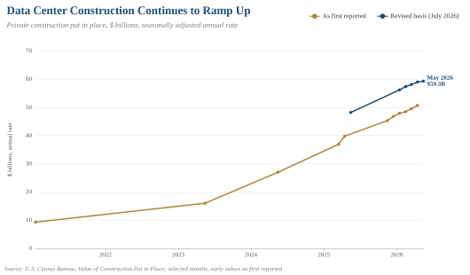
The AI buildout and the resistance to it both gained ground across the South last week, and the fight is moving up the ballot. QTS and Lancium will put a hyperscale campus of up to 11 data centers in Hall County, Texas ($10 billion-plus, announced July 13, with the developers funding the energy infrastructure and Lancium bringing its own solar and battery power). OpenAI topped it on July 22 with a $20 billion, 3.2-gigawatt campus in Effingham County, Georgia that could be the largest such project in state history, Submer’s Rubix Data Centers wants an $8 to $12 billion campus on the former AK Steel mill site in Russell, Kentucky, and Google was named the end user of an 8 million square foot, 23-building campus in Columbia County, Georgia. The Effingham filing left its water, environmental and economic-impact questions blank, which says something about how fast this money is moving. The Census Bureau’s tally of data center construction reached $59.3 billion at an annual rate in May, the highest in the history of the series and up 23% from a year earlier.
Local governments answered with a week of lines drawn. Nashville’s Metro Council passed the city’s first data center regulations on July 21, banning facilities larger than 500,000 square feet in Davidson County and freezing construction through December. Chester County, South Carolina adopted a six-month pause on July 20, joining York County’s nine-month pause on the I-77 corridor and a year-long moratorium in Spartanburg County on I-85, central Kentucky towns from Lexington to Georgetown have added pauses of their own, Cherokee County, Georgia approved a 30-day moratorium on July 22 that staff will ask to extend to 180 days in August, and Montgomery County, Maryland’s council votes today on an 18-month version, which would follow the two-year moratorium already adopted next door in Prince George’s County. The wave reached Data Center Alley on Monday, when Loudoun County, Virginia supervisors voted 6 to 1 to study the legality of pausing new applications and the planning commission rejected a 3.25 million square foot campus. The fight is spreading to the wires too; Texas Monthly reports that neighbors of Dinosaur Valley State Park are organizing against the transmission lines the buildout needs.
Politicians have noticed which way the wind is blowing. Gallup finds 71% of Americans oppose a data center in their own area, with the South at 75% and the Midwest at 76%, and pollster Heatmap Pro has opposition surging from an even split last September to 71% by May. Georgia’s open governor’s race now offers the country’s cleanest contrast: Democrat Keisha Lance Bottoms wants to press pause on new projects, while Republican Rick Jackson opposes a moratorium and argues for local control. In Texas, Governor Abbott directed regulators in June to make data centers fully fund the infrastructure that serves them, and Democratic Senate nominee James Talarico built his July 22 platform around making large users pay their own way and repealing the state sales-tax exemption, stopping short of a moratorium. The industry is answering with money, launching a Connected Georgia advertising campaign, while North Carolina’s attorney general spent Monday pressing Duke Energy to turn its ratepayer pledge into a binding large-load tariff. We look for the moratorium count to climb steadily between now and the November midterms; county commissioners read the same polls the candidates do.
Washington spent the week leaning the other way, with conditions attached. President Trump expanded his Ratepayer Protection Pledge on July 23, adding more than 200 utilities, cooperatives and developers to a roster the White House says now covers about 80% of the power delivered in the country, all committed to the principle that data centers bring, build or buy their own supply. The White House points to Southern Company’s freeze on base rates through 2029 as proof the model works, and the House Energy and Commerce Committee voted 52 to 0 on July 21 to start codifying the idea. The federal government is also becoming a landlord: the NNSA picked Amentum on July 20 to open negotiations on a 1-gigawatt AI data center backed by about 2 gigawatts of on-site generation at the Savannah River Site in South Carolina. The quieter deadline sits at FERC, where all six regional grid operators must answer June show-cause orders on large-load interconnection rules by August 17, the first serious federal pass at deciding who pays when a gigawatt shows up on the wires.
The opportunity for our region sits in the gap between the no votes. Capital turned away in one county lands in another, and communities that stay open are being sought out on better terms: Meta raised its Richland Parish, Louisiana commitment to more than $50 billion on July 13 with an Entergy deal that funds new generation, and Pittsylvania County, Virginia reaffirmed Stack’s $100 billion Berry Hill campus on July 22. The year’s earlier wins in the same vein still stand out, with AVAIO’s $6 billion first phase in Pulaski County, Arkansas and xAI’s $20 billion-plus in Southaven, Mississippi both booked in January. The winning posture pairs the welcome with the pledge model: bring your own power, pay your own freight, put the tax base on the county books. We look for developers to pay a growing premium for speed and certainty as the moratorium map spreads; the swing factor is this week’s earnings calendar, where capital spending guidance from Microsoft and Meta on Wednesday and Amazon on Thursday follows Alphabet’s raise to $195 to $205 billion and will tell us whether the demand behind all of this is still accelerating.
Inflation in the South
The June inflation numbers we walked through last week are aging well. The South’s 3.2% headline rate still sits three-tenths under the national 3.5%, with core (2.2% versus 2.6%) and shelter (2.9% versus 3.3%) telling the same supply-side story, and the week’s news pointed to more relief ahead. Retail gasoline climbed back above $4.00 a gallon nationally in the week of July 20 (Gulf Coast drivers paid $3.59), still well below the $4.50 peak set in May, and then the oil market broke: Brent crude, which topped $100 a barrel Thursday for the first time since May, fell 8.7% to $88.36 on Monday after Washington and Tehran moved to pause military strikes, and traded near $86 Tuesday morning in a third straight session of declines. Pump prices should follow with the usual lag.
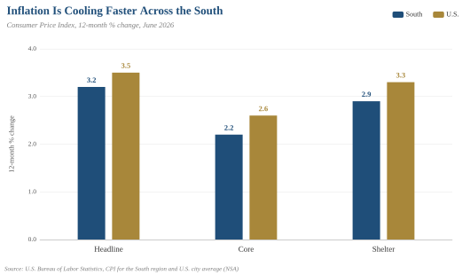
We look for Southern headline inflation to settle near 3% by late fall as the spring energy shock washes out of the 12-month math. The catch is that the market has priced the de-escalation faster than the physical supply has recovered. Six vessels transited the Strait of Hormuz on July 24 against a normal count closer to twenty, and Iran is publicly denying that formal negotiations are underway even as Omani mediation advances. Futures are trading the headline; the tankers have not moved yet. June’s PCE reading arrives Thursday and should confirm what the CPI already showed, and the August 12 release brings July readings for Dallas, Tampa and Washington, the next check on whether the Texas shelter slowdown is moving east. A collapse of the strike pause is the one development that would rewrite that path.
Labor Markets
The most surprising number of the week was 187,000. Initial jobless claims fell to that level in the week ended July 18, which the wires put at the lowest weekly count since September 1969, an odd companion to June’s weak payroll gain of 57,000. The reconciliation is that employers have largely stopped firing and hiring at the same time; the share of the unemployed out of work more than six months has climbed to 27.3% from 25.0% in January. We read the claims figure as labor hoarding, not strength.
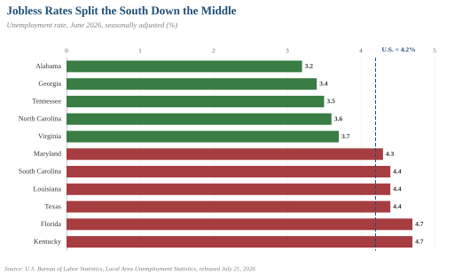
June’s state numbers, released July 21, split the South cleanly in two. Alabama (3.2%), Georgia (3.4%), Tennessee (3.5%), North Carolina (3.6%) and Virginia (3.7%) all sit below the 4.2% national unemployment rate, while Maryland (4.3%), South Carolina, Louisiana and Texas (4.4% each) and Florida and Kentucky (4.7%) sit above it. Texas again did the heavy lifting on hiring, adding 43,400 jobs in June and 177,900 over the year, the most of any state on both counts, with the Workforce Commission counting professional & business services (+25,500) and leisure & hospitality (+10,300) in front. Georgia is the region’s soft spot, losing 10,100 jobs in June with a gain of just 6,000 over the entire year, although the BLS treats both changes as statistically insignificant.
The federal corridor is still paying for Washington’s downsizing. Virginia has lost 43,600 jobs over the past year, the largest decline of any state in the country, with federal employment in the commonwealth down 19,000, or roughly a tenth. The District has lost 36,100 jobs, a 4.8% drop, and carries the nation’s highest unemployment rate at 6.0%; federal payrolls across the Washington metro area are down about 54,500 from a year ago. Maryland has held up better, adding 17,800 jobs in the first half. Wednesday’s metro-area employment report for June will show how far the damage extends city by city. We look for the Southern split to persist into 2027, with Texas and the Carolinas outgrowing the corridor, unless the low-hiring freeze breaks into outright layoffs, something Friday’s employment cost index and next week’s July payrolls will help referee.
Policy Watch
The Federal Reserve began a two-day meeting this morning, and for the first time in this cycle the live question is a hike. The committee has held the funds rate at 3.50% to 3.75% for four straight meetings, and futures markets put the odds of a quarter-point increase Wednesday near one in three, while pricing a hike as the likelier outcome by September. The hawks have been loud: Dallas Fed President Lorie Logan sees a case for “modestly higher” rates, and Cleveland’s Beth Hammack calls inflation flatly too high. Chair Kevin Warsh, running his second meeting, faces a White House pulling in the other direction. We look for a hold with hawkish language on Wednesday; June’s sharp CPI slowdown, the soft payroll print and this week’s break in oil prices give the committee room to wait, and the statement is more likely to prepare the ground for September than to move now.
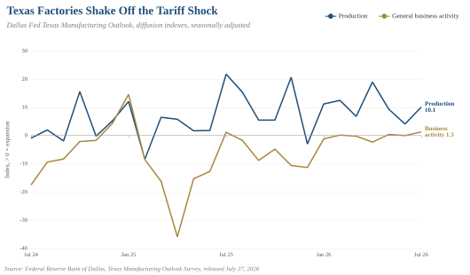
Monday’s data leaned the hawks’ way. The Dallas Fed’s Texas manufacturing survey showed production jumping to 10.1 from 4.1 and new orders firming to 6.4 from 2.3, although raw-material price pressure stayed elevated at 41.3 and one electronics maker told the bank the Iran conflict has destabilized circuit-board pricing. Texas factories are absorbing the tariff and energy shocks better than the national payroll numbers would suggest. June durable goods, out the same morning, made the point nationally: headline orders rose just 0.3% against expectations near 2.5%, but core capital goods shipments jumped 1.9%, the largest gain since December 2021, with core orders up 0.9% and 9.3% from a year ago. That is the AI buildout in this week’s lead story showing up in the hard equipment data, and it lands in Thursday’s GDP report as business investment.
Trade policy turned over again on Friday. The stopgap 10% global tariff imposed under Section 122 of the Trade Act of 1974 hit its 150-day statutory limit and expired July 24; a successor schedule built on 60 parallel Section 301 investigations took effect the same day, setting 10% on 17 trading partners and 12.5% on most of the remaining 43, with the European Union and Taiwan capped at 10% net of most-favored-nation duties and carve-outs for USMCA-qualifying goods, pharmaceuticals and civil aircraft. Two small importers sued at the Court of International Trade the same day, arguing that Section 301 does not authorize a near-uniform global schedule, so the new rates are not settled law. The safe harbor for goods already on the water closed at 12:01 a.m. Tuesday, and it was a narrow one: cargo had to be loaded before July 24 and cleared for consumption before this morning, so arrival alone did not spare it. Two more dates matter for the South: tiered Section 232 pharmaceutical tariffs reaching 100% on patented drugs begin phasing in Friday, squarely relevant to North Carolina’s drug-manufacturing corridor, and 50% tariffs on Canadian goods including vehicles, dairy and alcohol take effect August 19 under Section 338 of the Tariff Act of 1930, with no USMCA exemption, a direct hit to the parts networks feeding Southern auto plants. Importers saw it coming: July container imports are projected at a record 2.47 million TEU nationally, with August and September already forecast to fall back, and Port Houston just posted its best first half on record even as Savannah’s June container imports slipped 8.2% from May. We look for port volumes to sag this fall once the frontloading fades, unless the new schedule proves as short-lived as its predecessors.
Commercial Real Estate Across the South
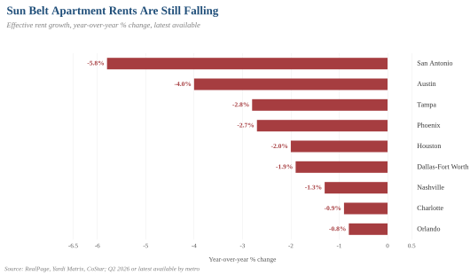
Multifamily. The supply wave that built the South’s rent discount is finally receding. RealPage counts 340,200 completions over the past year, below the ten-year norm for the first time in three years and down from a peak near 588,000 in late 2024, and Austin, the market that overbuilt most, just posted its first positive quarter of rent growth since fall 2022, even though rents there are still down 4% from a year ago. National effective rents are still down 0.2% over the year, with nearly a quarter of professionally managed units offering concessions averaging 7.6% off. Texas housing tells a similar leveling-off story; the Texas Realtors’ second-quarter report (July 21) put the statewide median price at $340,000, flat over the year, on closed sales up 4.5%.
Industrial. The warehouse market has quietly turned. Cushman & Wakefield’s national vacancy rate fell back below 7% (6.9%) as first-half absorption (113.6 million square feet) ran at the strongest pace since 2023, and Dallas-Fort Worth leads the country with 40.3 million square feet of leasing this year. Tariff whiplash froze decisions early in the year, but occupiers now want inventory on hand, which favors inland hubs; CBRE puts Atlanta at 8.2% vacancy with 2.6 million square feet absorbed in the quarter and Nashville at 4.8%.
Office. The sector is no longer getting worse, which in this cycle counts as news. Cushman & Wakefield holds national vacancy at 20.1%, roughly flat for an eighth straight quarter, with sublease space down 15% from a year ago. Atlanta’s 24.9% vacancy is its lowest in eight quarters and the market has now strung together two quarters of positive absorption, and the distress trade is thawing: Atlanta’s Regent Partners, in a joint venture with Florida-based Morning Calm Management, is in due diligence on Buckhead’s Tower Place 100, the 639,000-square-foot tower Starwood walked away from after a $212.5 million default.
Retail. Retail stays the tightest market in the region. National vacancy sits at 6.0% against a 7.4% long-run average, and the South posted the strongest annual rent growth of any region at 3.3%. Sterling Organization’s $93.2 million purchase of the Whole Foods-anchored Merchants Walk center in Marietta shows institutional money paying up for well-anchored suburban Atlanta retail.
Capital markets. Credit is coming back faster than prices are. Trepp’s CMBS delinquency rate fell 20 basis points in June to 7.35%, although office delinquencies are still climbing (up 4 basis points to 11.57%), multifamily rose 28 basis points to 7.23% and retail rose 30 basis points to 6.91%. The banks are back in the pool: Truist grew CRE loans 25% in the second quarter and PNC grew them 15%, with lenders favoring multifamily, logistics and data centers. We look for Sun Belt apartment rents to flip positive across most metros by mid-2027 as completions keep falling; the risk is the 10-year Treasury, which ended last week at 4.69% and has eased to about 4.63% as oil retreated, a level that still keeps the reopening fragile.
Development Wins of the Week
The Farnborough Airshow set the tone for a defense and energy-hardware week.
Atlantic South. Fortified Solar will put a $22.75 million solar-roofing plant in Greenville County, South Carolina (151 jobs, July 21), Lenovo committed $145 million to double its Whitsett, North Carolina campus (July 27) and Hepburn and Sons will move its headquarters to Prince William County, Virginia with 80 jobs and $18.1 million (July 20). Relativity Space expanded Terran R rocket production at Cape Canaveral with up to $134 million in Florida spaceport support (July 21). The Carolinas also landed a National Science Foundation grid-modernization research engine on July 14, led by UNC Charlotte with $15 million over two years and up to $160 million over a decade, aimed at the very transmission bottlenecks in this week’s lead story.
Gulf & Central. Alabama booked two Farnborough wins on July 20: Doncasters’ $50 million superalloy plant in Auburn (70 jobs) and Redwire’s 150-job expansion in Huntsville. Mississippi added SIP Manufacturing’s $100 million beverage co-packing plant in Southaven (187 jobs, July 22), and Siemens Energy broke ground July 17 on its $300 million switchgear factory in Pearl (up to 300 jobs).
Texas & the Plains. Saronic Technologies’ $3.2 billion autonomous shipyard at the Port of Brownsville (announced July 16, as many as 10,000 jobs) would make it the Valley’s largest private employer. Park Aerospace picked Tulsa for a $65 million composites plant with more than 100 jobs (July 21) and General Motors put $157 million into its Wentzville, Missouri paint shop (July 24). We look for the defense and grid-equipment pipeline to keep outrunning traditional automotive announcements through year-end, provided the Canadian tariff fight does not freeze auto-sector capital plans first.
The Week Ahead
Monday, July 27. Dallas Fed factory survey: Texas production 10.1 (chart above); June durable goods, core capital goods shipments +1.9%.
Tuesday, July 28 (today). FOMC begins; Consumer Confidence (10 a.m. ET); Atlanta Fed final Q2 nowcast; Montgomery County MD council vote; Section 301 in-transit window closed at 12:01 a.m.
Wednesday, July 29. FOMC decision (2 p.m. ET); BLS metro-area employment (June); Microsoft and Meta earnings.
Thursday, July 30. Q2 GDP advance (GDPNow 1.6%, July 27); June PCE; claims; Amazon and Apple earnings.
Friday, July 31. Employment Cost Index; final July Michigan sentiment; pharma tariffs; Abbott’s Texas deadline.
On deck. ISM (Aug. 3); July jobs report (Aug. 7); Dallas, Tampa and DC metro CPI (Aug. 12).
Recent Research
Our most recent weekly commentary, A View from the Piedmont, is posted at piedmontcrescentcapital.com. It covers money, credit, exchange rates and geopolitics, and pairs with this letter’s regional focus.
Sources & Notes
Sources: U.S. Bureau of Labor Statistics; U.S. Census Bureau; U.S. Department of Labor; Atlanta Fed GDPNow; Dallas Fed surveys; Federal Reserve Beige Book (July 15); CME FedWatch; EIA; Gallup and Heatmap Pro; White House, DOE, FERC, USTR and Federal Register releases; U.S. Court of International Trade filings; National Science Foundation; RealPage; Yardi Matrix; Cushman & Wakefield; CBRE; Trepp; CoStar; Texas Realtors; Texas A&M Real Estate Research Center; Texas Workforce Commission; Texas Monthly; Texas Tribune; Descartes and NRF/Hackett port data; state commerce and governors’ releases; company announcements and local press.
Notes: CPI figures are June 2026 twelve-month changes, not seasonally adjusted; metro reference months are noted in the text. The South core figure rounds from an unrounded 2.25%. State labor data are June 2026, seasonally adjusted. The data center construction chart compares the current data vintage with values as first reported and is our own calculation, not a published Census revision factor; Census began breaking out data centers separately in 2024, so earlier values are reconstructed. Apartment rent figures are asking rents and mix vendors and vintages by metro, so they are not strictly comparable across bars. Industrial figures for Atlanta and Nashville are CBRE’s; national industrial, office and retail figures are Cushman & Wakefield’s. Treasury yields through midday July 27; tariff details reflect press reporting at press time. © 2026 Southeast Economic Advisors / Piedmont Crescent Capital.