
SOUTHEAST ECONOMIC ADVISORS
Weekly Southeast Economic Update · Charlotte, North Carolina
The Week Across the South
A Tariff Cliff, a $50 Billion AI Bet, and Floodwaters in the Hill Country
The Week at a Glance
- The AI buildout keeps accelerating. Meta scaled its Richland Parish, Louisiana campus to five gigawatts and roughly $50 billion, lifting the state’s announced data-center pipeline well past $100 billion.
- So does the backlash. Fresh moratoriums and denials landed in Georgia, South Carolina, Florida and Virginia, while rural counties such as Stokes County, North Carolina stayed open to the tax base a large project brings.
- A consequential policy week. A 25% duty on Brazil takes effect Wednesday, the 10% Section 122 surcharge sunsets Thursday, June state jobs land Tuesday, and the FOMC meets July 28–29.
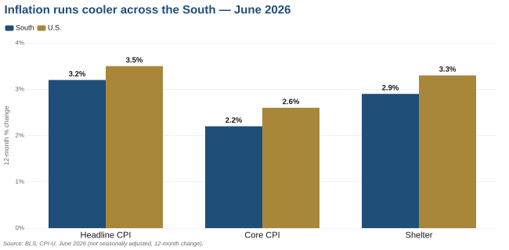
- The South is still the coolest inflation corner. June consumer prices rose 3.2% over the year, three-tenths below the nation, with core inflation at just 2.2%.
- Labor markets are easing from strength, and the second-quarter real estate data show tight industrial and retail against a still-heavy apartment supply wave.
The Boom Builds, and the Backlash Spreads
The South opens the week facing its busiest policy stretch of the summer, with a state jobs report, a new duty on Brazil, the sunset of a stopgap tariff and a Federal Reserve meeting all falling inside ten days. None of it slowed the capital pouring into the region. Meta formally scaled its Richland Parish, Louisiana data-center campus to five gigawatts and roughly $50 billion (Governor Landry’s office, July 13), more than doubling a project that was already one of the largest private investments in state history and lifting Louisiana’s announced data-center pipeline well past $100 billion. For a region that sells cheap land, cheap power and a welcoming government, the AI buildout remains the defining story of 2026.
The pushback kept pace with the buildout. Local governments across the South added to a lengthening list of pauses and denials. Marietta, Georgia passed a six-month moratorium, Colleton County, South Carolina enacted its own as pending projects statewide topped $7 billion, and boards in Palm Beach County, Florida and Prince William County, Virginia rejected large campuses outright after marathon hearings. The split we flagged earlier in the summer is hardening, with rural counties still competing for the tax base while wealthier suburbs increasingly say no. Stokes County, North Carolina sits on the welcoming side of that divide, its commissioners having turned down a proposed moratorium in mid-July, and a county with an even narrower industrial base than the Hickory area we profiled in our recent Catawba County and Hickory Metro Economic Outlook stands to gain the most from the tax-base infusion a single large project can bring.
The week’s other headline was written by the weather. Renewed flash flooding tore through the Texas Hill Country on July 17, and the President approved a major disaster declaration for 28 counties on July 19, opening federal cost-sharing for Kerr, Kendall, Uvalde and neighboring communities still recovering from the early-July floods. The human toll comes first, but the economic aftershocks, from damaged infrastructure to disrupted summer tourism along the same river corridors, will linger into the back half of the year.
Underneath the noise, the data still describe a Southern economy that is cooling gently rather than stalling. Inflation ran cooler in the South than in the nation again in June, labor markets are easing from a position of strength, and the largest near-term risk is not the regional economy itself but what Washington does to trade policy by Thursday.
Inflation in the South: Still the Coolest Corner
The South again posted the softest inflation of any region in June. Consumer prices rose 3.2% over the year, three-tenths below the national pace, and core inflation of 2.2% ran four-tenths below the U.S. (BLS, released July 14). Prices actually fell 0.4% in the month. The story remains shelter. Southern shelter costs rose 2.9% against 3.3% nationally, and the metro readings are starker still. Atlanta shelter is up just 1.3%, Dallas-Fort Worth rents are slightly negative, and Houston’s core index is falling outright (-0.6% over the year), the direct result of the Texas apartment supply wave working through to measured rents.
Houston’s 0.8% headline reading sat near the bottom of the major metros, while Washington’s 4.1% (a May figure) was the regional high, with capital-area energy costs up 25.9% over the year. The offsets to Southern disinflation are food (Atlanta grocery and restaurant prices are up 5.5%) and energy in the Texas metros (Dallas-Fort Worth energy +18.9%). For businesses and landlords, the region is still absorbing the disinflation its own construction boom created, and with roughly 1.3 million apartments nationwide still in lease-up, the shelter relief has further to run. The next reading, July CPI including the odd-month metros of Dallas-Fort Worth, Tampa and Washington, arrives August 12.
Labor Markets: Easing From Strength
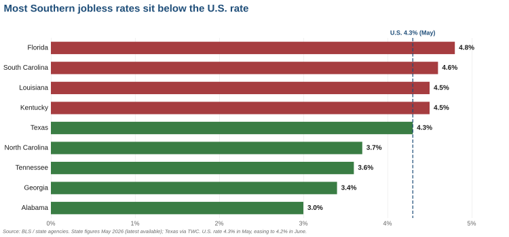
Southern labor markets are loosening from the top down, and Tuesday’s state release will show how far. Through May, Alabama (3.0%), Georgia (3.4%), Tennessee (3.6%) and North Carolina (3.7%) sat comfortably below the national rate, which eased to 4.2% in June from 4.3% in May, while Florida (4.8%), South Carolina (4.6%) and both Kentucky and Louisiana (4.5%) ran above it. Texas held at 4.3%, with payrolls up 98,000 over the year. The soft spots stay concentrated in the Washington-Baltimore corridor, where federal downsizing continues to bite, and June’s national pullback in leisure & hospitality hiring bears watching in the tourism-heavy states. June state figures land Tuesday, July 21.
Policy Watch: The Tariff Cliff and the Fed
The July 15 Beige Book described a Southern economy that is still growing, but grinding. Activity expanded at a slight-to-moderate pace nationally, and price growth held steady or slowed in every District, with contacts pointing to tariffs and the Middle East as the main cost pressures. The Atlanta Fed saw modest growth and roughly flat employment, with a tourism lift from World Cup matches, while Richmond reported moderate expansion and a little more hiring. Agriculture remained the weak spot, with soft crop prices, tighter credit and tariffs still pressing on soybeans.
Trade policy is the week’s genuine wild card. The 10% Section 122 surcharge (the stopgap Washington imposed in February after the Supreme Court threw out the IEEPA tariffs) sunsets by law at 12:01 a.m. Thursday, July 24, and no extension is moving in Congress. Its intended replacement, a USTR Section 301 action carrying roughly 12.5% duties on some 46 economies (part of a broader case covering about 60), was still unfinished as of Monday. If it does not land by Thursday, baseline duties on non-USMCA goods would fall briefly toward most-favored-nation levels. USMCA-qualifying goods stay exempt, which continues to favor the South’s Mexico-linked supply chains, and the third round of the USMCA joint review opened in Mexico today, with the United States pressing to raise automotive regional-content requirements from 75% to 82%, a change that would land squarely on the auto plants of Alabama, Tennessee, Georgia, South Carolina and Mississippi.
One tariff is already set. A 25% Section 301 duty on Brazilian goods takes effect at 12:01 a.m. Wednesday, July 22 (USTR, announced July 15), with an exemption for cargo already on the water. That one lands on Gulf and Southeast ports and on the coffee, orange-juice and steel supply chains that move through them. The finished-vehicle Section 232 tariff of 25% is unaffected by any of this.
The Federal Reserve meets July 28 and 29, and we look for no move. The debate has shifted from whether the Fed will cut to whether it might hike, with roughly a third of the market now pricing an increase and almost no one a cut, the funds rate at 3.50% to 3.75% and Chair Warsh keeping a hawkish line. The 10-year Treasury yield held near 4.55% and the 2-year near 4.18%, the Atlanta Fed’s GDPNow tracked second-quarter growth at 1.7% (July 17), Brent crude sat near $82 and gasoline near $3.86 a gallon. Equities slipped about 0.8% on the week as chip and AI names sold off, a reminder that the AI trade can wobble even while the physical buildout accelerates.
Commercial Real Estate Across the South
The second-quarter brokerage reports are landing, and they sharpen a picture the region already knew: industrial and retail are tight, apartments are still digesting a historic supply wave, and office remains split between the trophy towers and everything else.
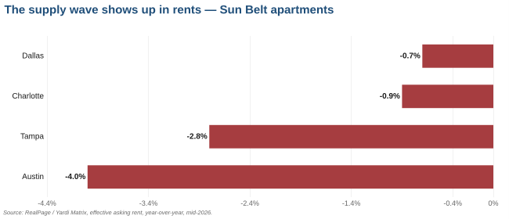
Multifamily. The South is the only region of the country with apartment occupancy below 95% and the only one posting annual rent declines (RealPage). Austin turned a corner, with effective rents up 1.3% in the quarter, its first quarterly gain since 2022, though rents are still down about 4% over the year (Yardi Matrix). Tampa fell 2.8%, and occupancy slipped below 93% in Houston and Atlanta. Dallas will lead the nation in new deliveries over the coming year, while Miami (+3.4%) is the region’s rent-growth standout.
Industrial. The port-and-logistics belt is the bright spot. Dallas-Fort Worth absorbed roughly 9 million square feet in the quarter and leads the nation in year-to-date leasing (40 million square feet), with vacancy at 8.1% (Cushman & Wakefield). Nashville is the region’s tightest market at 5.3%, Houston sits at 6.3% and Charlotte at 7.4%. Austin is the outlier at 22.3% as a wave of speculative supply lands, and Savannah softened to 10.5% with slightly negative absorption as the port’s building boom briefly outruns demand.
Office. Bifurcation persists. National office vacancy edged down to 20.1%, a second straight annual decline, though the Southern metro detail for the quarter is still publishing. Office CMBS delinquency stayed elevated at 11.57% in June (Trepp).
Retail. The tightest sector in the region. National vacancy held near 6.0% with the thinnest construction pipeline in decades, and the South posted the strongest annual rent growth of any region (+3.3%).
Capital markets. CMBS delinquency eased to 7.35% overall in June (Trepp), with multifamily at 7.23% and industrial at just 1.20%, while office remained the sore spot. A fresh read on Southern cap rates awaits the second-quarter surveys.
Development Wins of the Week
West South Central & Gulf. Toyota will invest $3.6 billion and add 2,000 jobs for a second assembly line in San Antonio, moving Tacoma pickup production from Baja California to Texas over about four years (announced July 6), the marquee reshoring win of the month. Meta scaled its Richland Parish, Louisiana campus to five gigawatts and roughly $50 billion (July 13), with about 1,000 permanent jobs and 7,500 more in construction.
South Atlantic. Highline Warren will build a $170 million logistics and operations center in McDonough, Georgia, creating 160 jobs (July 14). In South Carolina, SteelFab is adding a $39 million, 108-job naval-defense steel plant in Florence, and Detpak is opening its first U.S. facility in Spartanburg (about 50 jobs), both announced July 16.
On the other side of the ledger. Continental Tire will wind down its Barnesville, Georgia plant by year-end (about 235 jobs), a reminder that the region’s tire and rubber footprint is still consolidating even as advanced manufacturing expands.
The Week Ahead
July 21 (Tuesday). June state employment. Watch Virginia, DC and Maryland for federal-cut damage and Florida for tourism softness.
July 22 (Wednesday). Brazil’s 25% Section 301 duty takes effect. Watch Gulf and Southeast ports and the coffee, juice and steel that move through them.
July 24 (Thursday). The 10% Section 122 surcharge sunsets at 12:01 a.m. Watch for a USTR Section 301 replacement, and for what happens to duties if it slips.
July 28–29. FOMC meeting. No move expected; the post-meeting tone on tariffs and shelter is the tell.
August 12. July CPI, including the odd-month metros of Dallas-Fort Worth, Tampa and Washington.
Ongoing. Hill Country flood recovery under the July 19 disaster declaration; the USMCA third-round talks in Mexico; and the remaining second-quarter commercial real estate reports.
Recent research. Our latest regional outlook, the Catawba County and Hickory Metro Economic Outlook, is available now, along with the accompanying essay “My Hickory Story.” Find both, and our full archive of reports, at southeasteconomy.com.
Mark P. Vitner – Chief Economist, Southeast Economic Advisors
About Southeast Economic Advisors. Southeast Economic Advisors provides economic research and advisory services covering the economy of the U.S. South, financial markets, housing and commercial real estate. The Week Across the South is published weekly. Sources: U.S. Bureau of Labor Statistics; Federal Reserve; Office of the U.S. Trade Representative; state commerce and labor departments; Cushman & Wakefield, RealPage, Yardi Matrix and Trepp; company and state announcements. Chart sources appear beneath each exhibit. This commentary is for informational purposes only and does not constitute investment advice. © 2026 Southeast Economic Advisors. All rights reserved.