
The Week Across the South
Weekly Regional Review of the South · southeasteconomy.com
Weekly scan for August 10 to August 16, 2026: pharmaceutical and biomanufacturing onshoring becomes our seventh growth theme, and Louisiana and North Carolina both produced large-load fights over disclosure rather than over permission
The Macro Week: A Soft Consumer Print, a Stronger Firm Print, and a Region That Runs on More than Either of These
We add a seventh theme this week. Through last Monday we organized this report around six: the AI buildout, electrification, reshoring and the manufacturing reorientation, defense replenishment, the aerospace reboot and private space program, and Peak 65. Pharmaceutical and biomanufacturing onshoring becomes the seventh, and it gets its own section below.
The national data split cleanly in two this week, though the household half is softer on the surface than underneath. Retail sales fell 0.6% in July against consensus of plus 0.1% and the control group that feeds GDP fell 0.5% against plus 0.3%, its worst month since January 2025. Most of that sits in one line. Prime Day moved to late June this year after falling in July in every recent year, and Census publishes no promotional-event regressor, so the swing lands in the seasonally adjusted data as a break rather than a shift. Excluding nonstore, the control group rose 0.4%. Preliminary University of Michigan sentiment printed 51.0 against 55.2 in July. Tom Barkin, speaking in Greenville on Thursday, noted the survey has now recorded its three lowest monthly readings in more than seventy years.
The business half surged in the same five days, and the regional read is in the labor line rather than in the headline. NFIB small business optimism rose 2.4 points to 99.8, an eleven-month high and above its fifty-two year average, and plans to increase employment jumped 9 points to a net 20%, the highest since October 2022. The line that bears on this region is quality of labor, which returned to the top of the single most important problem list at 27%, up 8 points, with openings hard to fill at 36%. Five Southern states already report unemployment below four percent. The electricians, pipefitters and millwrights those firms are bidding for are the same trades every project in this issue needs, in the same counties and the same quarters.
Atlanta Fed GDPNow shows the split inside a single number. The third quarter estimate fell from 5.8% on August 6 to 4.3% on Friday, and the markdown was almost all consumption, from 4.1% to 2.5%. Gross private domestic investment fell from 17.9% to 15.2% and is still the fastest growing line in the build. Every one of the seven programs below sits inside that investment line.
Those readings are not contradictory. Every growth program we track in this region is a capital program. All seven press on a physical bottleneck, and none of them depends on household spending. That combination lets a state post a soft retail month and a record year of capital announcements in the same quarter, and it is why the state-level payroll release on Friday will tell you more about this region’s second half than any national consumer series published this week.
Energy is the wedge between the two halves. Gasoline is up 24.6% over the year, energy 14.7%, and retail diesel is a dollar and a half above last August. In this region the shock lands twice. It taxes household income where commutes run longer than the national average, and it is an input cost to the drayage running 15,000 daily transactions through Garden City Terminal, to the construction fleets building the seven programs in this issue, and to the backup generation those projects are installing behind the meter. Boston Fed work published in June finds the employment effect of an oil shock is essentially nil today against negative 1.8 points in the 1970s, which is why the firm side of the survey data did not flinch.
Pharmaceutical and biomanufacturing onshoring earns its place because Bristol Myers Squibb announced a $2.3 billion campus in Houston on Monday and because Section 232 tariffs on patented pharmaceutical imports took effect July 31 for the seventeen companies named in Annex III. But the region’s biologics cluster predates all of it by fifteen years. Lilly, Novo Nordisk and Amgen sited their plants before the tariff existed. The open question is whether trade policy accelerates a build-out that was already under way, and that will take quarters to answer.
Loops from last week, and where they stand. We flagged nine pending decisions. Edgecombe County adopted its two-year moratorium at the August 3 hearing, which we can now confirm. South Carolina regulators set the procedural calendar for the Dominion and NextEra merger, from a September 10 intervention deadline to a final order expected January 29, 2027. Greensboro’s public hearing holds for Monday, August 17 at 4 p.m., and Alamance and Yadkin counties will hold their own hearings the same day. Durham County still votes August 24, Pulaski County August 25, and the Public Utility Commission of Texas still meets August 20. Effingham County has narrowed its own forum to August 22 or August 29, with Chairman Rahn saying he wants to dedicate a meeting to nothing but the data center, and the county chamber has a tentative August 26 panel with OpenAI representatives, the development authority, Georgia Tech and independent academics. Two we cannot close: the Harrison County, Kentucky vote of August 11 and the xAI Memphis disclosure deadline of the same day have produced no published outcome we can find.
Theme 1 | AI Buildout: Louisiana Sealed the Data and North Carolina Went Federal
Last Monday we wrote that the instrument would shift away from the moratorium toward tools that survive litigation. It shifted somewhere we did not predict. Two of this week’s large-load actions turned on what the public may see before a project connects, and both went against disclosure. One is a state commission vote in Louisiana and the other is a federal Clean Air Act question in North Carolina.
Louisiana voted to close the books. On Wednesday the Public Service Commission voted three to one to kill administrative law judge Melanie Verzwyvelt’s ruling that would have required Meta to produce jobs and energy-use data for its Richland Parish campus, the project behind Entergy’s proposed $13 billion generation buildout. Eric Skrmetta, Jean-Paul Coussan and Mike Francis voted against disclosure and Davante Lewis dissented. Trial is set for October with a decision expected in December, and seven additional gas plants remain pending on an expedited timeline. The commission left the cost question for the trial and closed the underlying jobs and energy data in the meantime.
The vote landed one day after the reporting on who drafted the commission’s own motion. Gulf States Newsroom reported on Tuesday that Larry Hand, Entergy’s vice president of regulatory and public affairs, had authored the commission’s own motion approving the Entergy infrastructure plan for that campus. File metadata identified him, and he emailed the draft to a commissioner two days before the August 2025 vote. The motion read into the record matched his draft nearly word for word. In a separate docket concerning an Entergy transmission project serving Hyundai’s Ascension Parish steel mill, his tracked changes replaced “maintaining affordable rates” with “ensuring cost-based, affordable rates.”
Drafting alone would not be unusual. Regulated utilities write proposed orders in many jurisdictions and commissions adopt party language routinely. The sequence is what stands out, with the drafting and then a vote to seal the underlying data falling inside the same week.
North Carolina produced the second disclosure fight, and this one is federal. The Southern Environmental Law Center alleged on July 30 that Amazon and Duke Energy are structuring a roughly $10 billion hyperscale project in Richmond County, near Hamlet, to avoid Clean Air Act pollution limits on 649 diesel generators, 592 of them Amazon backup units and 57 Duke Energy primary units, across 21 buildings of about 200,000 square feet each on nearly 800 acres. The mechanism at issue is whether the generators are permitted as one source or as many. The North Carolina Department of Environmental Quality held its joint public hearing in Rockingham that same evening and the written comment period closed July 31, which means the record the allegation bears on was already shut when we picked it up. A ruling on how those generators are counted would reach well beyond Richmond County.
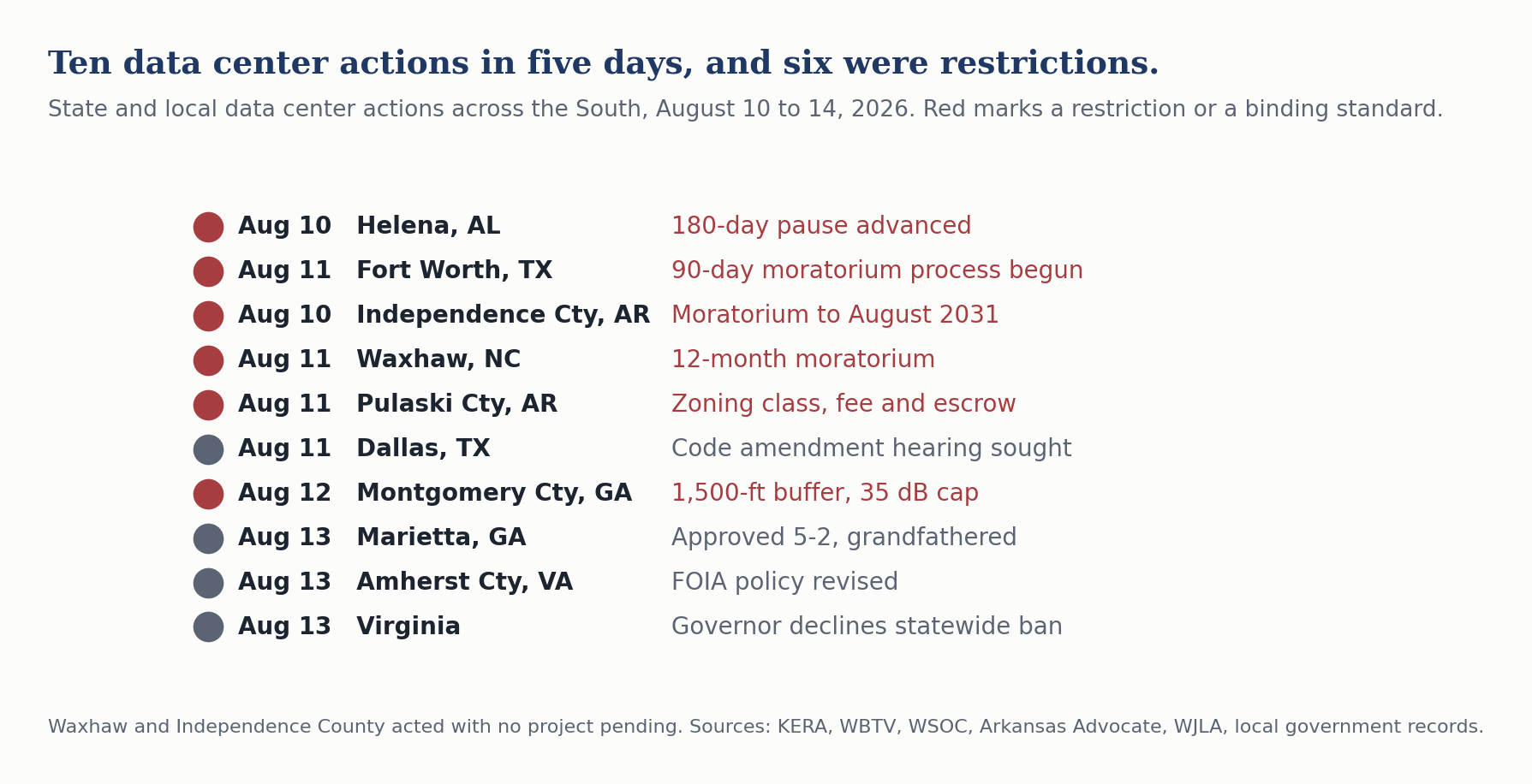
Meanwhile the county wave continued, and it reached Texas. Fort Worth’s council voted unanimously on Tuesday to begin a 90-day data center moratorium process, ten to one to require proof of utility-regulator grid-connection approval before an application may be filed, and ten to one to create a Data Center and Infrastructure Committee. The first hearing is November 10, the second January 5, and the moratorium takes effect February 16 only if it clears a three-fourths majority, which is nine of twelve votes, and it would end May 17, 2027. The grid-connection requirement and the new committee, by contrast, carry no expiration date. Dallas council members requested a public hearing on code amendments the same week, which puts both of the metroplex’s largest cities on the same track.
Elsewhere in five days: Independence County, Arkansas enacted a five-year moratorium expiring in August 2031, passed unanimously by the Quorum Court on Monday with no project proposed, citing water and power uncertainty. It is the longest in Arkansas. Pulaski County, Arkansas advanced an ordinance creating a High-Intensity Digital Infrastructure class with conditional use permits, 500-foot residential setbacks, a $25,000 application fee and a $100,000 review escrow, with a full vote August 25. Montgomery County, Georgia gave a first reading to an ordinance carrying a 1,500-foot buffer, a three-mile setback from water bodies and a 35-decibel cap. Waxhaw, North Carolina passed a unanimous twelve-month moratorium with no project pending. Helena, Alabama moved on a 180-day pause. Marietta, Georgia approved an eleven-acre project five to two, and only because the application predated the city’s own moratorium. Amherst County, Virginia revised its FOIA policy after a surge of records requests about suspected activity on Dillard Road, while officials denied a project exists. And Governor Spanberger declined a statewide moratorium on Thursday, telling reporters in Alexandria that it is a local choice and that she would work with the General Assembly on water, noise, land use and energy standards instead, which leaves siting in Virginia with the counties.
The planning assumption we set last week holds, with one amendment. Entitlement risk is still what gates the schedule, and the count of restricting jurisdictions is still climbing. The amendment is that the fight is now running on two tracks at once. One track is about whether the load may connect. The other is about what the public is entitled to know before that question is answered, and this week the second track produced the larger news in two states. A developer now has to underwrite the disclosure risk alongside the entitlement risk. We expect the disclosure track to produce more news than the permission track over the next month, because a moratorium expires and a sealed record does not.
Theme 2 | Electrification: Five States, Five Regimes, and a Missed Deadline in Texas
Last Monday we counted four states solving one problem four different ways. Louisiana made it five this week, and it answered in the opposite direction from the other four. Virginia assigned costs to the load through the State Corporation Commission’s large-load order. Florida legislated full cost of service. Georgia is running a contested case with a decision expected by year end. Texas ordered an audit. Louisiana reduced disclosure. A developer choosing among these five states faces five different cost and disclosure regimes, and the spread between them widened again this week.
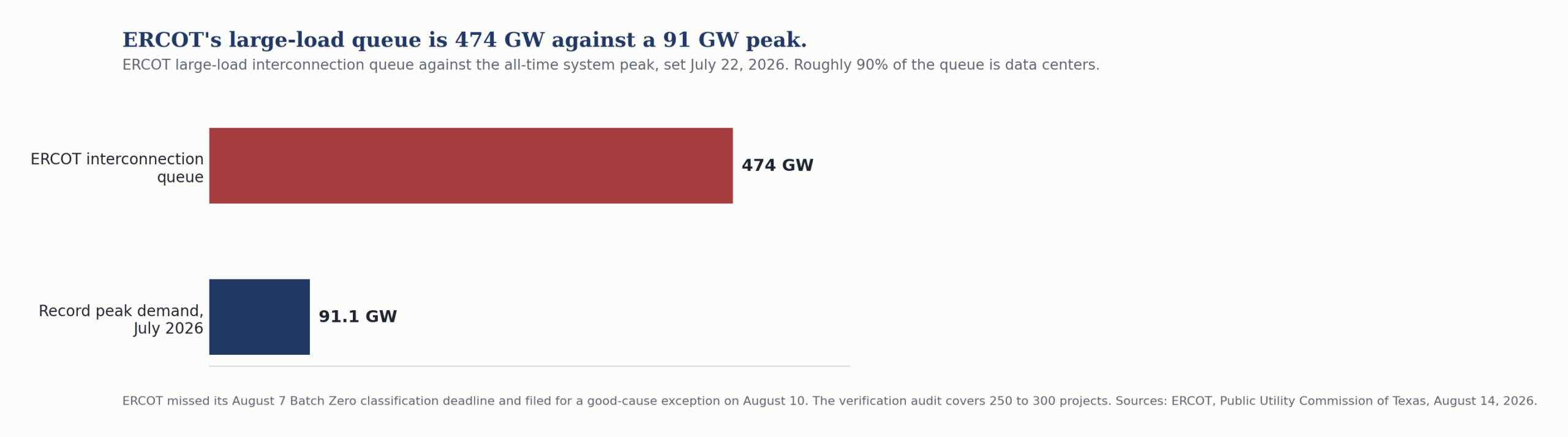
Texas missed its own deadline this week. ERCOT confirmed in a market notice that it did not meet its August 7 deadline to classify large loads under the Batch Zero process, and it filed a good-cause exception request on Monday, August 10, asking the Public Utility Commission to suspend the missed classification deadline along with the August 1 and November 1 quarterly stability assessments while it works through more than 200 data submissions. The interconnection queue behind that process stands at roughly 474 gigawatts, about ninety percent of it data centers, against an all-time system peak of 91.1 gigawatts set on July 22 of this year.
The August 3 pause we reported last week now has a size. ERCOT general counsel Chad Seely and commission chair Thomas Gleeson put the audit at 250 to 300 projects carrying roughly 200 gigawatts of future demand, and said it will take several months. It reaches into tax incentives, public financial assistance, on-site generation, water sourcing and reuse, cooling technology and project ownership. The process for classifying the loads the pause covers is now itself late. The state agriculture commissioner has called the directive all hat and no cattle and demanded a special session, noting that data center sales tax exemptions equal roughly seven percent of annual state sales tax revenue in the 2028 and 2029 biennium. No session has been called.
The South Carolina schedule we gave in outline last week is now filled in, and the pre-hearing dates are the ones a developer needs. Regulators have set the Dominion and NextEra review at intervention deadline September 10, petitioner testimony September 28, Office of Regulatory Staff and other parties October 28, rebuttal November 18, hearing December 8, proposed order December 29 and a final order expected January 29, 2027. Virginia’s governor moved to intervene earlier this month. We found no North Carolina filing this week. A combined company would serve roughly ten million customers across Virginia, Florida, North Carolina and South Carolina, which means one set of large-load terms would apply across most of this region’s Atlantic seaboard.
Georgia and Florida did not move this week. The Georgia Public Service Commission investigation into reallocating fuel costs between industrial and residential classes remains open. We could not verify a docket action, and we could not retrieve a prehearing order or confirmed dates for the Florida commission’s hearing on Duke Energy Florida’s large-load rate proposal in docket 20260064-EI. Treat both as unchanged until a docket entry says otherwise. We expect the five regimes to spread further before they converge, and we would not underwrite a multi-state siting decision on an assumption that any of them harmonize this year.
Theme 3 | Reshoring: A Milan Cable Maker Picks Three Southern Towns
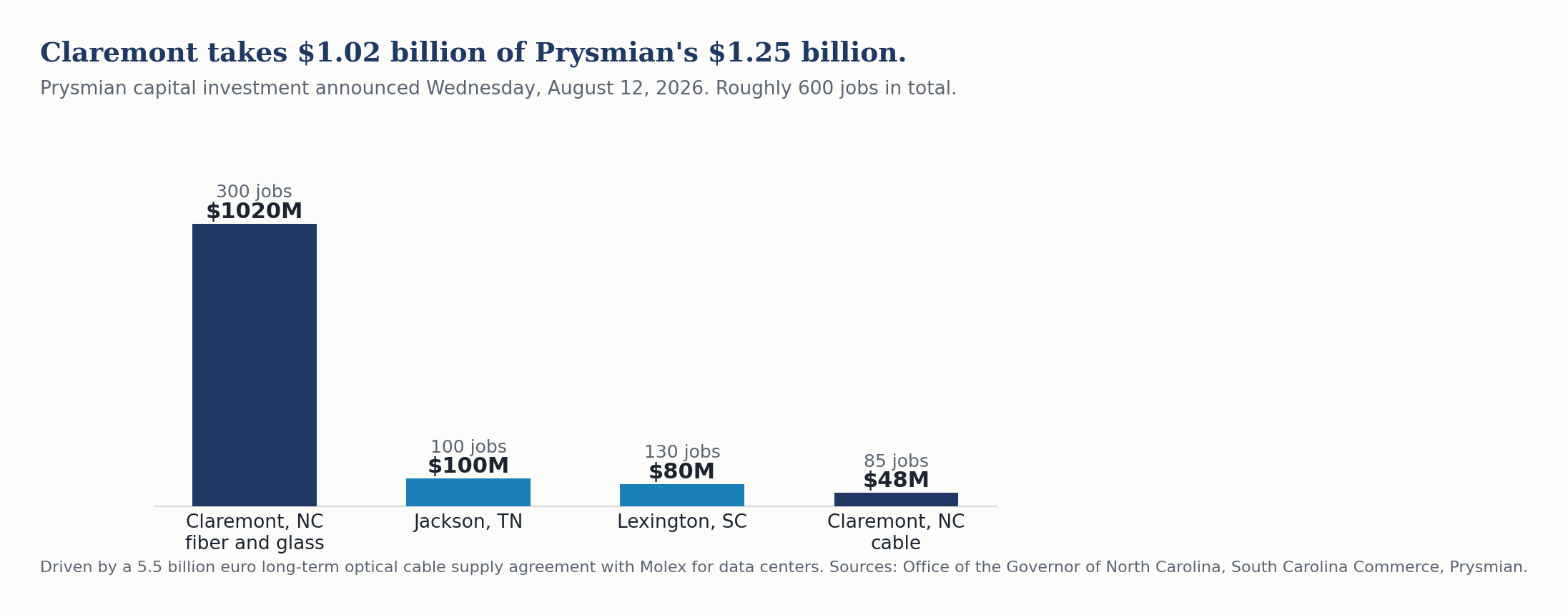
Prysmian announced $1.25 billion and roughly 600 jobs across three Southern states on Wednesday, and it was covered as three separate small-town stories.
Claremont, North Carolina, in Catawba County about 50 miles northwest of Charlotte, takes $1.02 billion for a new vertically integrated glass and fiber plant plus $48 million for cable, adding 385 jobs and 975,000 square feet, which doubles the site’s fiber optic capacity. The average wage is $60,870 against a Catawba County average of $56,937, worth $23.4 million a year in regional payroll. North Carolina attached a $1 million One North Carolina Fund performance grant contingent on $665 million of investment. Jackson, Tennessee, in Madison County about 80 miles northeast of Memphis, takes $100 million and 100 jobs. Lexington, South Carolina, in the Columbia metro, takes $80 million and 130 jobs at 700 Industrial Drive for FlexRibbon fiber optic cable, online by May 2028 with hiring phased to 2030.
Prysmian is Milan-based and is one of only three United States manufacturers of fiber and optical cable, a point its chief executive made on the announcement. The driver is a 5.5 billion euro long-term optical cable supply agreement, worth about $6.3 billion, with Molex, a Koch company, serving data centers.
Fiber and cable are the physical layer of the AI buildout, the plants are reshoring by a European company that could have expanded at home, and the product is grid-adjacent manufacturing of exactly the sort every interconnection docket in this region is short of. A $1.25 billion commitment covered as three small-town stories deserved regional coverage and did not get any.
Three smaller projects landed in the same week. IEB Americas, a subsidiary of the German firm Industrie Elektronik Brilon, chose North Charleston for its first major North American production operation on Tuesday, $1.5 million and 30 jobs at 4100 Carolina Commerce Parkway making battery charging and power supply systems. Trison Wells announced $3.37 million and 30 jobs in Walterboro, Colleton County, on Thursday for a new liquid-fill line producing private-label cleaning products, a second phase after a $1.2 million and 35-job start in 2022. UFP Industries announced a new structural packaging operation in Cherokee County, South Carolina at roughly $5.3 million on Thursday, with the job count not disclosed.
Three separate manufacturers, one of them foreign-owned, chose South Carolina in one week for operations under six million dollars. Projects that size tell you more about whether the reorientation is broad than any single billion-dollar headline does. Three sub-six-million-dollar wins in five days is the tell we said we would watch for, and it is a better test of breadth than the Prysmian headline.
Theme 4 | Defense Replenishment: A $10 Billion Training Award Lands at Fort Rucker
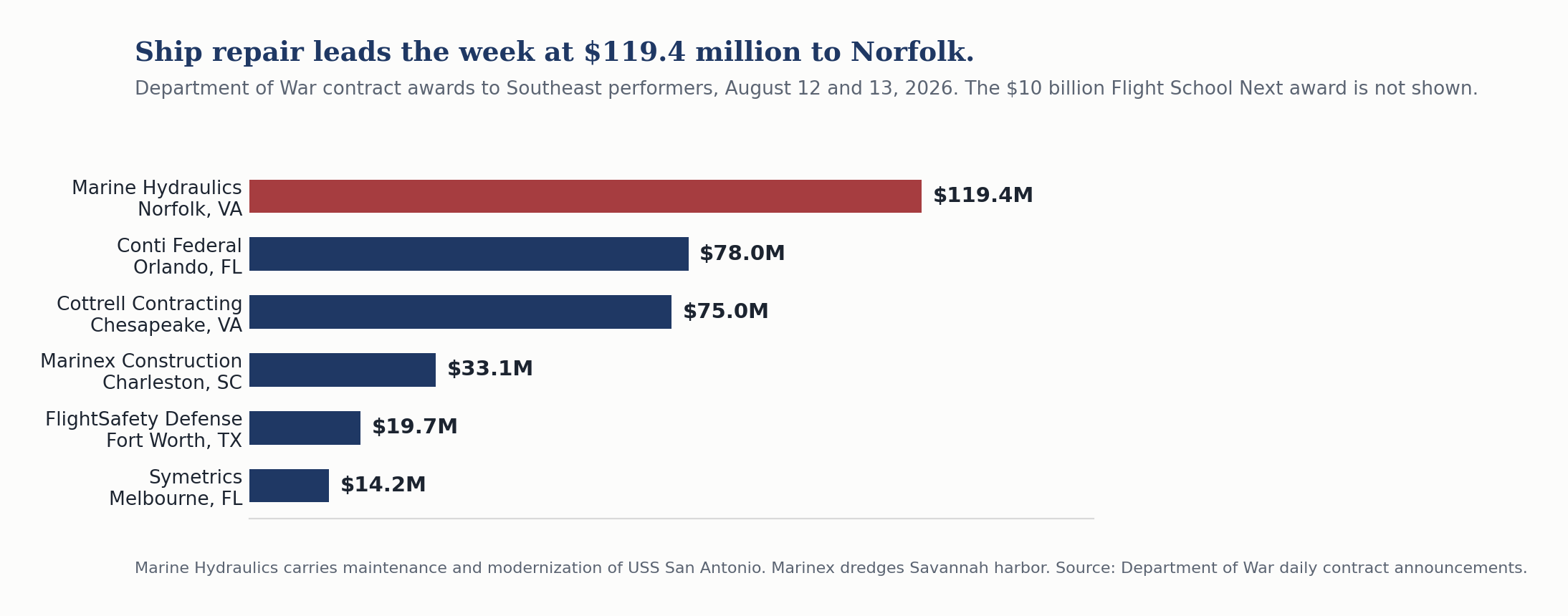
The Army named M1 Support Services of Denton, Texas the winner of Flight School Next on Thursday, a contract with a $10 billion ceiling over a potential 26-year performance period. The work is initial entry rotary-wing training at Fort Rucker, Alabama for 800 to 1,500 Army pilots a year, with the contractor supplying the aircraft, the maintenance, the simulators and the instruction. The initial task order runs three to four years. The ceiling runs to more than eighty times the $119.4 million Norfolk ship repair award that tops this week’s other Southeast contracts, and it moves a training pipeline the Army has run itself for decades onto a commercial contract.
The daily contract lists for Wednesday and Thursday put further money into Southeast performers, and none of it was a weapons program.
Marine Hydraulics International of Norfolk took $119,369,087 for maintenance and modernization of USS San Antonio, the Hampton Roads ship repair item of the week. Conti Federal Services of Orlando took $77,981,311 for ammunition magazines and a maintenance facility at Sigonella, Italy. Cottrell Contracting of Chesapeake took $75 million for maintenance dredging. Marinex Construction of Charleston took $33,052,500 for Savannah harbor maintenance dredging and construction, which is a South Carolina firm deepening a Georgia port. FlightSafety Defense of Fort Worth took $19,707,848 for KC-46 aircrew training devices. Symetrics Industries of Melbourne, an Extant Aerospace company, took $14,150,000 for F/A-18 weapon reusable assembly components.
A Navy multiple-award vehicle with a $278 million ceiling for operational exercise design went almost entirely to the Washington suburbs: Accenture Federal Services of Arlington, Booz Allen Hamilton of McLean, Deloitte Consulting of Arlington, General Dynamics Information Technology of Falls Church, Leidos and SAIC of Reston, Parsons Government Services of Centreville, and Cole Engineering Services of Orlando, the one awardee outside the Washington suburbs. Parsons separately took $15,139,840 for battlefield electronic warfare work.
The in-window list is ship repair, dredging, training devices, magazines and consulting. Replenishment runs through the industrial base that keeps hulls in the water and channels open, and every award above went to a firm in this region. The second-tier hiring against the $76.6 billion submarine award of July 30 and the $58.62 billion PAC-3 MSE multiyear of July 29, which will triple output at Camden, Arkansas, has not started yet.
Theme 5 | Aerospace & Space: Two Falcon 9 Launches 38.5 Minutes Apart
SpaceX flew two Falcon 9 missions 38.5 minutes apart on Saturday, the shortest gap between consecutive Falcon launches. The second lifted eight Globalstar replenishment satellites from Cape Canaveral SLC-40 at 9:12 p.m. Eastern, following a Vandenberg launch of the classified USSF-366 payload. It was the fifty-second orbital launch from Florida’s Space Coast this year, and the booster recovery was the 650th Falcon landing.
Two of the contract awards above are also aerospace items, Symetrics in Melbourne on the Space Coast and FlightSafety in Fort Worth.
Just outside the window, Joby Aviation established a hub at Perot Field Fort Worth Alliance Airport on August 6 for air taxi manufacturing and testing supporting future Dallas and Fort Worth service. Investment and job figures were not disclosed.
No Space Coast launch activity fell between Monday and Friday, so the week’s aerospace news came on Saturday and in the contract lists. JetZero, whose 14,500-job Greensboro campus is the largest jobs commitment in North Carolina history, published nothing this week, and the live thread there is still the July 20 Export-Import Bank exploration of up to $3 billion in financing.
Theme 6 | Peak 65 & the Travel Economy: Net Migration Is Projected to Fall 2.4 Million
Barkin said on Thursday that net migration is projected to fall by 2.4 million between 2024 and 2026. Combine that with the retirement cohort and this region’s labor supply is being drained from both ends at once. Five Southern states can therefore report unemployment rates below four percent while employers name labor quality as their single largest problem, which is why we read Peak 65 as a supply event rather than a consumption event.
On the demand side, the retail and sentiment readings above land harder here, because this region carries more exposure to discretionary travel than most. Existing home sales, released Tuesday, ran 4.06 million at an annual rate nationally, down 1.7% on the month, and the South fell 3.1% to a 1.86 million rate and was flat against a year earlier. Florida tourism reporting shows several consecutive months of declining Mexican arrivals affecting Miami, Orlando, Tampa and Fort Lauderdale, though we could not establish a publication date for it and would not build on it yet.
NOAA maintained its below-normal Atlantic hurricane season forecast on August 7, and no named storm activity occurred during the week. The National Hurricane Center’s Monday morning outlook expects no tropical cyclone formation over the next seven days and is tracking nothing in the Atlantic, the Caribbean or the Gulf. Florida property insurance and the coastal travel economy both need the season to stay that way through October.
Theme 7 | Pharmaceutical & Biomanufacturing Onshoring
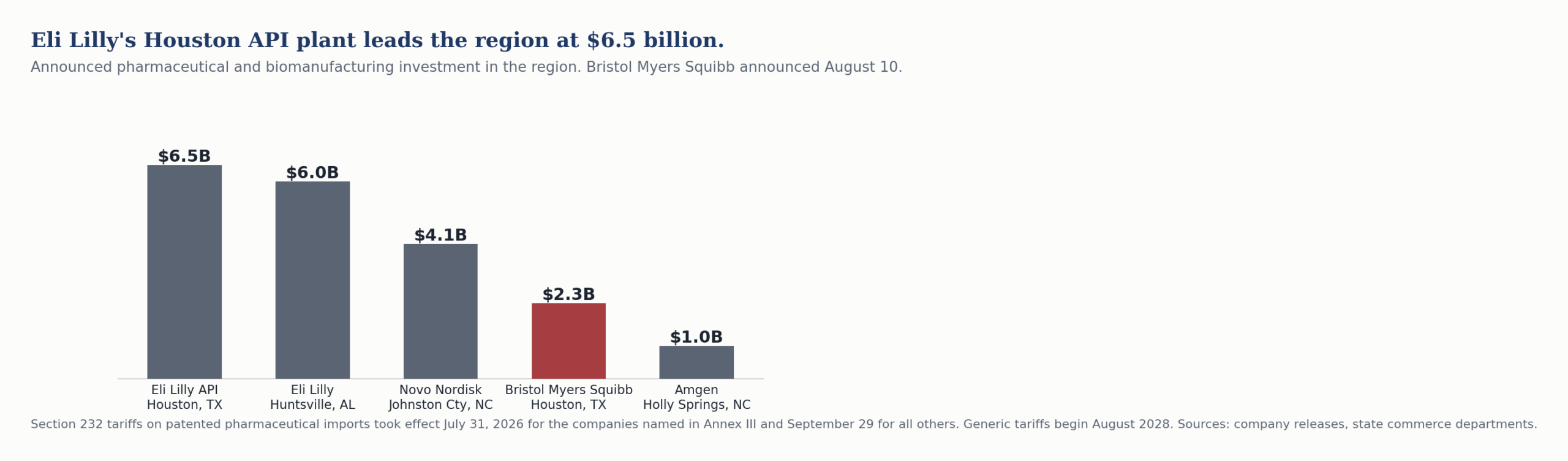
Bristol Myers Squibb announced a $2.3 billion manufacturing campus at Generation Park in Houston on Monday. The campus runs to 600,000 square feet in a modular multi-modal design covering small molecules, biologics and antibody drug conjugates, and carries roughly 500 permanent skilled positions plus approximately 2,000 construction and indirect jobs between 2027 and 2030. It is part of a $40 billion United States commitment. Both the company and the Commerce Department framed it explicitly as supply chain onshoring, and the governor’s office announced it the same day.
The policy clock behind it runs to 2029. Section 232 tariffs on patented pharmaceutical imports took effect July 31, 2026 for the seventeen companies named in Annex III and take effect September 29 for everyone else, and Customs and Border Protection issued implementation guidance on August 7. The generic schedule announced July 21 runs at zero from August 1, 2026 through July 31, 2028, then 100% for a year, then 200% from August 1, 2029. That two-year runway is explicitly a window in which to build domestic capacity, and it puts a date on the decision every generic manufacturer serving the American market now has to make.
The region already holds the capacity, and more of it is active pharmaceutical ingredient work than the biologics headlines suggest. Eli Lilly is building a $6 billion advanced manufacturing plant in Huntsville and a $6.5 billion active pharmaceutical ingredient facility at Generation Park in Houston, 615 permanent jobs and 4,000 in construction, which its chief executive framed at announcement as onshoring the company’s API production. That plant sits in the same master-planned district as the Bristol Myers Squibb campus. Novo Nordisk is expanding by $4.1 billion in Johnston County, North Carolina. Amgen is putting $1 billion into a drug substance facility in Holly Springs. The central Virginia pharmaceutical hub at Petersburg, built around Phlow and active pharmaceutical ingredient production, landed a $16 million federal grant on July 22. And STERIS, which led our reshoring section last Monday, committed $600 million and 335 jobs in Sanford, Lee County in early August for the chemistries used in surgical instrument reprocessing. The Richmond Fed counted at least $23 billion of Fifth District pharmaceutical commitments in 2025 alone, and put the share of active pharmaceutical ingredients used in this country that are produced domestically at 12%.
Biologics came south for land, power, Research Triangle labor and state incentives, and that was true before any tariff existed. The part of the pharmaceutical supply chain the country genuinely lost is generic manufacturing and active pharmaceutical ingredient production, and the return has started rather than finished. Lilly in Houston and Phlow in Petersburg are the two API anchors in this region and both predate the tariff schedule now attached to them. We will judge this theme on whether the South captures the generic and API wave as it captured biologics, and Petersburg and Generation Park will show it before Research Triangle Park does.
Pharmaceutical capital announcements arrive monthly rather than weekly. Some weeks the news here will be a grant, a tariff exclusion or a policy date instead of a plant.
State Employment: A Shrinking Labor Force Is Holding Virginia’s Rate at 3.7%
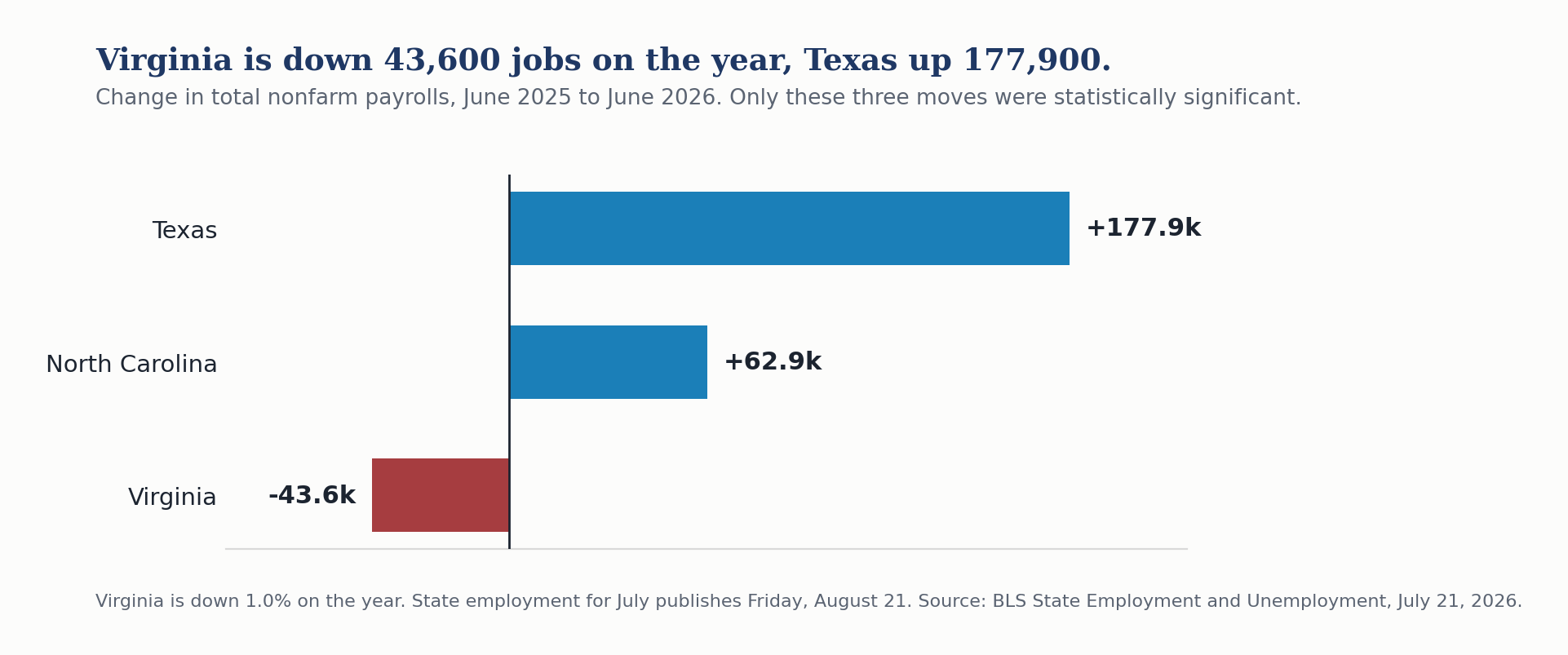
State employment and unemployment for July publishes Friday, August 21, so the most recent data remain June, released July 21.
Virginia is down 43,600 jobs, or 1.0%, over the year, and remains the only state in the region losing jobs. Texas is up 177,900, or 1.2%, and North Carolina up 62,900, also 1.2%. Those three were the only statistically significant year-over-year changes in the region. Texas was also the only state in our footprint with a statistically significant monthly gain in June, at plus 43,400.
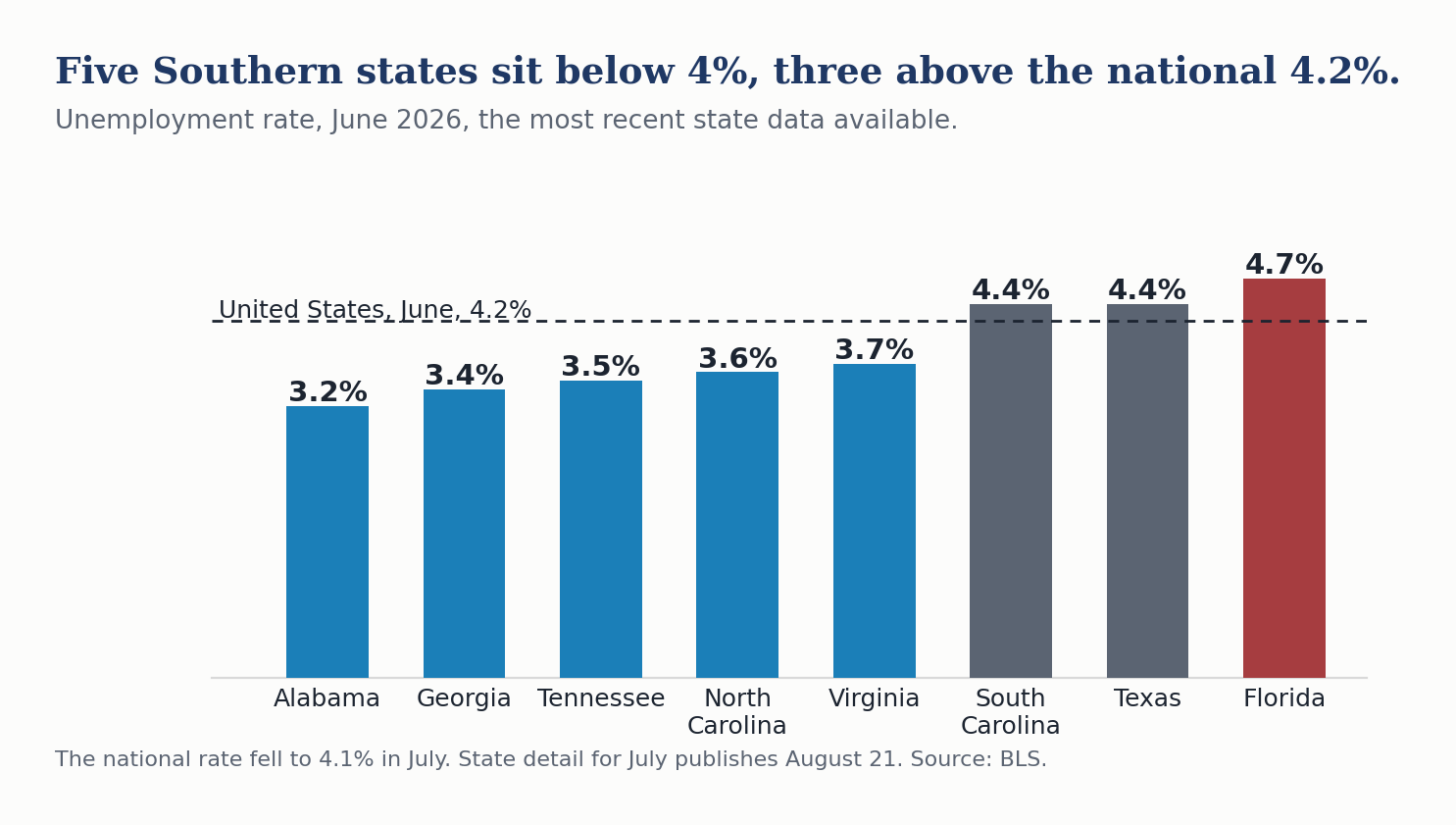
On unemployment the region looks tighter than the country. Alabama at 3.2%, Georgia 3.4%, Tennessee 3.5%, North Carolina 3.6% and Virginia 3.7% all sit below the national 4.2% for June. South Carolina and Texas are at 4.4% and Florida at 4.7%.
Virginia is shedding jobs at one percent a year and still carries a 3.7% unemployment rate. A shrinking labor force is the only way those two readings hold together, which is the national story showing up in one state with unusual clarity. Friday’s release is the first state-level look since national payrolls turned negative.
The Richmond Fed Came to Greenville
Tom Barkin delivered “The Mysterious U.S. Economy” to the Greenville Chamber of Commerce on Thursday, and it contained no Fifth District or Carolinas data at all. The speech was national by design, so the gap says more about how little state-level analysis reaches the people making capital decisions in this region than about the speech. He attributed the rise in inflation to tariffs, an oil price shock and a flood of AI spending, and this region carries all three at once.
He put June headline PCE at 3.7% and core at 3.3%, up from the mid to low twos in early 2025. He noted that unemployment at 4.1% in July is the fifty-eighth consecutive month at or below 4.5%, the longest such streak on record, while hiring is down, the hiring rate is running around 2013 levels and only 37% of firms are hiring for new positions. He said tariff rates remain uncertain and are deterring decisive investment. On September, he declined to prejudge and said so directly.
The bank does publish district work, and Matthew Wells covered pharmaceutical onshoring in the Fifth District for Econ Focus in March, several months before the tariff schedule that now frames it.
Layoff Watch
Texas produced the week’s only WARN filings we could retrieve.
Dylan Logistics filed in Texas on August 11 covering 70 employees in Fort Worth and 97 in Lewisville. T-Mobile filed on August 7 for 113 employees at an Irving, Texas office.
Virginia’s filings are running well above last summer, on a count published just before our window opened. The Roanoke Star reported on August 6 that 2,899 job losses had been announced in Virginia for June 21 through August 31, more than 52% above the same period a year earlier, and 6,102 year to date, up 20%. Named filers include T&H Services in Blackstone at 76 and Times Fiber Communications in Chatham, Pittsylvania County, at 78. It is the only substantive read we have outside Texas, and it lands in the one state in the region that is losing payroll jobs.
We could not achieve comprehensive WARN coverage outside Texas this week. Florida’s portal blocks automated access and the remaining state portals were not reached. Treat the above as incomplete rather than as the region’s full layoff activity. Nationally, initial claims were 209,000 for the week ended August 8, continuing claims 1,777,000 and the insured unemployment rate 1.2%.
Ports & Logistics
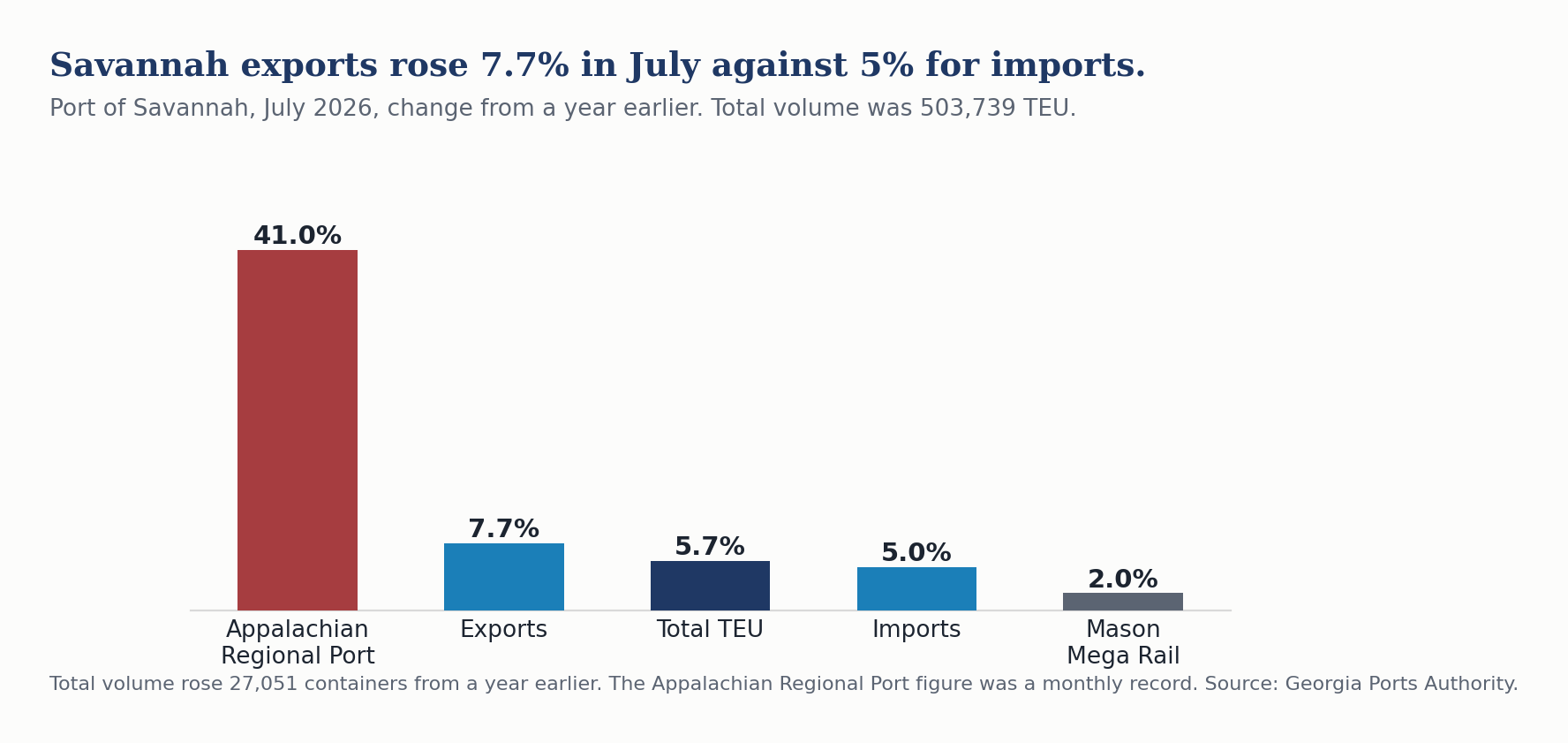
The Port of Savannah moved 503,739 TEU in July, up 5.7% or 27,051 containers from a year earlier. Imports rose 5% to 251,888 TEU and exports rose 7.7% to roughly 115,000 TEU.
The export side is where a tariff year shows up first, and Savannah’s export growth ran ahead of its import growth in July. The Appalachian Regional Port handled 4,800 containers, up 41% and a monthly record, and closed fiscal 2026 at 49,319 containers, up 20%, the fastest growth rate of any lane Savannah reports. Mason Mega Rail lifts rose 2% to 44,981. Truck turn times ran 31 minutes single and 51 minutes dual against roughly 15,000 daily transactions, 80% of them dual moves. The $126 million Brampton Road Connector, four lanes from Garden City Terminal Gate 3 to Interstate 16, opened July 15.
At Brunswick, auto imports rose 5.3% to 51,704 units while combined auto and machinery volume fell 1.6% to 67,881 on weaker exports.
South Carolina moved the other way. SC Ports paused operations at the Leatherman Terminal in North Charleston on August 1 to control costs. The pause came at the newest container terminal on the East Coast in the month after Savannah’s volumes grew 5.7%. Whether it extends into the fall peak season will show whether cost control is the whole story.
The Week Ahead: What We Are Watching
Monday, Aug. 17. Greensboro city council holds its 4 p.m. public hearing on a 120-day moratorium covering data centers above 10 megawatts, a reversal of its own July rejection. Alamance and Yadkin counties hold hearings the same day on a six-month and a yearlong moratorium.
Tuesday, Aug. 18. Housing starts and permits, and industrial production for July. Manufacturing output is the national check on whether the ISM turn is reaching the region’s factories. Also the July pending home sales index and the next Atlanta Fed GDPNow update.
Wednesday, Aug. 19. Minutes of the July FOMC meeting, which produced three dissents in favor of a rate increase. The Texas House Committee on State Affairs holds an interim hearing carrying a charge to study data center development, ERCOT’s large-load batch study process and 765-kilovolt transmission planning, which is the legislative counterpart to the commission meeting the next day.
Thursday, Aug. 20. The Public Utility Commission of Texas open meeting, where the commission acts on ERCOT’s good-cause exception request on the missed Batch Zero deadline. Also the Philadelphia Fed manufacturing survey.
Friday, Aug. 21. BLS State Employment and Unemployment for July. Watch whether Virginia’s 43,600 job loss deepens and whether Florida’s 4.7% unemployment rate moves.
Monday, Aug. 24. Durham County holds its public hearing and possible vote on a nine-month moratorium with an exemption for facilities under roughly 80,000 to 100,000 square feet.
Tuesday, Aug. 25. Pulaski County, Arkansas votes on its data center zoning ordinance, including the $25,000 application fee and the $100,000 review escrow. Also the Richmond Fed Fifth District manufacturing and service sector surveys.
Wednesday, Aug. 26. July personal income and outlays with the PCE deflator, the last major inflation print before the September FOMC, and the second estimate of second quarter GDP with corporate profits. The Effingham County Chamber holds its tentative panel with OpenAI representatives on the $20 billion Project Camellia campus, with the county weighing its own forum for August 22 or August 29.
Thursday to Saturday, Aug. 27 to 29. The Kansas City Fed’s Jackson Hole symposium, on financial innovation and its implications for payments and policy.
Friday, Aug. 28. The preliminary benchmark revision to the establishment survey, and the state and area preliminary benchmark the same morning, which is where Virginia’s 43,600 job loss will be revised. We expect a modest or positive number against a market conditioned by two consecutive large negatives.
Thursday, Sept. 10. Intervention deadline in the South Carolina review of the Dominion and NextEra merger. The hearing is December 8 and a final order is expected January 29.
Tuesday, Sept. 29. Section 232 tariffs on patented pharmaceutical imports take effect for every importer outside the seventeen companies named in Annex III.
October. The Louisiana Public Service Commission trial on the $13 billion Entergy generation plan behind Meta’s Richland Parish campus, with a decision expected in December.
Year end. The Georgia Public Service Commission decision on reallocating fuel costs between industrial and residential classes.
And One Thing That Is Not Economics
A correction to our own calendar. We said last Monday that the football series would open with the Economics of College Football this week and week zero the week after. It opens instead on August 29, with North Carolina against Texas Christian at Aviva Stadium in Dublin, and then runs weekly from Clemson at LSU on September 5. We will carry a key game across the South each week alongside the local economy behind the rivalry. Baton Rouge in early September is its own kind of capacity constraint.
Sources & Notes
Sources: Bureau of Labor Statistics; Bureau of Economic Analysis; Census Bureau; Department of Labor; Department of War daily contract announcements; Energy Information Administration; NOAA; NFIB; University of Michigan Surveys of Consumers; the Atlanta, Boston and Richmond Federal Reserve Banks; Offices of the Governors of Virginia, North Carolina, South Carolina, Georgia and Texas; South Carolina Department of Commerce; Georgia Ports Authority; ERCOT and the Public Utility Commission of Texas; Louisiana Public Service Commission; Public Service Commission of South Carolina; Bristol Myers Squibb; Prysmian; Southern Environmental Law Center; Eli Lilly; National Hurricane Center; National Association of Realtors; Spaceflight Now; Arkansas Advocate; Texas Tribune; The Roanoke Star; Kansas City Fed; WWNO and the Gulf States Newsroom; WAFB; Fox8 New Orleans; KERA; WFDD; WJLA; Rhino Times; WBTV; WSOC; Live 5 News; WIS-TV; Effingham Herald; Georgia Public Broadcasting; Holland & Knight; Crowell & Moring; Baker McKenzie.
Our definition of the South is more expansive than most: it includes every state that competes in the Southeastern Conference along with the South Atlantic states, extending up to Maryland and West Virginia.
Corrections and carry-forwards: ERCOT’s all-time system peak is 91,089 megawatts, set July 22, 2026, not the 85.4 gigawatt August 2023 figure we used last week. The Southern Environmental Law Center filing on the Richmond County project is dated July 30 and the North Carolina comment period closed July 31, so this item reaches readers eighteen days after the filing. STERIS in Sanford and the August 3 Texas pause both ran last Monday and are carried forward here rather than reported as new.
Notes: State employment figures are June 2026, the most recent available; July publishes August 21. Contract awards are as announced and are not obligations. Investment and job figures are as announced by the company or the state and are not independently verified. WARN coverage this week is incomplete outside Texas. The Harrison County, Kentucky vote of August 11 and the xAI Memphis disclosure deadline of the same day remain unresolved in published reporting. © 2026 Southeast Economic Advisors / Piedmont Crescent Capital.
The Week Across the South is published weekly by Southeast Economic Advisors for informational purposes only and does not constitute investment, legal, or tax advice. Views expressed are those of the author as of the date of publication and are subject to change.