
Permission Replaces Power | The Week Across The South
Louisiana and South Carolina near the top of the nation’s job-growth rankings, Hyundai weighs a super-sized Georgia plant and the Fed heads to Jackson Hole
Mark Vitner, Chief Economist, Piedmont Crescent Capital / Southeast Economic Advisors | August 24, 2026 southeasteconomy.com
Download the full report (PDF)
The week in five threads. First, permission has replaced power as the binding constraint on the AI buildout, and three states moved on it inside five days. Second, tariffs are redrawing Southern factory footprints, with Hyundai weighing the largest assembly plant in the country and Daimler Truck moving work to the Carolinas. Third, the region’s entire inflation gap with the nation now sits at the pump. Fourth, the South is running at two speeds, with the Gulf and the Carolinas adding jobs at a solid pace while the federal-dependent Potomac region sheds them. Fifth, federal policy is repricing the Southern wage floor from both directions at once, cutting mandated farm wages while enforcement removes workers and pushes market wages higher. Each thread carries a call and a marker that would break it, and we return to all five at the end.
Thread One | Permission: The Constraint Moved From Power to Permits
The AI buildout is still the biggest force reshaping the Southern economy, but the constraint has shifted from securing the silicon to securing permission. Texas froze data center grid interconnections this month pending a statewide audit of 250 to 300 projects representing roughly 200 gigawatts of future demand, more than double ERCOT’s July peak-demand record. TVA’s board went further on Thursday, pulling data centers out of the manufacturing rate class into one of their own at roughly 10% higher cost and adding an upfront capacity commitment charge near $1.5 million per megawatt, payable over three to five years. West Virginia set out a 20-year framework requiring developers to procure their own generation, and the local backlash rolls on: Waxhaw, N.C. approved a 12-month moratorium on Aug. 13, a Memphis council committee advanced one on Aug. 18, Fulton County came out against local data center tax abatements and Amazon walked away from its Calvert Cliffs campus in Maryland earlier in the month. Georgia’s Public Service Commission now faces an extended Aug. 26 deadline, pushed back from Aug. 14 by Georgia Power, on the contract behind OpenAI’s proposed $20 billion, 3.2-gigawatt campus in Effingham County. We look for the pipeline to keep growing and for new projects to tilt toward states where the developer pays for its own power and the tax deal is defensible in an election year, with a PSC rejection in Georgia the outcome that would change that call. The more interesting question is what this permitting regime does to industrial siting timelines generally. However, the rest of the region’s industrial economy refused to be crowded out of the headlines last week, and that is where we turn first.
Thread Two | Reshoring: Tariffs Are Redrawing Southern Factory Footprints
Hyundai floated the biggest auto-industry number the South has seen in years. CEO Jose Muñoz told CNBC on Thursday that the company is weighing an expansion of its Metaplant near Savannah from 500,000 vehicles a year to 700,000 to 800,000 by 2028. At the top of that range the Ellabell complex would pass Tesla and Toyota to become the largest auto assembly plant in the country by capacity. The company later cautioned that the plan remains under review, and we treat it as an option rather than a commitment, but the logic is plain: a 25% tariff on imported vehicles makes Georgia capacity far more valuable than Ulsan capacity. It follows Prysmian’s $1.25 billion, three-state fiber expansion, which puts $1.07 billion and 385 jobs in Claremont, N.C., $100 million in Jackson, Tenn. and $80 million in Lexington County, S.C., for 600 jobs in all, and Bristol Myers Squibb’s $2.3 billion Houston pharmaceutical campus. Daimler Truck reached the same conclusion in late July, ending Portland, Ore. manufacturing and shifting production to the Carolinas at a cost of about 375 Oregon jobs. Louisiana may join the list Monday: Governor Landry has called a major announcement in Abbeville, where SpaceX is reported to be planning a Starship spaceport on Pecan Island in Vermilion Parish. We flag that one as unconfirmed until the papers are signed.
The Macro Week
The macro data turned in a split decision, with housing the clear loser. July housing starts fell 12.4% to a 1.24 million-unit pace, with starts in the South down 12.6% and the region accounting for 52% of the national total, though permits rose 5.0% to 1.44 million. Retail sales fell 0.6%, the largest monthly decline in more than a year, and preliminary August Michigan sentiment dropped to 51.0. Industrial production rose 0.2%, and August’s flash composite PMI jumped to 56.0, a 52-month high, even as the manufacturing output index slipped to 51.9, a 13-month low. The Atlanta Fed’s GDPNow estimate for third-quarter growth stands at 4.0% as of Aug. 18, down from a 6.2% peak on Aug. 3 but still well above trend. We look for the housing drag to deepen through the fall as builders work off unsold inventory, and a sustained drop in the 10-year Treasury yield below 4.5% is the one development that would brighten that picture.
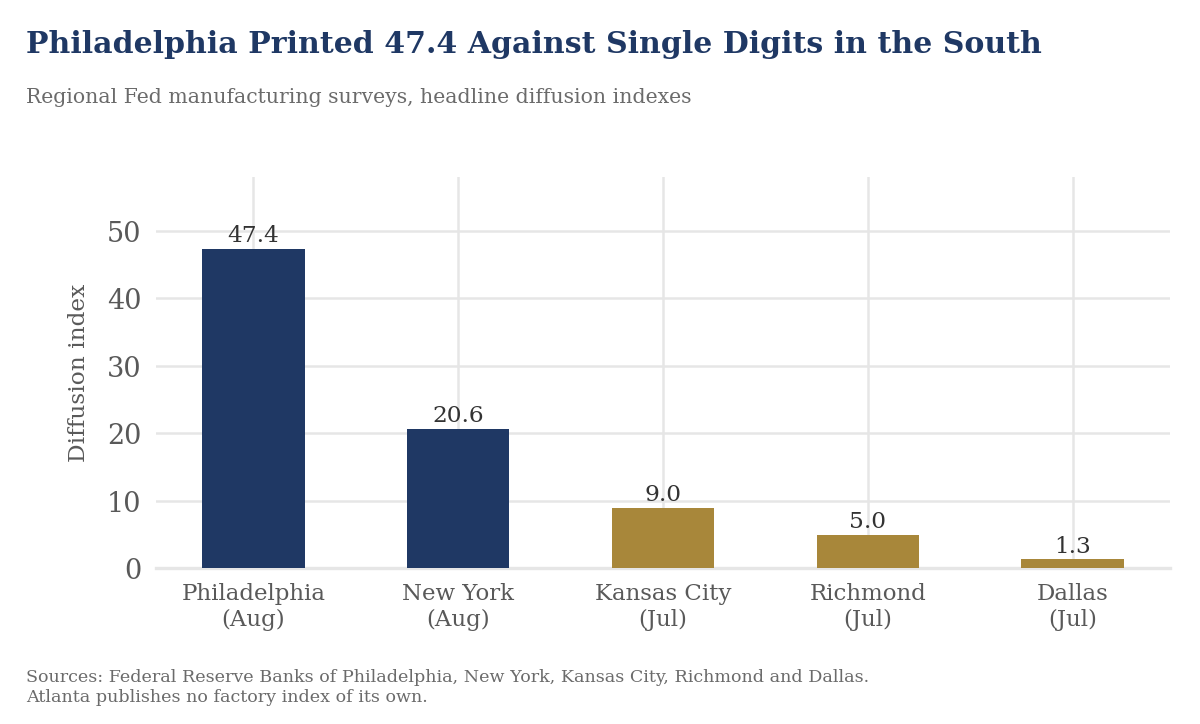
The factory floor delivered the week’s most surprising numbers, and the strength, so far, remains well north of our region. The New York Fed’s Empire State survey jumped to 20.6 in August from 15.6, its best reading in more than four years, and the Philadelphia Fed’s index surged to 47.4, the highest since April 2021, with its future-activity gauge at 73.6, a level last seen in August 1983. The Southeast’s closest proxy, the Richmond Fed’s manufacturing composite, edged up from 4 to 5 in July with its local business conditions gauge swinging from minus 1 to 10, while the Dallas Fed’s Texas survey inched up to 1.3 with production at 10.1 and Kansas City held at 9. Atlanta publishes no factory index of its own, so Tuesday’s Richmond release for August is the region’s first chance to confirm the Northeast’s signal. The gap between a 47 in Philadelphia and single digits across the South suggests the AI-equipment boom is landing first where the electronics and instrument makers sit. The industry mix in the Richmond district is more heavily weighted toward consumer goods. We look for the Southern surveys to close some of that gap by the fall reports, and a Richmond reading Tuesday still stuck in single digits would be the first strike against that call.
Thread Three | Energy: The Entire Inflation Gap Sits at the Pump
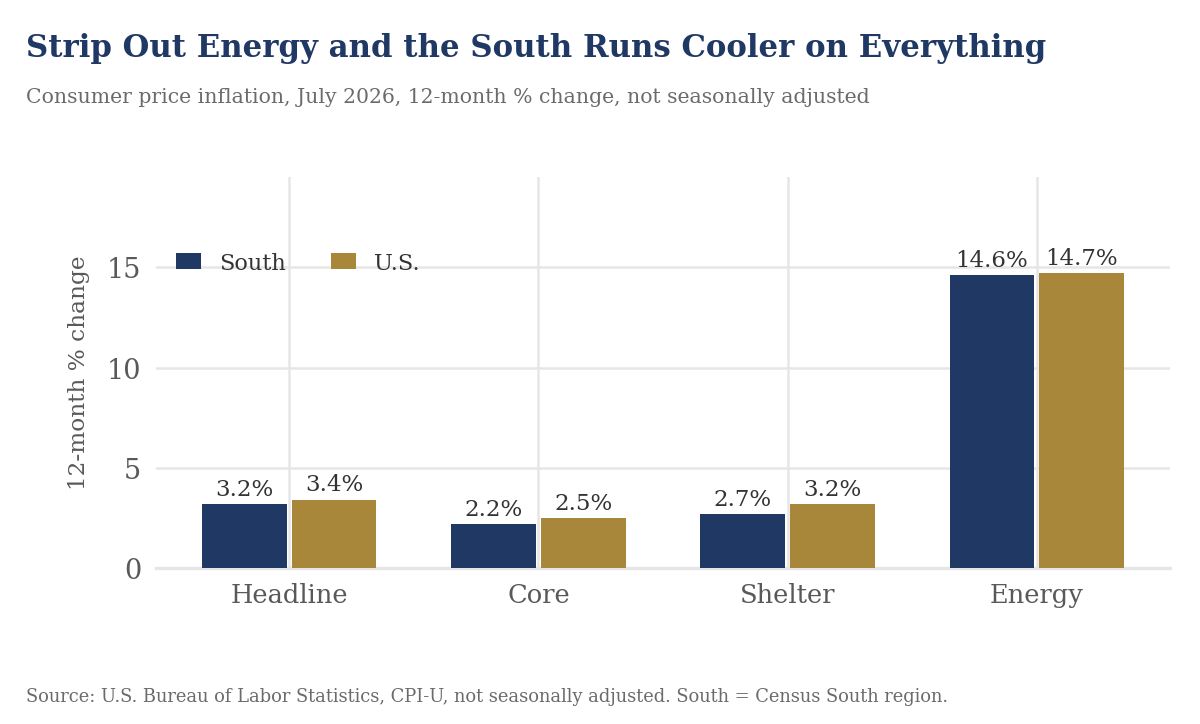
The South continues to run cooler than the nation on every major inflation gauge, and July widened the gap on shelter. The July CPI showed national headline inflation at 3.4% over the year with core at 2.5% and shelter at 3.2%. The South region came in at 3.2%, 2.2% and 2.7%, and the regional shelter index was flat on the month. Energy is the reason the headline is above 3% anywhere: the South’s energy index is up 14.6% over the year after this summer’s Strait of Hormuz closures, though July import prices brought a hint of relief, with fuel import prices down 7.2% on the month, the largest monthly decline since September 2024. Excluding energy, the South’s inflation problem is close to solved, but that is not how the Fed’s hawks read the headline number.
The August pump data will not help. The national average gasoline price reached $4.07 a gallon on Aug. 14 and $4.11 by Aug. 23, with diesel at $5.40. That is the most expensive August on record, against $3.16 and $3.70 a year ago, and gasoline inventories sit at their lowest since November 2025. Southern drivers still pay the least in the country: in the week of Aug. 14, Louisiana averaged $3.57, Mississippi $3.60, Texas $3.63 and South Carolina and Tennessee $3.65, a 45 to 50 cent cushion worth real disposable income across an 18-state region. Supply got no easier on Aug. 17, when lightning ignited three natural-gasoline tanks at Explorer Pipeline’s Glenpool tank farm south of Tulsa and shut the facility, a system whose southern leg carries up to 660,000 barrels a day of Gulf Coast product north.
Within the region the divisions are pulling apart, and the fastest-growing corners are no longer the priciest. The West South Central division posted just 2.5% headline inflation, against 3.4% in the South Atlantic and 3.5% in the East South Central states. Dallas–Fort Worth is at 2.9% with shelter up only 1.5%, Tampa is at 1.9% with a shelter index up just 0.2% over twelve months, and Houston’s June reading was 0.8%, while Washington remains the outlier at 4.0% with food up 5.0% and energy up 22.9%. The pattern is a supply story: the metros that delivered the most apartments in 2024 and 2025 now have the softest shelter inflation. We look for Southern headline inflation to hold in a 3.0% to 3.3% band through year-end, with the risk to that forecast entirely on the energy side if Hormuz traffic tightens again.
Thread Four | A Two-Speed South: The Gulf Gains, the Potomac Loses
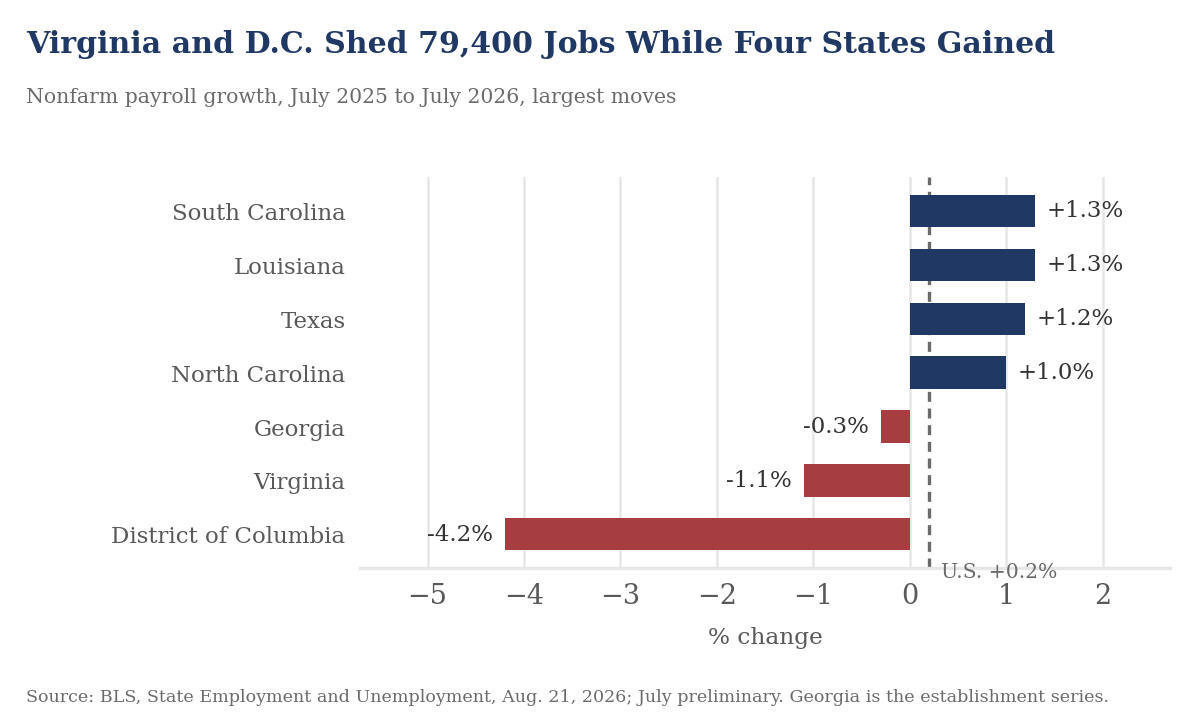
Friday’s state jobs report handed the South a surprise: the fastest-growing state labor markets in the country now sit on the Gulf Coast and in the Palmetto State. Louisiana and South Carolina posted the nation’s second-fastest job growth over the year at 1.3% each (26,800 and 32,100 jobs), behind only Minnesota’s 1.4%, and Texas added 165,600 jobs, the largest gain of any state. North Carolina’s 51,600 increase (1.0%) rounds out the region’s significant gainers; nationally only six states posted statistically significant over-the-year gains, and four of them are ours. The other side of the ledger is just as stark: Virginia (down 47,900, or 1.1%) was the only state in the country with a statistically significant job loss, and the District of Columbia shed 31,500 jobs (4.2%) as the federal downsizing compounds. Georgia deserves a careful reading. Its establishment-survey payrolls fell 15,700 over the year to 4,977,500, and 9,200 over the month, while the separate household survey put employment at a record 5,301,774 with a record labor force. Both are true; they measure different things, and the payroll series is the one that has turned. Federal cutbacks have clearly hit the state, with federal employment down 8.8% over the past year and private payrolls off 0.4%. Maryland posted the only statistically significant monthly gain in the nation (up 11,700), a welcome bounce after a year of federal-driven losses, with New Jersey the only significant monthly decline. We will be looking at the state and local detail in Friday’s preliminary benchmark, which is built from QCEW counts, for a clearer read on Georgia and the other states posting uncharacteristically weak payroll growth.
The Washington numbers now have a level behind them, and it is a generational one. Federal employment across the D.C. region has fallen to roughly 312,500, the lowest in about 30 years, down 63,300 from about 375,800 in early 2025, and the metro shed 100,500 jobs of all kinds between May 2025 and May 2026, 54,500 of them federal. Clark Mercer of the Metropolitan Washington Council of Governments put it in terms the region understands: “They’ve hired about 8,500 folks, so in one year that’s the equivalent of losing a dozen HQ2s.” The $7 billion to $10 billion in annual payroll savings to the Treasury is paid for locally through weaker consumer spending, softer Northern Virginia and suburban Maryland office demand and tighter local budgets. We look for Virginia to post a second consecutive year of job losses, and a federal hiring thaw after the fiscal-year turn is the development that would change that.
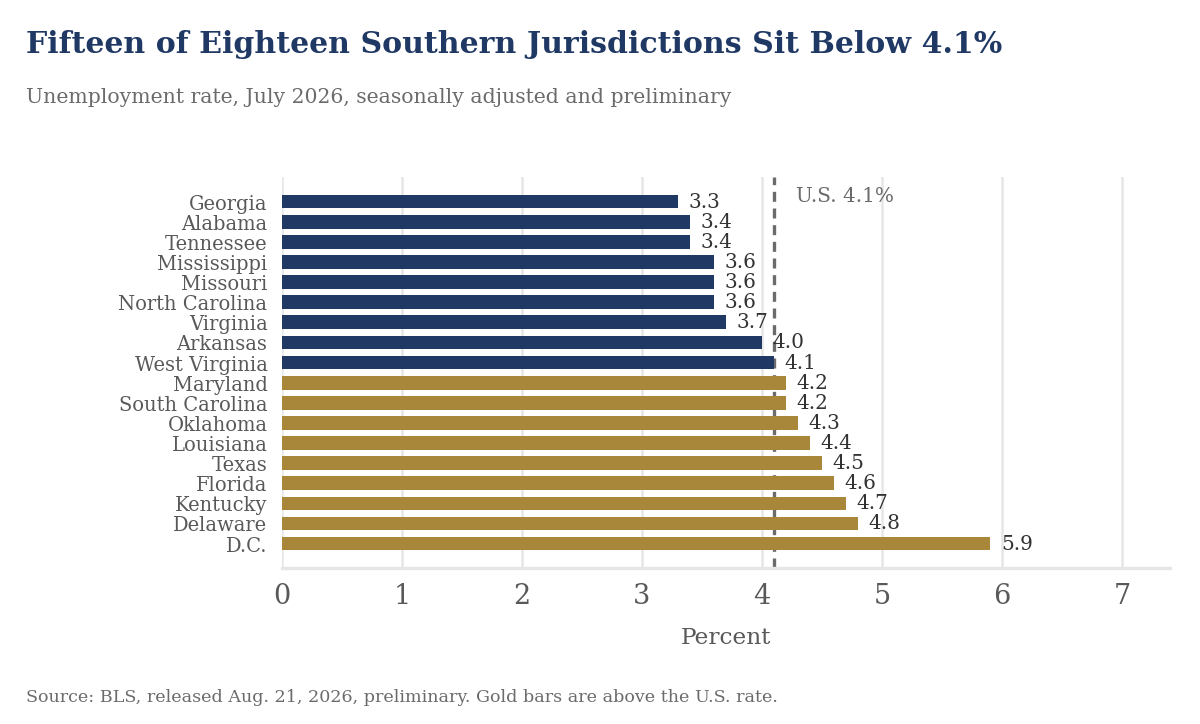
Unemployment rates told a friendlier story, with two of the region’s problem spots improving. Florida’s rate fell to 4.6% and South Carolina’s dropped to 4.2%, the region’s only statistically significant monthly declines, while Georgia (3.3%), Alabama and Tennessee (3.4% each) hold the region’s lowest rates. The year-over-year moves still bear watching: Oklahoma is up a full point to 4.3%, second only to Connecticut’s 1.3-point rise among the twelve states with significant increases, Florida is up 0.7 point, Alabama is up 0.6 point and Texas, at 4.5%, now sits above the national average. Nationally, July payrolls fell 23,000 with May and June revised down a combined 103,000, though initial claims eased to 206,000, so the weakness has yet to show up in layoffs. The wild card arrives Friday at 10:00 a.m., when BLS publishes its preliminary benchmark revision to state and national payrolls. We look for the region’s job growth to run near 1% over the coming year, led by Texas and the Carolinas, and a benchmark revision that cuts deeply into 2025-26 job counts is the event that would force us to mark that down.
Thread Five | Labor Supply: Policy Is Repricing the Southern Wage Floor
Immigration enforcement is now showing up in the labor data rather than just the anecdotes. Brookings estimates the 2025 enforcement surge cost 668,000 jobs across 86 targeted cities, with employment 0.73% below baseline immediately and 1.48% below after six months, a ratio of roughly 13 jobs lost for every excess arrest. Construction bore the worst of it at 2.2% below baseline, about 102,000 jobs, and between 51,000 and 297,000 of the lost positions would have been held by U.S.-born workers. Local reporting applying the same data puts Charlotte’s loss near 10,000 jobs. In Florida, where Haitian Temporary Protected Status ended in late July, some 93,000 TPS holders were employed statewide as of January, including roughly 16,000 cooks and servers, 12,000 in agriculture and 4,000 nursing assistants; two South Florida home-care agencies have already closed after each lost more than 80 employees. We look for this to keep showing up as a supply constraint on Southern construction and hospitality payrolls rather than as a wage effect, since the same policy mix is cutting mandated farm wages sharply.
The Farm Economy
The biggest single change in Southern farm economics this month was administrative, and it went almost unremarked. The Labor Department’s new H-2A Adverse Effect Wage Rate took effect Aug. 17 in seventeen mostly-Southern states whose implementation had been held back by the Kansas v. DOL order, replacing the USDA Farm Labor Survey with BLS occupational data and splitting the rate into two skill levels. Georgia’s Skill Level I rate fell from $16.08 to $12.27, a 23.7% cut, and Louisiana’s dropped 35.3% from a $14.83 base; across the cohort the reductions run from roughly a fifth to two-fifths, with published Level I rates in Mississippi and Florida implying cuts steeper than the first round of reporting suggested. The Economic Policy Institute estimates the rule removes $4.4 billion to $5.4 billion of annual farmworker earnings nationally, and because the AEWR sets a floor for domestic as well as visa workers, the effect reaches well beyond H-2A employers. This is a large margin transfer into Southeastern fruit, vegetable and nursery operations and Delta row-crop farms, and an equally large income withdrawal from the rural counties where those workers spend. We look for it to show up first as improved 2027 planting intentions in labor-intensive Southeastern crops, with litigation the obvious risk to that call.
The crop picture splits the region in half. The August WASDE cut the U.S. cotton crop to 13.61 million bales on an 8.5% reduction in expected yield even as planted acreage rose, with December futures holding above 80 cents. Conditions explain both the cut and the geography: as of Aug. 9, Texas cotton was rated 34% poor or very poor and Oklahoma 20%, while Alabama, Arkansas, Missouri and North Carolina all sat above 70% good to excellent. The Southeast, not the Southwest, is carrying this crop. In the Delta, input costs have restructured acreage outright: Arkansas growers planted 851,000 acres of rice, the smallest in roughly fifty years and comparable to 1976-77, after March intentions above one million acres, shifting ground to soybeans that fix their own nitrogen. Urea ran $669 a ton in June, down 20% to 25% from its April peak but well above last fall, and the American Farm Bureau reports that most Southern growers had not booked fertilizer before the spike.
Credit is tight and the cattle complex carries a tail risk worth naming. The Dallas Fed’s second-quarter agricultural survey described “stable but depressed conditions” across Texas, northern Louisiana and southern New Mexico, with loan demand down across every category and standards tightening. Cattle remains the one genuinely profitable protein, with prices up 57% since 2020 against a national herd at historic lows and Mexican imports halted since July 2025. The tail risk is New World screwworm: northern Mexico counted more than 1,800 active cases as of mid-May, and while later reporting describes far fewer active cases now, USDA sterile-fly capacity does not reach 100 million flies a week until spring 2027. A repeat of the 1972 outbreak is modeled at $2.5 billion and a prolonged episode above $6 billion. On the export side, China took about two thirds of new-crop U.S. soybean export sales in the week ending Aug. 13, 1.13 million tonnes of 1.72 million.
Policy Watch
The Fed’s minutes read hawkish, but the market has stopped believing in a September hike. Minutes from the July 28-29 meeting, released Wednesday, show several participants assessing that tariff pass-through to consumer prices is now largely complete, while the committee as a whole still saw inflation risks skewed to the upside; three dissenters, Hammack, Kashkari and Logan, wanted a quarter-point increase from the current 3.50% to 3.75% target range. Market-implied odds of a September hike have settled near 30%, down from about two thirds in late July, after the weak jobs report, a softer CPI and the retail sales decline. The two-year Treasury closed Thursday at 4.19% and the 10-year at 4.69%. All eyes now turn to Jackson Hole, where Chair Kevin Warsh delivers his first symposium address Friday under the banner “Financial Innovation: Implications for Payments and Policy.” We look for a hold in September and no move in either direction before December, with an upside surprise in the August CPI on Sept. 10 the one thing that could put a hike back on the table.
Trade policy did change this week, though not where most readers will assume. The administration invoked Section 338 of the Tariff Act of 1930, dormant for at least seventy years, to impose 50% duties on selected Canadian goods covering close to $20 billion of annual imports. Two features matter more than the headline rate. USMCA origin does not exempt covered goods, which is genuinely new. But goods already subject to Section 232, which covers passenger vehicles and parts, steel, aluminum and copper, are carved out, so the 50% does not stack on the existing 25% auto tariff; the exposure runs through dairy and alcoholic beverages instead. The duties were proclaimed with an Aug. 19 effective date, suspended for three days on Aug. 18, and took effect at 12:01 a.m. on Aug. 22. The rest of the structure is unchanged: Section 301 duties of 10% to 12.5% across roughly 60 economies since July 24, and Section 232 rates of 25% on autos and parts, 50% on steel, aluminum and copper and 100% on patented pharmaceuticals, with a 20% rate for firms committing to U.S. onshoring. Kentucky’s distillers, already working through a bourbon glut, are the region’s most obvious retaliation exposure. Congress remains out with competing continuing resolutions, so an Oct. 1 shutdown looks unlikely.
Savannah is winning share, and the reason is who its customers are. The Port of Savannah moved 503,739 TEUs in July, up 5.7% over the year, with imports up 5.0% to 251,888 TEUs and exports up 7.7% to 114,974, following an 18% June. The structural advantage is retail: the Savannah region holds the largest concentration of retail import distribution centers on the East Coast, with Amazon, The Home Depot, Target, IKEA, Dollar Tree, Wayfair and Floor & Decor all warehousing there across a 172.5 million square foot industrial market, and 62% of the U.S. population within a two-day drive. That customer base is why the Mason Mega Rail facility moved 541,405 containers in fiscal 2026, now 17% of Savannah’s container trade, and why the inland Appalachian Regional Port set a record 49,319 containers for the year, up 20%. Fiscal 2026 as a whole finished at 5.67 million TEUs, a shade below the prior year, so the strong run is a June-July rebound rather than a full-year trend. But against Charleston’s 4.6% fiscal-year decline it is a share shift, not a cycle. South Carolina idled its $1 billion Leatherman Terminal on Aug. 1, offered early retirements and slowed the $550 million Navy Base Intermodal Facility, with its chief executive conceding that rates were “a little out of whack” against regional competitors.
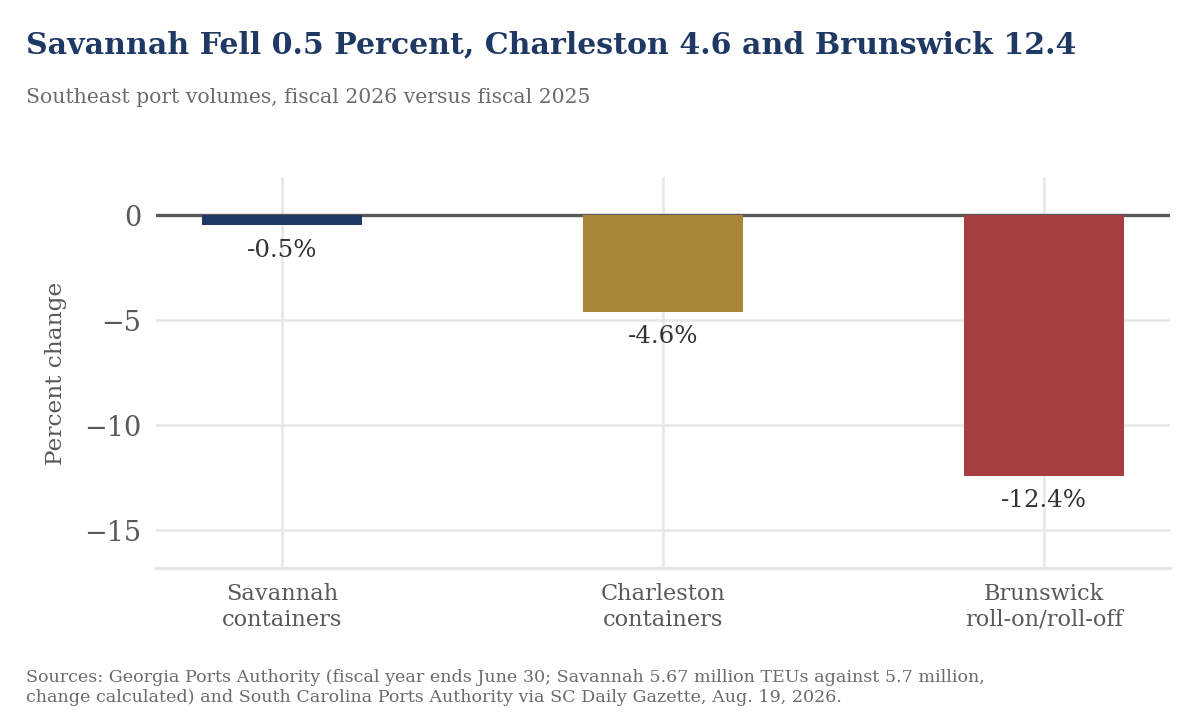
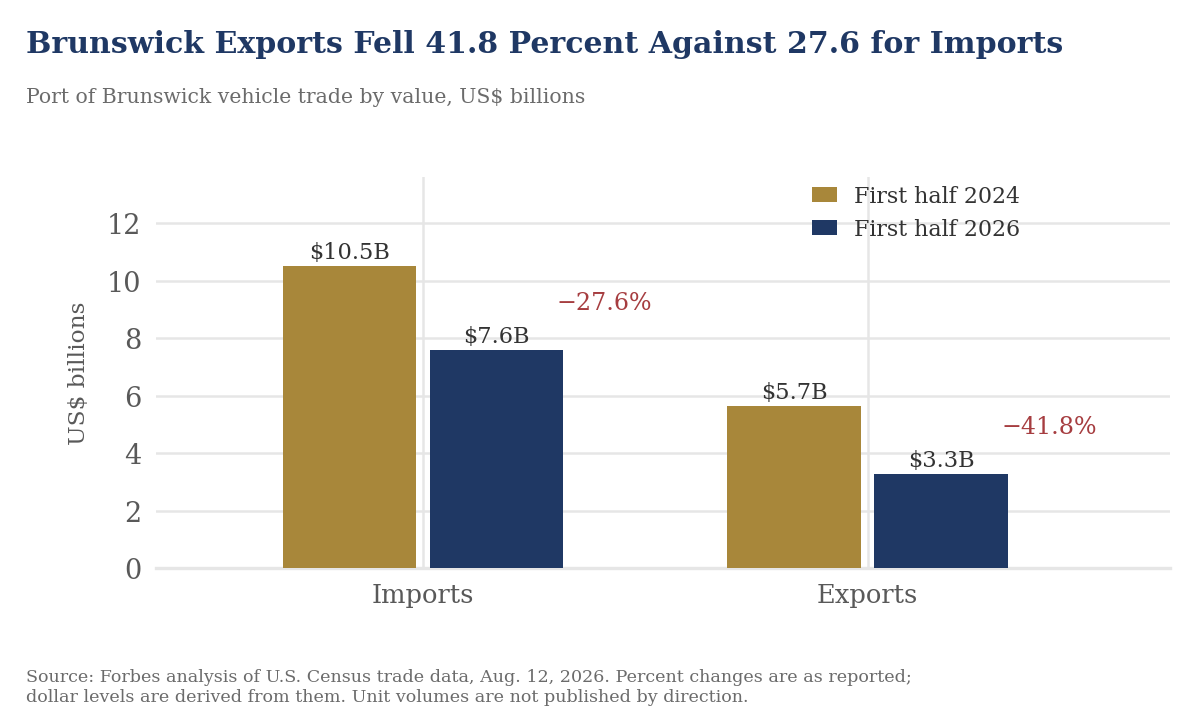
Brunswick tells a more complicated story, and the export half is the weak one. Colonel’s Island remains the busiest auto and roll-on/roll-off terminal in the country for a second consecutive year, handling 779,000 vehicles and more than 53,000 heavy machinery units across 731 vessel calls in calendar 2025. Imports are genuinely strong: July auto imports rose 5.3% to 51,704 units and drivable machinery rose 24.4%. But total auto trade fell 4.5% to 61,756 units, and Georgia Ports attributes that decline squarely to lower vehicle exports. The fiscal-year picture is harder still, at 763,122 roll-on/roll-off units, down about 12.4%. Census trade data show Brunswick vehicle exports down 41.8% by value in the first half of 2026 against the first half of 2024, a steeper fall than the 27.6% decline in imports, with luxury exports to China down 17.8% in 2025 alone. The 25% Section 232 auto tariff that took effect in April 2025 is the proximate cause on both sides. Capacity keeps arriving regardless: Berth 4, a $100 million project accommodating 975-foot vessels, opens in November 2027, and the Southside Railyard’s first phase has lifted annual rail capacity from 175,000 to 370,000 vehicles. We look for Brunswick imports to hold and exports to stay soft through 2027, and a negotiated rollback of the vehicle tariffs is the development that would change that.
The most consequential port news, though, came from Louisiana. The Army Corps of Engineers granted the federal construction permit on Aug. 17 for the Louisiana International Terminal in Violet, St. Bernard Parish, a roughly $1.8 billion deepwater container facility being developed with MSC’s Terminal Investment Ltd. and Ports America, sized for the post-16,000-TEU ships that the Crescent City Connection bridge keeps out of New Orleans today. A Louisiana Economic Development analysis projects $33 million a year in tax revenue to St. Bernard Parish. We look for regional container volumes to run 3% to 5% ahead of last year through the fall, with Savannah taking share from Charleston rather than the region gaining in aggregate.
State budgets are diverging, and Oklahoma is the one to watch. Texas collected $4.6 billion of sales tax in July, up 10.1% over the year and a second consecutive month above 10%, with oil production tax up 31%, natural gas up 36% and hotel occupancy up 17%; Comptroller Huffines is using the $1.4 billion August local allocation, up 13.6%, to press cities and counties for property-tax relief. Tennessee beat its estimate by $418.2 million, though the franchise and excise line running 287% over says more about a depressed post-rebate baseline than about corporate strength. Georgia’s $2.57 billion, up 3.1%, came with individual income tax down 2.1%, which is the more telling number. Mississippi closed fiscal 2026 $176.7 million above estimate and West Virginia with a $370 million surplus. Oklahoma is the outlier: July general revenue of $515.7 million came in 1.5% below estimate and 15.3% below a year ago, with gross production tax down 33.4% from July 2025. That is partly a timing artifact, but it is paired with the largest year-over-year rise in unemployment of any state in the region. Longer term, Pew finds Louisiana general fund revenue running 9.7% below its 15-year trend with corporate income 43.3% below.
Rural hospitals are the region’s most underpriced fiscal risk. Seven of the ten states judged most vulnerable to rural hospital closure are in our coverage area: Texas first with 50 at-risk facilities on top of 27 closures since 2010, Tennessee second with 27, Mississippi third with 24 and Georgia eighth with 25. The new $50 billion Rural Health Transformation Program is allocated in a way that runs against Southern need, with Texas receiving roughly $66 per rural resident against Rhode Island’s $6,305, while the 2025 reconciliation law reduces Medicaid spending by about $1 trillion over a decade and rural hospitals absorb $50.4 billion of it. Most of the exposed states never expanded Medicaid, so the shortfall lands on general funds at the same moment several are cutting income taxes.
The Two Largest Southern Economies
Texas is running a boom and a correction at the same time, and the two are 150 miles apart. The statewide housing market posted a thirteenth consecutive month of year-over-year price declines in June, with the median at $342,900 against $350,000 a year earlier, 5.4 months of supply and Austin permitting down 29% through May. San Antonio is the weakest large apartment market in the country. Yet Abilene now has a 2.5% apartment vacancy rate and the second-fastest rent growth of the 394 markets CoStar tracks. Four-star rents there are up 29% since Stargate was announced in early 2025, to $1,760 a month or $1.95 a square foot, higher than any major market in the state, and two-star rents have risen 25% over the same period to clear $1,000 for the first time on record. Sales volume has more than doubled over the year and 458 units are under construction. Kyle Wilks of Wilks Development: “It is an economic boom like we’ve never seen.” We look for Abilene rent growth to moderate as the first two Stargate phases complete and construction labor demand falls, and the wider point stands either way. The state’s housing weakness is a demand story everywhere except where the buildout is.
The rest of the Texas ledger runs the same split. Samsung is accelerating its second Taylor fab toward an end-2026 groundbreaking, lifting total Taylor investment above $37 billion with Tesla expected to anchor under a $16.5 billion chip agreement, and SpaceX’s $16.8 billion first phase of a Grimes County semiconductor complex carries 3,000 jobs and a $30 million Texas Enterprise Fund grant. Against that, WARN filings this month cover JPMorgan Chase in Plano (244), Alan Ritchey in Irving (232) and ZeniMax in Richardson and Austin (158 combined), and the freight sector added Dylan Logistics (167) and Revol Greens (115). Two live disputes are worth tracking for what they do to siting: the hemp industry has sued the state over its THC ban, and landowner-utility conflict over transmission routes escalated in the legislature during the window.
Florida’s housing recovery is real in single-family and still frozen in condominiums. July single-family closed sales rose 5.1% over the year to 23,870 with the median at $425,000, up 3.7%, on 4.5 months of supply, and new pending sales rose for a twelfth straight month. Condominiums moved the other way: sales rose 11% to 8,194, but the median was flat at $295,000 against 7.8 months of supply, nearly twice the single-family overhang. Florida Realtors attributes the volume recovery to associations and owners adapting to post-Surfside structural reserve requirements, rising assessments and building insurance costs. We look for the condo overhang to keep capping Florida price growth into 2027, and a sustained fall in association assessments is the development that would change that.
The bigger Florida story for local credit is on the ballot. A 2026 measure advancing through the legislature would raise the homestead exemption by $100,000 a year for a decade, eliminating non-school property taxes entirely by 2037. It has cleared the House State Affairs Committee with the governor supportive, while the Senate has not settled its approach. Counties, school districts and special districts carry the transfer, which makes this the largest single fiscal risk to Southern local credit we track. Elsewhere in the state, L3Harris ousted Chairman and CEO Chris Kubasik over a code-of-conduct violation and named Sam Mehta his immediate successor, with the shares off about 4%; Disney received zoning authorization for a potential fifth Central Florida theme park, though no proposal has been filed; and the Jacksonville Transportation Authority’s finances deteriorated by $29.5 million in three months. Postal Center International is cutting 181 jobs at its Weston headquarters, and Saddle Creek 178 in Plant City.
Commercial Real Estate Across the South
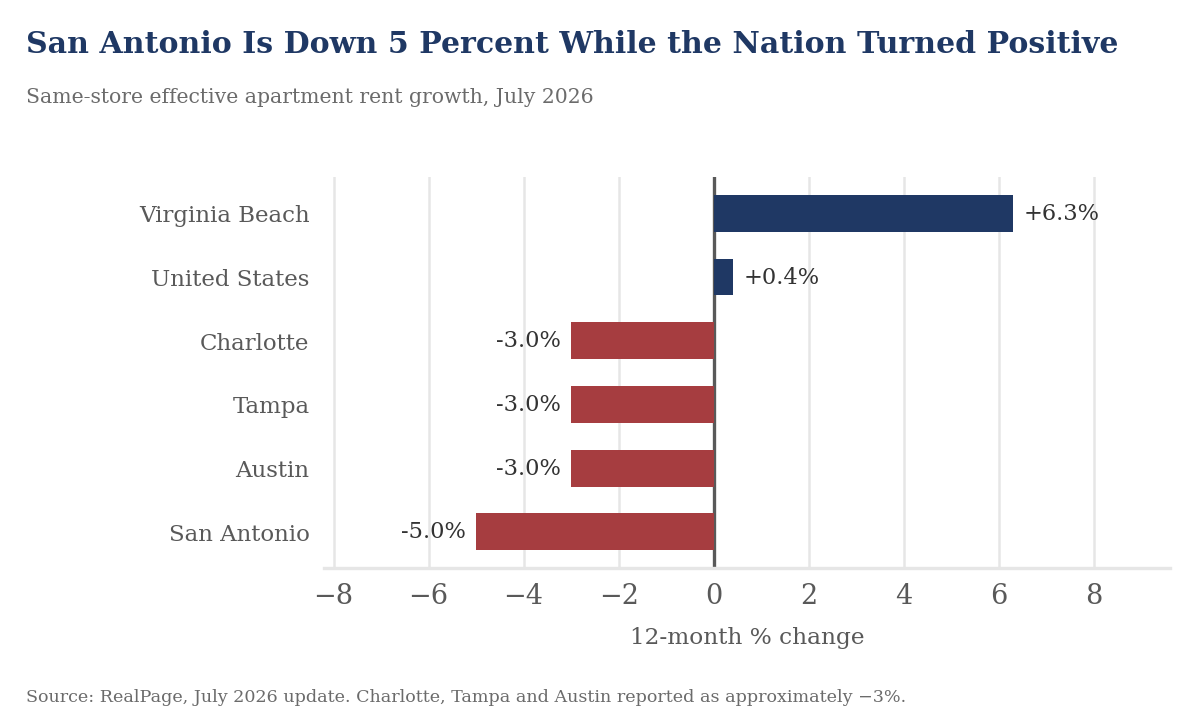
Multifamily. National rents turned positive over the year for the first time in this cycle, and the South is the only region still cutting. RealPage’s July data show same-store effective rents up 0.4% over the year and 0.3% on the month, the seventh straight monthly increase, with second-quarter occupancy at 95.5%. San Antonio is the weakest large market in the country at roughly 5% below a year ago and Austin, Phoenix, Charlotte and Tampa are all near 3% below, while Virginia Beach, up 6.3%, is the region’s standout. Second-quarter absorption topped 187,000 units against about 77,700 completions, so the supply wave is receding quickly. The apartment cap rate reached 5.79% in the second quarter, an 11-year high, and Trepp’s multifamily CMBS delinquency rate climbed 46 basis points to 7.69% in July. We look for Southern rents to cross back into positive territory in the first quarter of 2027, unless job growth in the big Texas and Carolina metros slows further.
Industrial, office and retail. Warehouse demand has re-accelerated and the Sun Belt hubs are absorbing the space, while office stabilizes at a high vacancy rate. Cushman & Wakefield put industrial vacancy at 6.9% in the second quarter on leasing of 193 million square feet, the strongest since mid-2022, with Dallas-Fort Worth absorbing 9.0 million square feet at asking rents up 13.3% and Atlanta 2.1 million; Savannah is the exception at 10.5% vacancy as new supply outran leasing. Office vacancy was 20.1% nationally, with sublease space down 15% and deliveries at a 14-year low; Washington (23.3%) and Austin (26.9%) are still losing tenants while Nashville’s 16.3% is the region’s lowest and Dallas absorbed 1.08 million square feet for a second consecutive million-plus quarter. Retail remains the tightest major property type at 6.0% vacancy against a 7.4% long-run average, with Southern asking rents up 3.3%.
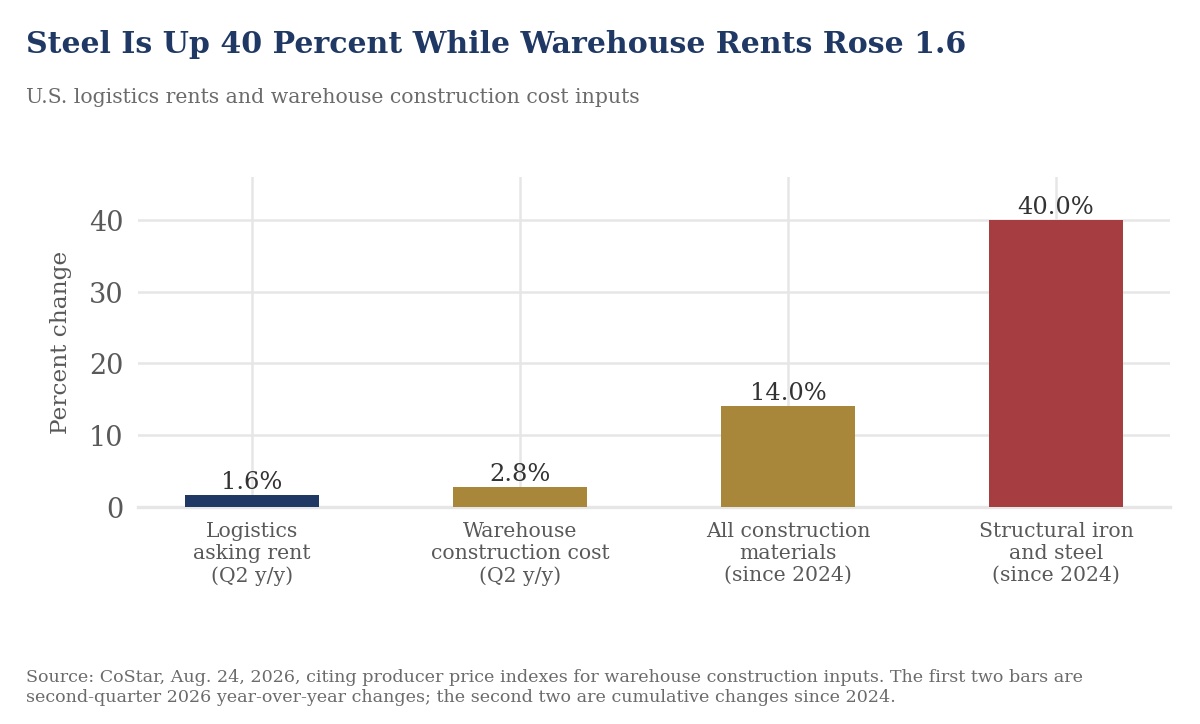
New warehouse supply is being rationed by construction cost, and the binding input is steel. CoStar puts second-quarter logistics asking rent growth at 1.6% against a 2.8% rise in warehouse construction costs. When costs outrun rents, fewer projects clear their return thresholds. Quarterly logistics starts were 61.8 million square feet, up from the first quarter but far below the 2022 peak above 150 million, with a trailing-year total near 223 million. The cost detail is the tariff story arriving in a different form: structural iron and steel prices are up nearly 40% since 2024, the fastest-rising warehouse input, against roughly 14% for construction materials generally, as Section 232 duties cut imports and redirected demand to domestic mills whose lead times have lengthened. More than half the pipeline is speculative against a pre-pandemic norm near 30%, and the overhang sits in the 100,000 to 500,000 square foot range rather than in bulk. We look for Southern industrial starts to stay restrained into 2027, with data center demand for electrical gear and cooling equipment the pressure that would push costs higher still.
The data center boom is now a warehouse story, and Texas owns it. National data center inventory has reached roughly 69 gigawatts with another 43 gigawatts under construction, hyperscale users accounting for 64% of existing capacity and vacancy near historic lows. The second-order effect is the one to watch for Southern industrial landlords: occupiers tied to data centers, meaning construction firms, operators, IT infrastructure providers and above all power, cooling and electrical equipment suppliers, took more than 6% of logistics leasing within five miles of data center facilities so far in 2026, against less than 3% in 2020. Dallas-Fort Worth leads the country with about 10 million square feet of such space leased since 2025, Houston ranks second and Atlanta third. Power availability is now the primary siting constraint, which is the same fact that Thread One reads from the permitting side.
Medical office is the exception to the healthcare boom. Healthcare now employs nearly one in seven American workers and has supplied close to half of all job growth since 2020, and at 2.4% year-over-year in July it is growing more than ten times as fast as total payrolls. Medical office buildings have not captured it. Vacancy has climbed back above 9%, near a decade high, and only 26% of healthcare leasing over the past twelve months went into medical office buildings against a historical average above 30% and a 35% peak two years ago. The space is going elsewhere: flex and industrial buildings now take nearly 20% of healthcare leasing on cheaper rents and easier parking, and traditional office has recovered to roughly 40% as landlords convert suburban low-rise product. For a region where health care is the largest single job engine, this argues the employment growth shows up in industrial and commodity office absorption rather than in purpose-built medical product.
Insurance. The single largest operating-cost problem in Southern real estate has stopped getting worse, at least in Louisiana. The statewide approved homeowners rate change is essentially flat through June, after double-digit increases in 2022 and 2023, 6.6% in 2024 and 4.6% in 2025. Nine carriers have now filed for decreases, with cuts as deep as 10%, and commercial property rates are reported down roughly 30% on falling reinsurance costs and three seasons without a major landfall. Florida drew its first real capital-markets endorsement of the cycle when Melbourne-based Orion180 filed its S-1 for a Nasdaq listing on Aug. 20. Texas is moving the other way on litigation, where three homeowners filed a federal RICO suit against the Texas Windstorm Insurance Association over Hurricane Beryl claims handling, alleging one estimate was cut from $91,000 to $31,000 against roughly $336 million paid on 34,000 claims. We look for Gulf Coast property costs to keep easing into the 2027 renewal season, with an active September the obvious reversal risk.
Capital markets. Deal volume is recovering, the cost of debt has stopped falling and bank credit is where the strain is surfacing. CBRE tallied $124.5 billion of U.S. investment volume in the second quarter, up 15% over the year, with the average commercial mortgage rate at 5.7% and cap rates near 6.3%. The supervisory signal came from Louisiana: First Guaranty Bank of Hammond, a $3.9 billion-asset lender, entered a consent order effective Aug. 7 over credit quality and commercial real estate, ordered to reach a 9% Tier 1 leverage ratio against an actual 7.09% at June 30 and barred from extending credit to borrowers previously charged off or classified as loss, with $276.6 million of substandard relationships on the books. The Federal Reserve announced an enforcement action against Birmingham’s SouthPoint Bancshares on Aug. 20. Consolidation continues alongside the stress: HomeTrust Bancshares of Asheville agreed on Aug. 17 to acquire Richmond’s Blue Ridge Bankshares for $448.1 million in stock, building a $7 billion Southeast franchise aimed at Virginia. We look for Southern transaction volume to finish 2026 roughly 15% above 2025, with a September rate hike the outcome that would stall it.
Development Wins of the Week
Carolinas & Virginia. North Carolina’s Rural Infrastructure Authority approved eleven grants Thursday tied to over $1 billion of private investment and 342 new jobs across eleven counties, or 673 in total including 331 previously announced, anchored by Johnson & Johnson’s $900 million expansion in Wilson (128 jobs), with Alamance Foods in Burlington ($36.6 million, 94 jobs) and drone maker Skyeton in Fayetteville (93 grant-tied jobs of 162 expected). South Carolina added Germany’s IEB Americas, which chose Charleston County for its first major North American production site making battery charging and power supply equipment. In Virginia, the governor’s office awarded agriculture infrastructure grants to 14 localities and intervened in the proposed NextEra-Dominion merger on affordability grounds.
Georgia & Alabama. A sustainable-packaging maker picked Hall County. Cirkla will invest more than $5 million and create about 140 jobs over three years in Gainesville making molded-fiber packaging from sugarcane bagasse, bamboo and wood pulp, a win the governor’s office tied to the new Gainesville inland port. It follows DeltaX’s battery-storage North American headquarters in Monroe ($141 million, about 250 jobs). In Alabama, Hanwha Defense USA won its first major U.S. Army contract, for six prototype K9 mobile howitzers with an option for twelve more, to be assembled in Opelika, and Brasfield & Gorrie broke ground on a $65 million Birmingham headquarters expansion adding at least 80 jobs.
Tennessee, Kentucky & Mid-South. Sweden’s Dometic is bringing marine manufacturing to the Upper Cumberland. Dometic will expand in Sparta, Tenn. with more than 90 jobs, relocating marine steering and helm production from Pennsylvania. Kentucky broke ground Aug. 18 on Anthro Energy’s $40 million Louisville battery-electrolyte plant, 110 permanent jobs plus 390 in construction, and Mississippi added Solero Technologies’ $14 million, 86-job expansion in Water Valley. Southwire’s $256 million Starkville, Miss. expansion and InnovAsian Cuisine’s Jonesboro, Ark. plant round out the Mid-South ledger from earlier in the month.
Texas, Louisiana & the Gulf. The Gulf waits on Monday’s announcement in Abbeville. Bristol Myers Squibb’s $2.3 billion Generation Park campus in Houston, about 500 jobs, remains the month’s marquee win, and if the reported SpaceX spaceport in Vermilion Parish is confirmed Monday, Louisiana will have landed two of the summer’s most consequential projects in a single month, alongside a development pipeline that Louisiana Economic Development now puts at 225 projects, 47,000 direct jobs and $321 billion, second nationally only to Texas.
The Week Ahead
Jackson Hole and a payroll benchmark revision headline a busy late-August calendar. Monday, Aug. 24: Governor Landry’s announcement in Abbeville, La. Tuesday, Aug. 25: July new home sales, June Case-Shiller home prices, August consumer confidence and the Richmond Fed’s August surveys. Wednesday, Aug. 26: the second estimate of Q2 GDP (advance estimate 1.5%), July durable goods, July personal income and PCE inflation, and the Georgia PSC’s extended deadline on the Effingham County contract. Thursday, Aug. 27: weekly jobless claims, the Kansas City Fed’s August factory survey and the opening of the Jackson Hole symposium, through Aug. 29. Friday, Aug. 28: Chair Warsh’s Jackson Hole address, the BLS preliminary payroll benchmark revision at 10:00 a.m. and final August Michigan sentiment. The Dallas Fed’s Texas survey lands Aug. 31, the Beige Book and metro employment follow Sept. 2 and the August jobs report arrives Sept. 4.
Where the five threads stand. On permission, the marker is Georgia’s PSC on Wednesday: a rejection would confirm that the permitting regime, not the grid, now sets the pace. On reshoring, it is whether Hyundai converts an option into a commitment and whether Landry’s Abbeville announcement lands. On energy, it is Hormuz traffic and the Explorer restart, since the region’s headline inflation runs through diesel and gasoline and nothing else. On the two-speed South, it is Friday’s benchmark revision, which is where Virginia’s job loss and the region’s 1% growth call both get tested. On labor supply, it is litigation against the new wage rule and whether the enforcement effect keeps showing up as a supply constraint rather than a wage effect. We would mark down the growth call on a deep benchmark revision and mark up the inflation call on a Hormuz reopening.
Upcoming Research
Our annual college football coverage kicks off this week, with the economics of college football on Wednesday and a preview of this Saturday’s game between UNC and TCU. Each report will provide background on each featured school, an overview of the local economy and a preview of that week’s game.
New on southeasteconomy.com: our Catawba County and Hickory Metro Economic Outlook and the essay “My Hickory Story,” a first-person account of how the region rebuilt after the furniture and fiber-optic busts.
Sources & Notes
Sources: BLS (CPI, State Employment and Unemployment, Employment Situation, import/export prices); U.S. Department of Labor (ETA wage rates, weekly claims); BEA; Census Bureau; USDA (WASDE); Federal Reserve Board (FOMC minutes, G.17, H.15); Federal Reserve Banks of Atlanta, New York, Philadelphia, Richmond, Kansas City and Dallas; FDIC; CME FedWatch; S&P Global; AAA; EIA; USTR; Georgia Ports Authority; South Carolina Ports Authority; Port of New Orleans; Savannah Economic Development Authority; CoStar; RealPage; Cushman & Wakefield; CBRE; Trepp; Florida Realtors; Texas Real Estate Research Center; Chartis; Economic Policy Institute; Brookings Institution; American Farm Bureau Federation; Pew Charitable Trusts; company statements; state comptrollers, revenue offices, governors’ offices and economic development agencies; CNBC, Forbes, Automotive Logistics, SC Daily Gazette, Insurance Journal, Banking Dive, Talk Business & Politics, The Current (Louisiana), Maryland Matters, WFAE and WBTV.
Notes: State labor data are July 2026, preliminary, released Aug. 21; the benchmark revision lands Aug. 28. CPI is July 2026; Houston metro CPI is June. Georgia payroll and household employment figures come from different surveys and are labeled as such. Division-level CPI figures are drawn from the CPI database series rather than the regional news release, which carries no division breakout. Tampa’s 0.2% shelter reading sits against owners’ equivalent rent of 2.0% and rent of 1.8%. CRE data are Q2 2026 plus RealPage’s July update. Yields are Thursday, Aug. 20. GDPNow is Aug. 18. Savannah’s fiscal 2026 change is calculated from 5.67 million TEUs against 5.7 million; Georgia Ports does not publish a percentage. Brunswick export figures are by value from Census trade data, as unit volumes are not published by direction. The Hyundai and SpaceX plans are unconfirmed as of this writing. Abilene rent, vacancy and sales figures are CoStar’s and are not comparable with the RealPage series used in Chart 7. CoStar’s August data center report gives national capacity under construction as both 43 and 49 gigawatts in the same document; the lower figure is used here.
Items carrying unresolved conflicts: H-2A Skill Level I rates published for Mississippi ($8.84) and Florida ($10.87) imply larger reductions than the percentages first reported for those states; the DOL wage table governs. Oklahoma’s gross production tax is reported here against July 2025, not against estimate. No July container volume has been published in text by the ports of Charleston, Virginia or New Orleans, so monthly comparisons for those ports are avoided. RealPage’s July metro-level rent figures and the metro office statistics are drawn from subscription releases and are not independently reproducible from public sources.