
SOUTHEAST ECONOMIC ADVISORS
Weekly Regional Scan · Charlotte, North Carolina
The Week Across the South
Payrolls beat by 100,000, the September call comes down to Friday's CPI, and eleven Southern jurisdictions acted on data centers in five days.
Weekly scan for August 31 to September 7, 2026: Labor Day week delivered the strongest payroll gain of the year, and the September decision still turns on Friday's inflation report rather than on jobs.
The Week at a Glance
- Payrolls rose 162,000 in August against a consensus near 55,000, and the September decision still turns on Friday's CPI. Two seasonally distorted categories supplied 104,000 of the gain; the three-month average of 71,000 is the better guide. We expect a hold on September 16, a first increase on December 9 and a terminal range of 4.00% to 4.25%.
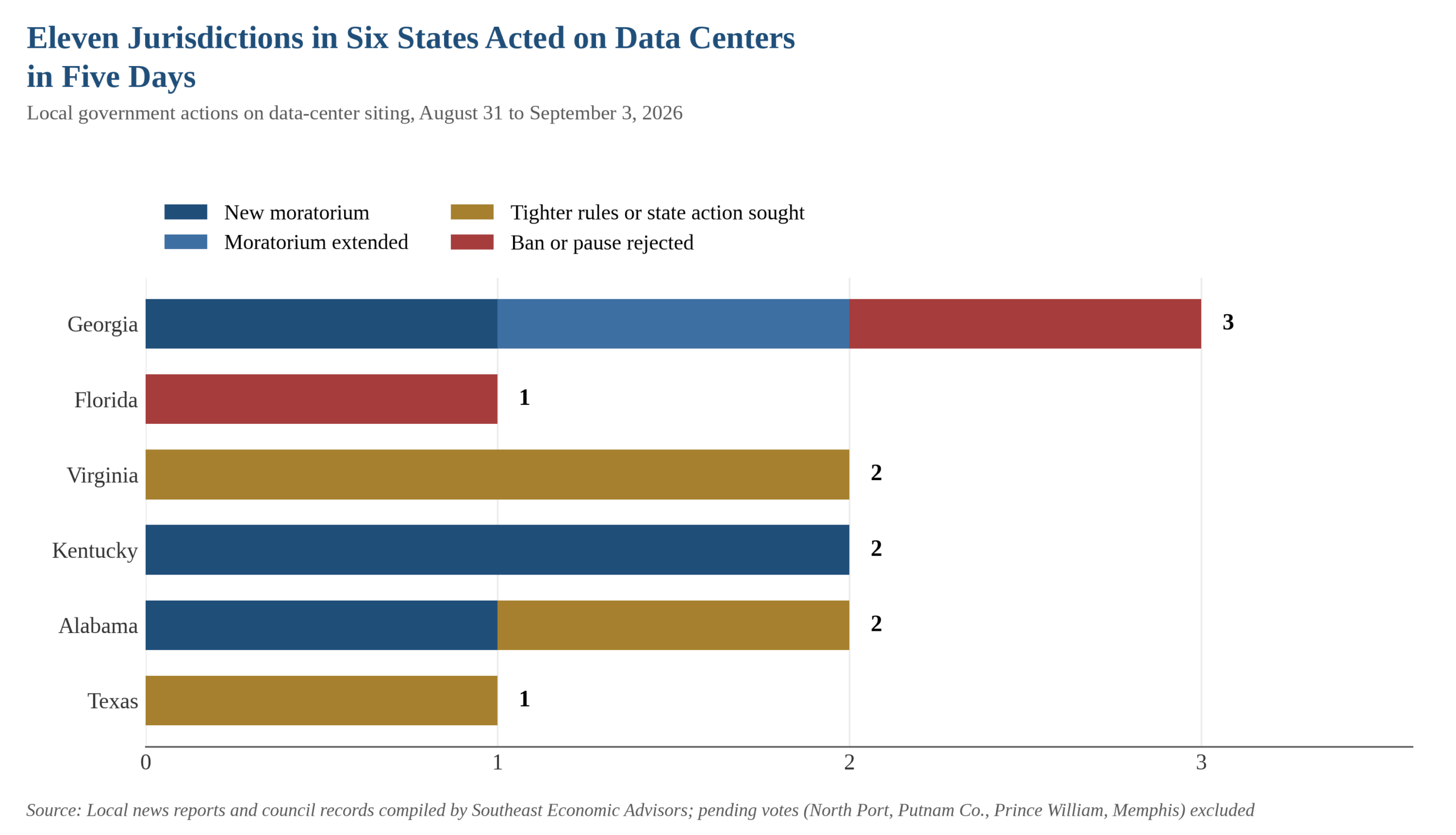
- Local governments in six Southern states acted on data centers in five days, and two of the votes went against a pause. In Arkansas, Entergy sued two newspapers over the Google West Memphis rider and lost.
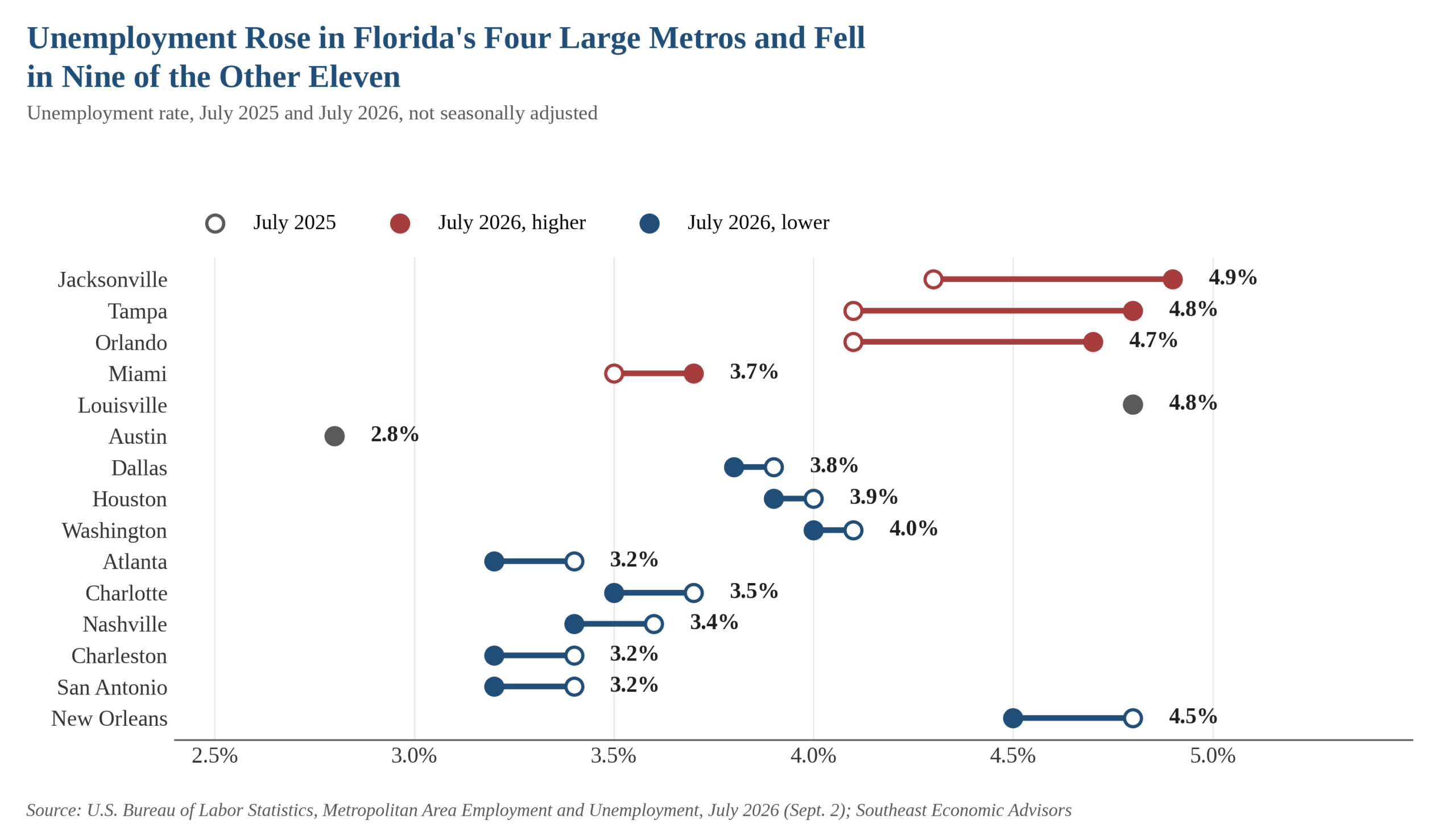
- Florida is the regional number to watch. Jacksonville (4.9%), Tampa (4.8%), Orlando (4.7%) and Miami all have higher unemployment than a year ago while nearly every other large Southern metro has lower.
- The capital kept coming, with more jobs attached: Hyundai Steel's $5.8 billion Louisiana mill broke ground, GE Appliances is moving dryer production from Mexico to Louisville, Eaton will put 1,200 jobs in North Little Rock and West Virginia certified a second Mason County campus at $12 billion.
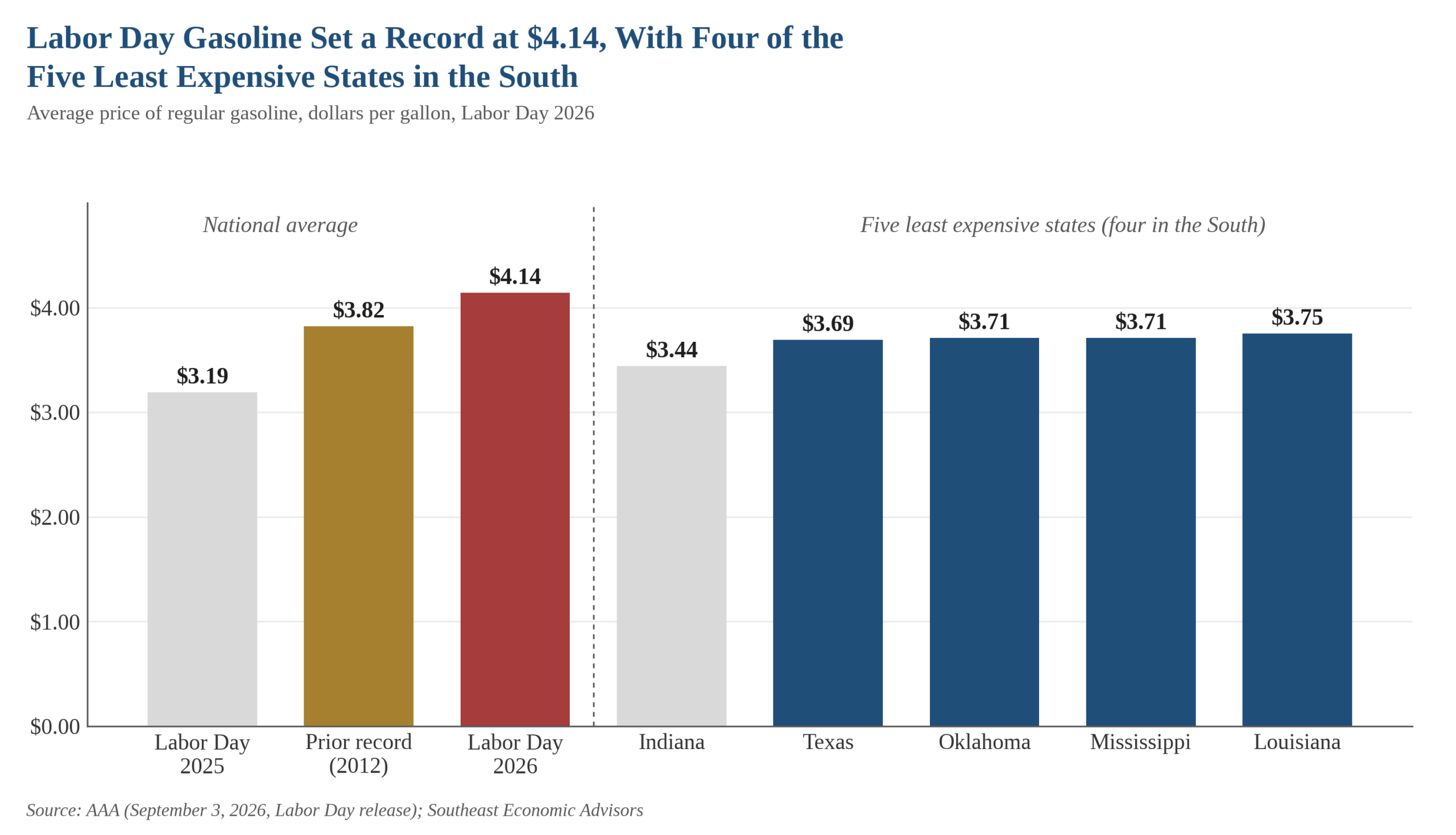
- Labor Day gasoline set a record at $4.14, and four of the five least expensive states were Southern. The South's cushion is intact; its energy exposure is rising.
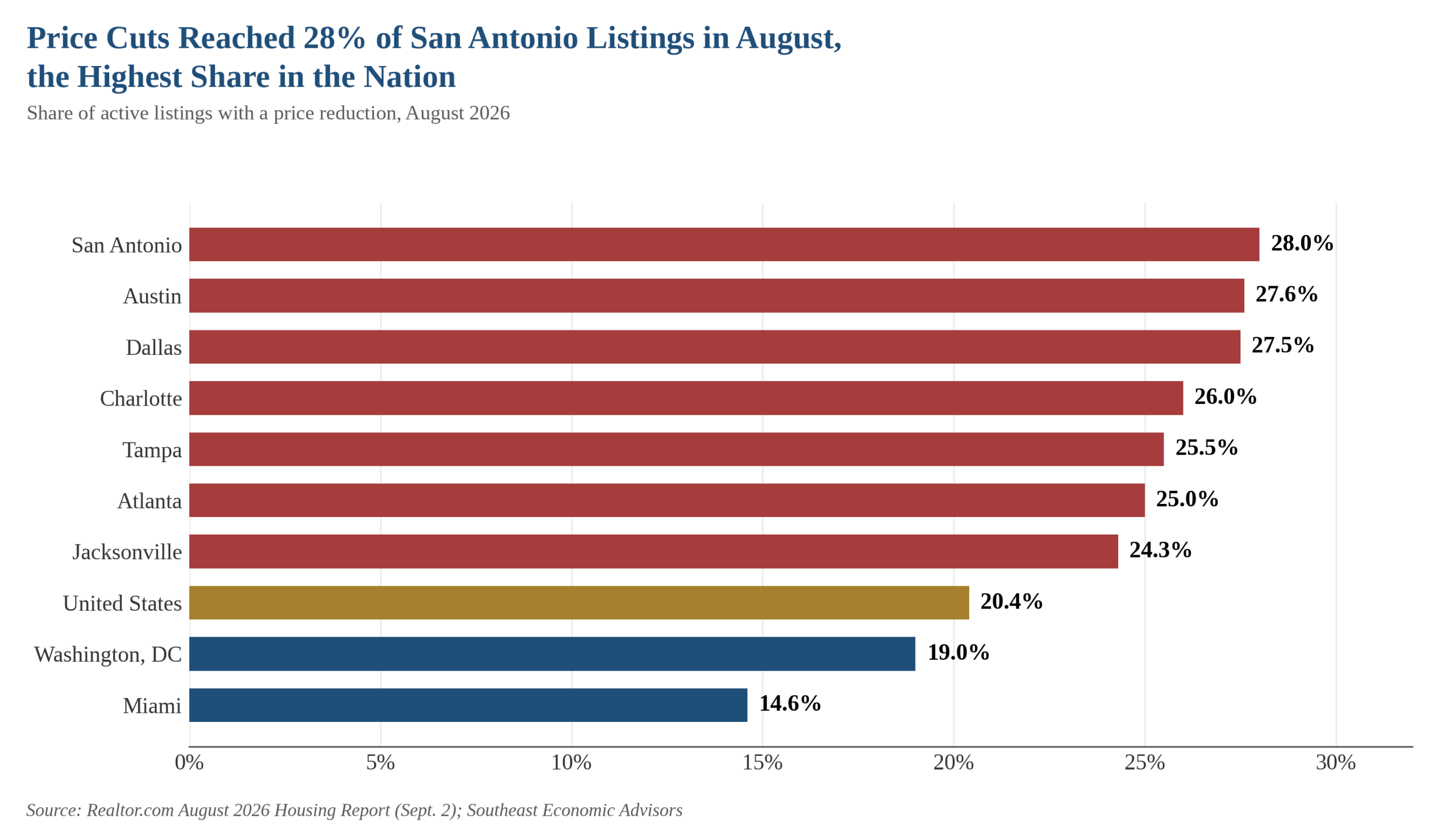
- Texas leads the nation in price cuts, with 28.0% of San Antonio listings reduced in August, and the G20 left Asheville with a Hormuz navigation line, an AI-superpower pledge from Secretary Bessent and about $2 million in local spending.
Labor Day week delivered the strongest payroll gain of the year, and the September decision still turns on Friday's inflation report rather than on jobs. Nonfarm payrolls rose 162,000 in August against a consensus near 55,000, June and July were revised up a combined 55,000 and the unemployment rate held at 4.1%. Two categories with unusually wide summer seasonal swings, restaurants and school districts, supplied 104,000 of the gain, so the three-month average of 71,000 is a better guide to the underlying trend. Governor Waller had already said on Thursday that his vote will be shaped by the August CPI rather than by employment, and the market read the report the same way: the probability of a quarter-point increase at the September 15-16 meeting ran near 65% in the hour after the release and settled at 58% by Friday's close, with the two-year Treasury at 4.37%, a 52-week high, and the ten-year at 4.78%. We expect a hold on September 16, a first quarter-point increase on December 9 and one more in 2027 to a terminal 4.00% to 4.25%. Core CPI at or above 0.3% on Friday with core goods above 0.4% is what would move a September increase to our base case that morning.
Local governments in six Southern states acted on data centers in the five days after August 31, the fastest pace of the year, and two of the votes went against a pause. Dougherty County, Georgia extended its moratorium 180 days, Forest Park adopted a 90-day pause, Rowan County, Kentucky imposed two years and Winchester one, Fort Payne, Alabama rewrote its zoning to make data centers a conditional use and Harpersville adopted six months. Bulloch County, Georgia, however, killed a permanent ban on a 4-3 tiebreaker citing legal risk, and Indiantown, Florida voted 4-1 against a one-year pause after the applicant's attorney threatened to sue, then dismissed its village manager and attorney the same night. Northern Virginia took the question up the chain, as Loudoun's supervisors asked the county attorney whether they can rescind the 2025 grandfathering resolution that shelters roughly 18.4 million square feet of by-right development, and Stafford asked Governor Spanberger for a special session on siting and ratepayer protection. In Arkansas, Entergy sued two newspapers to keep the terms of Google's West Memphis campus out of print, lost its request for a restraining order on Wednesday and then published its own arithmetic, a $6-a-month, 20-year rider on ratepayers against what it says is a $2.1 billion commitment from Google. Georgia's commission appeared to settle the cost-allocation question two weeks ago; Arkansas shows that it remains open everywhere else.
Capital commitments kept arriving, and this week's carried more jobs per dollar than the summer's data-center announcements. West Virginia certified a second hyperscale campus in Mason County, Starwood Digital Ventures' $12 billion, 2.16-gigawatt Project Tamarack, alongside Nscale's $69 billion Monarch campus, and the governor now counts roughly $96 billion of commitments since October, close to nine-tenths of the state's annual output. The larger news for local labor markets was industrial. Hyundai Steel and POSCO broke ground on their $5.8 billion automotive steel mill in Ascension Parish, Louisiana (1,300 jobs), GE Appliances will move dryer production from Mexico to Louisville in a $512 million expansion that makes Appliance Park the largest home-appliance manufacturing site in the country (4,700 production jobs secured), Eaton will put 1,200 jobs into a $242 million enclosure plant in North Little Rock and Greenheck will bring more than 700 to a former Macy's fulfillment center outside Tulsa. Georgia closed its fiscal year with a record $35.2 billion of announced investment and 25,300 jobs, with three-quarters of the projects outside the ten-county Atlanta metro.
Florida is the regional number to watch, since every large metro in the state now has higher unemployment than a year ago while nearly every other large Southern metro has lower. Wednesday's metro data put Jacksonville at 4.9%, Tampa at 4.8% and Orlando at 4.7%, each up 0.6 to 0.7 percentage point over the year, against declines in Atlanta, Charlotte, Nashville, Dallas, Houston and Charleston. The household survey is now telling the same story as the county payroll data we described last week, in which two-thirds of Florida's reported counties lost jobs, and as two consecutive quarterly declines in visitation. We look for the data-center buildout to keep rolling because the money is committed and the power contracts are signed, for Florida to remain the soft spot in the regional labor market through year-end, and for the September meeting to be decided on Friday morning.
Inflation in the South
The South enters the August CPI with its inflation advantage intact and its energy exposure rising. The July data, the latest available until Friday, put Southern inflation at 3.2% against 3.4% nationally, with core prices up 2.2% versus 2.5% and shelter up 2.7% versus 3.2%, so the entire regional premium is energy. Energy got more expensive over the holiday, with Labor Day gasoline averaging $4.14 nationally, the first holiday reading above $4 and 95 cents above a year earlier, and retail diesel set a record $5.85 on Friday after West Texas Intermediate rose 9.7% on the week and Brent settled near $96. The Gulf conflict moved from a pause to a campaign, with roughly 100 U.S. targets struck on Tuesday and two Saudi-chartered tankers hit in the Strait of Hormuz, and the five-year breakeven rose seven basis points, which says the bond market priced the oil move as inflation rather than as growth. The regional cushion is still there, however, as four of the five least expensive states on Labor Day were Southern, with Texas at $3.69, Oklahoma and Mississippi at $3.71 and Louisiana at $3.75 (Indiana, at $3.44, was the least expensive in the country), a discount of 39 to 45 cents to the national average that the Gulf Coast refining complex delivers and that Tropical Storm Edouard tested for about a day when Valero's Port Arthur refinery lost power on Tuesday.
The survey data say price increases are broad rather than concentrated, and the distinction matters for how the Committee reads them. The ISM prices indexes printed 71.1 in manufacturing and 72.6 in services in August, the highest services reading since August 2022. Both are diffusion indexes, which measure the breadth of firms reporting higher prices rather than the size of the increases, and in manufacturing the share paying more and the share paying less fell by almost the same amount, which is why the index held flat at a high level. The Beige Book released Wednesday said prices increased moderately in eight of twelve Districts, with energy, metals and petrochemicals driving input costs and firms in nearly every District absorbing rather than passing them on. All four Southern Districts were growing: Richmond at a moderate pace with ports expanding, Atlanta modestly with employment flat, Dallas moderately with manufacturing, banking and energy picking up, and St. Louis, where prices had "risen at a robust pace" and rising nonlabor costs "remained widespread," the sharpest language in the book. Dallas also reported that agricultural conditions deteriorated on drought, on top of the row-crop strain the July book described. We continue to look for the South's headline CPI to hold in the low 3% range through year-end as gasoline base effects turn favorable in the fourth quarter; Brent holding above $95 into October is what would break that.
Labor Markets
August's employment report was the strongest of the year at the headline and unremarkable underneath, and we would read its composition before its total. We looked for a gain near 50,000 with unemployment at 4.2%; the headline beat that by more than 100,000 and the seasonal detail explains most of the difference. Leisure & hospitality added 62,000 after revised declines of 54,000 in June and 21,000 in July, so the industry has lost 13,000 jobs over the summer, and restaurants and bars shed just 700 workers before seasonal adjustment, which factors built for a midsummer roll-off printed as a 59,200 gain. Local government education added 41,900 after its 57,500 July drop, with the smallest August re-entry in four years underneath. The parts of the report that were not seasonal were better in the right places. Manufacturing added 16,000 with six of ten factory industries hiring, led by machinery and fabricated metals, and construction added 22,000, all of it nonresidential, with heavy & civil engineering up 27,200 over the year, which is where the data-center and transmission work in this region shows up in the payroll data. Information lost 23,000, and wages rose 3.1% over the year, the slowest of 2026, against unit labor costs up 1.4%. Initial claims were 206,000 in the week of August 29 and continuing claims 1.78 million, still a low-hire, low-fire market; claims for the week of September 5 are the first that could carry an Edouard signature from Texas and Louisiana.
The July metro data split the region along a line that runs through Florida. Of 387 metropolitan areas, 241 had lower unemployment than a year earlier and 128 higher, and the South's large metros were nearly all in the first group. Atlanta fell to 3.2% from 3.4%, Charlotte to 3.5% from 3.7%, Nashville to 3.4%, San Antonio and Charleston to 3.2% and New Orleans to 4.5% from 4.8%, while Dallas-Fort Worth added 54,000 jobs over the year and Houston 50,300, the second- and third-largest gains in the country behind New York. Washington lost 73,200 jobs, or 2.2%, by far the largest decline of any metro. Florida is the exception to the regional pattern, with Jacksonville at 4.9%, Tampa at 4.8%, Orlando at 4.7% and Miami at 3.7%, all higher than a year ago. Birmingham's jump to 3.5% from 2.8% is the other reading that does not fit, and we would want to see Alabama's August data before drawing a conclusion from a household series that has been erratic all summer. The July JOLTS data put the South's job-openings rate at 4.2% against 4.4% nationally and its hiring rate at 3.3% against 3.2%, which is an economy still hiring at a normal pace against a shrinking stock of vacancies.
Layoff notices were light, and the largest of them was a housing signal. Louisiana-Pacific will idle its oriented strand board mill in Jasper, Texas on October 2, affecting 150 workers, citing weak OSB demand, which lines up with the permit declines and price cuts described below. Kilgore Flares will cut 127 jobs in Hardeman County, Tennessee as a contract rolls off, with the plant staying open. The Dallas Fed's Texas manufacturing employment index slipped to 8.0 in August even as every activity gauge improved, the same hiring hesitation the national data show. State employment for August arrives September 18. We look for Florida's unemployment rate to hold at 4.6% or higher in that release; a reading below 4.5% would tell us the summer softness was seasonal rather than the turn the county data suggest.
Policy Watch
Four FOMC voters set out their thinking in the week before the blackout, and the front end repriced on each of them. Governor Barr opened Tuesday undecided, citing the "risk of broader price pressures taking hold." President Williams saw "no clear signs" on Wednesday. Governor Waller said Thursday he would hold if August inflation shows continued progress and would "consider a rate hike" if it "comes in hot," setting aside twelve-month core PCE at 3.3% in favor of a three-month annualized rate that has fallen every month since February. President Hammack said Friday that "now is the time to act." Every one of those reaction functions holds everything else equal, and the thing that is not being held equal is oil. The hike camp now includes Dallas's Logan and St. Louis's Musalem, two of the four Southern District presidents, while the Atlanta Fed sits under interim president Cheryl Venable. The meeting after September falls on October 27 and 28, six days before the midterms, so a September hold is a hold until December 8 and 9, which is where we have the first increase. The European Central Bank is expected to raise to 2.50% on Thursday on the same energy channel, six days before the FOMC, and the continuing resolution through December 11 puts the appropriations fight on the December meeting as well.
The state-level power fights produced more filings than decisions, with Arkansas the exception. ERCOT finished the first screening of its Batch Zero large-load queue on Thursday, three days late, sorting roughly 250 to 300 projects and 200 gigawatts into conditional, studied and excluded groups, with the full audit still due December 10; total requests stand near 474 gigawatts, nine-tenths of them data centers. Virginia's House Speaker Don Scott sent the State Corporation Commission a letter on Wednesday setting his conditions for the $67 billion NextEra-Dominion merger, including zero rate increases and data centers paying their full infrastructure cost, ahead of public testimony November 5 and a January 11 statutory deadline. Duke Energy Florida asked its commission on Thursday to lower rates in January, 71 cents a month for a typical residential bill, while its request to defer a large-load tariff stays pending. Santee Cooper said it will run Google's weather and planning models against a $10 billion grid budget, with its chief financial officer noting that a one-degree forecast error moves load by about 100 megawatts. In Arkansas a federal judge rather than a regulator made the week's ruling, and the ratepayer rider on the Google campus is now public record.
Washington's week for the region ran through trade and the Treasury. The White House added nine mid-sized drugmakers to its most-favored-nation and tariff arrangement on Monday, $19.6 billion of pledged U.S. manufacturing in exchange for grace periods from the Section 232 pharmaceutical tariffs, which extend from the original seventeen companies to every other importer on September 29; trade reporting attributes a $530 million Kyowa Kirin facility to North Carolina and a $2 billion UCB biologics plant to Georgia, neither yet sited. Canada's counter-tariffs of 15% to 50% on C$27.6 billion of U.S. steel, lumber, pulp, textiles, appliances and furniture take effect today. Texas closed August with sales tax collections of $4.62 billion, up 7.1% from a year earlier and up 7.3% for the fiscal year, with oil production taxes up 18% and motor fuel taxes down 6%. Georgia's August collections are due this week, and Oklahoma's, after a July that ran 15.3% below the prior year, are the revenue report we most want to see.
The G20 finance ministers and central bank governors left Asheville with a chair's statement rather than a communique, and the parts that matter for this region were about energy and AI. The August 31 to September 1 meeting at the Grove Park Inn produced a chair's statement that called for stable and predictable macroeconomic policy, warned against export restrictions, described artificial intelligence as a driver of productivity and called for "free, safe and predictable navigation" of the Strait of Hormuz, with China dissenting on the last point, which matters because China takes roughly 90% of Iran's crude. Treasury Secretary Bessent used the closing press conference to say the United States "will be an AI superpower," projecting the country at 80% of global AI compute capacity by 2028, and to call the host a "comeback city" whose recovery from Helene was the reason the meeting came to the mountains. He also said the AI industry needs "a big reset" in how it explains itself to the public, a comment that landed in the same week eleven Southern jurisdictions acted on data centers. The economics on the ground were modest, with direct local spending near $2 million against a $20 million total-impact figure the Secretary cited, and demonstrators at Pack Square kept the recovery arithmetic in view: about $9.7 billion of federal aid has arrived against roughly $60 billion of damage. The G20 Innovation Ministerial on artificial intelligence and technology followed in Chapel Hill on Wednesday, the foreign ministers meet in Atlanta on October 30 and 31 and the leaders' summit convenes at Doral in Miami on December 14 and 15, so the region hosts the G20 twice more before the year is out.

Commercial Real Estate Across the South
Housing. Southern list prices are still falling, and the share of listings with a price cut in Texas is the highest in the country. Realtor.com's August report put the South's median list price at $380,000, down 2.6% from a year earlier, with 21.4% of active listings carrying a price reduction against 20.4% nationally. Austin's median list price is down 9.8% over the year with 27.6% of listings cut, San Antonio leads the nation at 28.0%, Dallas sits at 27.5%, Charlotte at 26.0%, Tampa at 25.5% and Atlanta at 25.0%, while Richmond (+2.4%) and Atlanta (+1.2%) are the only large Southern metros with rising list prices. The 30-year mortgage rate moved to 6.70% after the payroll report, and the ten-year at 4.78% sits two basis points from our year-end forecast. Louisiana-Pacific's OSB curtailment in Jasper shows the same weakness from the supplier side. We look for Southern list prices to keep falling at a low single-digit pace through the spring selling season; a mortgage rate back below 6.5% by March is the condition that would turn them.
Multifamily. Rents are still falling across most of the Sun Belt, and Texas is where the declines are deepest. Apartment List's latest national report has rents down 0.8% from a year earlier with vacancy at 7.1%, and the declines are concentrated in the South and Mountain West. San Antonio's 4.9% decline is the sharpest among large metros, with Austin at -2.9%, Houston at -2.6% and Dallas at -1.5%. The September report, due this week, will carry the first read on the fall leasing season. We continue to look for Southern rents to turn positive by mid-2027 as deliveries fall.
Industrial. Data-center spillover is now visible in industrial rents, and Atlanta leads the country. Yardi's August report puts Atlanta's in-place rent growth at 7.9%, the highest in the nation, at 8.5% vacancy; Dallas-Fort Worth is the top sales market at roughly $4 billion year to date with rents up 7.3%, Houston's vacancy is 6.4% and Nashville's fell 330 basis points over the year to 5.5%. Charlotte is the soft spot, with vacancy above 10% and a pipeline that grew 59% in a month, and Memphis's pipeline grew 34%.
Office and capital markets. Office trades are clearing at reset values, and the two-year yield is doing the underwriting. Granite Properties sold the 215,000-square-foot Factory Six03 in Dallas to Dealco at an undisclosed price against a $34.8 million assessment, and a Washington office building traded at $37.5 million. With the two-year at 4.37% and better than even odds of a September increase already in the price, we look for cap rates to drift higher through year-end; a hold on September 16 that reads as a close call is the scenario that steepens the curve and hurts the long end without helping the short.
Development Wins of the Week
Carolinas. No new projects cleared our verification bar in either state. Governor Stein spent the week on a trade mission to Ireland, and South Carolina's only announcement was Santee Cooper's forecasting contract, noted above.
Georgia & Florida. Georgia's fiscal year closed at a record, and Florida's news was on the Space Coast. Georgia counted $35.2 billion of investment, 25,300 jobs and 436 projects in fiscal 2026, with foreign direct investment more than doubling to $7.8 billion led by Korea, Italy, Belgium, Canada and France, and 79% of the projects expansions of companies already in the state (September 3). Blue Origin broke ground on a 120,000-square-foot payload processing facility at Launch Complex 36 in Brevard County, sized for sixteen missions a year and opening in early 2028 (September 1), and won a NASA contract worth up to $700 million for a Mars communications orbiter to be built on its Blue Ring platform in Huntsville (September 2). SpaceX has ended Falcon 9 Starlink launches from Florida after roughly 260 over seven years, pending Starship from the Cape in 2027, which puts the Space Coast's 100-launch years at risk in the interim.
Alabama, Mississippi & Louisiana. Louisiana broke ground on a $5.8 billion steel mill that will feed the Southern auto cluster. Hyundai Steel and POSCO's electric-arc mill at RiverPlex MegaPark in Ascension Parish will produce 2.7 million tons a year, 1.8 million of it automotive steel for the Hyundai and Kia plants in Georgia and Alabama, with 1,300 direct jobs and production in 2029; the air permit is still pending (September 4). Reporting on the SpaceX Vermilion Parish package put its incentives at $27.5 billion, including a 25-year property-tax exemption worth about $23.8 billion against the $25 million annual payment in lieu of taxes we cited last week. ONE Nuclear signed a binding letter of intent for a 2.88-gigawatt gas plant and 700-megawatt battery near RiverPlex to serve an unnamed data-center tenant (September 1). Gulf Ship, an Edison Chouest subsidiary, will spend $43.8 million on robotic welding at its Gulfport yard with 121 jobs (September 2). U.S. Space Command reported 140 personnel now at Redstone Arsenal a year into its move, with $147.5 million of fiscal 2026 infrastructure funding (September 2).
Tennessee & Kentucky. Kentucky had the deepest deal flow in the region. GE Appliances, owned by China's Haier, will invest $512 million more at Appliance Park in Louisville, including a $400 million dryer line relocated from Mexico, securing 4,700 production jobs and lifting the site's total commitment past $1 billion (September 2). Astemo Americas, the Hitachi-Honda venture, will expand its hybrid-motor plants in Berea by $112 million in a first phase and up to $379 million in total, with up to 282 jobs (September 1). The Army added $30.8 million to the contract for the first domestic TNT plant since the 1980s in Muhlenberg County, now $435 million (September 1), and a $141.3 million Corps of Engineers contract will build a river intake and pump house in Kingsport, Tennessee, funded from Army ammunition accounts. Sam Dong will add $13.5 million and 22 jobs to its transformer-wire plant in Rogersville, Tennessee (September 1).
Texas, Oklahoma & Arkansas. Arkansas landed the week's largest job count, and it is tied to the data-center supply chain. Eaton will build a $242 million, one-million-square-foot plant in North Little Rock making modular electrical enclosures for data centers and utilities, with 1,200 jobs (September 2), and Smackover Lithium signed a $1.5 billion, ten-year offtake with LG Energy Solution that secures roughly 90% of first-phase output from its southwest Arkansas project ahead of a final investment decision this year (August 31). Greenheck will convert the former Macy's fulfillment center in Owasso, outside Tulsa, into a $300 million HVAC plant with more than 700 jobs (September 3), and O-I Glass took a $2 million state award to modernize its Muskogee plant and retain 200 jobs (August 31). Bitdeer paid $100 million for 200 acres of the former Alcoa smelter site in Rockdale, Texas, with 563 megawatts of grid capacity for AI conversion (September 4).
Virginia, Maryland, DC & West Virginia. West Virginia certified two Mason County campuses whose combined cost approaches the state's annual output. Starwood Digital Ventures' $12 billion Project Tamarack in West Columbia will draw 2.16 gigawatts over existing Appalachian Power lines with roughly 300 permanent jobs, and Nscale's Monarch campus near Point Pleasant was certified at $69.2 billion for its first two gigawatts with 645 permanent positions (September 3); Google signed a power purchase agreement for an 86-megawatt solar and storage project on a reclaimed mine in Kanawha County the same day. Randox will add 100 jobs in Jefferson County. Newport News Shipbuilding won $336 million in advance procurement for the fifth Ford-class carrier, with work through 2039 (September 4), Clark Construction won $121.8 million to build a cyber operations facility at Fort Meade (September 2), and Manassas Regional Airport received the first new commercial-service certificate issued in Virginia in 53 years, with flights targeted by the end of 2027.
The Week Ahead
Tue., Sept. 8 NFIB Small Business Optimism (August): 98.7, down 1.1 (released); Canadian counter-tariffs on C$27.6 billion of U.S. goods take effect; North Port, Fla. final vote on a data-center moratorium; Jasper County and Mount Pleasant, S.C. moratorium votes.
Wed., Sept. 9 Putnam County, Fla. final moratorium vote; Prince William County, Va. planning commission rehearing on ending by-right data centers in the overlay district.
Thu., Sept. 10 Producer Price Index (August); initial jobless claims for the week of September 5, the first with possible Edouard filings; ECB decision, with an increase to 2.50% expected.
Fri., Sept. 11 Consumer Price Index (August), 8:30 a.m., with metro CPI for Atlanta, Miami and Houston; University of Michigan sentiment (September preliminary). Core at 0.3% or above with core goods at 0.4% or more moves a September increase to our base case.
This week Georgia August net tax collections (July: +3.1%); Oklahoma August general revenue (July: -15.3%); Apartment List September rent report.
Sept. 15-16 FOMC meeting with Summary of Economic Projections; Starship Flight 14 no earlier than September 15 from Starbase, Texas.
Sept. 18 State employment and unemployment (August).
Sept. 22-29 Prince William County board vote on by-right data centers (September 22); Section 232 pharmaceutical tariffs extend to all importers (September 29); TVA's data-center rate class takes effect October 1.
Recent Research
Three pieces from our desk this week look at the September decision from different angles. Friday's employment report note, "Not the Blowout It Appears," sets out the seasonal arithmetic behind the 162,000 print and argues for carrying the three-month average. The latest A View from the Piedmont, "Four Umpires, One Pitch," tracks the four reaction functions described in the week before the blackout and the market's repricing on each, and the new Piedmont Perspective essay, "The Umpire Defines His Strike Zone," tests our own December call against Governor Waller's framework. The football series posted "Two Sets of Tigers" on Clemson at LSU and "Two Washingtons" on the Apple Cup. This week the series stays home for a classic east-versus-west matchup, with Appalachian State traveling to East Carolina, and pairs the game with the regional differences that run the length of North Carolina, from the industry base of the mountains and the coastal plain to the barbecue each side would defend. All of it posts at southeasteconomy.com.
Mark P. Vitner – Chief Economist, Southeast Economic Advisors
Sources & Notes
Sources: U.S. Bureau of Labor Statistics (Employment Situation, August 2026; Metropolitan Area Employment and Unemployment, July 2026; JOLTS, July 2026; CPI, July 2026); Federal Reserve Board (Beige Book, September 2; remarks by Governors Barr and Waller, President Williams and President Hammack, September 1-4); Federal Reserve Bank of Dallas (Texas Manufacturing and Service Sector Outlook Surveys, August 31 and September 1); Institute for Supply Management (August manufacturing and services reports); U.S. Department of Labor; NFIB; AAA (Labor Day gasoline, September 3); Realtor.com (August 2026 Housing Report); Apartment List; Yardi Matrix / CommercialCafe; CRE News; ERCOT and the Public Utility Commission of Texas; Virginia Mercury, Loudoun Now and Potomac Local; Arkansas Democrat-Gazette, Arkansas Advocate and Entergy Arkansas; WALB, Statesboro Herald, News-Daily, WAFF, LEX18, WFLX and the Marshall News Messenger for county and municipal actions; Duke Energy, Utility Dive, RTO Insider; Texas Comptroller; U.S. Treasury (G20 Chair's Statement, September 1), U.S. Department of State and Blue Ridge Public Radio; White House (pharmaceutical agreements, August 31) and Pharma Manufacturing; governors' offices and economic development agencies in West Virginia, Louisiana, Kentucky, Arkansas, Oklahoma, Mississippi, Tennessee and Georgia; Greenheck, GE Appliances, Louisiana-Pacific, Hyundai Steel; Department of Defense contract announcements; Naval Technology, GeekWire, WFTV, NASASpaceflight, Baton Rouge Business Report; Piedmont Crescent Capital (A View from the Piedmont, September 6).
Notes: CPI figures are 12-month changes, not seasonally adjusted; the August CPI is released September 11. Metro unemployment rates are July 2026, not seasonally adjusted; national payroll data are August 2026 preliminary. Diffusion indexes measure the breadth of change across respondents, not its magnitude. Hike probabilities are futures-implied as reported at Friday's close. The Kyowa Kirin and UCB facilities are as attributed by trade press; the White House fact sheet gives only the aggregate commitment. Starwood's permanent job count is the local press figure; the governor's release cites about 1,500 including construction. West Virginia's annual output is 2025 nominal GDP from the Bureau of Economic Analysis. Market levels are Friday, September 4 closes. Our definition of the South includes every state that competes in the Southeastern Conference along with the South Atlantic states, extending up to Maryland and West Virginia. Forecasts are those of Southeast Economic Advisors and Piedmont Crescent Capital.
© 2026 Southeast Economic Advisors / Piedmont Crescent Capital.
About Southeast Economic Advisors. Southeast Economic Advisors provides economic research and advisory services covering the economy of the U.S. South, financial markets, housing and commercial real estate. The Week Across the South is published every Monday and covers the prior Monday-to-Sunday week. Chart sources appear on each exhibit; the full source list is above. This commentary is for informational purposes only and does not constitute investment advice. © 2026 Southeast Economic Advisors / Piedmont Crescent Capital. All rights reserved.