
SOUTHEAST ECONOMIC ADVISORS
Sports Economics | Regional Report
Week Two: The Second That Reshuffled the Poll
East Carolina Hosts Appalachian State as the SEC and Big Ten Collide
A Week Two review and preview: Michigan's controversial escape, a reshuffled AP Top 25, the SEC-Big Ten games that headline the weekend, and our own matchup in Greenville
September 10, 2026
Week One of the 2026 season ended the way only college football can, with a disputed extra second on a stadium clock in Ann Arbor deciding a game and reshuffling the national picture within forty-eight hours. Michigan needed that second to beat Western Michigan 13-12 in Kyle Whittingham’s debut, in a finish so contested that the Mid-American Conference formally appealed it and the NCAA formally declined to touch it. The Wolverines survived the scoreboard and lost the poll anyway, dropping out of the AP Top 25 entirely one week after their opener nearly repeated the most famous upset in the sport’s history. Elsewhere, LSU dismantled Clemson, Ole Miss needed a walk-off field goal to hold off Louisville, and two decided underdogs, UMass and Colorado, delivered the weekend’s real upsets.
Week Two brings a new AP Top 25, three featured SEC-Big Ten crossovers headlined by No. 1 Ohio State at No. 4 Texas, and our own preview of a smaller stage with just as much regional character. East Carolina hosts Appalachian State on Saturday in Greenville, the second game of the year for both programs and a rematch of a series the Mountaineers have now won three straight times. We cover all of it below: the review, the reshuffled rankings, the week ahead, and the game we have been building toward since Week Zero.
- Week OneMichigan needed a disputed added second to beat Western Michigan 13-12, and fell out of the rankings anyway. LSU routed Clemson 51-10 and jumped from No. 11 to No. 8.
- The pollOhio State holds No. 1 with 46 of 65 first-place votes. Oregon fell from No. 2 to No. 6 despite winning. Virginia entered at No. 25 off a win over NC State.
- Week TwoThe SEC and Big Ten meet three times, led by No. 1 Ohio State at No. 4 Texas Saturday night on ABC.
- Our previewEast Carolina, coming off a 48-10 loss at Alabama, hosts Appalachian State, fresh off a 55-3 win over Maine, in a series the Mountaineers lead 22-12.
Table 1. Key takeaways, Week Two, September 12, 2026.
Week One: An Extra Second, and a Reshuffled Poll
Michigan’s season opener came within one disputed second of repeating the most famous upset in college football history, and it happened in a more controversial fashion than the original. In 2007, fifth-ranked Michigan lost at home to Appalachian State, then a Football Championship Subdivision program, on a blocked field goal as time expired, an upset so improbable it became the sport’s standard for the word. On September 5, Kyle Whittingham’s Michigan debut nearly produced a sequel against Western Michigan, a Mid-American Conference team given little chance against a Big Ten opponent. Western Michigan appeared to have won when the clock read zero, before replay operators restored one second to it, over the Broncos’ protest, and Bryce Underwood used the extra second to throw the winning touchdown in a 13-12 Michigan victory. The Mid-American Conference formally appealed the finish; the NCAA responded that its rules give the football oversight committee no authority to overturn a completed game’s outcome, closing the matter without endorsing the call. Video of the final sequence suggested the clock had already reached zero before the extra second was added, which is the detail that kept the story alive through the following week.
Michigan won the game and lost the poll anyway, falling out of the AP Top 25 entirely from No. 16 the week before, a voter rebuke of a result the sport’s own governing body would not revisit. It is an odd echo for a program whose most famous loss already carries the word “controversial” in the retelling, minus the controversy this time, since nobody blocked anything on September 5. They simply disagreed about when a clock reads zero.
The rest of the ranked slate mostly went to form, with one thorough exception: LSU handled Clemson 51-10 in Death Valley, piling up more than 600 yards and sending Dabo Swinney’s program from a preseason top-15 ranking into a week of hard questions. Ole Miss needed a walk-off field goal from Trinidad Chambliss to escape Louisville 41-38 in a shootout, the closest call among the weekend’s ranked winners. Texas eased past Texas State 59-7 behind four Arch Manning touchdown passes, Ohio State routed Ball State 56-3 with Jeremiah Smith scoring twice, and Georgia handled Tennessee State 63-3 behind a four-quarterback rotation and a dominant defense. Miami’s offense made the week’s loudest statement, a 45-6 win over Stanford in which Darian Mensah threw five touchdown passes, three of them to Malachi Toney. Notre Dame beat Wisconsin 41-13 in a neutral-site game at Lambeau Field, and Oregon needed a late surge to hold off Boise State 34-27 as 25-point favorites, the kind of trailing performance that cost the Ducks four spots in the poll despite the win.
The two real upsets of the week belonged to UMass and Colorado, both of them on the road against programs picked to finish well ahead of them. UMass beat Rutgers 37-21, snapping the nation’s longest active losing streak against Football Bowl Subdivision opponents and putting Greg Schiano’s program under immediate pressure. Colorado won at Georgia Tech 14-13 on a blocked walk-off field goal attempt as time expired, the same category of finish that decided the Michigan game a few hours earlier, minus the argument afterward.
Our own preview’s two participants each opened a week ago, and neither result changes the pairing so much as it sets the stage for it. East Carolina lost 48-10 at Alabama, a scoreline that says more about the gap between the Pirates and the sport’s true blue bloods than it does about this Saturday. Appalachian State opened at home with a 55-3 win over Maine, its largest margin of victory since 2018, behind 291 passing yards and three touchdowns from Malachi Singleton. Both teams now turn to a game with real stakes for their own seasons, in Greenville.
| Rank | Team | Note |
|---|---|---|
| 1 | Ohio State | 46 first-place votes; routed Ball State, 56-3 |
| 2 | Georgia | Routed Tennessee State, 63-3 |
| 3 | Notre Dame | Beat Wisconsin 41-13 at Lambeau Field |
| 4 | Texas | Routed Texas State, 59-7 |
| 5 | Indiana | 8 first-place votes |
| 6 | Oregon | Down from No. 2; needed a late surge past Boise State, 34-27 |
| 7 | Miami | 1 first-place vote; routed Stanford, 45-6 |
| 8 | LSU | Up from No. 11; routed Clemson, 51-10 |
| 9 | Ole Miss | Edged Louisville, 41-38, on a walk-off field goal |
| 10 | Texas A&M | — |
| 11 | Oklahoma | — |
| 12 | Alabama | Routed East Carolina, 48-10 |
| 13 | Texas Tech | — |
| 14 | USC | — |
| 15 | BYU | — |
| 16 | Penn State | — |
| 17 | SMU | — |
| 18 | Tennessee | — |
| 19 | Washington | — |
| 20 | Utah | — |
| 21 | Iowa | Routed Northern Illinois, 40-0 |
| 22 | Houston | Rallied past Oregon State, 33-20, on a late Conner Weigman scramble |
| 23 | Missouri | Opened with a 54-14 win over Arkansas-Pine Bluff |
| 24 | Louisville | The poll’s only ranked loser; fell to Ole Miss, 41-38 |
| 25 | Virginia | In; beat NC State behind transfer quarterback Beau Pribula |
Table 2. The AP Top 25, released Sunday, September 6, 2026. Sources: The Associated Press and Southeast Economic Advisors.
Michigan is the poll’s most notable absence, falling from No. 16 to out of the rankings despite winning, while Virginia is its most notable addition, entering at No. 25 on the strength of a win over NC State behind transfer quarterback Beau Pribula. LSU’s three-spot jump from No. 11 to No. 8 is the poll’s biggest riser among ranked teams; Oregon’s four-spot fall from No. 2 to No. 6, despite a win, is its steepest for any team that did not lose.
Looking Ahead: Week Two’s Biggest Games
Week Two is loaded, and its headline matchup is also good evidence of conference realignment’s new geography: No. 1 Ohio State travels to No. 4 Texas on Saturday night, a Big Ten power against an SEC power in a game that would have waited for a bowl a decade ago and is now a September occasion. Ohio State’s Jeremiah Smith, the most talked-about receiver in the country, faces a Texas defense built to slow him down, while Arch Manning gets his first real test of the season after four touchdown passes against Texas State. Kickoff is 7:30 p.m. Eastern on ABC.
Two more SEC-Big Ten games round out Saturday’s cross-conference slate, both with a ranked team on the road. No. 11 Oklahoma travels to an unranked but sharply motivated Michigan for the Big Noon window on Fox, a chance for the Wolverines to answer their critics with a result instead of a replay review. Mississippi State visits Minnesota in the late afternoon, a lower-profile pairing that fits the same pattern: conference realignment has turned September into a month of games that used to wait for bowl season.
The rest of the ranked slate is not short on stakes either. No. 6 Oregon visits Oklahoma State at noon on ESPN, No. 2 Georgia hosts Western Kentucky, No. 12 Alabama travels to Kentucky, and No. 8 LSU hosts Louisiana Tech, all Saturday afternoon. No. 18 Tennessee visits Georgia Tech Saturday evening, and No. 23 Missouri opens the weekend Friday night at Kansas.
| Game | Kickoff (ET) | TV |
|---|---|---|
| No. 1 Ohio State at No. 4 Texas | Sat., 7:30 p.m. | ABC |
| No. 11 Oklahoma at Michigan | Sat., 12:00 p.m. | Fox |
| Mississippi State at Minnesota | Sat., 3:30 p.m. | — |
| No. 6 Oregon at Oklahoma State | Sat., 12:00 p.m. | ESPN |
| No. 2 Georgia vs. Western Kentucky | Sat., 12:45 p.m. | SEC Network |
| No. 12 Alabama at Kentucky | Sat., 3:30 p.m. | ABC |
| No. 8 LSU vs. Louisiana Tech | Sat., 7:30 p.m. | SECN+ |
| No. 18 Tennessee at Georgia Tech | Sat., 7:00 p.m. | — |
| No. 23 Missouri at Kansas | Fri., 8:00 p.m. | — |
| Appalachian State at East Carolina | Sat., 12:00 p.m. | ESPNU |
Table 3. Week Two’s biggest games, September 11-12, 2026. All times Eastern. Sources: ESPN, conference schedules and Southeast Economic Advisors.
That last game is ours. While the sport’s biggest brands share a Saturday full of primetime and Big Noon windows, we turn to a smaller stage in Greenville, North Carolina, where two in-state programs with very different trajectories and very different local economies play the second game of their season with the same intensity as any of the games above.
East Carolina vs. Appalachian State
The Coastal Plain Meets the High Country in Greenville
Week Two of the 2026 college football season brings an all-North-Carolina matchup to Greenville on Saturday, as East Carolina hosts Appalachian State at Dowdy-Ficklen Stadium. The game is the Pirates’ home opener, and after each team opened its season a week ago, this is the second game of the year for both programs. The pairing is a natural one for an economic review, because it places two of the state’s most prosperous local economies side by side while showing how differently the two arrived there. Greenville is a coastal-plain city built on health care, higher education and a fast-growing life-sciences base. Boone sits a world away in the High Country, where Appalachian State and a tourism economy anchored by the mountains drive the action. Roughly 270 miles and more than 3,000 feet of elevation separate the two campuses, and the gap between their economies is nearly as wide.
Forging an Identity Outside the ACC
Part of what makes this matchup compelling is that neither school sits in the part of North Carolina’s higher-education story that most people know. The state’s reputation rests on its ACC powerhouses, the University of North Carolina at Chapel Hill, North Carolina State, Duke and Wake Forest, and the Research Triangle they helped build. East Carolina and Appalachian State have spent decades forging their own identities in that shadow. Both belong to the University of North Carolina System, which the state constitution charges with delivering high-quality education as affordably as possible, and in-state tuition and living costs in North Carolina remain among the lowest in the country. The payoff shows up in the economy. The steady stream of graduates the system produces each year, well over 60,000 of them, is one of the more reliable engines behind the state’s strength in information technology, life sciences, financial services and advanced manufacturing. Greenville and Boone are two of the places where that engine runs.
Two Programs Headed in Different Directions
The teams arrive on very different trajectories, and each has already played once this season. East Carolina is coming off its best season in years, a 9-4 campaign capped by a Military Bowl win over Pittsburgh and a final ranking of No. 18, but opened 2026 with a 48-10 loss at Alabama, a scoreline that reflects the gap between the Pirates and the sport’s true blue bloods more than it does their season. Second-year head coach Blake Harrell has the Pirates pointed up, and Greenville will bring one of the louder home crowds in the American Conference. Appalachian State, by contrast, is in the early stages of a reset that started with emphasis: the Mountaineers opened with a 55-3 rout of Maine, their largest margin of victory since 2018. The Mountaineers went 5-8 in 2025 in Dowell Loggains’ first season and fell to Georgia Southern in the Birmingham Bowl, their second losing season since moving up to the Bowl Subdivision. Loggains returns for year two with a highly regarded recruiting class and the weight of a program that expects to win.
History favors the visitors. Appalachian State leads the all-time series 22-12 and has taken the last three meetings, including a 21-19 decision in Greenville in September 2024. The Pirates will be looking to end that streak in front of their own fans. The Mountaineers also carry one of the sport’s giant-killer reputations, the subject of more detail below. Kidd Brewer Stadium, known to the faithful as The Rock and perched at better than 3,300 feet, remains one of the toughest road environments in the country. The catch for App State is that this game is not in Boone.
Deep Roots on Both Sides
Both programs carry more history than their recent records suggest. Appalachian State began playing football in 1928 and takes the name of its stadium, Kidd Brewer, from the coach whose 1937 team went unbeaten and unscored upon during the regular season, outscoring opponents 206 to nothing. The modern dynasty came under Jerry Moore, whose teams won three straight national championships from 2005 through 2007 at the level now known as the Football Championship Subdivision, a feat only Army had managed before. The 2007 team authored the most famous upset in the sport’s history, a season-opening win at fifth-ranked Michigan sealed by a blocked field goal, and became the first FCS team to receive votes in the final Bowl Subdivision Associated Press poll. When the Mountaineers moved up to the Bowl Subdivision and the Sun Belt in 2014, they wasted little time, winning the Camellia Bowl in their first year of eligibility, the first team ever to win a bowl game that quickly.
The Mountaineers’ reputation as a giant-killer did not end in 2007. On September 10, 2022, Appalachian State beat No. 6 Texas A&M 17-14 at Kyle Field in College Station, holding on after the Aggies missed a field goal with time running out under coach Jimbo Fisher. Kyle Field seats 102,733, the largest stadium in the Southeastern Conference and the fourth-largest in the country; pair it with the 107,601-seat Michigan Stadium from 2007, and Appalachian State has now won road games at two of the largest venues in the sport, each a ranked-opponent upset delivered as the visitor.
East Carolina has been playing since 1932, in a city whose teams take their name from the coast where Blackbeard and his fellow pirates once roamed. The Pirates’ high-water mark came in 1991, when they finished 11 and 1, closed out the year with seven straight wins over ranked opponents, beat North Carolina State in the Peach Bowl and rose to ninth in the final AP poll, still the program’s best finish. East Carolina later won back-to-back Conference USA titles in 2008 and 2009. The two schools once met almost every year, mostly in the old Southern Conference, before a long hiatus split the series. When we last previewed this matchup, in 2021, East Carolina had won six in a row against the Mountaineers. Appalachian State has since turned the tables, taking the past three meetings to stretch its all-time lead to 22 wins to 12.
Greenville: A Coastal-Plain Economy on a Life-Sciences Roll
Greenville is the unquestioned hub of eastern North Carolina, the economic center of the Middle Coastal Plain, a fourteen-county stretch that runs from Raleigh to the coast and stays deeply tied to agriculture. The region long ago shifted from cotton to tobacco, and it still produces sweet potatoes, poultry, peanuts and, fittingly for barbecue country, a great many hogs. Pitt County now counts roughly 183,000 residents, and the population keeps grinding higher as the area pulls in workers and students from the surrounding rural counties. Two institutions anchor everything. East Carolina University is one of the state’s largest public research universities, with more than 27,000 students and the rare distinction of housing medical, dental and engineering schools on a single campus. Its Brody School of Medicine trains physicians for the region, while ECU Health, the former Vidant system, stands as the largest employer in all of eastern North Carolina, with more than 12,000 workers, nine hospitals and a flagship Level 1 trauma center that serves well over a million people across nearly 30 counties.
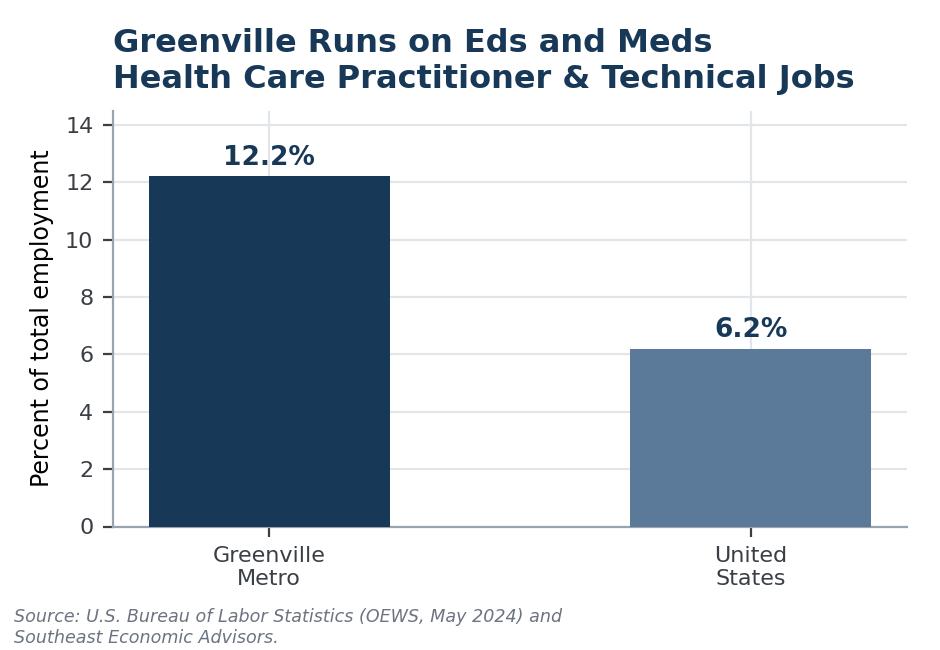
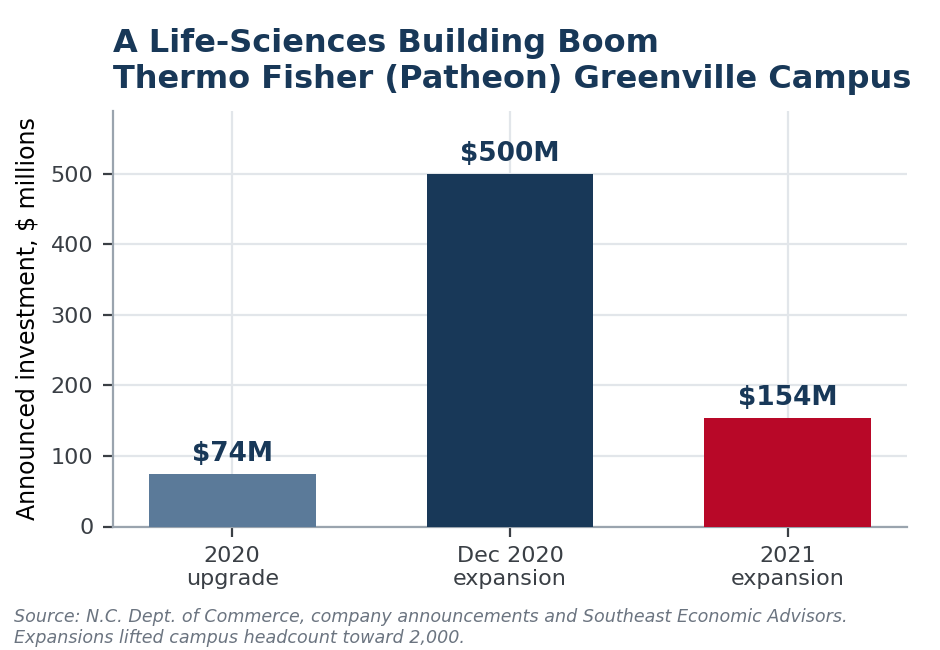
What sets Greenville apart from a typical eds-and-meds town is the pharmaceutical base that has grown up alongside the hospitals. The Thermo Fisher Scientific campus, still known to many locals by its Patheon name, is the county’s largest industrial employer and one of the company’s most important sites anywhere. A wave of expansions since 2020, including a 500-million-dollar build-out and a follow-on investment of more than 150 million dollars, has pushed headcount on the campus toward 2,000 and lifted the region’s profile as a center for sterile-fill and contract drug manufacturing. Catalent, Mayne Pharma and a deepening network of suppliers round out a cluster that did not exist at this scale a decade ago, and homegrown firms such as Grover Gaming, a software company founded in Greenville, show the base broadening beyond the hospitals. The result is a local economy that increasingly looks capital-led rather than consumption-led, with high-wage manufacturing and clinical jobs paying well above the area average and drawing investment that tends to stay put. Health-care practitioner and technical occupations alone account for better than 12 percent of area employment, nearly double the national share.
Boone: A High-Country Economy with a Personality All Its Own
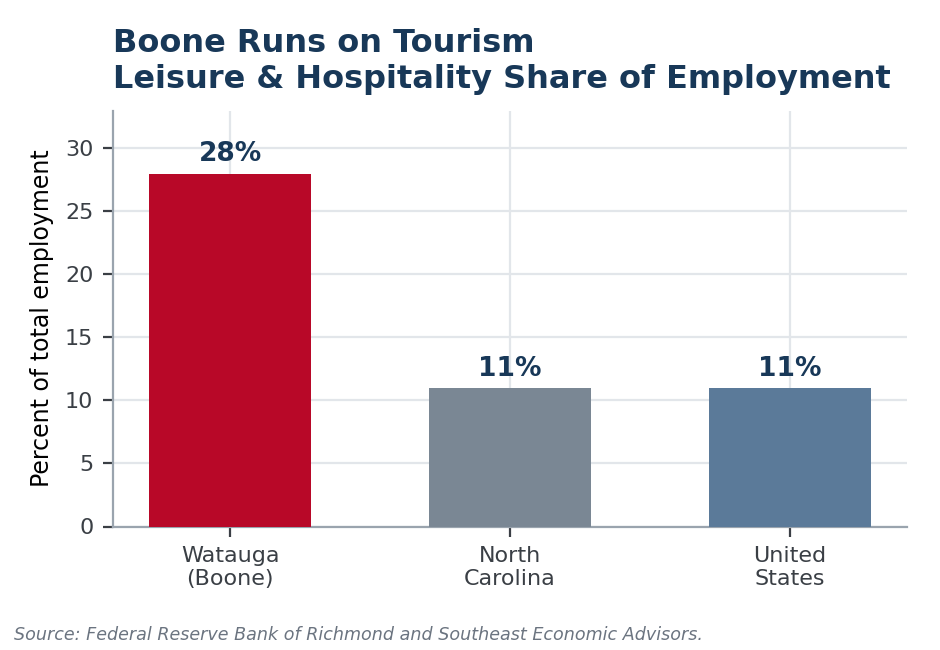
Boone could hardly be more different. The seat of Watauga County sits high in the Blue Ridge, a small mountain town of roughly 19,000 residents whose economy swells and contracts with the seasons. Appalachian State, with more than 20,000 students, is the steady anchor, but the defining feature of the local economy is tourism. Leisure and hospitality account for about 28 percent of total employment in Watauga County, nearly triple the national share, a concentration that turns ski season, leaf season and football Saturdays into the rhythm of the entire economy. Visitors come for the slopes at Sugar, Beech and Appalachian, for Grandfather Mountain and the Blue Ridge Parkway, and for the kind of small-town character that the High Country has spent decades cultivating, from the Mast General Store and Tweetsie Railroad to the long shadow of Doc Watson and the music tradition just down the mountain.
Boone’s reach extends well beyond the town limits. Boone serves as the commercial hub of the High Country, a seven-county mountain region of more than 200,000 residents that holds some of the highest peaks in the eastern United States, and people drive in from the surrounding counties to shop, dine and see a doctor. The calendar runs on the seasons. Ski areas at Sugar, Beech and Appalachian fill the hotels from Thanksgiving through March, and that same Thanksgiving weekend opens a brisk Christmas tree season, since the High Country is one of the nation’s leading growers of Fraser firs. Summer brings a different crowd. With July highs near 79 degrees, roughly ten degrees cooler than Charlotte and far less humid, Boone and neighboring Blowing Rock and Banner Elk have long been a refuge for part-time residents escaping the heat of Florida and the Deep South. That seasonal churn is the engine, and it is also the vulnerability, because a soft winter or a disrupted fall, as the area learned after Hurricane Helene, lands directly on the businesses that depend on visitors.
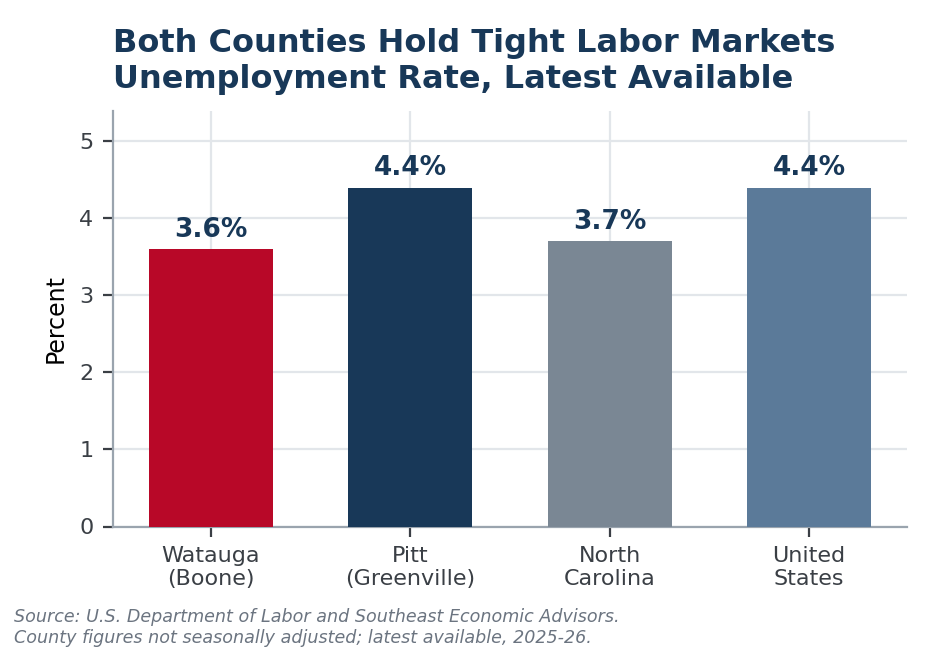
That tourism gravity has a flip side, and it shows up most clearly in housing. The median home price in Watauga County now runs near 600,000 dollars, and close to half of all property tax bills are mailed out of county, a telltale sign of just how much of the housing stock is held as second homes. Demand from outside owners has been a boon for property values and the construction trades, but it has steadily squeezed affordability for the workers who keep restaurants, shops and resorts running. The most important recent chapter in the area’s story is recovery. Hurricane Helene tore through the High Country in late September 2024, and the rebuild has dominated the local economy ever since. A year out, the picture is encouraging but uneven. Sales tax collections have climbed back above prior-year levels, suggesting visitors who do come are spending freely, even as lodging and occupancy revenue has stayed soft against the long road back for tourism. For all of that, the labor market has stayed remarkably tight. Watauga County’s unemployment rate sat at just 3.6 percent in the most recent reading, among the lowest in North Carolina.
A Word on Barbecue
No North Carolina matchup is complete without acknowledging the state’s other great rivalry, the one fought over barbecue. North Carolina is split down the middle by a sauce line as real as any conference boundary. In the east, barbecue means the whole hog, cooked low and slow over a banked pit, then chopped and drenched in a thin sauce drawn from the drippings and sharpened with vinegar, salt and red pepper. That the style took hold in the part of the state that raises so many hogs is no accident. In the Piedmont and on into the mountains, the western school takes over, built on the pork shoulder, cooked more like a brisket, then pulled and finished with a red dip of vinegar, tomato or ketchup, a little brown sugar and pepper, and served with a slaw dressed in that same sauce.
On this score, the geography lines up neatly with the matchup. Greenville sits squarely in the heart of eastern, whole-hog, vinegar country, with Ayden’s Skylight Inn and a generation of Jones-family pitmasters just down the road serving as the gold standard for the style. Boone, up in the mountains beyond even the Lexington belt, falls on the western, tomato-touched side of the divide. Pirates fans will bring the vinegar; Mountaineer fans will bring the dip. That backdrop fits a game that pits the coast against the mountains, a reminder that in North Carolina, even the side dishes pick a side.
The Outlook
On the field, the trend lines point toward the home team. East Carolina enters as the more established Bowl Subdivision program at the moment, fresh off nine wins and a ranking last year, and it holds home-field advantage in a building that has grown comfortable hosting bigger names. Appalachian State has the history, the series edge and a coach in year two who knows how to score points, but a roster still finding its footing makes this a tougher spot than the recent results between these two might suggest. We would make the Pirates a clear favorite, while respecting that the Mountaineers have a long habit of ignoring the point spread. The one shared data point so far, a rough season opener against a College Football Playoff-caliber Alabama defense, tells us more about the gap between the Pirates and the sport’s true blue bloods than it does about this Saturday. For the season as a whole, East Carolina looks like a team capable of reaching eight or nine wins and contending in the American, while Appalachian State should take a step forward toward bowl eligibility as Loggains’ rebuild matures. Off the field, both communities are winners. Greenville’s life-sciences engine and Boone’s tourism-and-university economy are two of the more durable local stories in the state, even if they could scarcely look more different from one another.
Economic Snapshot
| Greenville / Pitt County | Boone / Watauga County | |
|---|---|---|
| County population (2025 est.) | ~183,000 | ~57,000 |
| Largest city or town | Greenville, ~95,000 | Boone, ~19,000 |
| Regional role | Hub of 14-county Middle Coastal Plain | Hub of 7-county High Country (~200K) |
| Anchor university (enrollment) | East Carolina, 27,000+ | Appalachian State, 20,000+ |
| Largest employer | ECU Health (12,000+; eastern NC) | Appalachian State University |
| Defining industries | Health care, education, pharma | Tourism, higher education, housing |
| Largest industrial employer | Thermo Fisher / Patheon (~1,900) | Hospitality and resort base |
| Unemployment rate (latest) | ~4.4% | 3.6% |
| Signature concentration | Health-care jobs ~2x U.S. share | Leisure & hospitality 28% of jobs |
| Housing note | Demand rising near ECU / medical core | Median ~$600K; ~48% of bills out of county |
| Top-of-mind driver | $700M+ life-sciences build-out | Hurricane Helene recovery (Sept 2024) |
| SEA outlook | Above-average, capital- and eds/meds-led | Steady, tourism-led, affordability-tight |
Table 4. The two host economies. Sources: U.S. Census Bureau, U.S. Department of Labor, N.C. Department of Commerce, company announcements and Southeast Economic Advisors. Figures rounded; outlook reflects SEA estimates.
Football Snapshot
| East Carolina Pirates | Appalachian State Mountaineers | |
|---|---|---|
| Conference (2026) | American | Sun Belt |
| Head coach (2026) | Blake Harrell (2nd season) | Dowell Loggains (2nd season) |
| Home stadium | Dowdy-Ficklen (~50,000), Greenville | Kidd Brewer / The Rock (~30,000), Boone |
| Record: 2023 / 2024 / 2025 | 2-10 / 8-5 / 9-4 | 9-5 / 5-6 / 5-8 |
| 2025 postseason | Won Military Bowl; finished No. 18 | Lost Birmingham Bowl to Ga. Southern |
| 2026 opener (Sept. 5) | L 10-48, at Alabama | W 55-3, vs. Maine |
| All-time series | Trails App State, 12-22 | Leads ECU, 22-12; won last three |
| Last meeting | Sept. 14, 2024 (lost 19-21, home) | Sept. 14, 2024 (won 21-19, at Greenville) |
| Calling card | Pirate Nation; loud home crowds | Three FCS titles; road upsets at Michigan (2007) and Texas A&M (2022) |
Table 5. Sources: ECU Athletics, Appalachian State Athletics, ESPN, Sports Reference and Southeast Economic Advisors.
Mark Vitner | Chief Economist, Southeast Economic Advisors
About this report
This Week Two issue is published by Southeast Economic Advisors and combines three regular features: a review of the prior week’s games and its effect on the national rankings, a look ahead to the coming week’s biggest matchups, and a paired on-field preview and economic outlook for the two communities hosting our featured game. Economic figures come from the U.S. Bureau of Labor Statistics, the U.S. Bureau of Economic Analysis, the U.S. Census Bureau and the sources cited in each section, and are subject to revision. Metropolitan employment totals are seasonally adjusted; industry detail and unemployment rates are not. Football results reflect games played through September 6, 2026. The Associated Press released its Week Two poll on Sunday, September 6, 2026; rankings and betting lines move throughout the week and are current as of the publication date above.
This material is provided for informational and educational purposes only and does not constitute investment, legal, tax or financial advice, nor a recommendation regarding any security or wagering market. Opinions reflect our judgment as of the publication date and are subject to change. Figures are drawn from sources we believe to be reliable, but their accuracy and completeness are not guaranteed.
© 2026 Southeast Economic Advisors. All rights reserved.