
SOUTHEAST ECONOMIC ADVISORS
Sports Economics | Regional Report
Carolina Blue vs. Horned Frog Purple
UNC and TCU Open 2026 in Dublin
The Aer Lingus College Football Classic, a Week Zero preview and economic outlook for Chapel Hill and Fort Worth
The 2026 college football season opens not in the Southeast but across the Atlantic, where TCU and North Carolina meet at Dublin’s Aviva Stadium on Saturday, August 29 at noon Eastern time (5:00 p.m. in Ireland). The Aer Lingus College Football Classic is serving as the sport’s Week Zero kickoff for the fifth straight year, and TCU is the designated home team and a 7.5-point favorite.
It is a quick rematch, and an uncomfortable one for the Tar Heels, who lost 48–14 to TCU in Chapel Hill last September in Bill Belichick’s debut as a college head coach. North Carolina still leads the all-time series 3–1, but the four prior meetings span 85 years (1940, 1994, 1997 and 2025), and Dublin will be the first on neutral ground and the first international game in either program’s history.
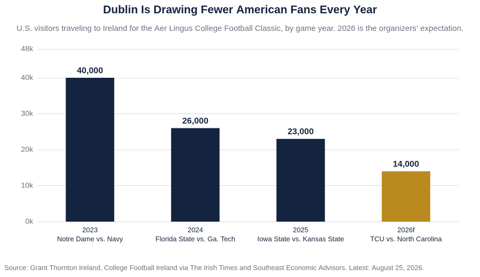
The game is also an economic event, and a smaller one than it used to be, with organizers expecting roughly 14,000 American visitors this week against about 23,000 for last year’s Iowa State–Kansas State opener and about 40,000 when Notre Dame and Navy played here in 2023. Chapel Hill and Fort Worth arrive in Dublin with employment growth 1.5 percentage points apart, a gap that has nothing to do with football.
At a Glance
- TCU opens a 7.5-point favorite with the total at 47.5 points. Neither team is ranked, and North Carolina drew no votes at all in the preseason AP poll and was picked 15th of 17 in the ACC.
- Both teams start a quarterback who has never taken a snap for them. Both play-callers were hired in the same December week, and Bill Belichick will call the North Carolina defense himself while his son is on medical leave.
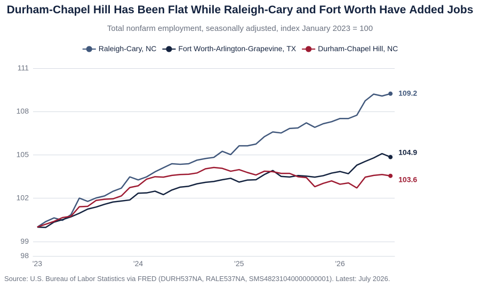
- Durham–Chapel Hill payrolls fell 600 jobs over the past year while Raleigh–Cary added 17,300. Federal research funding cuts are the difference. UNC-Chapel Hill’s research awards fell 9.5 percent in fiscal 2025.
- It is the drag on a dynamic region, not a weak one. The ten-county combined area holds 2.48 million residents and grew 2.0 percent, and Durham–Chapel Hill is past its trough, up 2,900 jobs since March.
- Fort Worth is now the tenth-largest city in the country at 1,028,117 residents. It landed $6.7 billion of capital investment in fiscal 2025 and has begun manufacturing AI hardware rather than merely hosting it.
- Franklin Street accumulated its value over a century; West Berry Street is being purchased. TCU is spending $83 million on the corridor inside a $500 million campus plan, in a district with neither a public improvement district nor a TIF.
- Dublin is drawing fewer Americans every year. Organizers expect roughly 14,000 U.S. visitors against about 40,000 in 2023, and no impact projection has been published for this year’s game.
| TCU Horned Frogs | North Carolina Tar Heels | |
|---|---|---|
| Conference | Big 12 | ACC |
| Head coach | Sonny Dykes (5th season, 36–17) | Bill Belichick (2nd season, 4–8) |
| 2025 record | 9–4, Alamo Bowl champion | 4–8, missed bowl |
| Final 2025 AP poll | No. 25 | Unranked |
| 2026 preseason media pick | 6th of 16 in the Big 12 | 15th of 17 in the ACC |
| 2026 preseason AP poll | Unranked (11 votes) | Unranked (no votes) |
| 2026 projected win total | 6.5 | 4.5 |
| 2026 starting quarterback | Jaden Craig (Harvard transfer) | Billy Edwards Jr. (Wisconsin transfer) |
| Home stadium | Amon G. Carter Stadium (~47,000) | Kenan Stadium (~50,500) |
| All-time series | 1–3 | 3–1 |
| Dublin 2026 | Designated home team, 7.5-point favorite | Visiting team, 7.5-point underdog |
Table 1. The tale of the tape. Sources: ESPN, the Associated Press poll archive, the ACC and Big 12 preseason media polls, school athletics and Southeast Economic Advisors. Records and rankings reflect the completed 2025 season; betting lines are the consensus across seven books on August 27, 2026.
A Transatlantic Rematch: Week Zero Goes Global
Dublin has hosted ten college football games and stages its eleventh on Saturday, the fifth consecutive year the Aviva Stadium has opened the American season. Week Zero, the handful of games staged a week before college football’s traditional Labor Day opening, has carried the sport’s international schedule for five years running. Eleven games have been played in Ireland since 1988, all but one of them in Dublin, and Saturday marks the first appearance by a team from Texas. Week Zero itself keeps growing, from four games in 2024 to five in 2025 and eight this year, though only one of the eight involves a team ranked in the preseason coaches’ poll, No. 14 Southern California.
Last year’s game generated €132 million for the Irish economy, and the first four games of the current series generated €514 million between them, according to Grant Thornton Ireland. The 2025 opener drew 47,226 spectators, 25,999 of them international visitors, and the 22,910 who came from the United States stayed an average of 7.1 nights. The 4.7 million viewers ESPN drew at the telecast’s peak were worth more to both athletic departments than the 47,226 in the building.
The American travel party has shrunk in each of the past three years, however, and organizers expect roughly 14,000 U.S. visitors this week against about 40,000 for Notre Dame and Navy in 2023. Tickets remained available through Ticketmaster.ie two days before kickoff, with student seats from €50, and no organizer has published an economic-impact projection for this year’s game. Notre Dame and Navy travel, two unranked teams from Fort Worth and Chapel Hill apparently do not, and we would not assume the €132 million figure repeats.
Ireland’s infrastructure is proven across eleven games since 1988, which the ACC’s own experiment this year was not. The conference had planned to open 2026 with NC State and Virginia in Rio de Janeiro, the first FBS game in South America, but the organizer informed the ACC on June 3 that the game could not be staged, and it was moved to Scott Stadium in Charlottesville on the same date. Ireland is planning to keep hosting through 2037, pending approval, with Pittsburgh and Wisconsin already booked for 2027, and we expect the series to hold its slot as long as it can keep drawing a brand-name traveling side.
Low Expectations on Both Sides of the Atlantic
Neither team is ranked, and the betting market opened the week with TCU a 7.5-point favorite and the total at 47.5 points, which prices Saturday as a modest Horned Frog win instead of a repeat of last year’s rout. TCU is quoted between -300 and -330 on the moneyline across the major books, and the total has drifted down two points from an opening 49.5. The SportsLine model projects about 51 combined points, several points above the posted number, and plays the over.
North Carolina was picked 15th of 17 in the ACC preseason media poll, drew no votes in the preseason AP Top 25 and carries a win total of 4.5 games, about as little expectation as a Bill Belichick team has ever carried. That prices a second straight year without a bowl. The schedule offers no relief, with five opponents drawn from the ACC preseason top seven (Miami, Louisville, Clemson, Virginia and NC State) plus Notre Dame on October 3.
TCU carries more modest expectations than its 2022 title-game run once implied, picked sixth of sixteen in the Big 12 preseason poll with a 6.5-game win total and 11 stray votes in the preseason AP poll. The Horned Frogs have, however, won six of their last seven against teams now in the ACC, including last September in Chapel Hill. We expect the line to hold near a touchdown unless North Carolina’s rebuilt offensive front, which returns two starters, gives Jaden Craig less time than TCU’s defense gave the Tar Heels a year ago.
Sources: consensus of bet365, BetMGM, DraftKings, Caesars, FanDuel, Fanatics and BetRivers via scoresandodds.com on August 27, 2026; the ACC and Big 12 preseason media polls; the Associated Press preseason poll of August 17, 2026; SportsLine.
The Programs
TCU: Two Straight Nine-Win Seasons and a New Quarterback
TCU football dates to 1896, claims national championships in 1935 and 1938, the latter powered by Heisman winner Davey O’Brien, and reached the College Football Playoff title game in 2022 in Sonny Dykes’s first season. That run included a 12-0 regular season and a Fiesta Bowl semifinal upset of Michigan. Dykes is 36–17 in four seasons and signed a multiyear extension in April that runs past 2028.
The Horned Frogs have won nine games in each of the past two seasons, closing 2025 at No. 25 in the final AP poll after beating No. 16 USC 30–27 in overtime in the Alamo Bowl. It was TCU’s first appearance in a final poll since the 2022 title run, and it came with a 5–4 conference record in a Big 12 that sent four other teams to the final rankings.
The offense turns over almost entirely, with quarterback Josh Hoover (3,472 yards and 29 touchdowns in 2025) transferring to Indiana and coordinator Kendal Briles leaving for South Carolina. Jaden Craig, a fifth-year graduate transfer who left Harvard as its all-time leader with 6,074 passing yards and 52 touchdowns, takes over under new coordinator Gordon Sammis, whose UConn offense averaged 35.3 points a game last season. Safety Jamel Johnson (96 tackles, five interceptions) and receiver Jordan Dwyer, who put up 136 receiving yards against North Carolina last September, both return.
North Carolina: Year Two of the Belichick Experiment
North Carolina’s first season under Bill Belichick ended 4–8 and 2–6 in the ACC, the program’s first bowl miss since 2018, behind an offense that averaged 19.3 points and 288.8 yards a game, the latter 131st among 136 FBS teams. The Tar Heels scored 24 offensive touchdowns in twelve games, lost five games by double digits and closed with a fifth straight defeat to rival NC State.
Belichick fired his offensive and special teams coordinators in December and hired Bobby Petrino, whose Arkansas offense ranked 13th nationally at 454.8 yards a game, to fix the side of the ball that failed. Roughly 60 new players are on the roster, about 40 of them freshmen, and only two offensive and three defensive starters return. The high school class ranked between 14th and 22nd depending on the service, but the transfer class, which supplies most of the snaps in a second-year rebuild, ranked 52nd by 247Sports and 63rd by Rivals.
Billy Edwards Jr., a sixth-year quarterback who threw for 2,881 yards and 15 touchdowns at Maryland in 2024 before tearing a knee ligament in Wisconsin’s 2025 opener, was named the starter on August 21 after close to 2,000 snaps in spring practice and training camp. Belichick rested the decision on consistency and experience rather than any single throw, saying it was “kind of a whole composite of it, and he just came out ahead.”
The off-field record has not improved, with general manager Michael Lombardi placed on paid administrative leave on July 27 amid an internal human-resources investigation and the College Sports Commission opening an inquiry into the program the same week. Defensive coordinator Steve Belichick began an indefinite medical leave on August 6, is not expected to travel to Dublin and his father will call the defense himself on Saturday, and Bubba Cunningham handed the athletic department to Steve Newmark this summer, ending an athletic-director tenure that began in 2011. Coverage of Belichick’s personal life, including a public-records request the university estimated at nearly 800,000 pages, has drawn more national attention over the past year than anything the team did on the field.
North Carolina also lost its leading scorer to an appellate docket, sixteen days after a court gave him back. Kicker Rece Verhoff scored 77 points in 2025 on 19 of 23 field goals and 20 of 20 extra points, including a program-record 57-yarder against Wake Forest. He returned on August 5 under a court injunction granting class-of-2022 players a fifth season, then lost eligibility again when the Tenth Circuit stayed that injunction on August 21. Roster availability now turns on litigation rather than on rules, which is a cost of the post-settlement era that no athletic department has learned to budget for.
Belichick is paid $10 million a year on a contract guaranteed through December 31, 2027, so the cost of dismissing him without cause falls to roughly $10 million in January and to nothing a year after that. That arithmetic, more than the preseason poll, is what makes year two a referendum. Measurable improvement means an offense scoring in the mid-20s instead of 19.3 points a game, six wins and a bowl bid and a program that stops generating investigations. Belichick set the near-term bar himself this week, saying the first thing against TCU is “not to beat ourselves,” and covering the 7.5-point spread in Dublin would be a reasonable first data point where a second five-touchdown loss would not.
Sources: NCAA official statistics via cfbstats, ESPN, the Associated Press, On3, 247Sports, Rivals, WRAL, The Assembly, school athletics and Southeast Economic Advisors. Statistics reflect the completed 2025 season.
Key Players to Watch
Both teams will start a quarterback who has never taken a snap for them, and both will run an offense installed by a coordinator hired in the same December week. TCU’s Gordon Sammis came from UConn and North Carolina’s Bobby Petrino from Arkansas, so neither play-caller has a body of work with these personnel to scout. The only coordinator on either sideline with continuity is TCU defensive coordinator Andy Avalos, in his third year, and Bill Belichick will call North Carolina’s defense himself in his son’s absence.
| Player | Team | Why Saturday matters |
|---|---|---|
| Jaden Craig, QB | TCU | Harvard’s all-time leader with 6,074 passing yards and 52 touchdowns, and 2,869 yards and 25 scores in 2025. Saturday is the first FBS snap of his career, against a defense Bill Belichick is calling personally. |
| Billy Edwards Jr., QB | North Carolina | Threw for 2,881 yards and 15 touchdowns at Maryland in 2024, then threw 16 passes all of 2025 after tearing a knee ligament in Wisconsin’s opener. Named the starter on August 21. |
| Melkart Abou Jaoude, EDGE | North Carolina | Led the ACC with 10.5 sacks and added 12 tackles for loss, the sixth-highest single-season sack total in school history. The best player on the field, aimed at a quarterback making his first FBS start. |
| Jamel Johnson, S | TCU | 96 tackles and five interceptions in 2025, the most picks in the Big 12 and seventh nationally. On the Nagurski and Bednarik watch lists. |
| Jordan Dwyer, WR | TCU | 54 catches for 730 yards and seven touchdowns in 2025, including nine for 136 against North Carolina in last year’s opener. Biletnikoff watch list. |
| Jordan Shipp, WR | North Carolina | Led the Tar Heels with 60 catches, 671 yards and six touchdowns. With the leading rusher and leading tackler both gone to the portal, he is the one high-production returner left. |
| Jeremy Payne, RB | TCU | 623 rushing yards and five touchdowns in 2025 and the overtime game-winner in the Alamo Bowl. TCU lost roughly 800 rushing yards to graduation and transfers. |
| Peyton Seelmann, LB | North Carolina | 120 tackles and two interceptions at Richmond in 2025, including nine tackles against North Carolina in September. Replaces Khmori House, who left in the portal. |
| Trech Kekahuna, WR | North Carolina | Wisconsin transfer with 26 catches and 129 rushing yards in 2025, and the only receiver on the roster who has caught passes from Edwards before. |
| Rece Verhoff, K | North Carolina | Will not play. Scored 77 points in 2025 on 19 of 23 field goals, regained a fifth year by injunction on August 5 and lost it to an appellate stay on August 21. |
Table 2. Key players to watch. Sources: TCU Athletics, North Carolina Athletics, cfbstats, WRAL, 247Sports and Southeast Economic Advisors. Statistics reflect the completed 2025 season.
Chapel Hill and the Research Triangle: An Education Economy Under Pressure
The town of Chapel Hill was laid out in 1793 around the University of North Carolina, chartered in 1789 as the nation’s first public university and opened to students in 1795. For much of its early history education was the town’s only major industry, and as of June the Durham–Chapel Hill metro area still drew 42.6 percent of its employment from private education & health services and government combined. UNC-Chapel Hill enrolls 34,099 students and employs roughly 14,400 people before counting UNC Health.
The region’s problem this year is that its principal industry is federally funded, and UNC-Chapel Hill’s research awards fell 9.5 percent in fiscal 2025, to $1.10 billion from $1.21 billion, the steepest decline in at least fifteen years. Federal sponsors accounted for 62 percent of awards and the National Institutes of Health for 76 percent of the federal share. The Daily Tar Heel tallied $38.4 million of terminated and stop-work federal awards as of September 2025, and the university has since raised its operating savings target to roughly $90 million, of which $17.5 million had been banked by late July.
A unanimous First Circuit panel affirmed the vacatur of the 15 percent cap on NIH indirect-cost recovery on January 5, but the money has been slow to move even with the cap gone. NIH had obligated $23.3 billion by July 31, about 69 percent of its grant budget and roughly $2.4 billion behind the fiscal 2024 pace at the same point, leaving $10.6 billion to place in two months, though the agency says it is ahead of last year on award count and on track to spend its full budget. Duke, Durham County’s largest employer, set a $364 million cost-reduction target and accepted 599 voluntary separations.
Durham–Chapel Hill does not stand alone, and it is the drag on an otherwise dynamic region: the ten-county Raleigh–Durham–Cary combined statistical area holds 2,484,238 residents and grew 2.0 percent in the year to July 2025, with Raleigh–Cary alone ranking tenth among the nation’s 387 metro areas in percentage growth. Payrolls across the two metropolitan areas that make up the bulk of the CSA rose 16,700 (+1.5 percent) over the year through July, but every one of those jobs and then some came from Raleigh–Cary. Strip Durham–Chapel Hill out and the region grew payrolls 2.3 percent; leave it in and the CSA grew 1.5 percent, more slowly than Fort Worth’s metropolitan division.
Durham–Chapel Hill employment fell by 600 jobs (-0.2 percent) in the year through July, while Raleigh–Cary, thirty minutes down Interstate 40, added 17,300 (+2.3 percent). Government payrolls in the Durham metro, which is where UNC and UNC Health employees are counted, are down 3.0 percent over the past year, and manufacturing is down 4.1 percent. Durham–Chapel Hill employment peaked in October 2024 and sits 2,000 jobs below that level, while Raleigh–Cary has added 31,600 over the same span. The trough appears to have passed, however: Durham–Chapel Hill bottomed at 356,000 in March and has added 2,900 jobs in the four months since, and Durham County’s nominal GDP grew 8.7 percent in 2024, faster than Wake’s 6.5 percent.
The offsetting investment is landing east of Orange County, where AbbVie committed $1.4 billion and 734 jobs to a Durham campus in April. Genentech more than doubled its Holly Springs investment to roughly $2 billion in January, and Novartis announced $771 million and 700 jobs across Durham and Wake counties in November. Merck, however, is winding down Gardasil production and cutting 154 Durham jobs effective May 1, 147 of them at the $1 billion plant it opened only in 2025.
Chapel Hill’s own answer is Carolina North, roughly 230 acres of planned development on a 974-acre university-owned tract, announced in January as the largest physical expansion in UNC’s 232-year history. The first phase covers 100 to 150 acres and roughly 2,200 student beds, with academic and research facilities in biomedical engineering and artificial intelligence to follow. UNC plans to add 5,000 undergraduates over ten years, and first-year applications are up 45 percent over five, but groundbreaking is scheduled for the summer of 2027 and Carolina North will not add payrolls inside the current forecast horizon.
Orange County itself is in better shape than the payroll data suggests, with retail vacancy at 3.88 percent in the second quarter against 5.20 percent Triangle-wide, and flex and life-science vacancy down to 4.28 percent from 10.31 percent at the end of 2025. The county unemployment rate was 3.3 percent in June. CITEL America, the U.S. arm of the French surge-protection manufacturer, is moving its North American headquarters from Florida to Hillsborough with 57 jobs at an average wage of $83,611 against the county average of $69,728. Chapel Hill adopted a $170.0 million budget for fiscal 2027, up 3.6 percent, and held its property tax rate flat at 50.0 cents on the strength of sales tax collections, while Orange County raised its rate 4.22 cents to 68.05 cents.
Downtown Chapel Hill is finally building, and the enabling asset was a parking deck. The $51 million, 1,100-space garage that opened on East Rosemary Street in August 2024 cleared the way for the redevelopment around it, and BioLabs NC opened a 23,000 square foot shared wet lab on the Franklin and Rosemary block in June 2025, the town’s first off-campus lab space. Ram Realty is converting the old University Place mall into a $160 million project with more than 350,000 square feet of retail, 253 apartments and a Barnes & Noble due in the fourth quarter, and the town council approved $280,000 of parking credits in April to move a roughly $28 million Element by Marriott hotel off the drawing board. Not every bet has paid off, however: Longfellow abandoned a nine-story, 320,000 square foot life-science tower at 306 West Franklin that would have been the tallest building in town, and Redgate filed a replacement plan in June for 225 apartments, which is the rational response to a research funding shock and an admission that the wet-lab thesis arrived a cycle early.
The median Chapel Hill home sold for $657,642 over the three months through June, up 9.6 percent from the same period a year earlier, while the Wake County median fell to $485,000 in July on record inventory. Orange County has added 2.5 percent to its population since 2020 against 11.3 percent in Wake, so the price gap is a supply story and not a demand boom. We expect Chapel Hill prices to stay elevated relative to the size of the local economy until Carolina North and the town’s own approvals deliver units, and the condition that would change that call is a federal research budget that returns to its fiscal 2024 obligation pace.
Sources: U.S. Bureau of Labor Statistics and U.S. Bureau of Economic Analysis via FRED, UNC Research, UNC Finance & Operations, the First Circuit, Inside Higher Ed, The Daily Tar Heel, Tri Properties, NC Commerce, Chapelboro, Redfin, Doorify MLS, the U.S. Census Bureau and Southeast Economic Advisors. Metro GDP is our sum of BEA county estimates for 2024; Redfin medians are rolling three-month figures.
Fort Worth: From Cowtown to Aerospace and AI Hardware
Fort Worth was founded in 1849 as a frontier outpost on the Trinity River and grew into the cattle-and-rail hub nicknamed Cowtown, and TCU’s arrival is woven into that identity. Founded as Add-Ran College in 1873 and forced to relocate after a 1910 fire destroyed its Waco campus, the university chose Fort Worth in part because city leaders, eager to soften the rowdy Cowtown image, offered fifty acres, $200,000 and streetcar service. Classes opened on the present southwest campus in 1911.
Fort Worth crossed one million residents and now ranks as the tenth-largest city in the country, with 1,028,117 people as of July 1, 2025 and a one-year gain of 19,512, the second-largest numeric increase of any American city behind Charlotte. Tarrant County holds 2,248,466 residents, and county GDP reached $178.0 billion in 2024, up 6.2 percent from 2023. Metro-division payrolls rose 1.3 percent over the year through July, and the wider Dallas–Fort Worth metro area posted the largest over-the-year job gain of any metropolitan area in the country in June, at 54,600.
Lockheed Martin’s Fort Worth plant employs 19,000 people and delivered 191 F-35s in 2025, an all-time record set as it worked off a delivery backlog, with the line itself running at 156 aircraft a year. About 5,000 machinists ratified a five-year contract in June that averts a strike through mid-2031. The fiscal 2027 request seeks 85 aircraft, however, and only 32 sit in the base discretionary budget, with the other 53 riding on a reconciliation bill whose passage is not assured.
Fort Worth also lost the Air Force’s sixth-generation fighter, awarded to Boeing as the F-47 in March 2025, so the city’s next franchise program is Bell’s MV-75. Bell Textron began construction in April on a $632 million, 448,000 square foot plant at AllianceTexas to build rotor blades and transmissions for the Army’s Black Hawk replacement, with up to 520 jobs and low-rate production targeted for 2028, alongside a separate remodel of its existing Fort Worth plant for aircraft assembly. Bell employs roughly 4,000 people in the city, and more than 1,000 of them already work on the program.
Fort Worth has begun building artificial-intelligence hardware instead of merely hosting it, and Wistron, NVIDIA’s contract manufacturer, opened a $700 million, 324,000 square foot plant in July making GB300 Grace Blackwell Ultra systems with 500 employees and 1,000 targeted by year end. Celestica committed $876 million and roughly 1,700 jobs across two Alliance Center North facilities in May, and Siemens opened a $190 million electrical-equipment plant in south Fort Worth in March 2025 that is ramping toward 800 jobs. The $2.1 billion ACS Group data center approved near Saginaw will employ 37 people, against roughly 4,000 across those three manufacturing announcements.
Downtown is acquiring an institutional core it has never had, starting with the eight-story, 228,000 square foot law and education building Texas A&M opened on August 5 at a cost of roughly $200 million. The system broke ground the same day on an eleven-story research building budgeted at up to $260 million, and the city advanced the $606 million second phase of a $701 million convention center expansion in February, with completion set for early 2030. Visitors totaled 11.7 million in 2025 and generated $3.6 billion of economic activity, up from 11.5 million and $3.5 billion in 2024, and the FIFA World Cup matches in Arlington lifted Stockyards traffic 85 percent during the tournament, to 1.8 million.
TCU enrolled the largest first-year class in its 153-year history this fall, with more than 2,800 new students and record undergraduate enrollment above 11,000. A Tripp Umbach study of fiscal 2023, released in 2024, put the university’s national economic impact at $2.1 billion, $1.6 billion of it in Texas and $1.3 billion in Fort Worth. TCU is funding a $300 million scholarship initiative and roughly 2,500 new residence beds, and its Burnett School of Medicine placed 100 percent of its graduating class into residencies for a fourth consecutive year.
Downtown’s weak spot is its most famous address, and its owners conceded the point in May. Sundance Square, the 3.7 million square foot, roughly 35-block district the Bass family has controlled since the 1970s, has somewhere between 14 and 25 percent of its storefronts empty depending on whether the count comes from management or from the Star-Telegram, and in May 2026 the family handed retail leasing for more than 105,000 square feet to JLL, the first time that function has gone outside. Downtown around it is healthy, with 21 million visits in 2025, up 3 percent, 52,800 employees and office vacancy of 11.8 percent against 18.3 percent metro-wide.
The median Fort Worth home sold for $339,815 over the three months through June, essentially unchanged from a year earlier, with sales up 5.0 percent and days on market at 46. The broader North Texas market carried 4.1 months of supply in May, roughly balanced. A median price near half of Chapel Hill’s is what allows the city to absorb close to 20,000 new residents a year, and we expect that advantage to hold as long as builders keep pace with in-migration.
Sources: U.S. Census Bureau, U.S. Bureau of Labor Statistics and U.S. Bureau of Economic Analysis via FRED, Lockheed Martin, Military Times, Hillwood, NVIDIA, KERA News, the City of Fort Worth, Visit Fort Worth, Downtown Fort Worth Inc., the Texas A&M University System, TCU, Tripp Umbach, Redfin and Southeast Economic Advisors.
Two Main Streets: Franklin and West Berry
Each university has a commercial street along its campus edge, and the two are the clearest illustration of how differently these economies were built. Franklin Street runs three miles along the north side of the UNC campus and carries five businesses that have operated there more than fifty years, among them Sutton’s Drug Store, which opened in 1923. It is also the town’s civic ritual: roughly 55,000 people filled the intersection at Columbia Street after the 2017 national championship and 35,000 to 40,000 after the 2022 Final Four win over Duke, which the town prepared for by greasing the light poles.
West Berry Street runs along the south side of the TCU campus and plays the same role, but its value is being purchased rather than accumulated. Fort Worth has zoned the Berry and University corridor as an urban village with a form-based code since 2007, yet the district has neither a public improvement district nor a tax increment district, so its improvement capacity is TCU’s balance sheet rather than a self-taxing budget. The university assembled 21 lots into 5.2 acres and is building Morado on Berry, an $83 million project with roughly 780 beds and about 25,000 square feet of ground-floor retail that topped out on July 31 and delivers for the 2027 academic year, inside a $500 million, 35-project campus plan.
The contrast runs to the fans as well. When TCU beat Michigan in the Fiesta Bowl semifinal in December 2022 and reached the national championship game, hundreds of Horned Frog fans gathered at a watch party at Sundance Square, five miles from campus, because Berry Street has no such tradition. Chapel Hill accumulated its main street over a century and now has to defend it; Fort Worth is capitalizing one, which is the faster route and the more expensive one. We expect Berry Street to look materially different by the 2027 season, and the condition that would change that view is a TCU enrollment plan that stalls short of its 17,900 target.
Sources: the City of Fort Worth Berry/University Development Plan, TCU, Endeavor Real Estate Group, Tri Properties, Downtown Fort Worth Inc., the University of North Carolina, Chapelboro and Southeast Economic Advisors.
Two Economies, Side by Side
| Indicator | Durham–Chapel Hill, NC | Fort Worth–Arlington–Grapevine, TX |
|---|---|---|
| Metro GDP (2024, nominal) | ~$71.4 billion | ~$199.4 billion |
| Nonfarm employment (July 2026) | 358,900 | 1,219,900 |
| Employment change, year ago | -600 (-0.2%) | +16,000 (+1.3%) |
| Unemployment rate (June 2026) | 3.2% | 4.6% |
| Population | 625,485 (2025) | ~2.70 million (2024) |
| Median home sale price (3 mo. to June 2026) | $657,642 (Chapel Hill) | $339,815 (Fort Worth) |
| Anchor university enrollment | 34,099 (UNC-Chapel Hill) | 12,980 (TCU, fall 2025) |
Table 3. The two host economies. A note on comparability: These are not like-sized peers. Fort Worth–Arlington–Grapevine is a metropolitan division inside the Dallas–Fort Worth metroplex, the nation’s fourth-largest metro area, so its larger totals partly reflect geography and not relative prosperity. Metro GDP figures are our sums of BEA county estimates for 2024, because BEA discontinued published metropolitan GDP in February 2026. Employment is seasonally adjusted, unemployment rates are not, and both median prices are Redfin rolling three-month figures.
Sources: U.S. Bureau of Economic Analysis, U.S. Bureau of Labor Statistics, U.S. Census Bureau, Redfin, UNC-Chapel Hill, TCU and Southeast Economic Advisors.
The Bottom Line
The 2026 Aer Lingus College Football Classic is a smaller event than the one Dublin staged three years ago, drawing roughly 14,000 American visitors against about 40,000 in 2023, and both programs playing in it have something to prove. TCU is a 7.5-point favorite that most of the sport has stopped thinking about, and North Carolina is a 4.5-win team whose head coach drew a public-records request the university estimated at nearly 800,000 pages. The international model runs on brands, and neither of these teams is ranked.
The host economies make the same point in a different register, with Fort Worth payrolls up 1.3 percent over the past year and Durham–Chapel Hill payrolls down 0.2 percent. Fort Worth is levered to defense procurement, AI hardware and in-migration, all three of which are running strong, while Durham–Chapel Hill depends on a federal research budget that was 69 percent obligated by July 31 and roughly $2.4 billion behind last year’s pace. We expect Fort Worth to keep adding jobs near that pace and Durham–Chapel Hill to stay roughly flat until NIH obligations recover, which is not a local decision.
For both universities the opener buys an ESPN window that drew four million viewers last year, and that visibility is worth more to the program with something to fix. North Carolina will get its answer about Bobby Petrino’s offense and Billy Edwards Jr. before noon on Saturday. If the Tar Heels lose by five touchdowns again, the conversation for the rest of the fall will be about a guarantee that steps down in January and not about a rebuild.
Mark Vitner
Chief Economist, Southeast Economic Advisors
About this report
This Week Zero preview is published by Southeast Economic Advisors and pairs an on-field preview with an economic outlook for the two communities that host the participating universities. Economic figures come from the U.S. Bureau of Economic Analysis, the U.S. Bureau of Labor Statistics, the U.S. Census Bureau and the sources cited in each section, and are subject to revision. Football statistics reflect the completed 2025 season and come from NCAA official statistics via cfbstats. Polls, win totals and betting lines are as of August 27, 2026 and move daily.
This material is provided for informational and educational purposes only and does not constitute investment, legal, tax or financial advice, nor a recommendation regarding any security or wagering market. Opinions reflect our judgment as of the publication date and are subject to change. Figures are drawn from sources we believe to be reliable, but their accuracy and completeness are not guaranteed.
© 2026 Southeast Economic Advisors. All rights reserved.