
No Fooling: April 1 Was a Big Day for Alabama
Executive Summary
April 1, 2026 will be recorded as one of the most consequential single days in Alabama's modern economic history, and the coincidence was not accidental. It was the product of three decades of deliberate industrial strategy. Mercedes-Benz announced a $4 billion commitment to its Tuscaloosa manufacturing plant, the largest capital commitment in MBUSI's 30-year history, while staging world premieres of its new GLE and GLS models on an Alabama factory floor. That evening, the Space Launch System rocket — whose core stage propulsion was designed and managed at NASA's Marshall Space Flight Center in Huntsville — carried four astronauts beyond low Earth orbit for the first time since Apollo 17. Simultaneously, Boeing and the U.S. Department of War announced a seven-year framework to triple PAC-3 missile seeker production at Redstone Arsenal.
Motor vehicles, space exploration, and national defense are now core pillars of Alabama's economy, and all three were on display on the same afternoon. The developments reflect the compounding returns on the institutional, industrial, and human capital investments that Alabama has been building since Mercedes-Benz chose a greenfield site in Tuscaloosa in 1993.
Key Takeaways
- Mercedes-Benz is committing $4 billion to MBUSI Tuscaloosa through 2030, adding the GLC model to its production roster, and celebrating five million vehicles assembled in Alabama since 1997. The plant exports approximately 60% of its output globally, making it one of the largest automotive exporters in the United States.
- Artemis II lifted off April 1, the first crewed lunar mission since Apollo 17 in 1972, and Huntsville was at the center of it. NASA's Marshall Space Flight Center designed and manages the SLS core stage and its four RS-25 engines. President Trump's designation of Redstone Arsenal as the permanent home of U.S. Space Command — announced in September 2025 — brings 1,400 direct positions, with a purpose-built headquarters breaking ground in 2027.
- The Boeing PAC-3 seeker agreement — a seven-year framework to triple production — combined with the $9.8 billion Patriot missile contract awarded in September 2025, represents the most significant expansion of missile defense manufacturing at Redstone Arsenal since the Cold War.
- Alabama recorded $14.6 billion in new capital investment in 2025, shattering its prior record. The headline project is Eli Lilly's $6 billion pharmaceutical manufacturing facility in Huntsville, the largest single private investment in the state's history. ArcelorMittal's $1.2 billion electrical steel plant in Calvert, along with automotive, data center, and rural manufacturing commitments, makes clear the investment cycle has broadened well beyond any single sector.
| Development | Significance |
|---|---|
| Mercedes-Benz $4B | MBUSI Tuscaloosa commits through 2030; adds GLC; celebrates 5 million vehicles. World premieres of new GLE and GLS models held on the Alabama factory floor. Exports 60% of output globally. |
| Artemis II Launch | First crewed lunar mission since Apollo 17 lifts off at 6:35 p.m. EDT. Crew will travel 252,000 miles from Earth — the farthest any humans have ever traveled. SLS core stage managed at NASA Marshall, Huntsville. |
| Boeing PAC-3 Deal | Seven-year framework triples PAC-3 seeker production at Boeing's Huntsville facility. Boeing has already invested $200M+ since 2024. Part of the 'Arsenal of Freedom' initiative underpinning the Golden Dome initiative. |
| Population Growth | Huntsville MSA ranked as the 6th fastest growing in the U.S. (2.6%, 2025); city population up 15.9% since 2020. Daphne-Fairhope-Foley MSA ranked 11th nationally at 2.3%. Baldwin County posted the nation's 3rd fastest employment gain of any county this past year. |
Section 1: Mercedes-Benz — A $4 Billion Vote of Confidence
When Mercedes-Benz chose the Tuscaloosa factory floor to stage the world premieres of the new GLE and GLS models on April 1, it was making a statement. The plant had recently assembled its five-millionth vehicle since opening in 1995 as the first major Mercedes-Benz facility outside Germany. Mercedes-Benz used the occasion to announce a $4 billion capital commitment through 2030 and confirmed that the GLC — one of its highest-volume global models — will enter production in Tuscaloosa in late 2027.
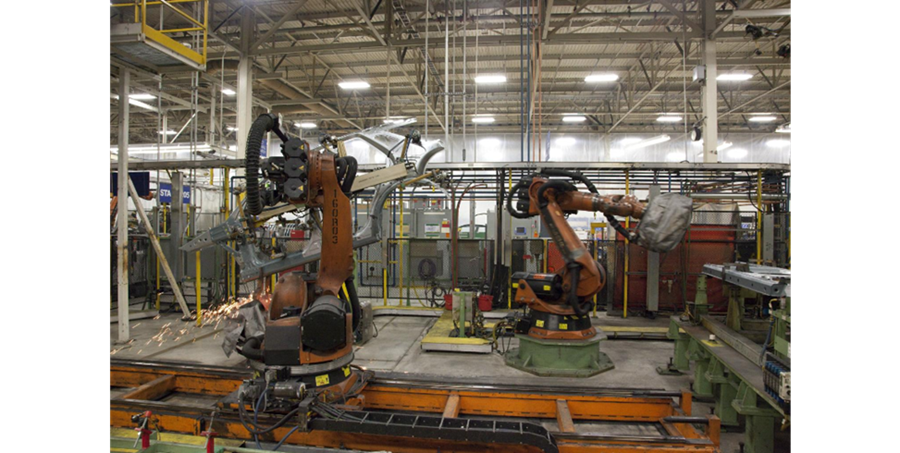
The tariff environment has made domestic production more attractive, but this investment looks like more than a tariff hedge. Anchoring additional model lines in Alabama reflects a longer-term judgment about the plant's cost structure, its workforce, and the depth of the supply chain that has built up around it over thirty years. That supply chain did not exist when Mercedes-Benz broke ground in 1993. Its arrival helped attract Honda to Lincoln, Hyundai to Montgomery, and Mazda-Toyota to Huntsville. Alabama is now a top five auto-producing state with annual output exceeding one million vehicles.
"The new GLE and GLS, alongside the EQE SUV, the EQS SUV and the Mercedes-Maybach EQS SUV, are symbols of our commitment to Alabama. In the future, the localized GLC will further strengthen our U.S. footprint. And for me personally, this place isn't just part of our company's history as the first major plant outside Germany — it marks one of the most important chapters of my own story."
— Ola Källenius, Chairman of the Board of Management, Mercedes-Benz Group AG
MBUSI directly employs approximately 5,800 workers and produces around 260,000 vehicles annually, exporting roughly 60% of output — a scale that places it among the largest automotive exporters in the United States. The $4 billion capital program through 2030 spans production system upgrades, advanced automation, and electrification-ready infrastructure, with the GLC addition scheduled for late 2027. The investment is part of a broader $7 billion-plus U.S. commitment that includes a new research and development hub in Atlanta anchoring Mercedes-Benz's North American headquarters.
The tariff environment has sharpened the strategic logic of the Tuscaloosa commitment. Localising the GLC — a model competing directly with BMW X3 and Audi Q5 in the premium SUV segment — removes one of the brand's highest-volume offerings from import exposure. Tuscaloosa is the global hub for Mercedes-Benz SUV manufacturing, not merely an American production outpost. We read the totality of the April 1 announcements as evidence of a company deepening its U.S. roots structurally, not merely responding to near-term tariff pressure.
Economic Footprint
Thirty Years of Compounding Impact
MBUSI's anchor investment in 1995 catalyzed the establishment of Honda (Lincoln), Hyundai (Montgomery), and Mazda-Toyota (Huntsville) — collectively giving Alabama a top-five national auto-production ranking and output exceeding one million vehicles annually. Mercedes-Benz supports an estimated 160,000 U.S. jobs across 400 domestic suppliers. The $4 billion commitment, combined with the GLC addition, ensures MBUSI remains the global home of Mercedes-Benz SUV manufacturing through at least 2030.
Section 2: Huntsville — Rockets, Missiles, and the Golden Dome
Artemis II: Alabama's Role in America's Return to the Moon
At 6:35 p.m. EDT on April 1, 2026, the Space Launch System lifted off from Kennedy Space Center carrying four astronauts toward the moon for the first time since Apollo 17 in December 1972. Commander Reid Wiseman, Pilot Victor Glover, and Mission Specialists Christina Koch and Jeremy Hansen will travel approximately 252,000 miles on a free-return trajectory, with splashdown in the Pacific on April 10. Glover is the first person of color to travel beyond low Earth orbit, Koch the first woman, and Hansen the first non-U.S. citizen.
The engines that got them there were built in Huntsville. NASA's Marshall Space Flight Center leads development and program management of the SLS core stage and its four RS-25 engines, each producing 512,000 pounds of thrust, along with the Interim Cryogenic Propulsion Stage and the Exploration Upper Stage now in development for Artemis IV. Marshall has been building large rockets since the Saturn V. That six decades of institutional knowledge is the reason Artemis has a rocket at all.
Marshall Space Flight Center
The Engineering Heart of America's Moon Rocket
NASA's Marshall Space Flight Center in Huntsville leads the development, testing, and program management of the Space Launch System — the most powerful rocket NASA has ever built. Marshall manages the core stage, four RS-25 engines, the Interim Cryogenic Propulsion Stage, and the Exploration Upper Stage under development for Artemis IV. Cummings Research Park, adjacent to Redstone Arsenal, houses more than 300 companies and 26,000 workers. Huntsville has the highest concentration of engineers per capita of any U.S. city, with engineers comprising 6.1% of the total workforce. The September 2025 announcement that U.S. Space Command would relocate its permanent headquarters to Redstone Arsenal adds a fourth anchor institution alongside NASA Marshall, the Army Aviation and Missile Command, and the Missile Defense Agency, further cementing Huntsville's status as the nation's preeminent space and defense hub.
Redstone Arsenal: Missile Defense and the Golden Dome
On the same day as the launch, Boeing and the U.S. Department of War announced a seven-year framework to triple production of PAC-3 missile seekers at Boeing's Huntsville facility. Boeing delivered more than 500 PAC-3 seekers in 2024 and has put more than $200 million into expanding its North Alabama footprint since then, including a new 35,000-square-foot manufacturing facility. The deal pairs with Lockheed Martin's own seven-year agreement to scale PAC-3 interceptor production from 600 to 2,000 units annually.
Redstone's defense build-up extends well beyond the PAC-3 program. The U.S. Army's $9.8 billion Patriot missile contract, the largest in the Arsenal's history, was awarded in September 2025. In January 2026, the Pentagon and Lockheed Martin agreed to quadruple THAAD interceptor production from 96 to 400 units annually. Raytheon is completing a $115 million expansion of its Standard Missile integration facility, adding 185 jobs and 50% more capacity. Northrop Grumman has expanded Integrated Battle Command System production from Huntsville. No other American city is ramping up production across so many programs at the same time.
The Space Command headquarters relocation brings 1,400 direct positions to Redstone over five years, with groundbreaking on a permanent facility in 2027. Mayor Tommy Battle estimates 1,200 to 1,600 direct jobs and 2,000 to 3,000 indirect positions for the broader region. Huntsville now simultaneously anchors America's return-to-moon program, its missile defense architecture, and its military space warfighting command. No other American city is close.
"Huntsville holds the highest concentration of engineers per capita of any city in the United States. The defense and aerospace industry employs more than 70,000 workers in the metro area and generates over $6 billion in annual economic impact. Golden Dome could reinforce that foundation for decades."
— Huntsville-Madison County Chamber of Commerce Economic Impact Assessment, 2025
Risk Factor
Concentration and Capacity Constraints
The rapid pace of defense expansion at Redstone Arsenal risks outrunning the available engineering and skilled manufacturing workforce. Housing affordability in Huntsville is a growing constraint, with home prices rising faster than incomes as 18 new residents arrive daily. Power grid capacity is a live issue for both the data center pipeline and defense facility expansion. Federal budget cycles and program continuity represent the primary downside risk to the defense investment outlook.
Section 3: Population Growth and the 2025 Investment Record
Alabama Booming at the North and South, Growing More Modestly Elsewhere
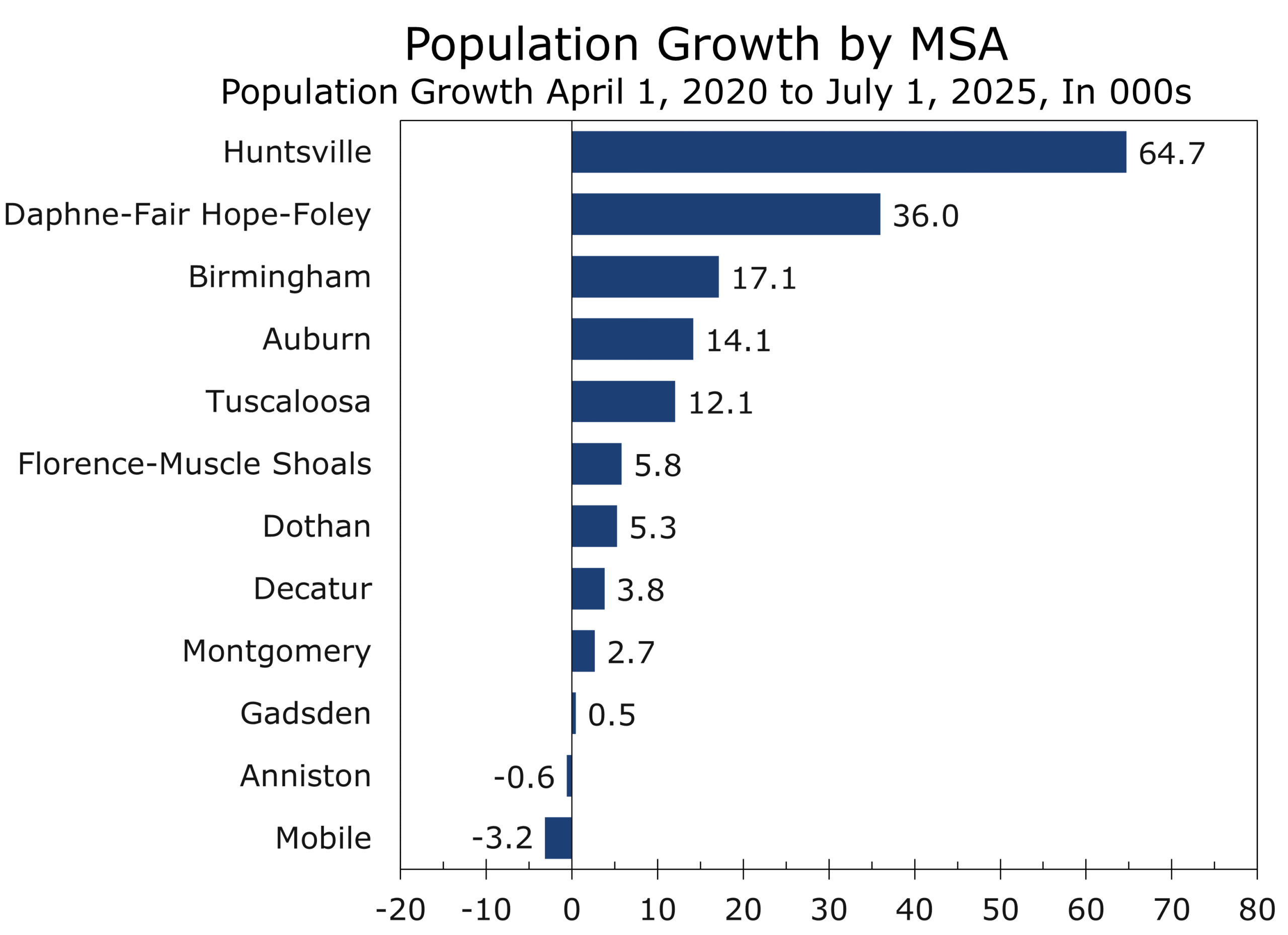
The U.S. Census Bureau's Vintage 2025 population estimates, released March 27, 2026, show Alabama growing broadly, not just in its two fastest-expanding corners. The Huntsville MSA reached 556,444 residents as of July 1, 2025, a gain of 14,322 in a single year. That 2.6% growth rate ranked 6th fastest among all U.S. metro areas. The Daphne-Fairhope-Foley MSA posted 2.3% growth in 2025, ranking 11th nationally. Baldwin County has added 35,983 residents since the 2020 Census, and BLS county employment data through Q3 2025 show jobs up 3.5% year-over-year, the third-fastest gain of any county in the country.
| Metro / City | Growth Rate | Key Driver | U.S. Ranking |
|---|---|---|---|
| Huntsville MSA | 2.6% (2025); 64,700 net new residents | Defense, aerospace, tech | 6th fastest growing MSA |
| Huntsville city | +15.9% (2020–24) | Redstone, NASA, Eli Lilly | Top 20 U.S. cities |
| Daphne-Fairhope-Foley MSA | 2.3% (2025) | Coastal amenity, remote work | 11th fastest growing MSA |
| Gulf Shores city | 2.7% (2024) | Tourism, retirees | Top 10 fastest AL city |
| Madison city | 4.9% (2024) | Huntsville suburb overflow | 2nd fastest growing city in AL |
| Baldwin County | +2.3% (2025); added 35,983 residents since 2020 | In-migration, coastal growth, retirees | 3rd fastest growing county in Alabama (2025) |
Alabama's Record $14.6 Billion Investment Year
Alabama announced $14.6 billion in new capital investment in 2025, a record that reflects breadth as much as size. The largest single commitment is Eli Lilly's $6 billion pharmaceutical manufacturing facility in Huntsville, the biggest initial private investment in the state's history and already in its construction phase, generating an estimated 3,000 jobs on site alongside 450 permanent positions at full operation. ArcelorMittal's $1.2 billion electrical steel plant in Calvert, Mobile County, addresses a genuine supply gap: the United States has relied heavily on imported electrical steel for EV motors, generators, and industrial applications, and this facility, scheduled to begin production in 2027, will help close it.
Honda Alabama crossed seven million cumulative vehicles in January 2026, and Mazda Toyota Manufacturing is approaching its one-millionth unit. Georgia-Pacific's $800 million modernization of its Alabama River Cellulose mill in Monroe County is the largest of roughly $2 billion in rural commitments — a sign that the investment cycle extends well beyond the state's major metros.
| Company / Project | Investment | Location | Jobs |
|---|---|---|---|
| Eli Lilly (API Manufacturing) | $6.0B+ | Huntsville | 450 + 3,000 const. |
| Mercedes-Benz MBUSI | $4.0B | Tuscaloosa / Vance | 5,800 existing |
| Meta (data center expansion) | $1.5B+ | Montgomery | 100+ |
| ArcelorMittal Calvert (Elec. Steel) | $1.2B | Calvert, Mobile Co. | 200+ |
| Georgia-Pacific (mill upgrade) | $800M | Monroe County | 100+ |
| Toyota Alabama (engine plant) | $282M | Huntsville | 350 |
| Howard Industries (transformers) | $236M | Clarke/Jones/Simpson | 450 |
| Boeing PAC-3 expansion | $200M+ | Huntsville | 300+ |
| Southwire (wire & cable) | $176M | Heflin | 85+ |
| Glaukos (life sciences) | $82M | Huntsville | 154 |
Outlook and Key Risks
Alabama's near-term economic outlook is among the most constructive in the Southeast. The $14.6 billion 2025 investment record is better understood as a leading indicator than a lagging one: most of that capital is still in its construction and commissioning phase, and the employment, supply-chain, and tax-base effects will build through 2027 and beyond. We expect Alabama's gross state product to outperform the Southeast regional average in 2026, with Huntsville's defense and aerospace complex, the Eli Lilly construction ramp, and MBUSI's production volume as the primary drivers. The Gulf Coast provides a secondary engine through population growth and retail sales, though housing affordability is becoming a constraint in both Huntsville and Baldwin County.
"April 1, 2026 captured in a single day what Alabama has spent three decades building: the infrastructure, the institutions, and the industrial relationships to compete at the intersection of mobility, defense, and space. The $4 billion that Mercedes-Benz is committing to Tuscaloosa is a vote of confidence not just in a factory — it is a vote of confidence in a state."
— Mark Vitner, Chief Economist, Southeast Economic Advisors
Risks to Watch
- Housing affordability and infrastructure capacity: Huntsville is adding 18 residents a day, and while construction has picked up, home prices are rising faster than incomes. Roads, utilities, and schools are becoming real constraints on the in-migration the city's defense and aerospace build-out requires. Huntsville remains much more affordable than other competing metros, however.
- Federal budget and program continuity: The concentration of federal defense and space spending at Redstone creates a real dependency on Congressional appropriations and program-level decisions the state cannot control. Golden Dome's funding is particularly uncertain: the initiative is large, its authorization is incomplete, and missile defense programs have a history of slipping schedules and shrinking budgets.
- Tariff and supply-chain risk: MBUSI's decision to localize the GLC reduces its direct tariff exposure, but the broader Alabama automotive supply chain — including Tier 2 and Tier 3 suppliers with significant import content — faces sustained cost pressure. The ArcelorMittal Calvert electrical steel facility addresses part of the supply chain vulnerability, but closing the gap on advanced automotive grades will take years.
- K-shaped economic divergence and legacy metro resilience: Birmingham-Hoover, the state's largest MSA at nearly 1.2 million residents, added more than 3,450 residents in 2025. The region's steel complex generated more than $400 million in Jefferson County economic development projects in 2025, with average manufacturing wages exceeding $71,000. Andrews Sports Medicine is breaking ground on a $110 million flagship facility at Brookwood Village this spring.
- Mobile (MSA population 411,658) has assets its population numbers do not yet fully reflect. The Port of Mobile is one of the deepest and busiest on the Gulf Coast, and Airbus's U.S. A320 and A220 final assembly lines give the region a manufacturing profile most mid-size metros cannot match. The city itself continues to lose population, and reversing that will require policy attention beyond what the investment pipeline alone can provide.
- Montgomery (MSA population 388,747) has a large federal employment base and is home to Meta's $1.5 billion data center investment. The city's population is still declining, reflecting structural challenges that predate the current investment cycle. The broader concern across the state is a growing divide between communities with strong institutional anchors and the rural counties that are losing people and struggling to attract capital.
Mark Vitner, Chief Economist at Southeast Economic Advisors LLC, certifies that the views expressed in this report accurately reflect his professional assessment of the subject matter and that no part of his compensation was, is, or will be directly or indirectly related to the specific views expressed herein.
This report is prepared for informational purposes only and does not constitute investment advice. Information is derived from sources believed to be reliable; however, Southeast Economic Advisors LLC makes no representation as to its accuracy or completeness. © 2026 Southeast Economic Advisors LLC. All rights reserved.
Printable version — Adobe PDF