
Rebels vs. Wildcats: Two Historic Programs, Two Evolving Economies

Week 1 Recap: The ACC Surges, the SEC Wobbles, and Tradition Holds
The 2025 season opened with fireworks. Four top ten teams lost this past weekend, with three of those losses coming against other, albeit lower ranked, top ten teams. Previously unranked Florida State delivered the weekend’s biggest shock, stunning No. 8 Alabama in Tallahassee and snapping the Tide’s long streak of season-opening wins. Miami added to the ACC’s momentum, toppling Notre Dame in a primetime thriller, while Georgia Tech mounted a dramatic comeback to beat Colorado. Overall, the ACC went 12-5. Clemson nearly survived against LSU, but the Tigers from Baton Rouge escaped with a narrow victory.
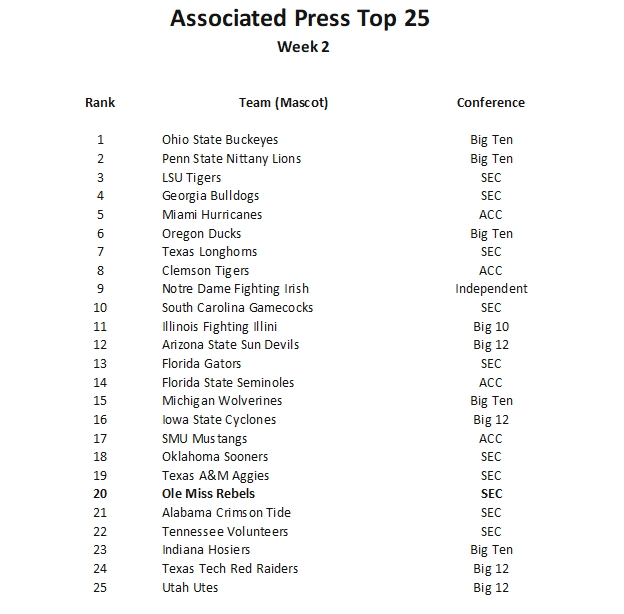
The SEC, meanwhile, looked as formidable as ever, going 14-2 on opening weekend. Georgia cruised past Marshall, and LSU edged Clemson—but the top of the conference also looked vulnerable, with Alabama and Texas both losing. The abundance of marquee matchups has turned opening weekend into both a cultural and economic hallmark of college football, much like NASCAR kicking off its season with the Daytona 500. Week 2 usually brings a quieter slate, but one game of real consequence stands out: Ole Miss at Kentucky. It’s the conference opener for both programs and could set the tone for the rest of their seasons.
The Universities: Rich Southern Legacies
The University of Mississippi (Ole Miss), founded in 1844, sits in Oxford, a small city in northern Mississippi about 75 miles south of Memphis, Tennessee. Ole Miss has long been a cultural touchstone, from the literary legacy of William Faulkner to the pivotal civil rights milestone of James Meredith’s enrollment in 1962. It remains Mississippi’s flagship university, blending tradition with forward-looking research and innovation.
The University of Kentucky (UK), established in 1865, is located in Lexington, a vibrant city in central Kentucky, about 75 miles southeast of Louisville and 98 miles south of Cincinnati. As Kentucky’s flagship and land-grant institution, UK has long been a center of agricultural research, medicine, and public service. Today, it serves as one of the South’s leading research universities, with UK HealthCare anchoring Lexington’s economy. Both institutions embody the resilience and identity of their states, symbols of continuity in a region constantly reinventing itself.
Football Histories: Eras of Glory
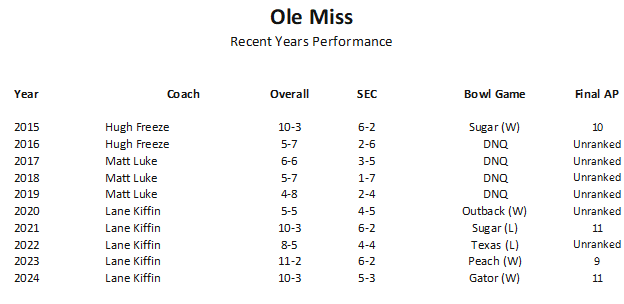
Ole Miss football reached its zenith in the late 1950s and early 1960s under coach John Vaught, when the Rebels claimed three national championships (1959, 1960, 1962) and six SEC titles. This era of college football often produced more than one national champion, as there were multiple rankings. Ole Miss later produced household names like Archie and Eli Manning, and more recently found new energy under Lane Kiffin, highlighted by a New Year’s Six bowl win in 2015 and its first-ever 11-win season in 2023. The Rebels’ fan culture is inseparable from their identity—rooted in The Grove, perhaps the most iconic tailgating venue in college football, and the charming refrain “Hotty Toddy,” which first appeared in 1926 as “Heighty Tighty” before evolving into its current form as a greeting for friends new and old. While its origins remain debated—ranging from military cadences to a playful jab at perceived elitism—its place in Southern sports culture is unquestioned, as deeply woven into the region’s lexicon as “Go Dawgs,” “Roll Tide,” or “Geaux Tigers.”
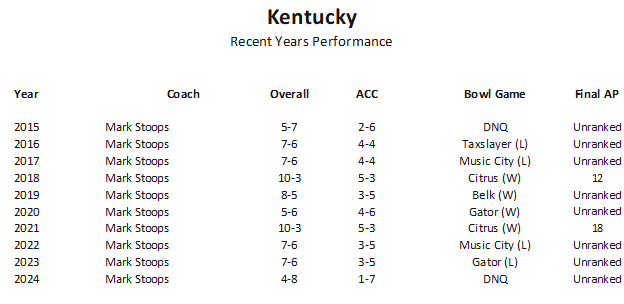
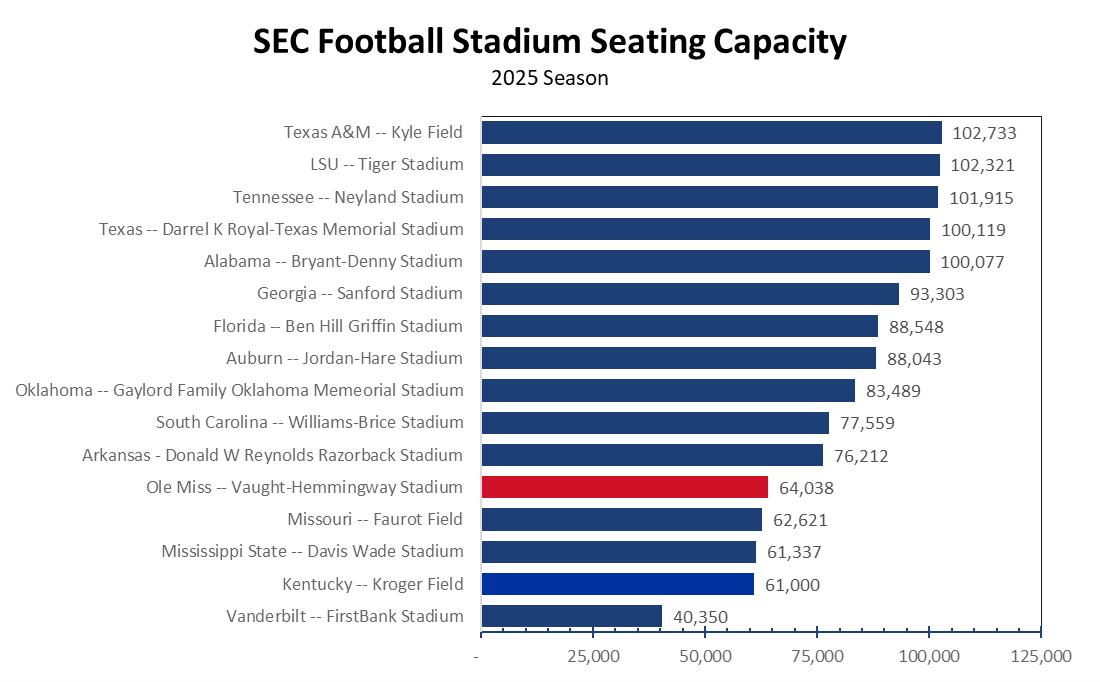
Kentucky football enjoyed its greatest success under Paul “Bear” Bryant in the late 1940s and early 1950s. The Wildcats posted an 11–1 season in 1950, capped by a Sugar Bowl win over No. 1 Oklahoma, and were later retroactively awarded a national championship by several selectors. Since then, Kentucky has often been overshadowed by its basketball dynasty, but under Mark Stoops the program has gained consistency, toughness, and bowl credibility. Their home, Kroger Field, reflects both history and modernity—originally opened as Commonwealth Stadium in 1973, renamed in 2017 through a sponsorship with Cincinnati-based Kroger (headquarters just 98 miles north), while the playing surface honors C. M. Newton, UK’s iconic former athletic director.
Ole Miss plays in Vaught–Hemingway Stadium, named for legendary coach John Vaught and alumnus H. D. Hemingway, an early booster. Known for its roaring atmosphere, it is where the traditions of The Grove spill seamlessly into Saturday night football.
Oxford, Mississippi: Small Town, Big Stage
The city of Oxford, population 26,801 (2024 Census estimate), thrives on the outsized influence of Ole Miss. The university employs thousands, generates more than $100 million annually in research activity, and attracts over 22,000 students, sustaining steady flows of spending in housing, retail, and hospitality. Oxford is located in Lafayette County, which is in the middle of the northern portion of the state and has a population (2024 Census estimate) of just under 60,000 residents.
Culturally, Oxford is steeped in Southern identity. William Faulkner’s Rowan Oak remains a literary landmark, while The Square has become a magnet for dining and music. On football weekends, The Grove transforms into a 10-acre carnival of Southern hospitality—red-and-blue tents, chandeliers, silver trays, fried chicken, and barbecue. Coupled with a steady stream of “Hotty Toddy” greetings to friends old and new, it is an event that blends tradition, culture, and economics. Each home weekend injects millions into Lafayette County, underscoring Oxford’s unique ability to punch above its demographic weight.
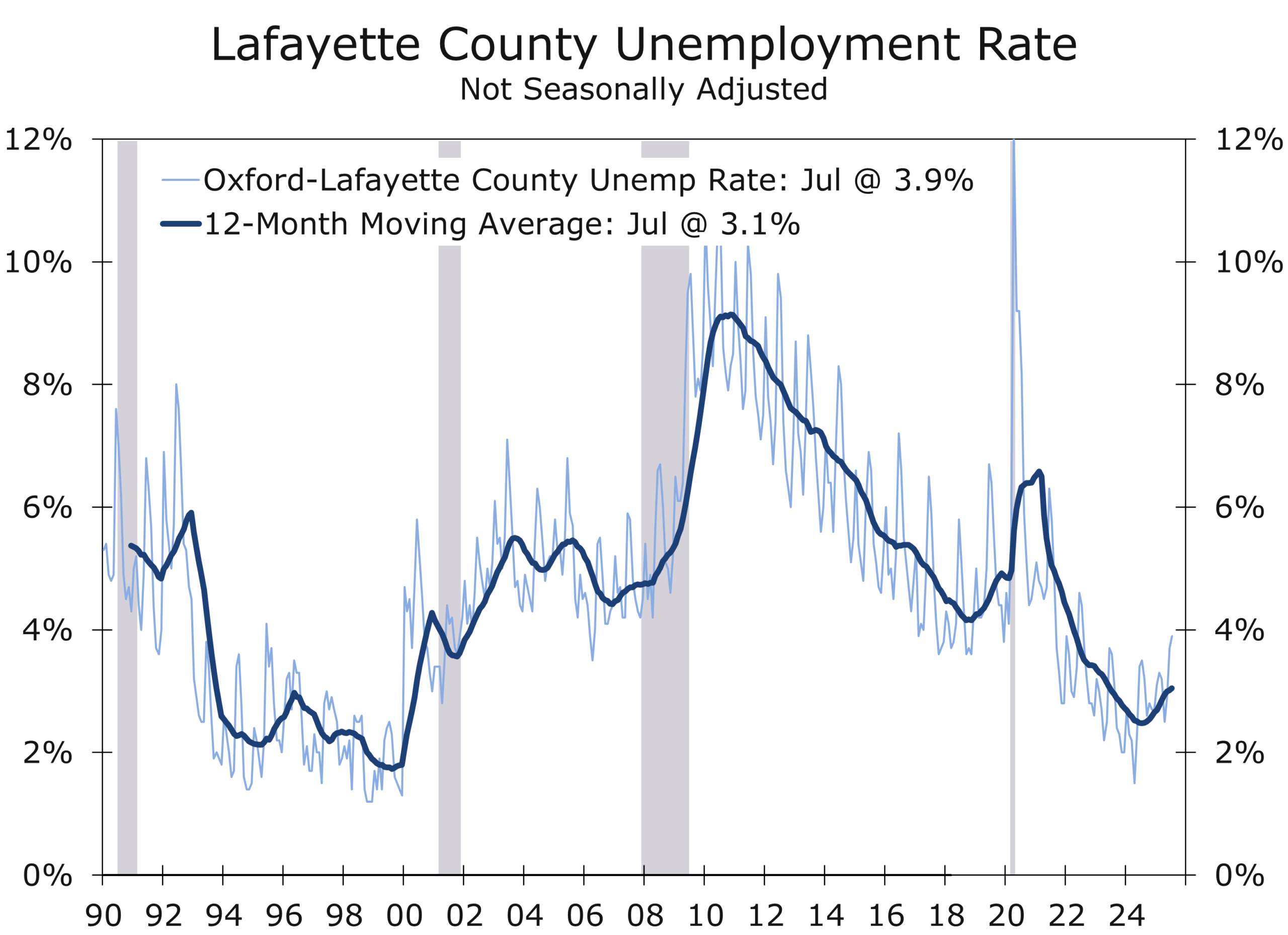
From a broader perspective, Oxford and Lafayette County stand out as one of Mississippi’s most dynamic sub-regions, with growth fueled by the University and related research, a rising healthcare hub, and targeted industrial recruitment. Lafayette County’s unemployment rate sits slightly below the national rate at just 3.9% as of July-2024, versus 3.5% a year ago. Mississippi has added 16,200 net new jobs over the past year, underscoring solid momentum across healthcare, logistics, and advanced manufacturing sectors.
Per capita income in Lafayette County reached $52,791 in 2023, well above the state’s overall $49,652 but well below the nation’s $69,810. The income premium relative to the state as a whole reflects Oxford’s higher concentration of high-skilled jobs tied to the university, research commercialization, and healthcare. Manufacturing spillovers add ballast: the Toyota Mississippi assembly plant at Blue Springs, located within the broader Oxford–Tupelo corridor, along with its PUL Alliance supply chain, reinforces a diversified base that extends beyond the region’s education and healthcare base.
With its combination of academic innovation, robust healthcare infrastructure, and manufacturing supply chains, Oxford is positioned as a bright spot in Mississippi’s economy—one that outpaces the state in both income and employment growth while linking seamlessly to the region’s broader economic renaissance
.
Mississippi: From Cotton to Advanced Manufacturing
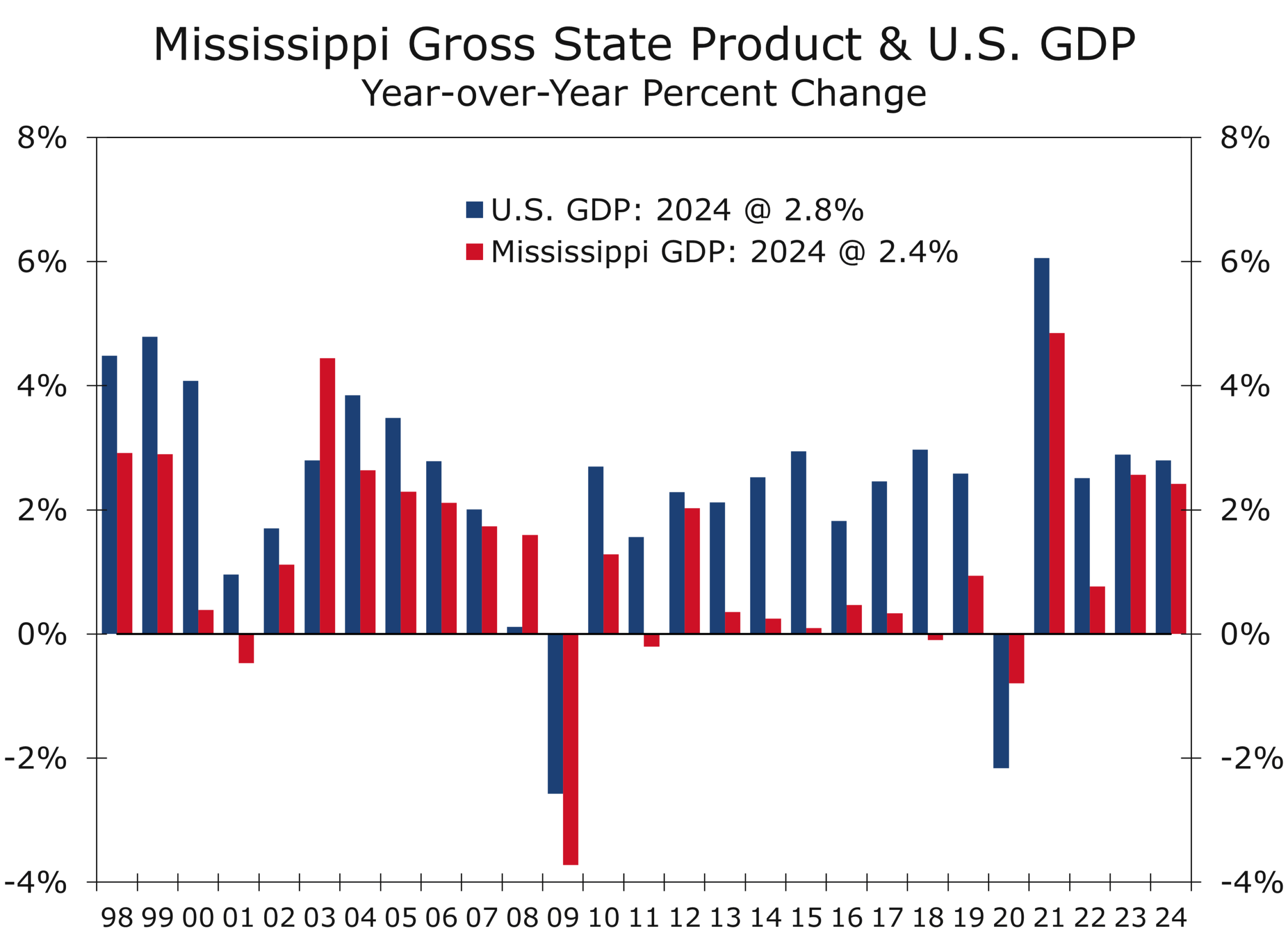
Mississippi’s economy has evolved from its agrarian roots to a diverse mix of agriculture, manufacturing, energy, and technology. Agriculture remains foundational—soybeans, poultry, and catfish are core commodities—but recent years have brought an unprecedented wave of capital investment that is reshaping the state’s industrial landscape. Landmark projects include Amazon Web Services’ $10 billion data center complexes near Jackson, Compass Datacenters’ $10 billion hyperscale development in Meridian, and AVAIO Digital’s $6 billion project in Brandon, positioning Mississippi as an emerging hub for digital infrastructure.
The state’s traditional manufacturing base is simultaneously expanding. Automotive remains a powerhouse, with Toyota’s Blue Springs facility and Nissan’s Canton plant, while new projects like the $1.9 billion Accelera-Daimler-PACCAR EV battery plant in Marshall County underscore Mississippi’s pivot toward next-generation mobility. Columbus has emerged as a steel center, anchored by Steel Dynamics, and Tupelo —best known as Elvis Presley’s birthplace—continues to thrive as a leading U.S. furniture manufacturing hub, blending heritage industries with modern logistics.
Meanwhile, investments in forestry, advanced materials, and energy and power—such as Hood Industries’ $245 million Waynesboro sawmill and Howard Industries’ $236 million transformer expansion—highlight the state’s diversification. This surge reflects Mississippi’s pro-business policies and infrastructure readiness, with the Mississippi Development Authority’s Site Development Grant Program ensuring shovel-ready industrial sites to compete for mega-projects. Together, these developments illustrate how Mississippi is leveraging its workforce and location to attract high-wage industries while maintaining its agricultural backbone.
Lexington, Kentucky: Bluegrass Economy with a Manufacturing Backbone
Lexington, home to 329,437 residents (2024 Census estimate), anchors one of the South’s most balanced and resilient mid-sized metropolitan economies. Known worldwide as the “Horse Capital of the World,” the city blends its equine heritage with a diverse economic base built around education, healthcare, manufacturing, and logistics. The Lexington–Fayette MSA, which now tops 533,000 residents, generates roughly $35.7 billion in GDP, making it a key driver of growth for central Kentucky.
The University of Kentucky serves as the region’s cornerstone institution, enrolling more than 33,000 students and investing over $500 million annually in research, fueling innovation in health sciences, agriculture, and engineering. UK HealthCare has evolved into one of the state’s largest and most advanced medical systems, providing a deep employment base and regional healthcare reach.
Manufacturing adds heft to the metro’s economy, led by Toyota’s massive assembly plant in nearby Georgetown, which employs more than 8,000 workers and sustains a broad network of automotive suppliers. The region’s reputation for craftsmanship extends to bourbon distilling, with central Kentucky accounting for 95% of the world’s bourbon production, creating both export strength and a tourism magnet. Logistics is another pillar, bolstered by proximity to UPS Worldport in Louisville and access to the Cincinnati/Northern Kentucky Airport, making the region a vital freight and supply chain corridor.
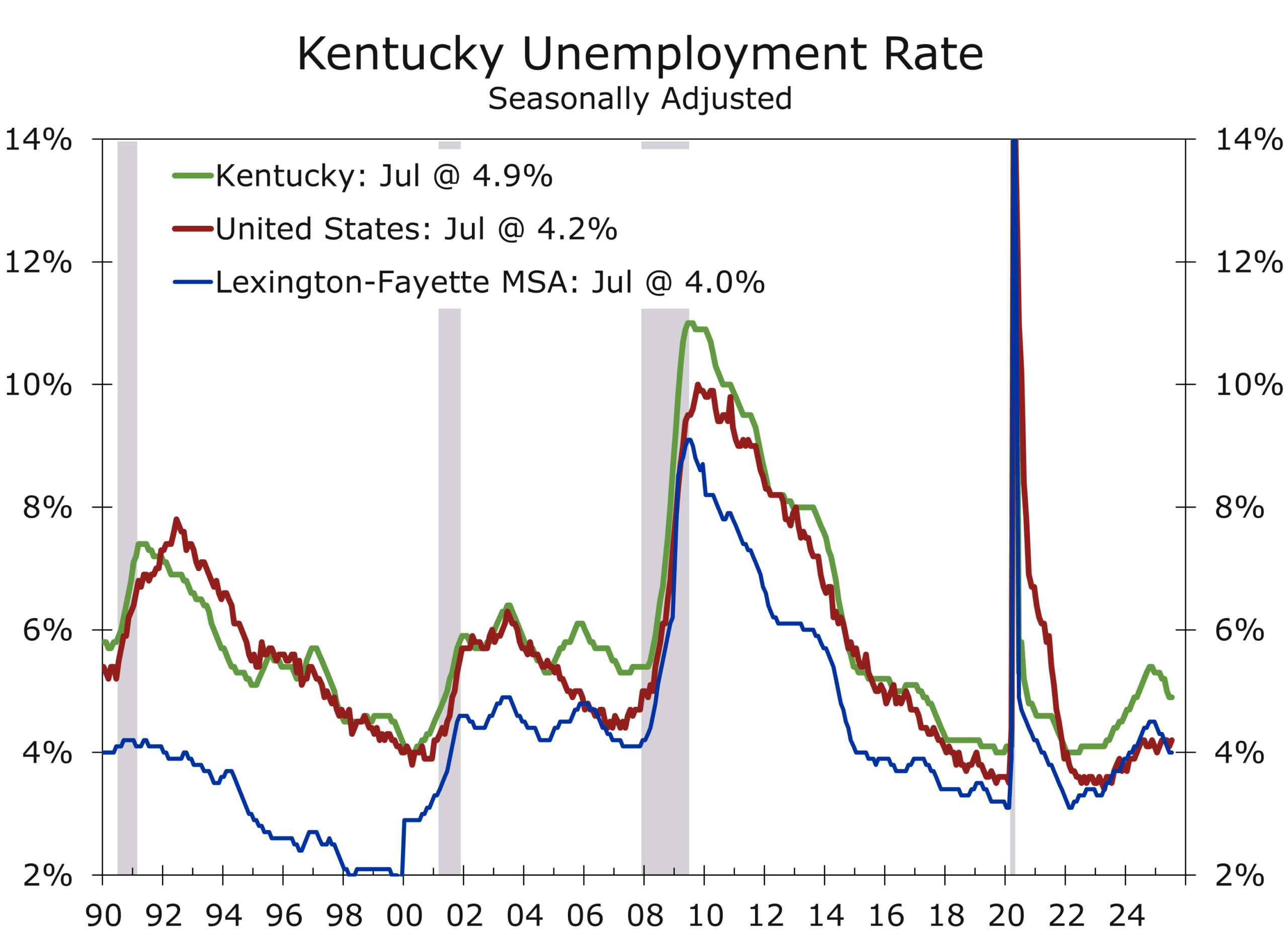
Labor market conditions remain healthy: Lexington’s unemployment rate was 4.0% as of July 2025, down from 4.3% at the start of the year, while Kentucky statewide nonfarm employment grew by 1.3% year-over-year, comfortably outpacing the nation and yielding 26,200 net new jobs. These gains reflect the metro’s ability to attract new investment, including supply-chain growth tied to GE Appliances’ multibillion-dollar expansion in Louisville and recent state-led site development initiatives. Together, these factors reinforce Lexington’s position as a thriving, diversified hub where heritage industries and cutting-edge sectors converge.
Kentucky’s Big Win Off the Field
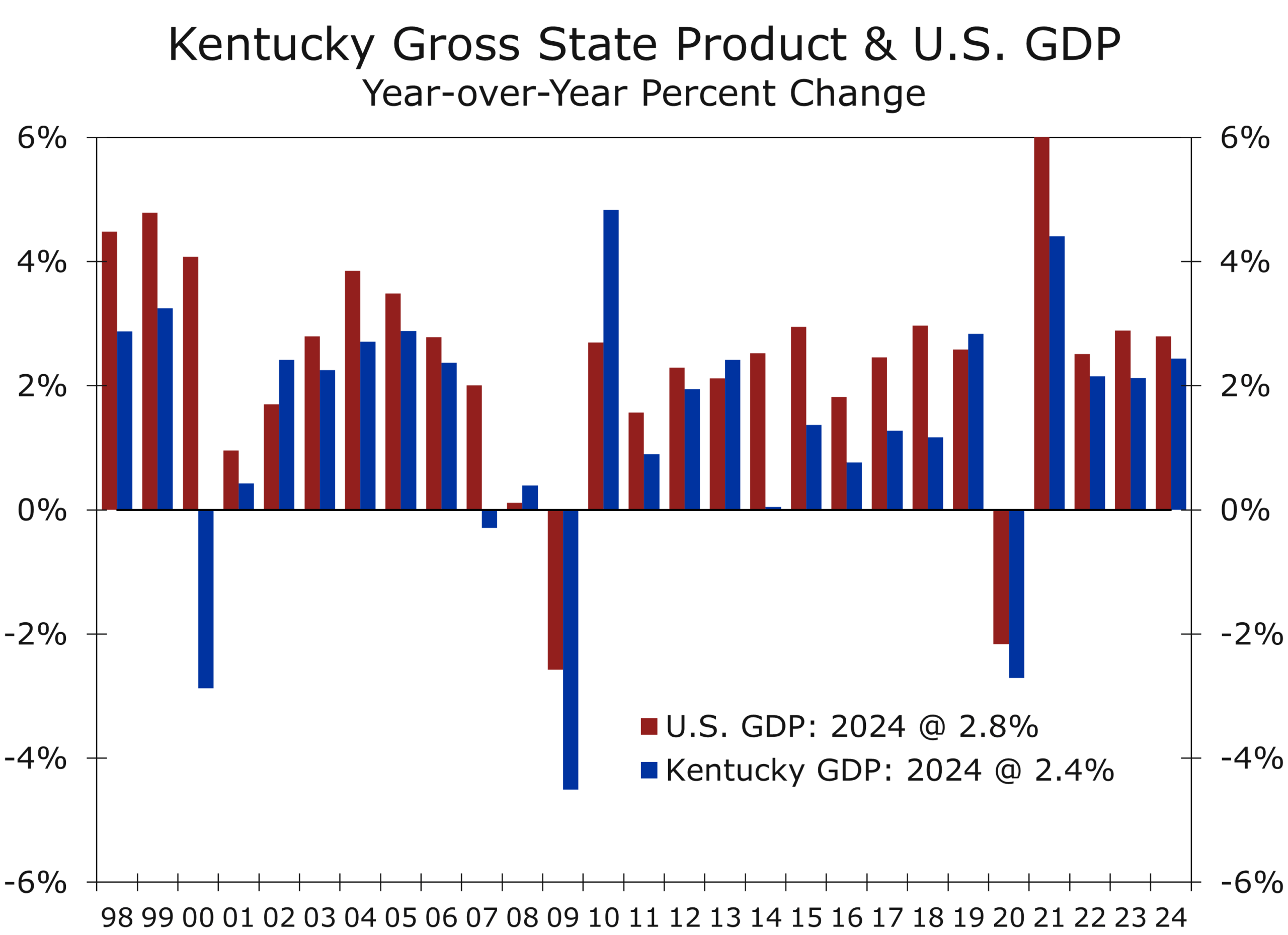
The Bluegrass State scored a major industrial victory with GE Appliances’ multibillion-dollar expansion in Louisville, which will add thousands of jobs and reinforce Kentucky’s position as a key manufacturing hub. While Louisville is nearly 80 miles from Lexington, the benefits ripple across Central Kentucky through supply chains, workforce development, and regional visibility. The reshoring of manufacturing figures to be a major theme going forward and Kentucky is well positioned to benefit.
Kentucky’s industrial mix extends beyond bourbon and autos. The aerospace sector—centered in Louisville and northern Kentucky—has become a national leader, particularly in jet engine and aerospace component manufacturing. Logistics and distribution are another linchpin: with Louisville serving as UPS’s Worldport hub and Cincinnati/Northern Kentucky Airport nearby, the state has become a freight and supply-chain powerhouse. Healthcare continues to expand as well, with UK HealthCare and Norton Healthcare among major employers.
Yet, as in Mississippi, challenges persist. Rural poverty remains entrenched in eastern Kentucky, and the state’s dependence on cyclical manufacturing industries can expose it to downturns. Still, Kentucky has built a balanced economy like many of its peers, positioning it to capitalize on reshoring and advanced manufacturing trends in the decade ahead.
Game Flashback: Kentucky’s Oxford Upset
In late September 2024, Kentucky delivered one of the SEC’s most surprising results of the season, upsetting No. 6 Ole Miss 20-17 at Vaught-Hemingway Stadium. The victory was the Wildcats’ first in Oxford since 1978 and came as a 17-point underdog, underscoring the volatility and competitive balance that define SEC play.
Quarterback Brock Vandagriff ignited the game-winning drive with a dramatic 63-yard completion to Barion Brown on 4th-and-7. That play set up a bizarre but decisive sequence: a fumble recovery in the end zone by tight end Josh Kattus with just 2:25 remaining. Ole Miss had a chance to force overtime, but a 48-yard field goal attempt sailed wide in the final seconds, sealing a signature road victory for Kentucky.
For Kentucky, the win briefly reignited preseason optimism after a highly anticipated campaign that began with New Year’s Six bowl aspirations. Yet the Wildcats’ season ultimately faltered, finishing 4-8 overall, with the upset in Oxford standing as their only SEC win and one of the few bright spots in a disappointing year.
This game highlighted both the high-stakes drama and the economic weight of SEC football: a single Saturday reshaped fan sentiment, ticket sales, and regional media narratives, while illustrating the razor-thin margins that separate triumph and frustration in the nation’s most competitive college football conference.
Game Preview: Ole Miss vs. Kentucky
One year later, the stakes feel just as high as Ole Miss prepares to face Kentucky in Lexington for its SEC opener. The Rebels enter the matchup seeking both redemption and validation after last season’s shocking home loss—a defeat that derailed their early-season momentum and haunted the program throughout the year. Ole Miss opened the 2025 season in emphatic fashion, crushing Georgia State 63–7 at Vaught-Hemingway Stadium. Quarterback Austin Simmons threw for 341 yards and three touchdowns, while running back Kewan Lacy added 108 rushing yards and three scores of his own. The defense was equally impressive, holding Georgia State to just 260 total yards and forcing multiple turnovers, including a standout performance by defensive lineman Zxavian Harris. That dominant opener has fueled optimism in Oxford that the Rebels have found the balance and depth needed to compete for an SEC title.
For Kentucky, this rematch is a chance to prove last year’s upset was more than a fleeting moment of magic. The Wildcats are coming off a hard-fought Week 1 win over Toledo, a game that highlighted both their resilience and areas needing improvement. Head coach Mark Stoops has emphasized discipline and ball security, knowing his team must control the tempo, limit explosive plays, and lean on veteran leadership to compete with Ole Miss’s high-powered offense. The Wildcats will need to do that all afternoon in order to stay competitive with what appears to be a more talented Ole Miss team. Key defensive lineman Mi’Quise Humphrey-Grace is expected to play despite a minor injury, bolstering a unit that will need to be at its best. While Ole Miss aims to reclaim its standing in the SEC hierarchy, Kentucky is focused on proving it belongs among the league’s disruptors—setting the stage for a rematch shaped by last year’s drama and this year’s opportunity.
The Tigers’ competitive edge sharpened under John Heisman, who coached at Clemson from 1900–1903 and introduced innovative offensive strategies. Clemson matured into a Southern powerhouse under Frank Howard, an Alabama native who coached the program for over 30 years, embedding traditions such as rubbing Howard’s Rock and sprinting down The Hill, one of college football’s most iconic pregame rituals. The breakthrough came in 1981, when Danny Ford—a former Alabama lineman who began his career as an assistant at Auburn—guided Clemson to an undefeated season and its first national championship.
After intermittent success in the 1990s and early 2000s, Clemson surged to the top of the college football world under Dabo Swinney, who became head coach in 2008. From 2015 to 2020, Clemson reached six consecutive College Football Playoffs, claiming national titles in 2016 and 2018 with quarterbacks Deshaun Watson and Trevor Lawrence. Although Clemson has never produced a Heisman winner, it has developed an NFL talent pipeline, particularly at quarterback and defensive line, and stands as one of the sport’s most consistent and innovative programs. Today, Clemson represents the pinnacle of ACC football, challenging SEC dominance while honoring traditions that trace back to Auburn’s formative role.
September 4, 2025
Mark Vitner, Chief Economist
Southeast Economic Advisors
704-458-4000