
Highways, Horizons, and Hand-Offs: A Cross-Country Trip with Our Daughter

A week ago, I completed a cross-country drive with our daughter, Sylvia, as she traveled from Boone, North Carolina, to Spokane, Washington, to begin a summer internship at a tech startup. We began our journey in Asheville—where my wife had dropped me off for a speaking engagement at a furniture logistics conference—and Sylvia and I headed west together. We got started right away and passed through the narrow gorge at the border of North Carolina and Tennessee just a few hours before a mudslide closed this key highway once again.
This wasn’t just a road trip. It was a rare chance to spend precious time with my daughter and marked a personal milestone as well. It checked off two of the final three U.S. states I had yet to visit—Wyoming and Idaho (North Dakota is the only one remaining). It also gave me a chance to see the country through the eyes of a 21-year-old at a pivotal moment in her life.
The route took us through Tennessee, Kentucky, Illinois, Missouri, Iowa, South Dakota, Wyoming, Montana, and Idaho before arriving in Spokane. We had a tight schedule that only allowed for a few stops, the first of which was Nashville. We made our way down Broadway and stepped into Jelly Roll’s bar, Goodnight Nashville, where a band was playing 1980s rock. The bassist turned out to be from Spokane. One of the singers performed with her arm in a sling—Sylvia had shoulder surgery this past year, so the detail struck a chord. When the band played a Cole Swindell’s remake of Heads Carolina, Tails California, the lyrics took on new meaning.
Later that night, at Category Ten, Luke Combs’ multistory bar, we heard the original version of the same song while we had dinner at the rooftop bar. Combs, like Sylvia, attended Appalachian State. The moment stuck. That song became a bit of anthem for the trip—not a soundtrack to an escape, but to a new chapter in our lives.
We took time to see a few familiar landmarks—stopping for lunch in St. Louis to tour and ride to the top of the Gateway Arch, then stopping near Omaha for dinner before reaching Mitchell, South Dakota, on our second night. That set us up for a day of sightseeing as we made our way west across South Dakota, visiting the Corn Palace, Badlands National Park, and Wall Drug. We detoured to see Mount Rushmore and the Crazy Horse Memorial before reaching Spearfish. Tucked into the northern Black Hills, Spearfish turned out to be one of the most beautiful towns on our route—charming, walkable, and set against a stunning natural backdrop. We had a great dinner downtown before retiring for the evening, knowing we’d be up early to continue our journey west.
Some have asked if the long stretches of rural highway—miles of farmland and endless prairie—felt monotonous. As someone who’s spent a career analyzing the U.S. and local economies, I would say: not at all. Every town, every factory, every river, and every grain elevator has meaning. Even the trucks barreling past us on the interstate were familiar. I’ve met with many of the management teams behind those fleets. The country isn’t empty. It’s functioning and busy at work. And for someone like me, it’s never boring.
The next day took us across Wyoming and into Montana. We stopped in Billings, a working-class city framed by sandstone bluffs, for lunch and a short hike along the Yellowstone River—wide, swift, and deeply interwoven into the story of the American West. From there, we continued to Missoula, a vibrant college town surrounded by mountain ranges and shaped by the confluence of five valleys. We arrived that evening, tired but eager for the scenic stretch that lay ahead.
The final leg of our drive offered some of the most breathtaking scenery of the trip. Descending through the mountains from Montana into northern Idaho, we wound our way through thick forests, dramatic river valleys, and wide-open passes. The terrain felt wild and expansive—the kind of landscape that pulls you into silence—and delivered more than a few spontaneous “wows.”
Coeur d’Alene was a stop I had long looked forward to, and it did not disappoint. We hiked around the picturesque lake, where deep blue water meets pine-covered hills, and had lunch downtown in a lively, walkable district filled with local shops and restaurants—where an Ironman competition was underway. It was a refreshing pause before making the final push to Spokane.
When we finally reached Spokane, Sylvia was ready to begin her internship. The next day I turned around and flew back to Charlotte, grateful for the miles we’d shared.
As a parent, you know these moments are finite. You look for ways to stay connected as your children begin stepping out on their own. This trip did that and more. It offered time, conversation, and an uninterrupted stretch of America’s working landscape—something I’ve spent a lifetime studying, but this time with a companion who reminded me what it all looks like when you’re just starting out.
A Spirit for New Frontiers
We were thrilled when Sylvia landed her internship in Spokane—a destination that might seem a bit off the beaten path, especially for someone pursuing a future in tech. But that’s part of what made it perfect. Sylvia has the same sense of adventure I had at her age. She’s eager to explore new frontiers, whether they’re geographic, professional, or grounded in her love of hiking, mountain biking, and the thrill of discovering someplace new.
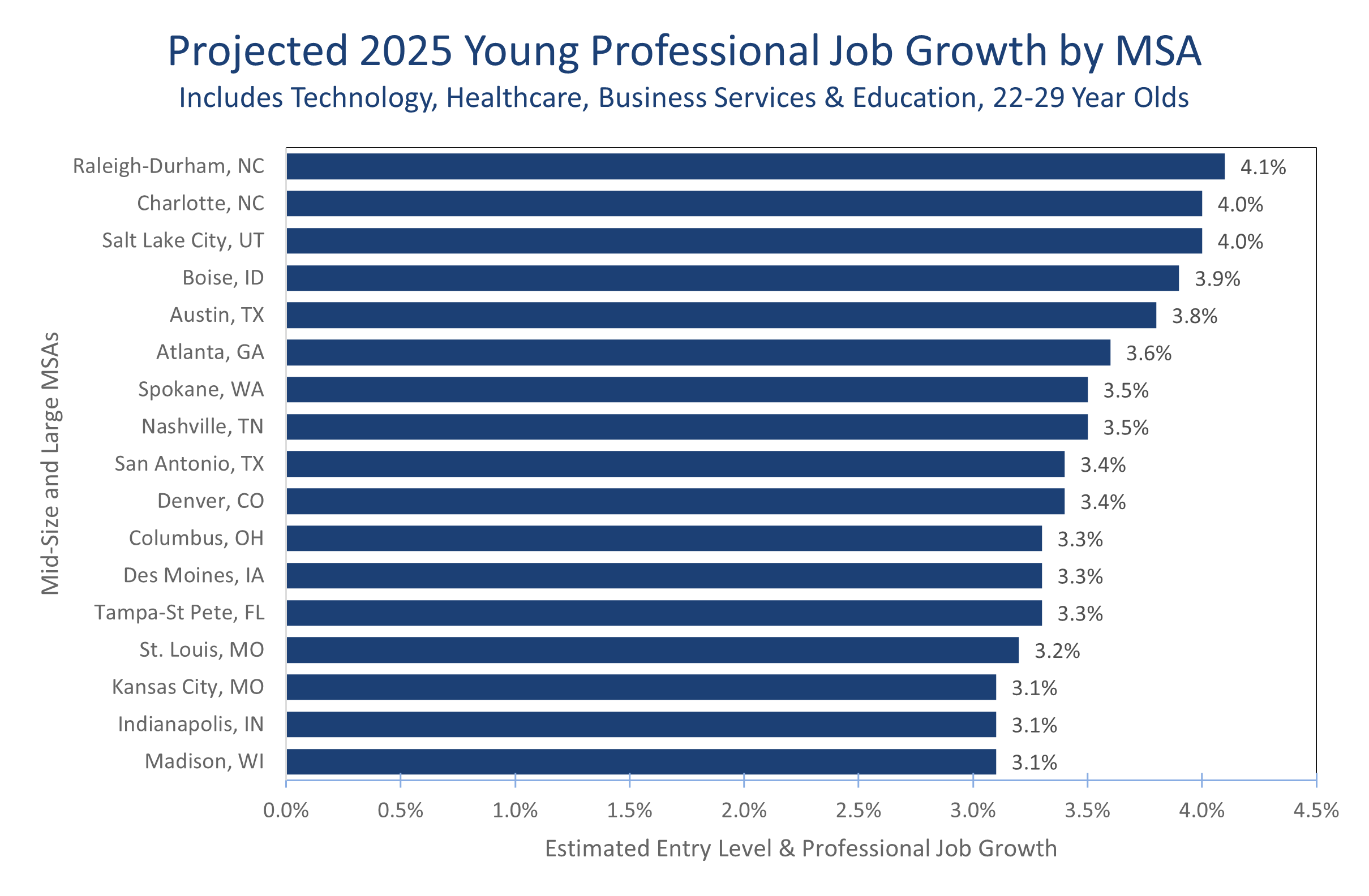
In many ways, today’s economy rewards that kind of mindset. The path from college to career no longer runs strictly through traditional tech centers like San Francisco, Seattle, Boston, or New York. High housing costs and intense competition in those cities have made them harder to crack without significant backing. For recent graduates, opportunity often lies elsewhere—places where the cost of living is lower, quality of life is high, and industries are expanding quietly but steadily. Many of these are in the Sun Belt, a few others are reworks of old, established metros that have suddenly become more affordable, and others are just off the beaten path altogether.
Spokane is somewhere in the latter two categories. With its strong sense of community, access to the outdoors, and growing innovation economy, it’s emerging as a viable launchpad for young professionals—particularly those willing to look beyond the obvious.
Today’s graduates are entering a job market that demands flexibility, resilience, and a willingness to go where the momentum is. Whether it’s a fast-growing mid-size metro like Durham, Raleigh, or Boise—or revitalized urban centers like St. Louis and Pittsburgh—the best opportunities often lie just outside the national spotlight. Sylvia’s decision to head west reminded me of something I’ve learned time and again: the economy does not simply grow—it is constantly evolving. In today’s tougher hiring environment, job seekers may need to look beyond the traditional path to find the roles that match their potential and ambition.