
SOUTHEAST ECONOMIC ADVISORS
Piedmont Crescent Capital / Southeast Economic Advisors
The Week Across the South
Hurricane Isaias Hits the Gulf Coast as Data Center Moratoriums Spread Across the Region
At a Glance
- Hurricane Isaias came ashore near Destin as a Category 2 storm. Brokers put insured losses in the mid-single-digit billions, and our early read puts total losses near $9 billion.
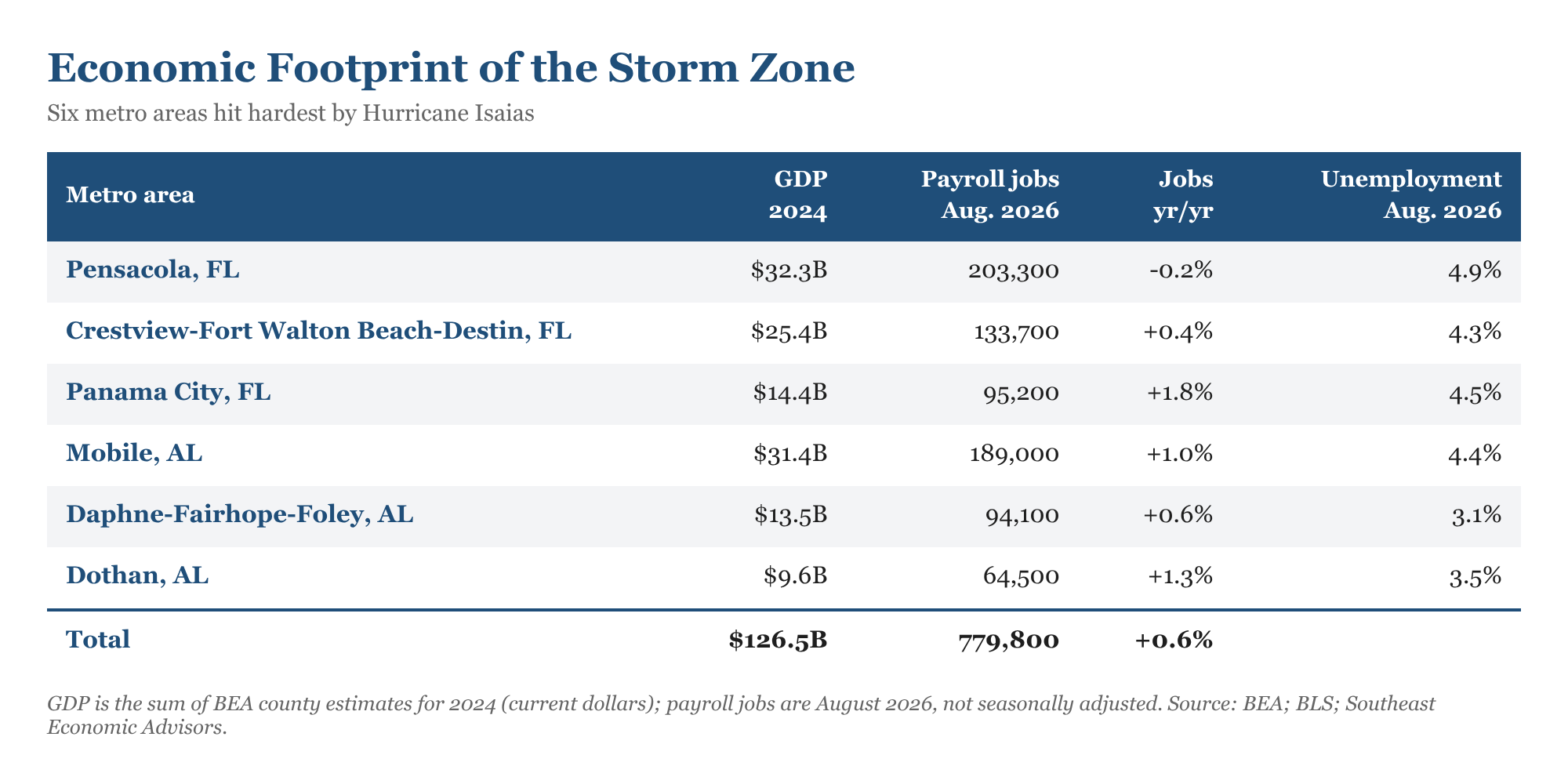
- The six hardest-hit metro areas produced about $126.5 billion of GDP in 2024 and employ about 780,000 workers, with defense and tourism the two pillars of the Panhandle economy.
- Texas is answering the data center power question with on-site generation, with about $23 billion of new campuses and power plants announced or filed. Local moratoriums spread from Raleigh to Manatee County.
- Defense and aerospace had a strong two weeks, led by Raytheon's SM-3 contract worth up to $6.3 billion and Anduril's planned $6.6 billion shipyard in Baltimore.
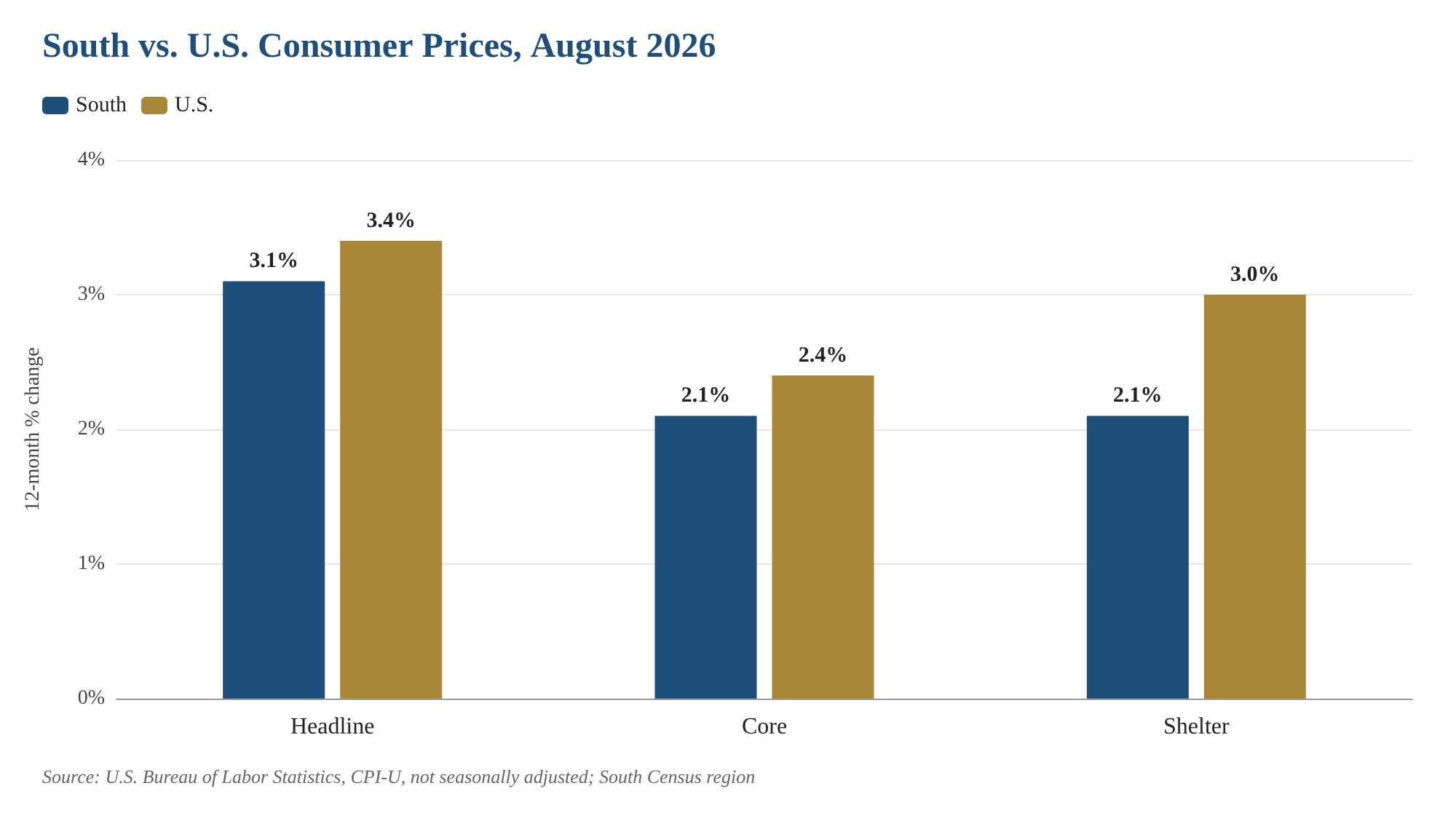
- Southern inflation is running below the nation's (3.1% versus 3.4% headline and 2.1% versus 3.0% for shelter), and September CPI arrives Wednesday.
- We look for the Fed to hold on October 28 and raise rates in December.
Seven Key Themes for the South
Texas and Alabama supplied the largest commitments among the seven themes we track over the past two weeks. The Commerce Department and South Korea announced Project Star on September 30, a $22.3 billion, 6.47-gigawatt natural gas power campus at Encinal in La Salle County, Texas, that Related Companies and NextEra will build with Lewis Energy to serve a privately funded 5-gigawatt Related Digital data center next door (first power is targeted for as early as 2029, and no tenant has been named). In Alabama, Raytheon won a five-year multiyear contract worth up to $6.3 billion (an initial $4.4 billion) for SM-3 Block IB interceptors built largely in Huntsville and Tucson, and Governor Ivey has put Huntsville forward for the proposed U.S. Space Academy (responses to NASA's request for information are due October 26). Anduril and the Navy also plan a $6.6 billion submarine-component shipyard at the Port of Baltimore with more than 3,100 jobs by 2034. The scoreboard below pairs each theme with the week's evidence.
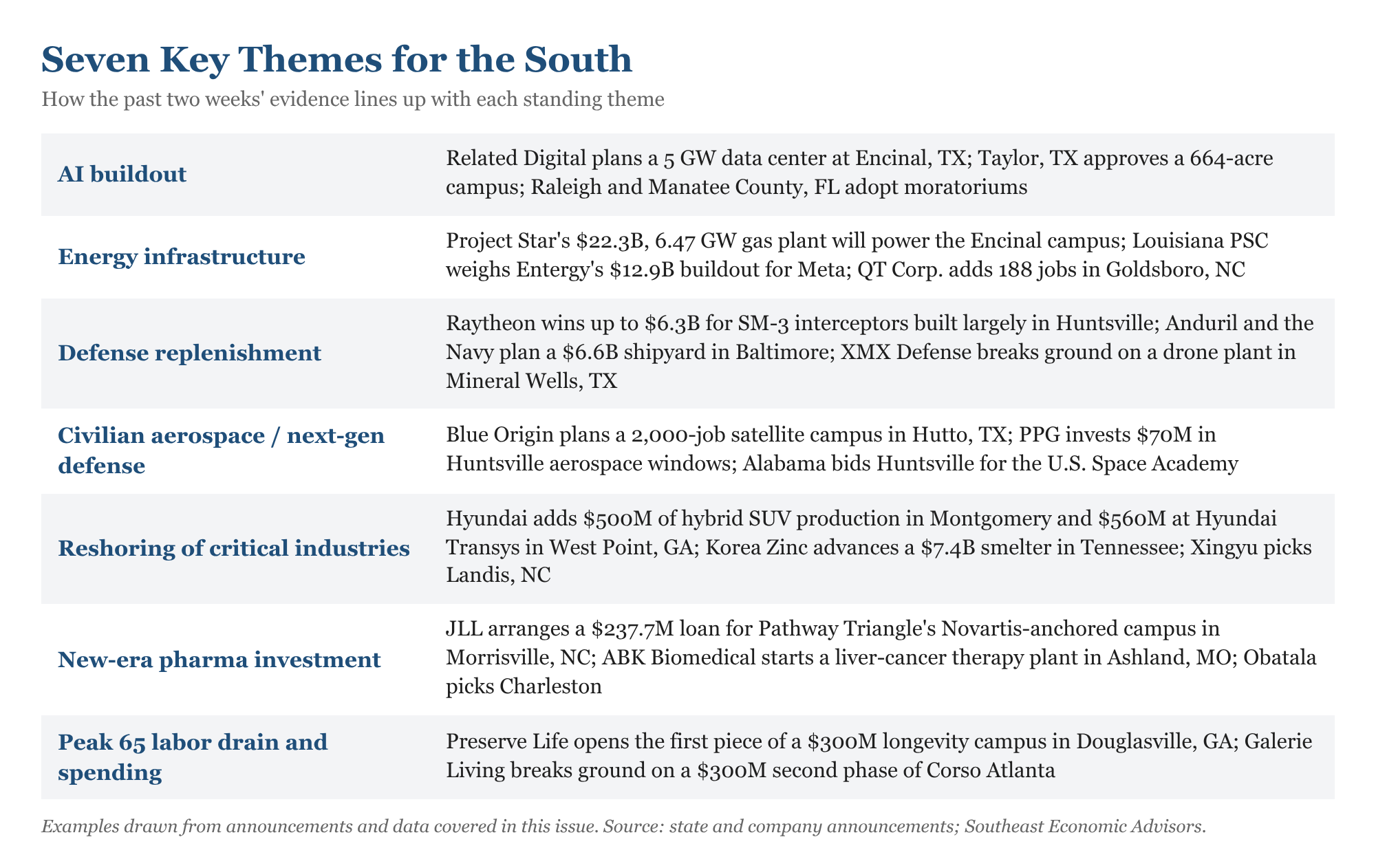
Texas developers are answering the power question by building their own. Project Star and a 490-megawatt building filed in Bastrop County (Project Longhorn, $366 million) will run on their own gas generation, Taylor approved a 664-acre campus from Big Watt Digital and PowerHouse Data Centers with its own on-site power plant and Soluna filed for a $471.8 million, 112-megawatt AI building in Willacy County. Together the newly announced or filed projects total about $23 billion, before counting the $15 billion campus Hudspeth County officials confirmed near El Paso. Metro Atlanta, meanwhile, has passed Northern Virginia to lead North America in data center construction (about 2.9 gigawatts underway, per CBRE). The equipment supply chain is spreading into smaller Southern towns as well. QT Corporation will build a $49 million switchboard plant in Goldsboro, North Carolina (188 jobs), and Mayville Engineering bought a plant in Thomson, Georgia, saying data center and critical power demand is on track to outpace its capacity. We look for more behind-the-meter campuses in Texas over the next year, a trend that would slow if the ERCOT review Governor Abbott ordered leads to tighter limits on large loads.
Korean capital runs through several of the largest recent projects. Project Star is tied to the U.S.-Korea trade agreement, Hyundai said in late September that it will spend about $500 million to build the Tucson Hybrid and Santa Fe extended-range EV in Montgomery and Hyundai Transys is adding a $560 million plant in West Point, Georgia. Korea Zinc's planned $7.4 billion critical-minerals project in Montgomery and Smith counties, Tennessee (740 jobs), which a Pentagon official called the first U.S. zinc smelter and critical-minerals processing facility since the 1970s, drew fresh attention this week.
Hurricane Isaias: Damage and Economic Stakes
Hurricane Isaias made landfall near Destin, Florida, on Friday evening as a Category 2 storm with winds near 105 mph, and early indications point to an insured loss in the mid-single-digit billions rather than a Michael-sized disaster. Gusts reached 116 mph near Santa Rosa Sound and 114 mph at NAS Whiting Field. Outages peaked near 950,000 customers across the region (Edison Electric Institute), including roughly 500,000 in Florida and more than 390,000 in Alabama, and about 160,000 were still without power Monday afternoon. FPL lowered its target to 85% restored by Monday night after finding heavier tree damage than expected, and most of Escambia and Santa Rosa counties should be back by Tuesday. At least four deaths have been confirmed (two in Florida and two in Alabama).
No catastrophe modeler has published a post-landfall loss estimate, so the ranges brokers set as the storm came ashore are the most useful reference. BMS raised its insured loss range to $4 billion to $6 billion on October 9, and Gallagher Re and Marsh Re both pointed to the mid-single-digit billions. Gallagher Re adds that total economic losses, including uninsured damage, typically run a few billion dollars higher. Before landfall, Cotality counted about 353,000 homes with $115.8 billion of reconstruction value in Escambia, Santa Rosa, Okaloosa and Walton counties. Our early read is that total losses will be in the neighborhood of $9 billion. For perspective, Hurricane Sally (2020) caused $7.3 billion of damage and Hurricane Michael (2018) about $25 billion, according to the National Hurricane Center. Florida's insurance regulator has issued a catastrophe data call, and the state will request a major disaster declaration once counties finish their damage assessments; Okaloosa officials warned that the northern end of the county "might have catastrophic damage."
The damage to energy, ports and military operations looks short-lived. Offshore oil shut-ins peaked near 72% of Gulf output on October 9 and were still about 58% on Sunday, but BP has restarted Na Kika and Thunder Horse, and Shell and Chevron report minimal damage. No refinery outages have been confirmed. The Port of Mobile reopened Saturday, and the ports of Pensacola and Panama City reopened Monday. Eglin AFB reopened its gates Sunday night, Tyndall AFB declared an all clear Saturday and Hurlburt Field has partly reopened. Agriculture took a more lasting hit. UGA's cotton agronomist expects lower quality across most of Georgia's cotton crop after 2 to 7 inches of rain fell on fields with about 80% of the crop still exposed, and Florida is offering farmers interest-free loans of up to $500,000 in 30 counties.
The storm zone is a $126 billion regional economy built on defense, tourism and a fast-growing aerospace base. The six hardest-hit metro areas produced about $126.5 billion of GDP in 2024 and employ about 780,000 workers (see table). Military and defense activity added $20.6 billion to Northwest Florida's economy in 2022 and supported 157,312 jobs, 23% of the regional economy and the highest share of any region in Florida, with Eglin, Hurlburt, Tyndall, NAS Pensacola and Whiting Field all in the storm's path. Tourism is the other pillar. Walton County's visitors generated $4.71 billion of economic impact in 2025, Baldwin County's coastal communities drew about $6.8 billion of visitor spending and Pensacola's October-to-December quarter accounts for about one-fifth of its annual visitor spending. Pensacola was soft before the storm, with payrolls down 0.2% over the year and unemployment at 4.9%.
Several of the region's largest economic development projects sit in or near the damage zone. Birdon America plans a $275 million, 2,000-job shipbuilding operation at the Port of Pensacola, and ST Engineering's aircraft maintenance complex at Pensacola International Airport is projected to employ more than 1,700 at full buildout. Williams International is building a jet-engine plant of about 1 million square feet in Crestview (more than $1 billion and 330 jobs, with its first phase due by late 2026). Across the state line, Airbus opened a second A320 final assembly line in Mobile last year, and Austal USA is completing a $450 million submarine module facility there. None has reported serious damage, and their timelines are the best barometer of how quickly the region regains its momentum.
We look for Panhandle payrolls to dip in October and recover by early 2027, with rebuilding adding to construction and retail sales through the winter. Florida's insurance market is far better positioned than after Michael. Citizens holds only about 8,300 policies in the five hardest-hit Panhandle counties, roughly 3% of its book, and Florida-based insurers posted a pooled combined ratio of 83% in 2025. Michael is the downside case, when Panama City payrolls fell 6.5% in a single month and took four years (with the pandemic in between) to regain their pre-storm level. That outcome would come into play if county assessments find widespread structural damage in northern Okaloosa and Santa Rosa counties or if beach closures and condo damage cut deeply into fall tourism.
A Wider Data Center Fight
The local backlash against data centers widened again, and it is no longer confined to rural counties. The Raleigh City Council voted 7-1 on October 6 for a six-month pause on large data centers, and Manatee County, Florida, adopted a 12-month moratorium on October 8. Lovejoy, in Clayton County, Georgia, banned data centers citywide on September 28 after a developer withdrew plans for a 1.25-gigawatt campus near two schools. The same day, Kentucky's Mercer County Fiscal Court unanimously rejected zoning that would have allowed hyperscale facilities next to the E.W. Brown power plant. South Carolina now counts 13 counties with moratoriums adopted this year, six of them in September alone.
The fight over who pays for the power has moved to the utility commissions. At the Louisiana Public Service Commission's hearing on Entergy's $12.9 billion buildout for Meta's Richland Parish campus, Entergy Louisiana's chief executive testified that Meta will draw 4,500 megawatts (a decision is due December 16). The EIA projects wholesale power prices in the PJM market serving Virginia up 41% this year, although it attributes much of that increase to weather.
We look for more moratoriums near large metros through year-end and a steady shift of hyperscale projects toward sites that can generate their own power. That view would break if Loudoun County, the heart of the industry, declines to enact its proposed 12-month pause on October 20, which would signal that the backlash has peaked where the stakes are highest.
Inflation in the South
Prices in the South are rising more slowly than in the nation, and shelter accounts for most of the gap. The South region CPI rose 3.1% over the year ending in August, compared with 3.4% nationally, and core prices rose 2.1% versus 2.4%. Shelter costs increased just 2.1% in the South, almost a full percentage point below the national 3.0%, reflecting the wave of Sun Belt apartment completions.
The metro figures show how wide the spread has become. Houston posted outright core deflation in August (core down 0.2% and shelter down 0.6%), and Atlanta's shelter index rose just 1.3%. Miami is the region's hot spot (3.7% headline and 3.0% shelter), while the Washington area ran at 4.0% in its most recent July reading.
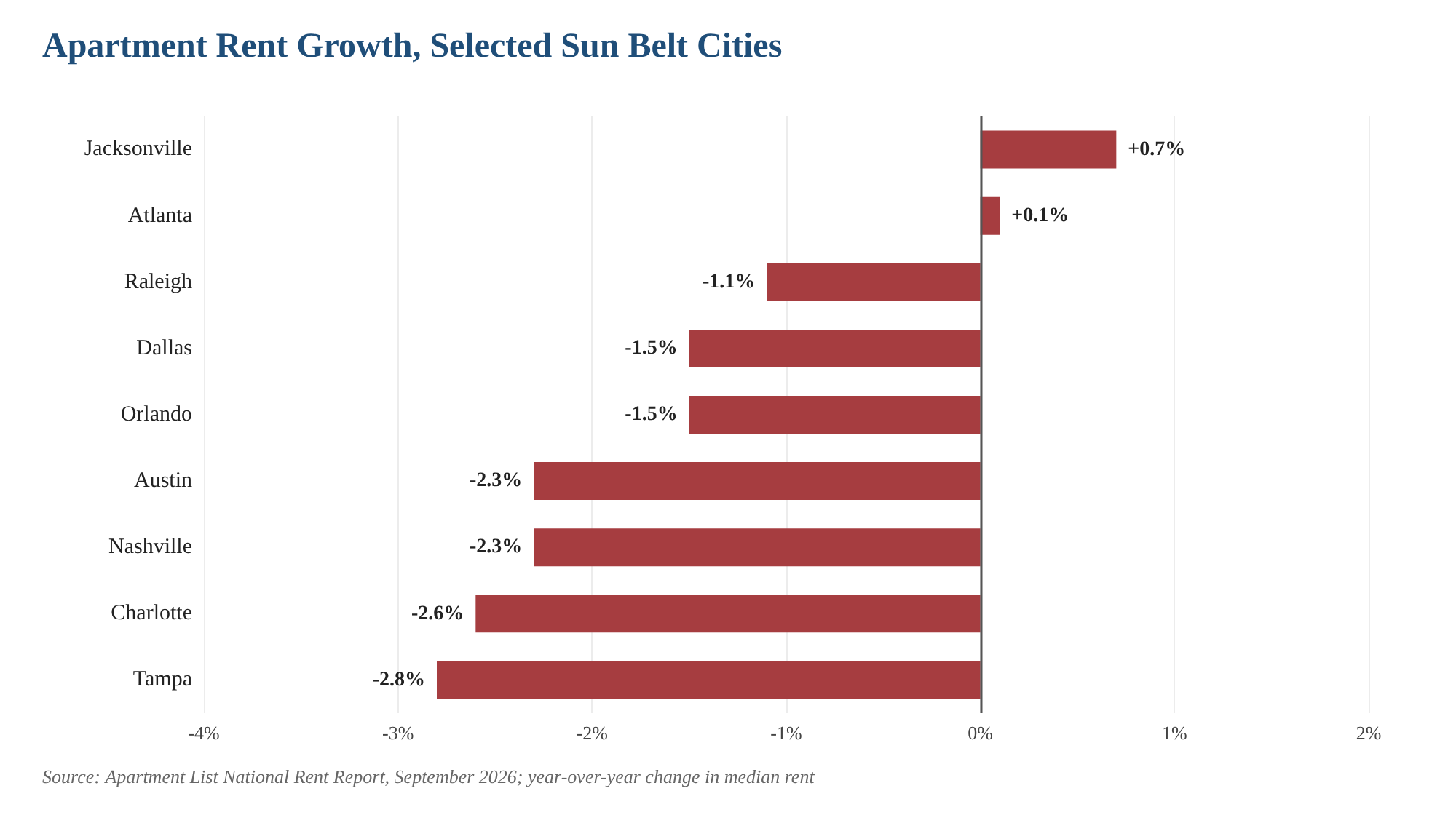
September's CPI arrives Wednesday, and gasoline will push the headline higher. The AAA national average stood at $4.36 a gallon on October 11, about 41% above a year ago, with Brent crude settling at $104.72 on Friday as the Strait of Hormuz remains largely closed. Consensus calls for headline CPI near 3.6% and core near 2.5%. We look for the South's headline rate to move up with the nation, although its shelter advantage should persist. Rent could close that gap. Apartment List reports Sun Belt rent declines are moderating, and a turn to rent growth would erase the region's cushion by next spring.
Labor Markets
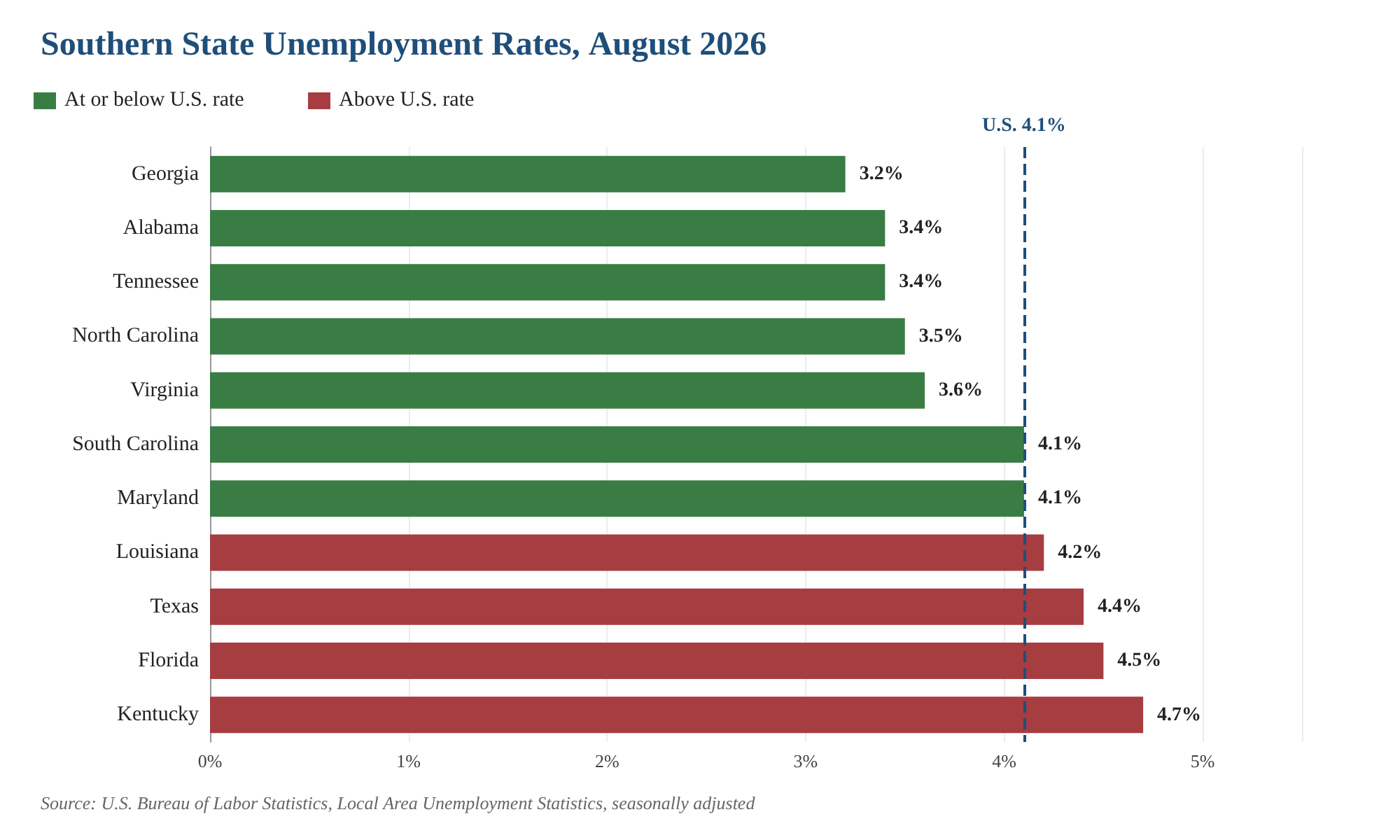
Southern labor markets are holding up better than national hiring would suggest. Georgia had the lowest unemployment rate in the region in August (3.2%), followed by Alabama and Tennessee (3.4% each) and North Carolina (3.5%). Kentucky had the highest rate (4.7%), with Florida (4.5%), Texas (4.4%) and Louisiana (4.2%) also above the U.S. rate of 4.1%.
The Carolinas stand out on job creation. South Carolina added 10,800 jobs in August, the fastest job growth of any state that month, and its payrolls are up 1.6% over the year. North Carolina has added 65,600 jobs over the year (up 1.3%), and both states have lowered their unemployment rates by roughly half a point. Alabama is going the other way, with its jobless rate up 0.6 point from a year ago.
Layoffs remain low across the region. Initial jobless claims fell to 197,000 in the week ending October 3, and the four-week average slipped to 198,000. Nationally, payrolls rose just 29,000 in September and the unemployment rate held at 4.2%, but the South's mix of manufacturing investment and population growth is still supporting hiring. With Peak 65 retirements and tighter immigration holding labor force growth near zero, it takes far fewer new jobs to keep the unemployment rate steady (payrolls have averaged about 51,000 a month over the past three months). SK On cut about 40 positions at its Stanton, Tennessee, battery plant. Building products accounted for the larger cuts. MasterBrand will lay off 391 workers at its Kinston, North Carolina, cabinet plant after its merger with American Woodmark, and Cardinal Glass is closing its Statesboro, Georgia, plant (115 jobs).
We look for Southern unemployment rates to hold near current levels when September state data are released October 20. The risk to that call is Isaias, which could temporarily lift claims and unemployment in the Florida Panhandle and southern Alabama in October's data.
Policy Watch
The Federal Reserve is in a tightening cycle for the first time in three years, and the next move appears to be on hold until December. The FOMC raised the federal funds target 25 basis points to a 3.75% to 4.00% range on September 16, and minutes released October 7 pointed to a year-end move rather than an October one. Fed funds futures priced about a 17% probability of an October 28 hike as of October 7 and about 84% for December (CME FedWatch). The 10-year Treasury yield closed at 5.24% on Friday, after touching 5.31% on October 5, and the 2-year finished at 4.80%.
The September Beige Book described a Southern economy carried by data center construction. The Atlanta Fed reported that data center buildouts drove manufacturing, industrial real estate and construction lending, while employment was flat and shortages of electricians persisted. The Richmond Fed noted that data center moratoriums in the Washington area raised concerns about slower construction. The Dallas Fed cited drought damage to cotton and wheat. The next Beige Book is due Wednesday afternoon.
Trade policy is producing uneven results at Southern ports. Savannah handled a record 504,015 containers (TEUs) in September, up 3.7% from a year ago, and Houston's steel imports jumped 54% in August. Charleston's loaded imports fell 9.2% in August, however. Section 301 tariffs of 10% to 12.5% on about 60 economies have been in place since July 24, the 25% Section 232 tariff on autos remains, and the third phase of refunds for the voided IEEPA tariffs opened October 6.
Federal funding runs through December 11 under the stopgap passed in early September. We look for the Fed to hold in October and raise rates in December, a call that would change if Wednesday's CPI surprises well above consensus.
Commercial Real Estate Across the South
Multifamily: The apartment supply wave is receding, though the South is the last region to feel the relief. RealPage reports national effective rents rose 0.9% over the year ending in the third quarter, with occupancy at 95.4%. Annual completions have fallen to about 318,000 units, 46% below the late-2024 peak, and the gap between supply and demand (about 13,000 units) is the narrowest since 2015. The South is the only region with falling rents and occupancy below 95%, and San Antonio (down 3.7%) is the weakest large market.
Industrial: Leasing hit records in the third quarter. Atlanta logged roughly 20 million square feet of industrial leasing according to Lee & Associates, a record for the market, and Houston recorded 14.7 million square feet, its best quarter in three years (CBRE). Savannah's vacancy rate dipped to 10.0% and asking rents rose 4.4%, aided by Amazon's purchase of a 1-million-square-foot building. North Carolina's Triad market is tight enough (5.8% vacancy in the second quarter, per Cushman & Wakefield) that some developers are returning to speculative construction.
Office: Demand is still soft in the region's largest market. Atlanta's office vacancy rate rose to 25.1% in the third quarter, and net absorption was negative by about 909,000 square feet as most leasing came from renewals. A proposed purchase of Buckhead's distressed Tower Place complex has fallen through, and the property is now valued at roughly $153 million.
Retail: The South is posting the fastest rent growth. Cushman & Wakefield put Southern shopping center vacancy at 5.6% in the second quarter, with asking rents up 3.3%.
Capital markets: Credit stress is moving from office to apartments. Trepp's CMBS delinquency rate rose to 8.02% in September, and the multifamily rate (8.04%) moved above the overall rate for the first time since the pandemic, with office at 12.16%. JLL arranged a $237.7 million loan for the first phase of Pathway Triangle, a Novartis-anchored manufacturing campus in Morrisville, North Carolina, and Publix bought Miami's Airpark Plaza for $83.2 million. We look for Southern apartment rents to turn positive by mid-2027, provided job growth holds near its current pace.
Development Wins of the Week
Atlantic South. Hyundai Transys will invest nearly $560 million in a third plant in West Point, Georgia, adding 320 jobs to build hybrid transmissions (October 8), and Mayville Engineering (MEC) plans about 140 jobs and $26 million in Thomson (October 1). Adeptus USA chose Anderson County, South Carolina, for its first state operation ($215.6 million and 217 jobs, September 30), Re:Build is expanding in York County ($20 million and 150 jobs, October 6) and Obatala Sciences picked Charleston County for its first East Coast biotech site (46 jobs, October 8). In North Carolina, QT Corporation will invest $49 million and add 188 jobs at a switchboard plant in Goldsboro, and Xingyu Automotive Lighting chose Landis for its first U.S. plant ($50 million and at least 300 jobs, early October). Anduril and the Navy plan a $6.6 billion shipyard at the Port of Baltimore (October 6), and Traditional Medicinals began production at its $47 million tea plant in Franklin County, Virginia (October 5).
Mid-South & Gulf. Hyundai will invest $500 million to add hybrid and extended-range SUV production in Montgomery, Alabama (September 30), and PPG will spend $70 million to expand its aerospace transparencies operation in Huntsville, including a leased 112,000-square-foot support facility (October 7). Advanced Navigation will also open a navigation-systems center there next spring. In Kentucky, Arvato opened a 150-job fulfillment center in Louisville (October 7), and R/S-Godwin Truck Body plans a $17 million, 65-job expansion in Floyd County.
Texas & the frontier. Blue Origin plans a satellite production campus in Hutto, Texas, with more than 2,000 jobs over 10 years (October 8), and XMX Defense broke ground on a military drone assembly and flight operation in Mineral Wells that local officials say could eventually employ more than 400 (October 3). Greenheck Group confirmed plans to convert the former Macy's distribution center in Owasso, Oklahoma, into a plant for commercial air-movement and air-conditioning equipment (about $300 million and 700 jobs over five years). ABK Biomedical began construction in Ashland, Missouri, on a plant for its yttrium-90 liver-cancer microspheres, with the University of Missouri Research Reactor as its irradiation partner (October 2).
The Week Ahead
Markets head into a heavy week of inflation data with growth still running hot. Atlanta Fed GDPNow tracks third-quarter growth at 3.6% as of October 8. The S&P 500 gained about 1% last week, and WTI crude settled near $92.
Mon., Oct. 12Columbus Day; bond market closed. ERCOT data center information responses due.
Tue., Oct. 13NFIB small business index; third-quarter bank earnings begin (JPMorgan, Goldman Sachs, Citigroup, Wells Fargo).
Wed., Oct. 14September CPI, including the South region (8:30 a.m.); Fed Beige Book (2:00 p.m.).
Thu., Oct. 15Initial jobless claims, September retail sales and PPI (8:30 a.m.); GDPNow update; Fed Chair Warsh speaks.
Fri., Oct. 16September industrial production (9:15 a.m.).
Tue., Oct. 20September state employment and unemployment; Loudoun County vote on a 12-month data center pause.
Mon., Oct. 26Responses due on NASA's U.S. Space Academy request for information.
Oct. 27-29FOMC meeting (decision Oct. 28); advance third-quarter GDP (Oct. 29).
Sat., Oct. 31Lexington-Fayette County data center moratorium expires unless the council extends it.
Tue., Nov. 3Election Day, including two Georgia Public Service Commission seats where power bills are the central issue.
Recent Research
Our latest research is posted at southeasteconomy.com. Last week's college football report previewed the Red River Rivalry, which delivered another tight contest when Oklahoma beat Texas 27-24 on a field goal as time expired. The game is over, but the report still provides a good overview of the Texas and Oklahoma economies. This week's report highlights Saturday's Arkansas-Vanderbilt game in Nashville and focuses on the economies of Arkansas and Central Tennessee. Recent posts also include "The South Is Adding Residents Faster Than Income," which focused on the recently released state personal income and state GDP data.
Mark Vitner, Chief Economist
Piedmont Crescent Capital / Southeast Economic Advisors
Sources & Notes
Sources: BLS; BEA; U.S. Department of Labor; Federal Reserve Board; Federal Reserve Banks of Atlanta, Richmond, Dallas and St. Louis; CME Group; U.S. Treasury; EIA; AAA; National Hurricane Center; FPL; Edison Electric Institute; BMS, Gallagher Re and Marsh Re via Artemis; Cotality; FloridaCommerce; Florida Defense Factbook; Visit Pensacola; Walton County and Gulf Shores & Orange Beach tourism; UGA Extension; RealPage; Apartment List; Yardi Matrix; CBRE; Cushman & Wakefield; Lee & Associates; Trepp; Georgia Ports Authority; Port Houston; Huntsville Business Journal; Axios; Manufacturing Dive; Atlanta Business Chronicle; Charlotte, Triangle and Triad Business Journals; CBS News; Utility Dive; state economic development agencies; local government records and news reports.
Notes: CPI and state labor data are for August 2026 unless noted; payrolls are for September and subject to revision. Market prices are October 9 closes. Hurricane figures are as of October 12, and insured loss ranges predate landfall. Hudspeth, Project Star, Longhorn and Soluna figures are from local officials, developers and state filings.