
Georgia vs. Tennessee: Southern Titans Meet on the Gridiron and in the Economy

Week 2 Recap: Upsets and Close Calls Shake Up the Rankings
Week 2 of the 2025 season delivered far more drama than expected for what is traditionally a “cupcake week” following the heavyweight matchups of opening weekend. While many top-ranked teams scheduled lighter opponents, several were pushed to the brink—or toppled outright.
Our featured game saw Ole Miss avenge last year’s loss to Kentucky, defeating the Wildcats 30-23 in Lexington. Running back Kewan Lacy powered the Rebels’ offense with 138 rushing yards and a touchdown, while QB Austin Simmons added 376 total yards. Kentucky surged late but could not overcome early mistakes, giving Ole Miss a crucial SEC road win.
Elsewhere in the Southeast, South Florida stunned No. 13 Florida 18-16 at the Swamp in Gainesville on a last-second field goal, one of the weekend’s biggest upsets. In Dallas, Baylor edged SMU 48-45 in double overtime, fueled by Sawyer Robertson’s 440-yard, four-touchdown passing performance.
Oklahoma scored a signature win over Michigan, taking control early in a 24-13 upset that reshaped the early season Top 25 picture. In the Midwest, Iowa State clipped Iowa 16-13 in the Cy-Hawk rivalry, as a 54-yard field goal in the final two minutes sealed the victory.
Top-tier teams largely survived their Week 2 tune-ups, but several were tested. While Georgia, Alabama, and Texas rolled, Michigan and Florida faltered, proving there are no guaranteed wins in college football. The volatility underscored how quickly early-season perceptions can shift, setting the stage for a pivotal Week 3 slate where conference play begins to heat up.
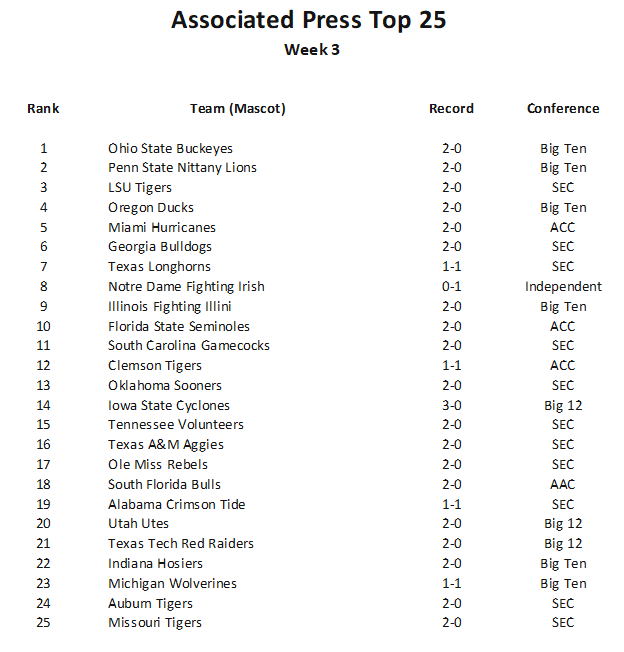
Key matchups this weekend include: #8 ranked Notre Dame traveling to #16 Texas A&M; this season’s early surprise team, #18 University of South Florida Bulls, who are coming off wins over Boise State and Florida and is located in Tampa, travel to South Florida to take on the #5 Miami Hurricanes; Clemson, which looked shaky in its 27-16 win over Troy, tries to get back on track at Georgia Tech; Florida, coming off their embarrassing loss to USF, travels to Baton Rouge to take on #4 ranked LSU in Death Valley Saturday night, where we expect the Gators to deliver their best performance of the season; and our featured game which has #6 Georgia traveling to Knoxville to take on the #15 Tennessee Saturday afternoon.
ESPN College GameDay Returns to Knoxville
ESPN’s College GameDay, the premier college football pregame show, will broadcast live from Knoxville on Saturday morning, adding to the electric atmosphere surrounding this rivalry matchup. The show transforms the host campus into a festival-like environment, drawing tens of thousands of fans before kickoff and showcasing SEC football to a national audience. For Tennessee, GameDay represents validation of the program’s resurgence under Heupel and a powerful recruiting tool. For Georgia, it’s another opportunity to demonstrate sustained dominance. Beyond the field, GameDay also delivers a significant economic boost to Knoxville through tourism and providing national visibility along its picturesque riverfront.
The Universities: Rich Legacies, Strategic Growth
University of Georgia (UGA)
Chartered in 1785, UGA holds the distinction of being the first state-chartered public university in the United States. During the Civil War, UGA closed from 1863 to 1866, reopening with veterans among its returning students. The post-war era saw UGA’s transformation into a land-grant institution, launching a College of Agriculture in 1872. Throughout the 20th century, the university expanded rapidly, adding colleges of Education, Journalism, Commerce, and Veterinary Medicine, ultimately earning R1 research status by the 1970s.
Recent milestones include the creation of the College of Public Health (2005), College of Engineering (2012), School of Computing (2022), and the College of Medicine welcoming its first class this year. UGA’s research budget now exceeds $500 million annually, fueling innovation in biosciences, data analytics, and environmental studies. Its Terry College MBA recently earned the No. 1 global best-value ranking from Financial Times, while The Princeton Review gave UGA a 92/99 ROI score, underscoring its reputation for providing one of the best returns on investment among U.S. public universities-noting its low relative all-in cost and higher earnings by its graduates.
Fast-growing programs include Public and International Affairs (SPIA), ranked top-three nationally, and the pioneering Master of Marketing Research, which boasts near 100% placement rates. These programs, alongside UGA’s deep ties to the state’s business community, make it a key driver of Georgia’s workforce and innovation pipeline.
National Championships: Claimed and Recognized Titles
Claimed National Championships (4):
- 1942, under coach Wally Butts, Georgia posted an 11–1 record, capping the season with a 9–0 Rose Bowl victory over UCLA, and claims the national title.
- 1980, Vince Dooley’s undefeated team (12–0) capped with a Sugar Bowl win over Notre Dame, securing the AP and Coaches’ Poll national championship.
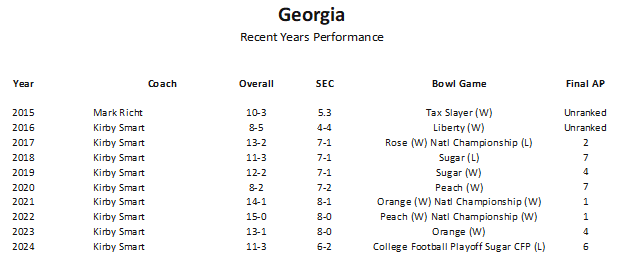
- 2021 and 2022, under Kirby Smart, Georgia won back-to-back College Football Playoff (CFP) National Championships—defeating Alabama and TCU, respectively—the latter of which was the most lopsided Championship win in history.
Unclaimed National Selections (4):
Georgia was also named national champion in four additional seasons—1920, 1927, 1946, and 1968—based on selectors like Berryman, Boand, Litkenhous, and Williamson. Though recognized by some historic polls, these titles are not officially claimed by the university.
Georgia’s teams became known as the “Bulldogs” in the early 20th century, influenced partly by Yale University, whose bulldog mascot inspired early Georgia leaders, including first president Abraham Baldwin. In 1920, Atlanta Journal columnist Morgan Blake proposed the name to symbolize dignity and ferocity. By the following year, “Bulldogs” had been widely adopted and remains central to UGA’s identity today.
Uga: A Mascot Like No Other
Since 1956, Georgia’s live mascot, Uga, has been cared for by the Savannah-based Seiler family. Uga wears a custom jersey, travels with the team, and resides in an air-conditioned doghouse on the sideline of Sanford Stadium. Uga X, one of the most celebrated mascots in college football, passed away in 2024, paving the way for Uga XI, “Boom,” to take over. Uga is widely regarded as one of the most iconic mascots in all of sports.
University of Tennessee, Knoxville (UTK)
Founded in 1794 as Blount College—two years before Tennessee achieved statehood—UTK has grown into a flagship research powerhouse and the state’s largest public university. The Knoxville campus enrolls nearly 39,000 students, with systemwide endowment assets now exceeding $1 billion. UTK’s reach extends statewide, with programs serving all 95 counties through agricultural extension, education, and healthcare.
The university is in the midst of what leadership calls its “Greatest Decade.” In FY 2024–25, UTK raised a record $428 million in philanthropic support, more than double the amount of five years earlier. Its research funding has reached historic highs, reinforcing its R1 classification and expanding opportunities for students and faculty.
Aerospace Leadership
UTK’s influence in aerospace is unmatched in the region. The University of Tennessee Space Institute (UTSI), founded in 1964 near the Arnold Engineering Development Complex (AEDC), provides students with access to one of the world’s most advanced flight-testing environments, including hypersonic wind tunnels and propulsion labs. UTSI’s collaboration with AEDC allows graduate students and researchers to work directly on cutting-edge defense and space technologies. The aerospace program was one of the key factors in former UT quarterback Joshua Dobbs, who has gone on to a long NFL career.
The Tickle College of Engineering offers one of the nation’s most comprehensive aerospace engineering programs, with specialties in aerodynamics, propulsion, orbital mechanics, and stability and control. Graduates have gone on to careers at NASA, SpaceX, Boeing, and Lockheed Martin, with nine alumni becoming NASA astronauts. UTK also offers an Executive Aerospace and Defense MBA through its Haslam College of Business, a unique program connecting defense contractors and aerospace leaders.
Fast-growing programs extend beyond aerospace, including the College of Medicine, expanded 4+1 master’s programs, and workforce-aligned graduate pathways designed to keep talent in-state. UTK’s partnerships with Oak Ridge National Laboratory (ORNL) further position it at the forefront of energy and advanced materials research.
Tennessee Volunteers: Tradition, Achievements, and Impact
Program Launch & Early Years
The University of Tennessee fielded its first football team in 1899, and by the early 20th century, the program had begun to establish itself as a regional power. The Volunteers soon became a fixture in the Southern Conference and later in the Southeastern Conference (SEC), where they remain one of its cornerstones.
The nickname “Volunteers,” or “Vols,” dates back to the early 1900s and reflects Tennessee’s historic role as the Volunteer State. Thousands of Tennesseans volunteered to fight under General Andrew Jackson at the Battle of New Orleans during the War of 1812, a tradition repeated during the Mexican–American War, when the state sent more troops than any other. Sportswriters first applied the term to the university’s teams after a 1902 game against Georgia Tech, and it has since become synonymous with the pride and resilience of the program.
The program’s mascot, Smokey, a bluetick coonhound, has been a sideline presence since 1953. The costumed and live versions of Smokey remain central to Tennessee’s gameday pageantry.
Historic Program Snapshot
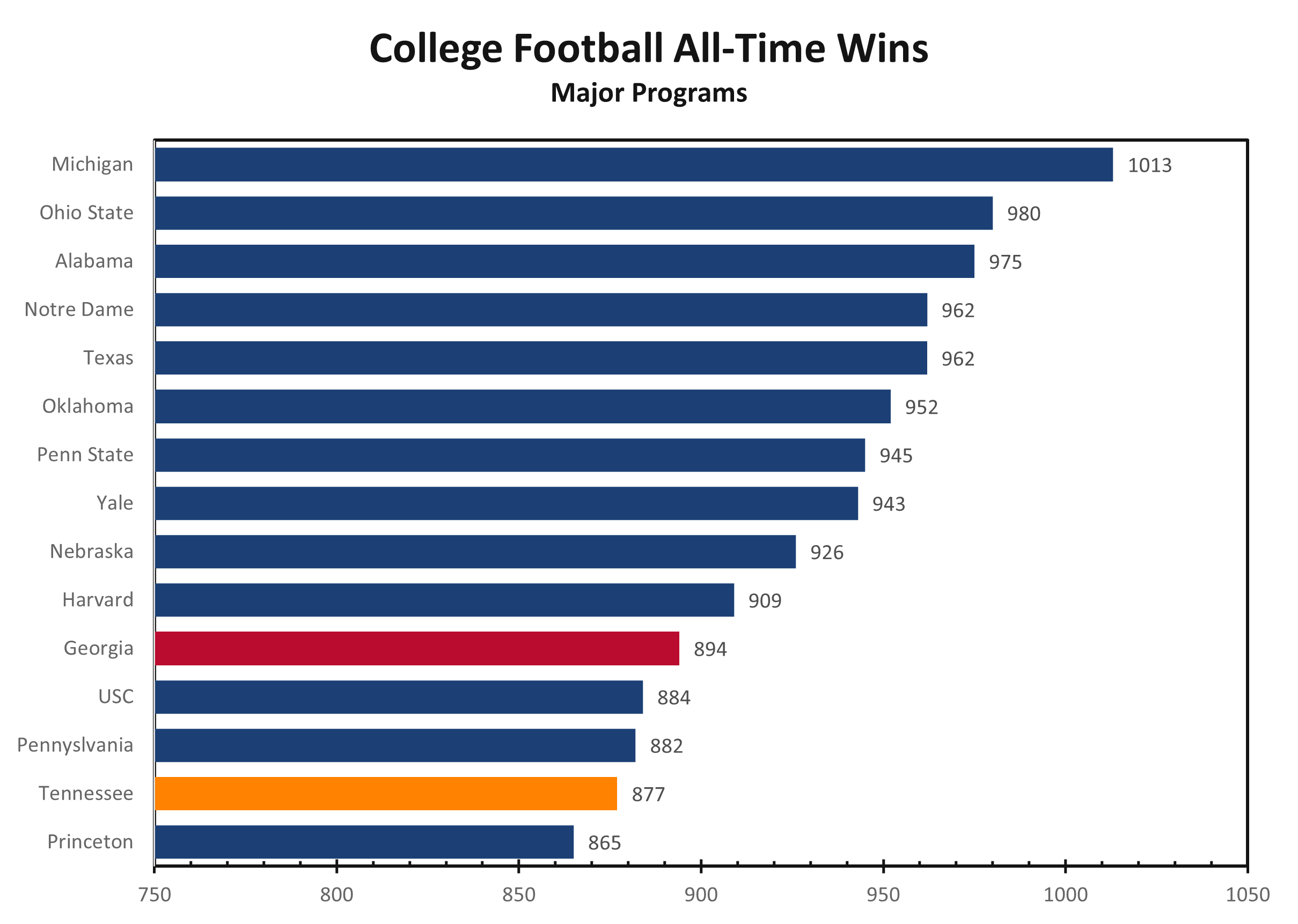
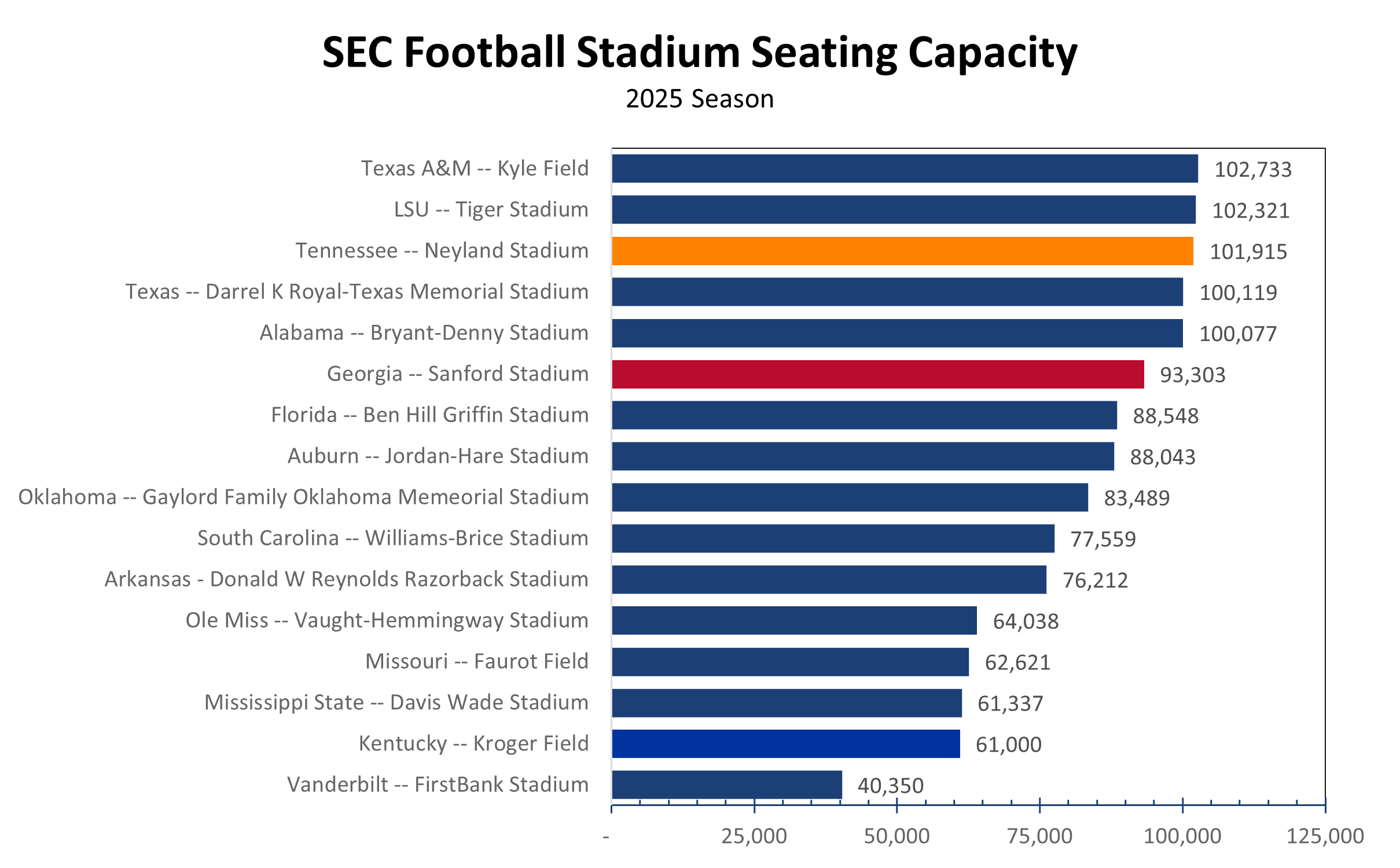
Tennessee has built one of the richest traditions in college football. Entering the 2024 season, the Volunteers had accumulated 877 wins, placing them among the top fifteen all-time in major college football history. The program’s home, Neyland Stadium, seats more than 100,000 fans and ranks among the most intimidating venues in the sport.
National Championships: Claimed and Recognized Titles
Claimed National Championships (6):
- 1938 – Robert Neyland’s team went undefeated and capped its season with an Orange Bowl win over Oklahoma.
- 1940 – Another Neyland-led squad finished 10–0 in the regular season before falling in the Sugar Bowl, earning national recognition.
- 1950, 1951 – Under coach General Neyland’s successors, Tennessee claimed back-to-back titles, including a 10–1 season in 1951 capped by a decisive Cotton Bowl victory.
- 1967 – Doug Dickey’s 9–2 squad shared a national title awarded by selectors.
- 1998 – Phillip Fulmer’s Volunteers, led by QB Tee Martin and wide receiver Peerless Price, went 13–0 and won the first BCS National Championship by defeating Florida State in the Fiesta Bowl.
Additional Recognitions: Tennessee has also been awarded national titles in 1939 and 1956 by certain historic selectors, though the university does not officially claim them.
Rivalry, Recent History, and Memorable Games
Series Record: Georgia leads 29–23–2 all-time and has won the last eight meetings, including a 31–17 victory in Athens in 2024.
Last 10 Games:
- 2024: Georgia 31–17 (Athens)
- 2023: Georgia 38–10 (Knoxville)
- 2022: Georgia 27–13 (Athens)
- 2021: Georgia 41–17 (Knoxville)
- 2020: Georgia 44–21 (Athens)
- 2019: Georgia 43–14 (Knoxville)
- 2018: Georgia 38–12 (Athens)
- 2017: Georgia 41–0 (Knoxville)
- 2016: Tennessee 34–31 (Athens)
- 2015: Tennessee 38–31 (Knoxville)
Memorable Games
- 1980 – Herschel Walker’s Arrival (Georgia 16, Tennessee 15):
The season opener in Knoxville introduced college football to one of its greatest running backs. Freshman Herschel Walker began the game on the sidelines as Georgia fell behind 15-2, but late in the first half, head coach Vince Dooley inserted Walker into the lineup. His defining play came when he ran over future Dallas Cowboy standout Bill Bates, flattening the Tennessee safety on his way to a touchdown run that electrified the crowd and his teammates. Walker’s physical dominance changed the game’s momentum, propelling Georgia to a comeback victory. That win launched a perfect season and Georgia’s 1980 national championship, cementing Walker as a legend from day one. - 1992 – The Last Tie in the Series (Georgia 31, Tennessee 31)
Georgia mounted a late comeback behind quarterback Eric Zier and running back Garrison Hearst to even the score in the closing minutes. Tennessee quarterback Heath Shuler led the Vols’ explosive offense early, but neither team could deliver a decisive blow in this pivotal matchup during the inaugural season of the SEC divisional format. - 1995 – Peyton Delivers Late and Loud (Tennessee 30, Georgia 27)
In a tied game at 27, Peyton Manning drove Tennessee to a game-winning field goal with just 10 seconds remaining, extending the Vols’ dominant streak to five straight wins over the Bulldogs. - 2001 – The Hobnail Boot Game (Georgia 26, Tennessee 24):
In just his second game as head coach, Mark Richt led Georgia into Neyland Stadium to face a Tennessee team ranked sixth nationally. Trailing 24-20 with under a minute to play, true freshman quarterback David Greene engineered a flawless final drive. With six seconds remaining, Greene delivered a perfect six-yard touchdown pass to tight end Verron Haynes, stunning the 100,000+ crowd. Legendary Georgia broadcaster Larry Munson captured the moment with his famous call:
“We just stepped on their face with a hobnail boot and broke their nose!”
The win marked a turning point for Richt’s tenure and remains one of Georgia’s most celebrated victories.
- 2004 – The Underdog Vols Shock Georgia at Home (Tennessee 19, Georgia 14) Then unranked Tennessee shocked No. 3 Georgia in Athens, snapping the Bulldogs’ 17-game home winning streak. Freshman quarterback Erik Ainge and a resilient Vols defense delivered a statement victory that shifted the balance of power in the SEC East race.
- 2016 – The Hail Mary Game (Tennessee 34, Georgia 31):
Georgia appeared to have sealed a win with a late 47-yard touchdown pass by Jacob Eason. But on the final play, Tennessee quarterback Joshua Dobbs connected with Jauan Jennings for a 43-yard Hail Mary, lifting the Vols to a stunning last-second victory. - 2022 – Georgia’s Defensive Showcase (Georgia 27, Tennessee 13):
In a No. 1 vs. No. 2 matchup, Georgia’s defense smothered Tennessee’s high-powered offense, preserving the Bulldogs’ path to a second consecutive national title and ending Tennessee’s playoff aspirations.
City Snapshots: Athens and Knoxville
Athens–Clarke County: The Classic City Rising
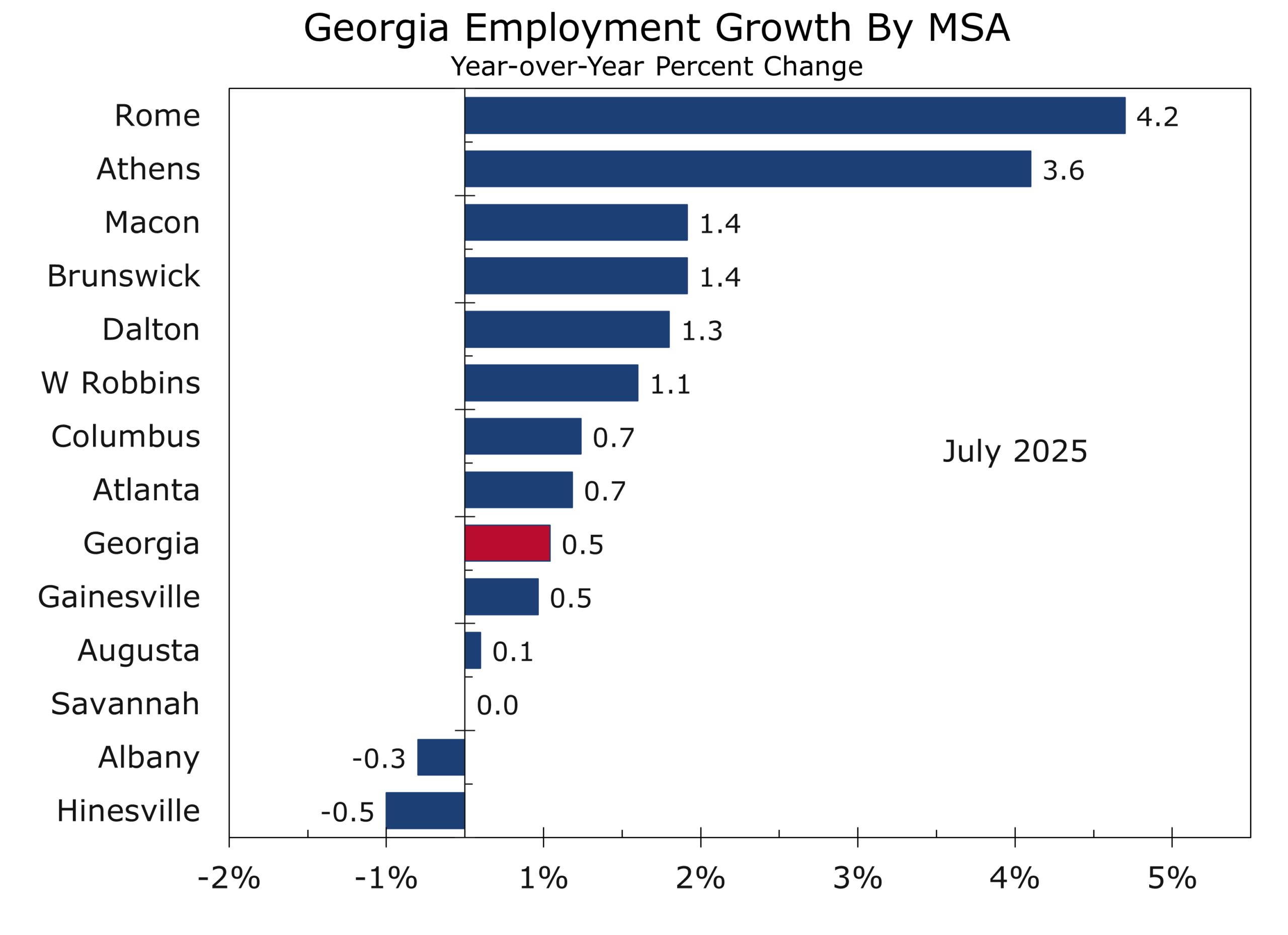
Located about 70 miles northeast of Atlanta, Athens–Clarke County blends small-town charm with the energy of a major university hub. Home to the University of Georgia, the city thrives on education, healthcare, and tourism, with UGA serving as the region’s largest employer and economic engine. Game weekends are transformative, drawing tens of thousands of fans and generating millions in visitor spending across hotels, restaurants, and retail. The consolidated city-county government, created in 1991, streamlines services for the four-county metro area, which includes Clarke, Oconee, Madison, and Oglethorpe counties. The metro population has grown steadily, surpassing 223,000 residents in 2024, fueled by migration from the Atlanta region. Spillover growth is especially evident in Jackson County, part of the fast-growing I-85 industrial corridor, where new subdivisions, logistics facilities, and major employers are reshaping the regional economy. Anchors like SK Battery America’s electric vehicle battery complex in Commerce and Toyota Industries’ $69 million Pendergrass expansion are generating thousands of jobs, reinforcing Athens’ role as a cultural and academic hub complementing Jackson County’s manufacturing and distribution muscle.
Athens’ cultural identity is as dynamic as its economy. The city is internationally renowned for its music scene, having launched R.E.M., The B-52s, Widespread Panic, Drive-By Truckers, and Pylon, with venues like the 40 Watt Club and Georgia Theatre serving as iconic stages. This creative energy now intersects with sports and entertainment at the new $146 million Akins Ford Arena, which opened in December 2024 and is home to the Athens Rock Lobsters, a professional hockey team named after The B-52s’ hit song “Rock Lobster.” The region continues to attract new industry and Athens Technical College opened a $17.2 million Industrial Systems building in December 2023 to help further the workforce-ready ecosystem. From the roar of Sanford Stadium to the pulse of live music and the hum of new factories, Athens is emerging as a dynamic metro bridging creativity, education, and advanced industry, with Jackson County’s explosive growth solidifying the region as one of Georgia’s most compelling economic stories.
Knoxville Metro — Catalyst at the Gateway to the Smokies
Once a river-and-rail crossroads, Knoxville has evolved into one of the Southeast’s most dynamic midsized metros, with an economy built on federal research, logistics, manufacturing, and higher education. Anchored by Oak Ridge National Laboratory (ORNL) and the Tennessee Valley Authority (TVA), Knoxville is a hub for energy innovation, nuclear research, and advanced materials, attracting federal funding and fostering cutting-edge private sector partnerships. The University of Tennessee, Knoxville (UTK) continues to expand its academic and research presence, while its nationally recognized athletics programs bolster the region’s identity and visitor economy. A decade of downtown revitalization has brought new life to historic warehouses and riverfront areas, creating a vibrant urban core that appeals to young professionals and remote workers. Knoxville also serves as the gateway to the Great Smoky Mountains National Park, the most visited national park in the U.S., which drew over 12 million visitors in 2024. Tourism-driven towns like Gatlinburg, Pigeon Forge, and Sevierville generate billions in annual visitor spending, much of which spills over into Knoxville through hotel demand, airport traffic, and retail activity, strengthening Knoxville’s role as a tourism and service hub for the region.
The Knoxville Metropolitan Statistical Area (MSA) includes nine counties: Anderson, Blount, Campbell, Grainger, Knox, Loudon, Morgan, Roane, and Union. The larger Knoxville–Morristown–Sevierville Combined Statistical Area (CBSA) adds tourism-heavy counties such as Sevier, Cocke, Jefferson, and Hamblen, reflecting growing integration between Knoxville’s workforce and the Smoky Mountain tourism economy. As of 2024, the MSA’s population reached approximately 957,600, while the CBSA topped 1.23 million, up from about 1.16 million in 2020, highlighting the region’s rapid growth. This influx of residents—driven by retirees, families, and remote workers seeking affordability and outdoor amenities—is fueling a suburban housing boom and rising labor demand. Tourism-dependent counties are now starved for workers, pushing hospitality and service businesses to increasingly rely on Knoxville’s labor force and commuting base. At the same time, industrial development is accelerating, with new projects in advanced manufacturing, automotive supply chains, clean energy, and logistics, positioning Knoxville as a key innovation hub for the Southeast. With its strong research base, expanding tourism economy, and deepening regional integration, Knoxville is emerging as both a lifestyle destination and a driver of sustainable, long-term economic growth.
Georgia: Low Unemployment, Slower Engine
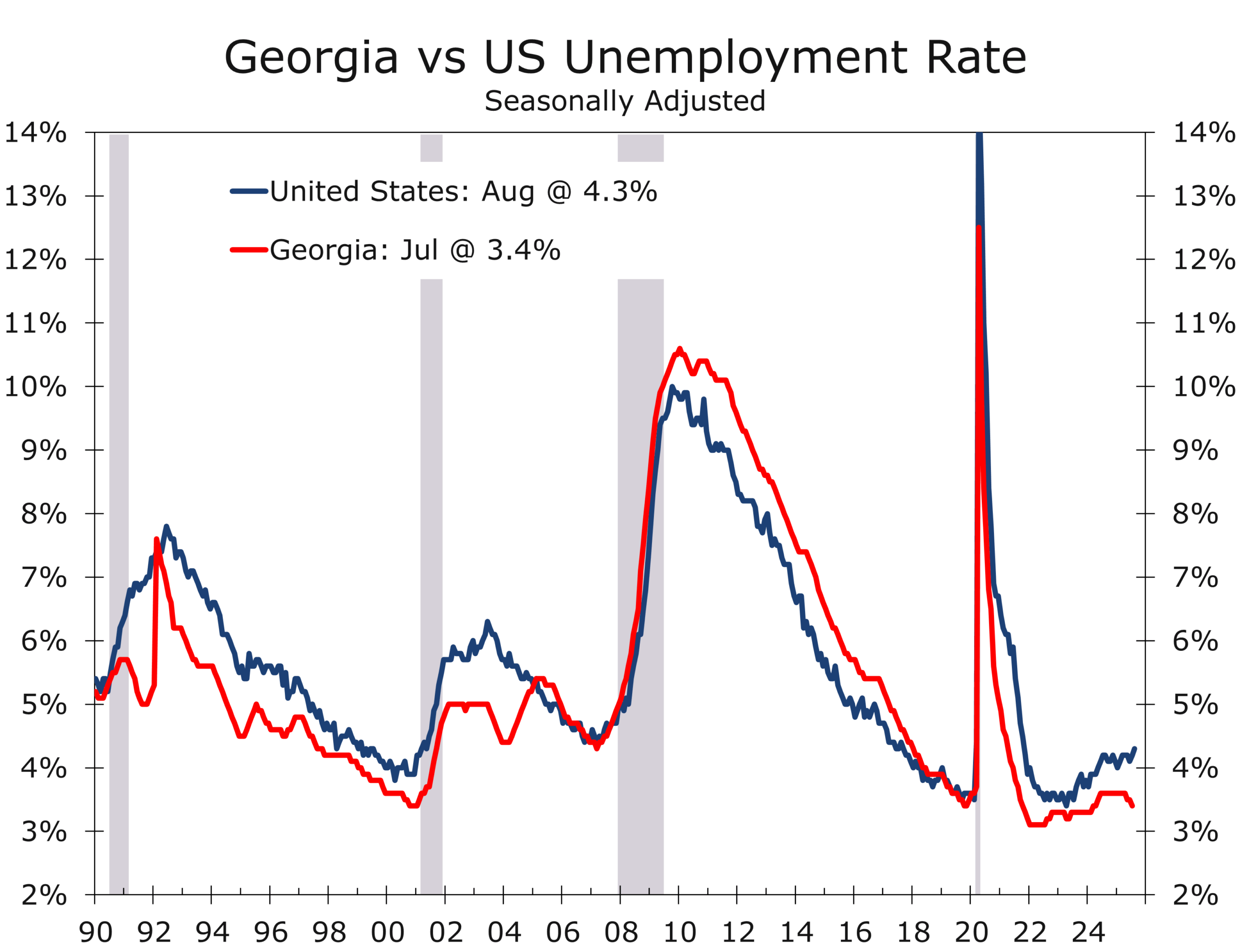
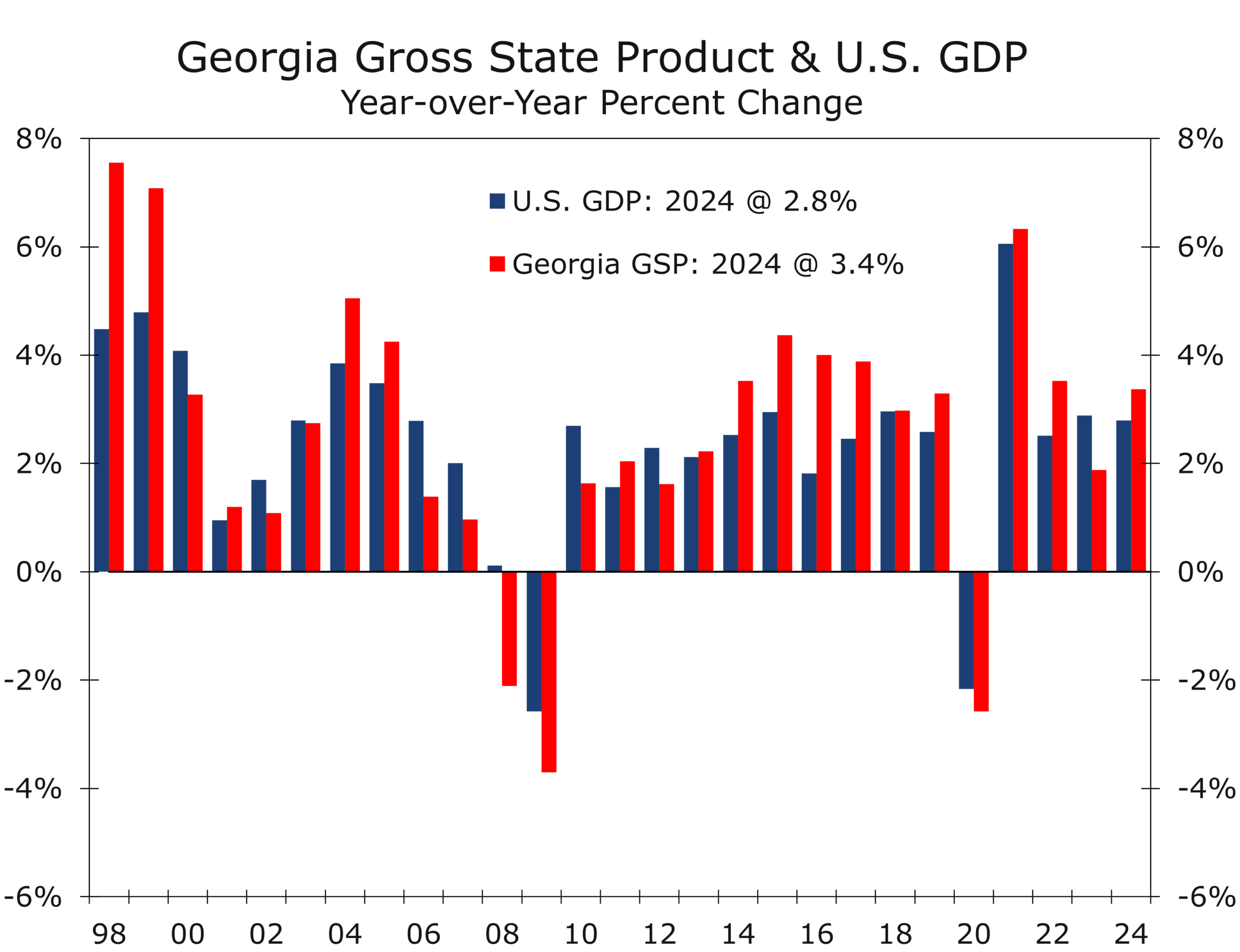
Georgia’s headline jobless rate sits at 3.4%, but beneath the surface, growth has cooled. BLS data show nonfarm payrolls essentially flat over the past year, and labor force participation has stalled near 60.7%. In short, low unemployment reflects sluggish labor-force growth, not accelerating job creation.
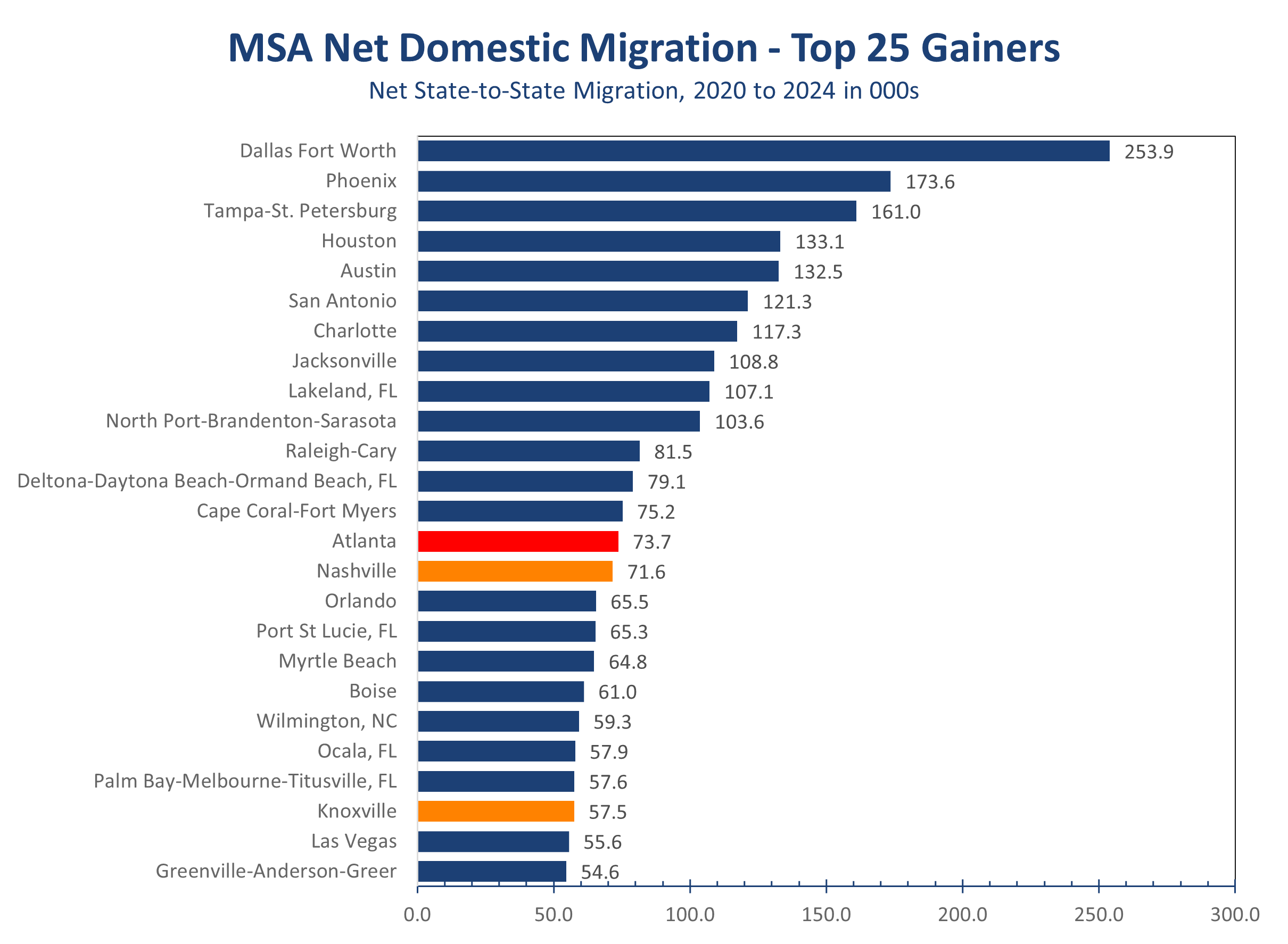
Population dynamics underscore the slowdown. Metro Atlanta posted a slight domestic migrant outflow ( around 1,300 people) in the year ending mid-2024, a historic reversal after decades of strong in-migration. Overall population gains are increasingly supported by international migration, while domestic flows have weakened. An important aside is that Atlanta is a major global gateway metro that attracts new residents from around the world. As in other global gateways, many of these new arrivals often resettle in other areas of the state and country and show up in the data a domestic out-migration.
Immigration enforcement has recently added to labor market strain, particularly in construction, where 92% of firms report difficulty hiring. A recent ICE action paused work at a Savannah-area EV battery plant, illustrating how compliance checks and heightened subcontractor caution can delay project timelines. Foreign direct investment is critically important to Georgia’s economy, and how state and federal officials navigate the sensitive issues surrounding this raid will have broad repercussions for future investment and growth.
Federal layoffs have also become a significant economic headwind for Georgia. With the CDC headquartered in Atlanta, cuts to public health budgets have already resulted in hundreds of final termination notices issued this summer, part of a broader reduction of roughly 2,400 CDC jobs. These cuts are tied to a sweeping Department of Health and Human Services (HHS) restructuring plan aimed at consolidating multiple agencies—including the FDA, NIH, and other health entities—into a new “Administration for a Healthy America.” HHS has announced plans to reduce its workforce by as many as 20,000 positions nationwide, though a federal judge has temporarily blocked additional terminations, citing concerns about the legality of the process. The uncertainty surrounding these reductions has rippled through metro Atlanta’s economy, threatening research funding, healthcare infrastructure, and the state’s broader innovation ecosystem, while sending a cautionary signal to investors evaluating long-term commitments in the region.
Despite near-term softness, Georgia’s capital investment pipeline remains robust:
- Amazon Web Services committed $11B+ to data centers and AI infrastructure.
- Georgia Power has 765 MW of battery storage under construction, with another 1,000 MW planned.
- Hyundai’s Savannah Metaplant added hybrid production to its EV portfolio still has significant growth ahead of it.
- The ports of Savannah and Brunswick now support 609,000 jobs—12% of statewide employment.
Bottom line: Georgia’s economy has cooled—flat payrolls, slowing migration, and labor frictions—but long-term prospects remain supported by world-class logistics, clean energy, and digital infrastructure projects. The Atlanta metro area now slightly lags behind other rapidly growing areas in the region, most notably, Raleigh, Charlotte and South Florida.
Tennessee: Diversified and Dynamic
Tennessee’s economy is built on diversity and rapid transformation. Automotive manufacturing remains a core strength, anchored by Nissan’s massive Smyrna facility and Volkswagen’s Chattanooga plant, both of which continue to attract suppliers and drive regional growth. The state’s logistics infrastructure, supported by Memphis International Airport, FedEx’s global superhub, and the Nashville–Louisville freight corridor, positions Tennessee as a national leader in transportation and distribution. In West Tennessee, Ford’s $5.6 billion BlueOval City EV complex in Haywood County will reshape the auto sector and regional labor market, though recent delays have pushed full-scale production back to 2028. Surrounding counties are seeing a wave of infrastructure and housing investments to prepare for this transformation, with workforce development emerging as a top priority.
Middle Tennessee, led by Nashville, has become one of the nation’s fastest-growing economic centers. The city is a magnet for corporate relocations, including a steady stream of headquarters moves from California and other high-cost states. Oracle’s $1.2 billion River North campus, now slated to become the company’s global headquarters, will bring an estimated 8,500 jobs by 2031, reshaping Nashville’s skyline and tech sector. Recent expansions include Pilot.com’s 450-job finance hub and In-N-Out Burger’s new Eastern Territory office near Franklin, which will support its multistate expansion and executive team relocation. Nashville’s healthcare sector remains one of the largest in the country, with more than 900 companies and over 500,000 jobs, while the city’s music industry extends well beyond tourism—its recording, publishing, and production ecosystem directly supports thousands of high-paying jobs and drives significant intellectual property revenue, cementing Nashville’s global reputation as “Music City.” Beyond Nashville, Advanex Americas announced an $11.4 million expansion of its U.S. headquarters in White House (Robertson County), adding 56 advanced manufacturing jobs, and the massive Nashville Yards development is bringing millions of square feet of office, residential, and entertainment space to the urban core.
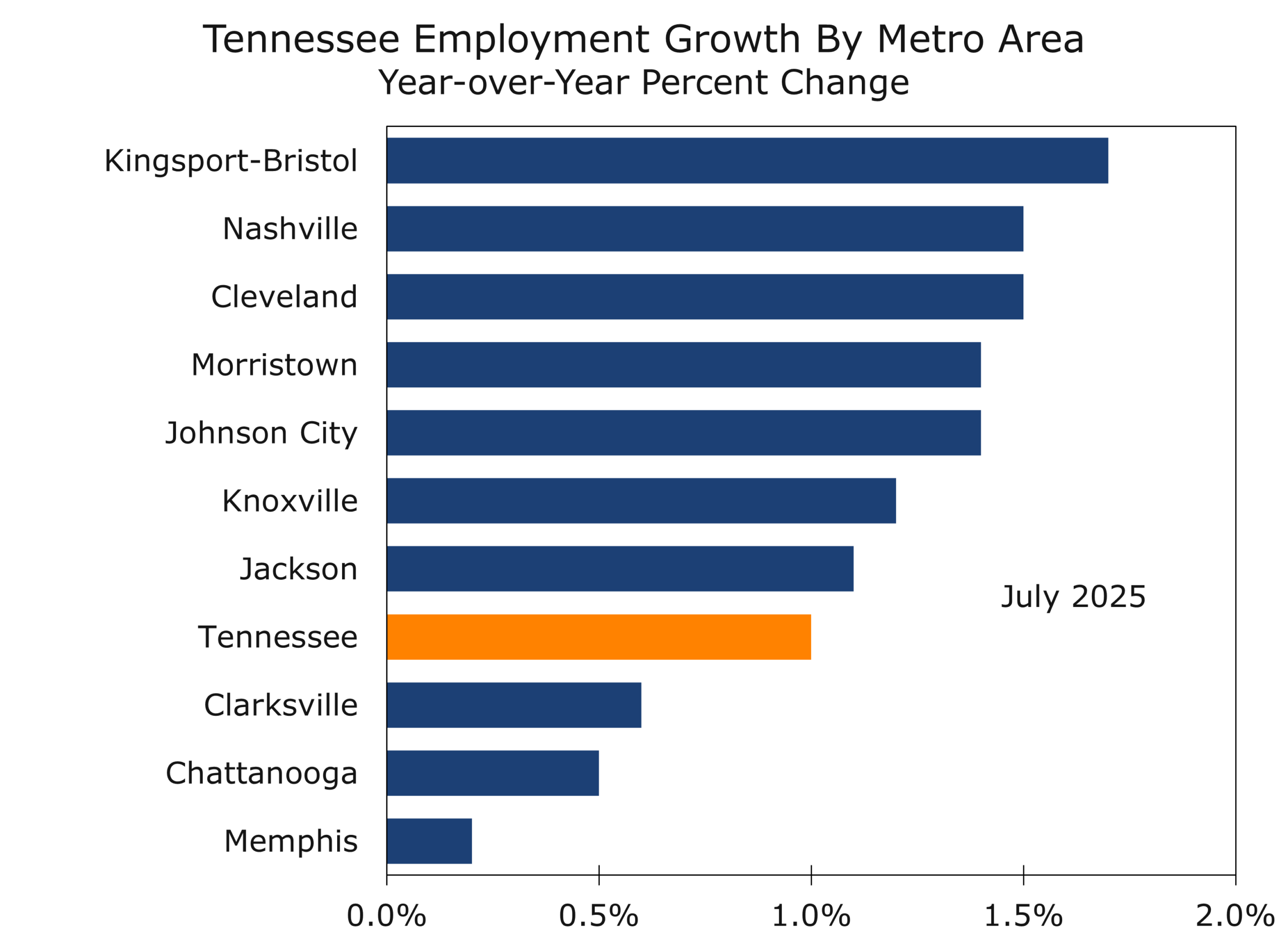
Northeast Tennessee’s Tri-Cities region, which includes Johnson City, Kingsport, and Bristol, plays an increasingly important role in the state’s balanced economy. With a population exceeding 500,000, the area has developed a strong base in healthcare, anchored by Ballad Health, and in advanced manufacturing sectors such as aerospace, automotive suppliers, and materials. Its location along I-26 and proximity to both Virginia and North Carolina make it a strategic logistics and distribution hub. Recent announcements include expansions in food processing and precision manufacturing, alongside continued growth in regional tourism driven by motorsports, craft breweries, and outdoor recreation in the Appalachian Highlands. The Tri-Cities’ workforce partnerships with East Tennessee State University (ETSU) are helping align education and training with emerging industries, positioning the region for sustainable growth.
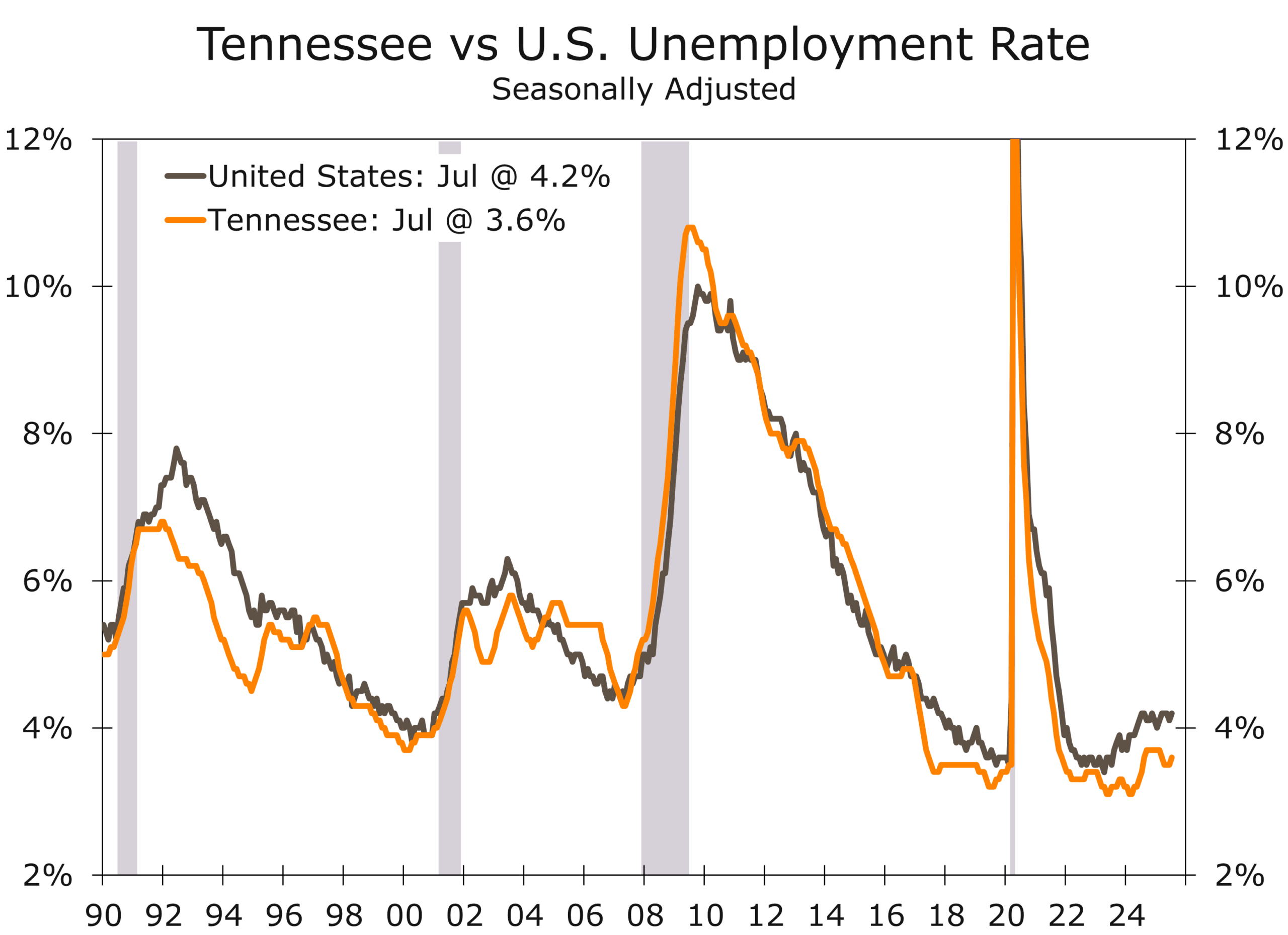
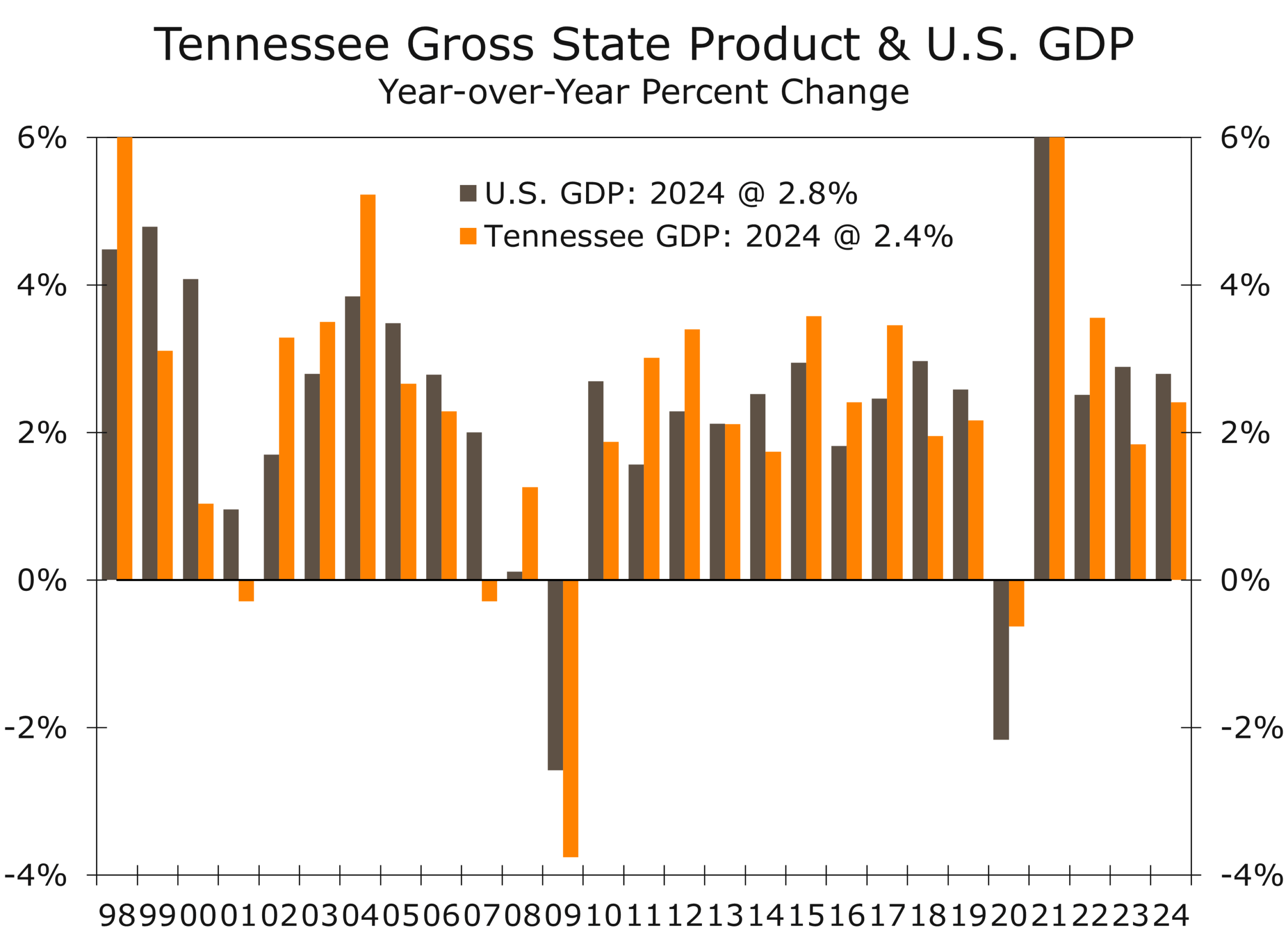
Tennessee’s unemployment rate sits at 3.6%, reflecting steady labor market performance despite global uncertainty. The state’s balanced mix of legacy industries, like automotive and logistics, and emerging sectors, like clean energy, healthcare technology, and advanced manufacturing, provides resilience through business cycles. With megaprojects like BlueOval City, Oracle’s headquarters campus, and a wave of corporate relocations, Tennessee is positioned to remain one of the nation’s most competitive growth states through the remainder of the decade.
Game Preview: Clash of Styles
Game Preview: Georgia Bulldogs vs. Tennessee Volunteers
Saturday, September 13 – Neyland Stadium, Knoxville, TN
Tennessee vs. Georgia Football Preview: September 13, 2025
This Saturday’s SEC matchup features the No. 6 Georgia Bulldogs (2-0) traveling to face the No. 15 Tennessee Volunteers (2-0) in a pivotal early-season contest. The game kicks off at 3:30 p.m. ET from Neyland Stadium in Knoxville, Tennessee, and will be televised on ABC. With both teams undefeated after handling lesser opponents, this rivalry clash could shape the trajectory of their campaigns, especially given Georgia’s recent dominance in the series.
Georgia Bulldogs
Georgia enters the game with steady leadership under quarterback Gunner Stockton, a junior who has earned the nickname “Runner Stockton” for his mobility and ability to extend plays. Stockton stepped in effectively last season after Carson Beck’s elbow injury in the SEC Championship Game, leading the Bulldogs to a win and performing solidly in the College Football Playoff semifinal against Notre Dame. His dual-threat style has been crucial early in 2025, where he’s completed passes at a 69.0% rate for 417 yards, 2 touchdowns, and no interceptions, while contributing on the ground. The offense averages 454.5 total yards per game (36th nationally), including 240.0 passing (60th) and 214.5 rushing (34th), scoring 36.5 points per contest (41st).
The backfield is led by Nate Frazier, who has rushed for 116 yards and 2 touchdowns on 25 carries, providing explosiveness amid the absence of star running back Branson Robinson, sidelined with an MCL injury. The passing attack has been bolstered by transfers like Zachariah Branch from USC, who brings elite speed with 112 yards and 1 touchdown on 6 receptions, and Noah Thomas from Texas A&M, adding size as a red-zone threat. Returning receivers Dillon Bell and London Humphreys offer reliability, while tight ends Lawson Luckie and Oscar Delp are key in short-yardage and play-action plays.
Defensively, Georgia boasts one of the nation’s top units, allowing just 201.5 yards per game (7th), 140.0 passing (25th), and 61.5 rushing (15th), while holding opponents to 6.5 points (9th). The physical front seven stands out as a dominant force, tasked with disrupting Tennessee’s up-tempo offense by forcing longer drives and limiting big plays. They excel on third downs (21.4% opponent conversion rate, 16th) and in the red zone (50.0% scoring rate allowed, 5th). However, injuries are a concern: Tight end E. Barbour is out with a knee injury, while offensive linemen Juan Gaston (knee/ankle, doubtful) and Earnest Greene (back, questionable) are dealing with issues that could impact protection and the run game.
Tennessee Volunteers
Tennessee has navigated a significant transition at quarterback this offseason after former starter Nico Iamaleava transferred to UCLA, prompting head coach Josh Heupel to recruit veteran Joey Aguilar, who previously starred at Appalachian State before a brief stint at UCLA. Aguilar, who threw for 6,760 yards and 56 touchdowns over two seasons at App State, quickly secured the starting role in fall camp. In 2025, he’s thrown for 535 yards, 5 touchdowns, and no interceptions on 66.1% completion, including a debut performance against Syracuse with 247 yards and 3 touchdowns (featuring a 73-yard strike to freshman Braylon Staley) and 288 yards with 2 scores against East Tennessee State. His quick decisions and deep accuracy have helped maintain the Vols’ high-octane, up-tempo style.
The offense ranks among the elite, averaging 605.0 total yards per game (2nd), 352.5 passing (8th), 252.5 rushing (20th), and 58.5 points (4th). Running back Star Thomas has contributed 161 yards and 3 touchdowns on 24 carries, while wide receiver Chris Brazzell II leads with 187 yards and 2 scores on 14 catches. The supporting cast remains strong, with depth to support the fast-paced attack, and the team is particularly motivated this week, hungry to snap an eight-game losing streak against Georgia that dates back to their last win in 2016.
Defensively, Tennessee allows 296.5 yards per game (53rd), with a solid run defense (76.0 yards allowed, 20th) but vulnerabilities in pass coverage (220.5 yards, 88th). Injuries have hit hard, particularly in the secondary: Starting cornerbacks Jermod McCoy (recovering from a January ACL tear) and Rickey Gibson III (upper-body injury from the opener, out extended period) are sidelined. Replacements like Colorado transfer Colton Hood and freshman Ty Redmond have stepped in, with Hood earning SEC co-defensive player of the week honors. Additionally, defensive tackle Jaxson Moi (injured early in opener), defensive end Tyree Weathersby, and offensive tackle David Sanders Jr. (missed first two games) are questionable, with Coach Heupel providing limited updates.
Game Outlook
This matchup pits Tennessee’s explosive, tempo-driven offense against Georgia’s elite, physical defense in a classic SEC battle that could hinge on execution and health. Georgia holds a historical edge, having won the last eight meetings—all by at least 14 points—with Tennessee’s most recent victory coming in 2016 via a Hail Mary pass. The Bulldogs’ first road test in a hostile Neyland Stadium adds intrigue, as the Vols aim to leverage home-field energy for a potential statement win.
Key things to watch include:
- Secondary Vulnerabilities vs. Passing Threats: Tennessee’s depleted cornerback group could be exploited by Georgia’s revamped receiving corps, led by speedsters like Branch, potentially opening up big plays through the air.
- Offensive Line Battles: Georgia’s injury-riddled front (Gaston and Greene) faces Tennessee’s defensive pressure, while the Vols’ front must contain Stockton’s mobility and Frazier’s runs to dictate tempo.
- Tempo and Discipline: Georgia’s front seven will look to slow Tennessee’s fast-paced attack and force mistakes, but the Vols’ penalty issues (55.0 yards per game, 84th) could provide short fields for the Bulldogs.
- Quarterback Poise in Pressure: Both Stockton and Aguilar thrive in high-stakes moments, but how they handle the rivalry’s intensity—especially with injuries forcing adjustments—could decide the outcome.
Georgia’s defensive strength and experience position them well, but Tennessee’s offensive firepower, home advantage, and determination to end their lengthy drought against the Bulldogs make this a tightly contested affair with playoff implications on the line.
Tennessee will aim to push the pace with Aguilar’s deep passing and Sampson’s speed, feeding off the energy of a raucous home crowd. Georgia will counter with Stockton’s poise, a balanced offensive attack, and one of the most disciplined defenses in the country.
For Tennessee, a win would validate its transition post-Nico Iamaleava and position the Vols as legitimate SEC title contenders. For Georgia, a victory would underscore the program’s depth and adaptability, proving that even with injuries, the Bulldogs remain a championship-caliber team. With ESPN College GameDay in town and the national spotlight focused squarely on Knoxville, this game is poised to be one of the defining moments of the early 2025 college football season.
Georgia enters the matchup with its trademark formula: elite defense, powerful line play, and a balanced offense designed to control tempo. Georgia thrives on methodical drives but must finish the drill and convert them into TDs. Tennessee counters with Josh Heupel’s high-octane, spread attack aimed at creating explosive plays and forcing mismatches. As always, field position and turnovers will drive momentum swings what looks to be a tightly contested game. Georgia’s rotation advantage could neutralize Tennessee’s faster pace late in the game and the Vols will try to make it difficult for Georgia to substitute on defense.
September 11, 2025
Mark Vitner, Chief Economist
Southeast Economic Advisors
704-458-4000