
From Baton Rouge to the Blue Ridge: Tigers Battle for Early Supremacy

LSU vs Clemson – The 2025 College Football Season Officially Kicks Off
The traditional kickoff to the 2025 college football season begins with several high-stakes games, including a top-10 clash as the No. 9 LSU Tigers face the No. 4 Clemson Tigers at Memorial Stadium in Clemson, South Carolina, on Saturday, August 30th. This marquee non-conference game, airing on ABC at 7:30 p.m. ET, is set to draw over 81,000 fans to Clemson’s “Death Valley”. The winner of this matchup will bolster their playoff potential but the loser of this big first game will still have plenty time to earn a playoff spot either by winning their conference or simply finishing the season strong.
Week 0 lacked the marquee matchups of recent years, but it still delivered high-stakes drama. In Dublin, No. 22 Iowa State edged No. 17 Kansas State 24–21, in a tight Aer Lingus Classic that could shape the Big 12 race. Hawaii stunned Stanford 23–20, with two late field goals, the last of which came in the final seconds, an early jolt for what is expected to be a better Cardinal team. Kansas overpowered Fresno State 31–7, Western Kentucky rolled past Sam Houston 41–24, and UNLV survived Idaho State 38–31 despite late defensive lapses. On the FCS stage, North Carolina A&T defeated Southern University 31–14 in the MEAC/SWAC Challenge, showcasing a balanced attack and stout defense. While Week 0 didn’t offer the star-power headlines, it set the tone for a season where every margin—and every stop—matters.
We continue our college football economic coverage this season, with each week featuring a key matchup of two southern teams drawn from the SEC, ACC, AAC, Sun Belt, and HBCUs within the region. Each report will provide a brief history of the participating schools and their football programs, as well as an overview and outlook for their local economies. This is the sixth year that we have covered college football and hope to provide some entertaining and interesting insights into the South’s favorite pastime and the Southeast economy.
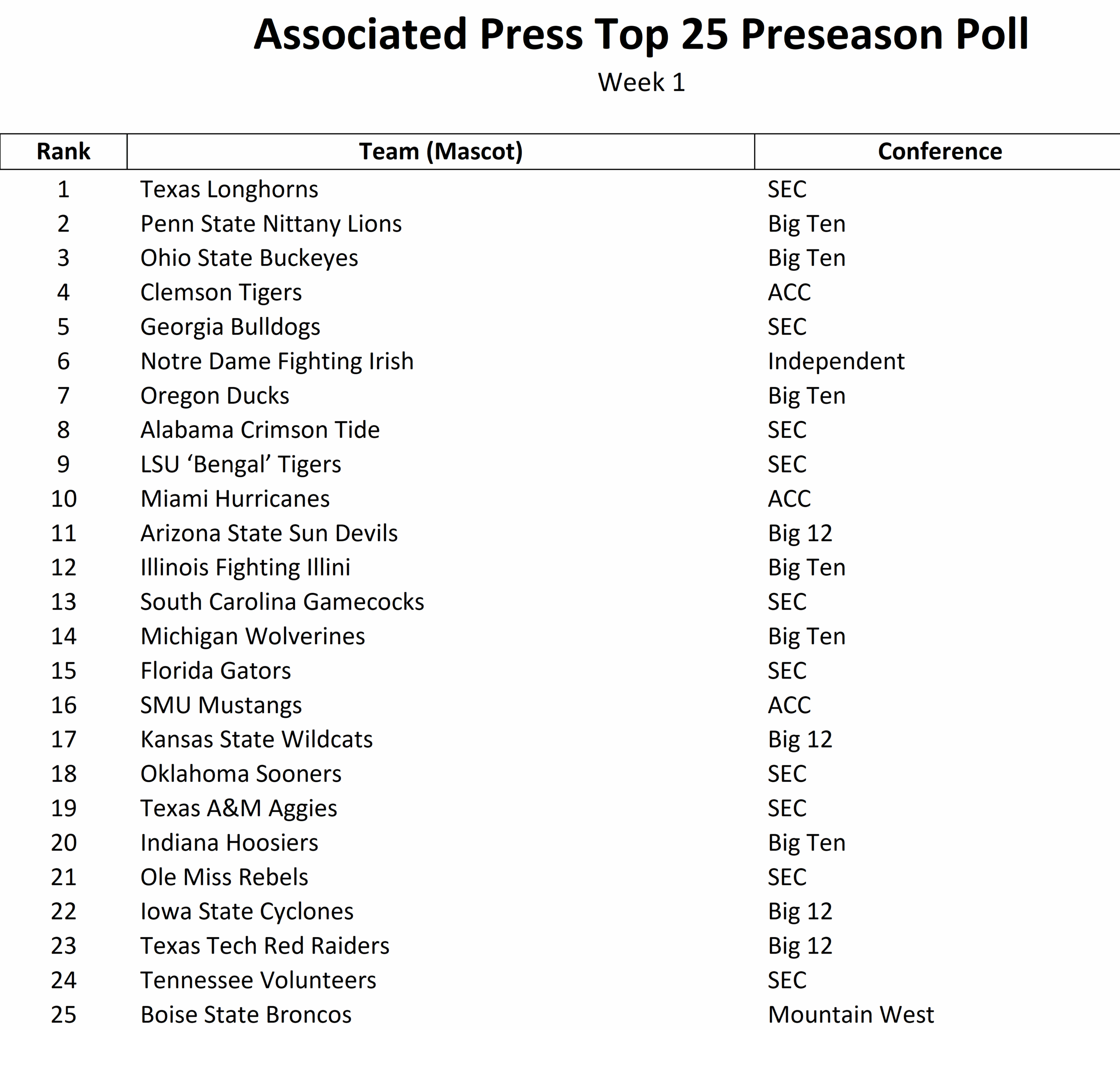
Week 1 delivers several heavyweight tone-setting contests. The season kicks off with No. 1 Texas at No. 3 Ohio State in Columbus—a national championship rematch packed with quarterback intrigue as Ohio State opens with its sophomore signal-caller and Texas, which is the nation’s consensus pre-season number 1 ranked team, counters with Arch Manning in his first road start. Meanwhile, No. 6 Notre Dame takes on No. 10 Miami in Miami Gardens, with Georgia-transfer Carson Beck debuting as a Hurricane QB against the team that knocked Georgia out of the playoffs last year after he went down with an elbow injury in the SEC Championship.
Other compelling storylines: Alabama opens at Florida State, a high‑stakes SEC‑ACC battle; and the Atlanta‑hosted Aflac Kickoff Game features No. 13 South Carolina against Virginia Tech alongside No. 24 Tennessee vs. Syracuse, each with added narrative juice—Beamer family ties and Labor Day spotlight energy. Our report focuses on another crucial SEC-ACC matchup, with No. 9 LSU traveling to No. 4 Clemson.
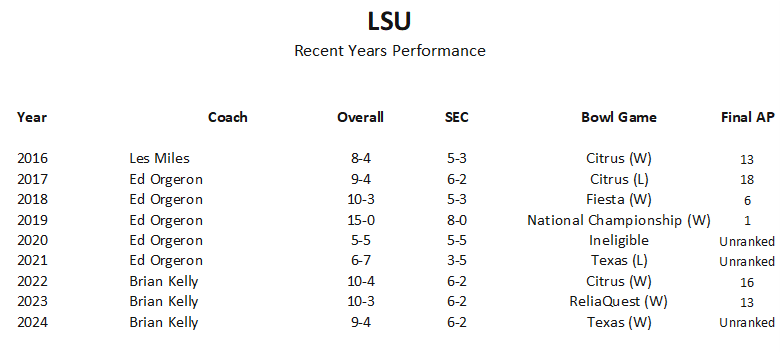
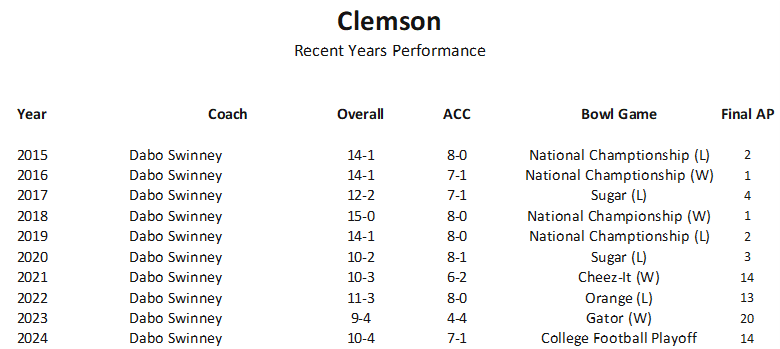
LSU finished 2024 with a 9-4 record (5-3 SEC), showing promise under coach Brian Kelly in his third year. Led by Heisman-hopeful QB Garrett Nussmeier and bolstered by a number of key transfers, LSU aims to overcome a shaky 2024 and secure a playoff berth. Clemson, with a 10-4 record (7-1 ACC) in 2024, returns significant production, including QB Cade Klubnik, whose offensive cohesion might set the tone for a national title run. LSU leads the series 3-1, with their last meeting a 42-25 LSU win in the 2019 CFP National Championship.
Baton Rouge Economy: Anchored in Energy, Pivoting to Transition
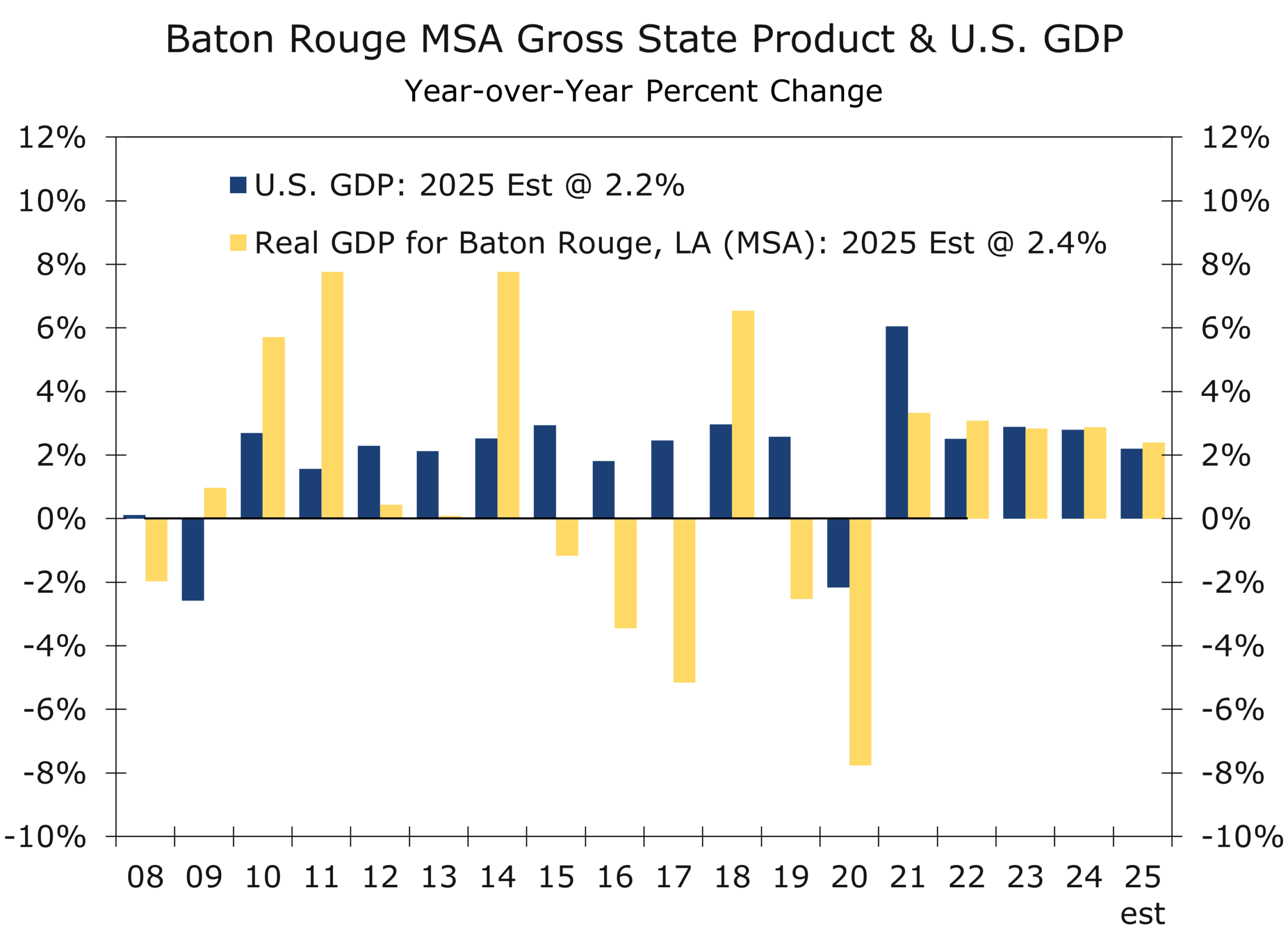
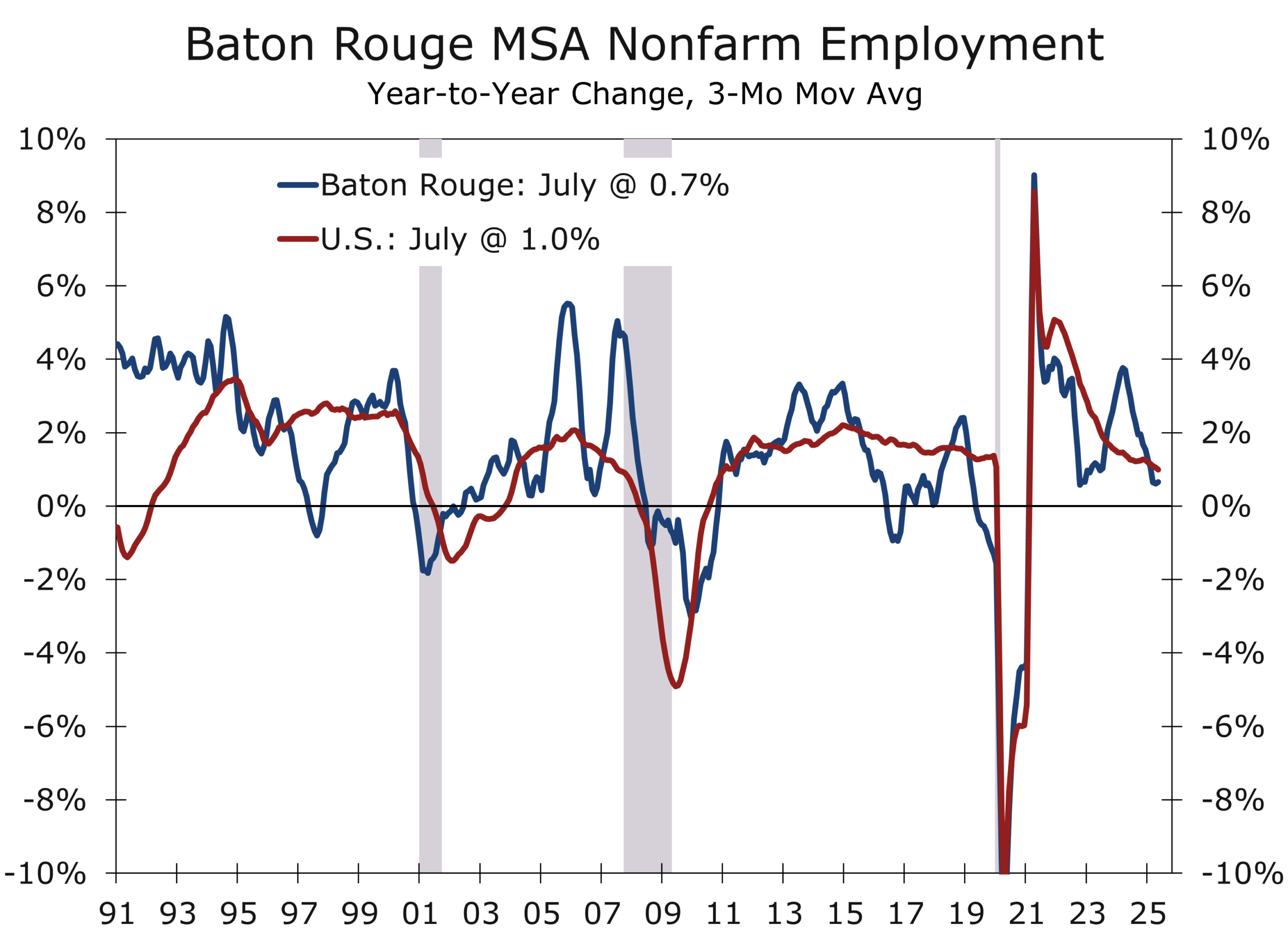
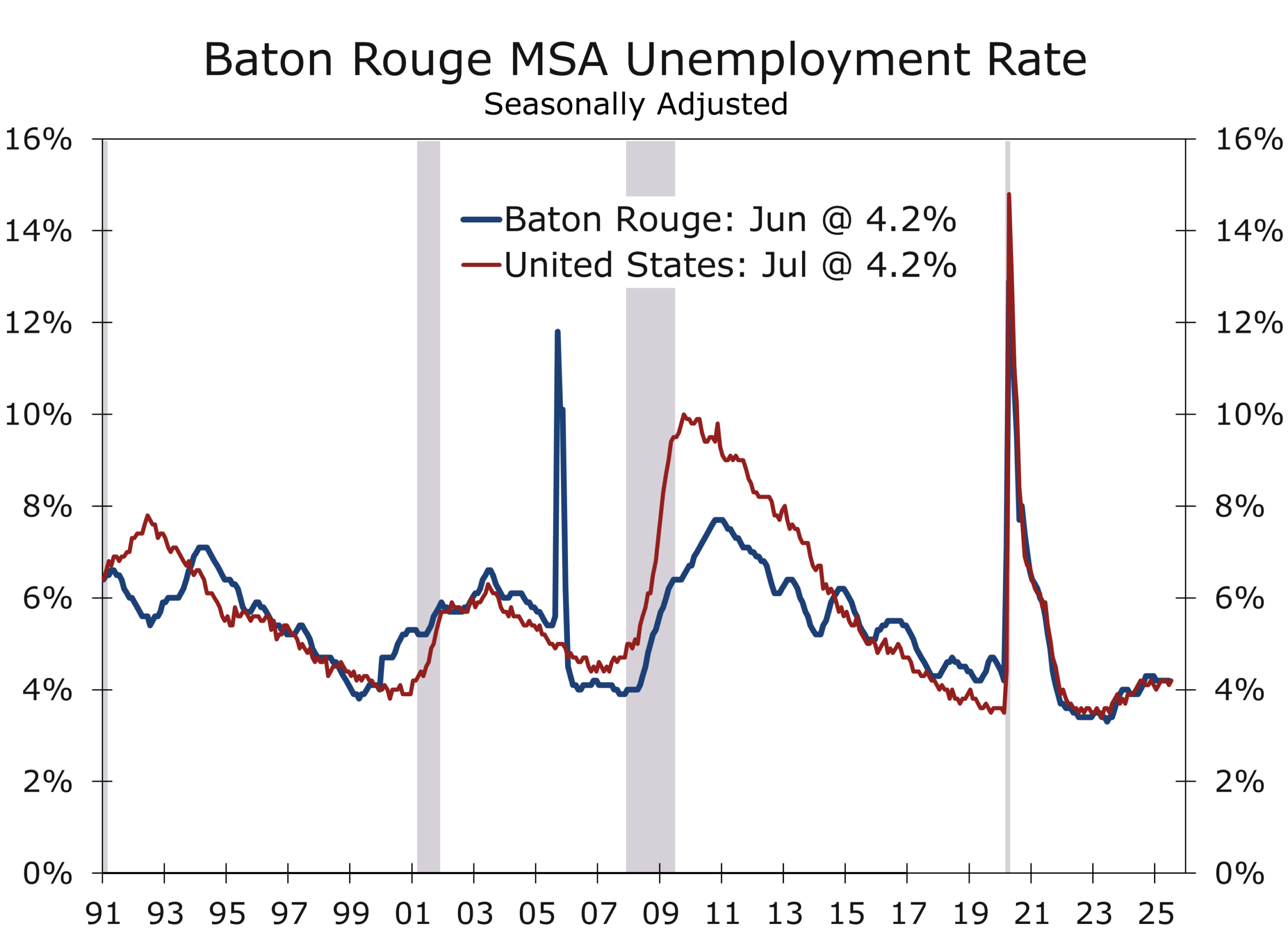
LSU hails from Baton Rouge—a 10-parish economy that has served as Louisiana’s capital since 1849. The region is anchored by state government, higher education, and the nation’s second-largest concentration of refining and petrochemicals, generating nearly $69 billion in GDP, with pronounced leverage to global energy markets. Baton Rouge’s role as the upriver bookend of the Lower Mississippi industrial corridor remains entrenched, led by ExxonMobil’s integrated refinery and chemical complex, one of the largest in North America. Higher education provides a stabilizer: Louisiana State University (LSU) and Southern University are economic engines in their own right, with LSU alone topping $480 million in annual R&D spend, sustaining the region’s research ecosystem. Logistics underpins this base—the Port of Greater Baton Rouge ranks among the nation’s top ten by tonnage, facilitating flows from crude and ammonia to agricultural exports. While job growth has cooled as industrial construction cycles normalize, service sectors—education, health, and professional services—continue to add payrolls and provide ballast.
Outlook: Value Play with Energy Transition and AI Upside
Near-term growth should track the national baseline as industrial output steadies and public-sector employment supports demand. Longer term, the region remains a high-beta energy transition trade, with marquee projects moving the needle. CF Industries’ $4 billion Blue Point ammonia complex, backed by JERA and Mitsui, cements Ascension Parish as a linchpin for low-carbon fuels, underpinned by CO₂ sequestration agreements and deep Gulf export optionality. Adding to this momentum is a transformational play in metals: Hyundai Steel will invest an estimated $5.8 billion to build its first U.S. steel mill at RiverPlex MegaPark in Ascension Parish, near Donaldsonville—roughly 30 miles south of Baton Rouge. This greenfield facility—the largest single economic development project in Capital Region history—anchors domestic steel capacity in the heart of the Gulf corridor, bringing thousands of construction jobs and a durable manufacturing base that will ripple through the region’s supply chain.
Elsewhere in Louisiana, Meta has broken ground on a $10 billion-plus AI data center campus in Richland Parish, about 180 miles northeast of Baton Rouge. The 4 million-square-foot facility—Meta’s largest globally—signals the energy implications of artificial intelligence, as power-intensive computing drives demand for low-carbon electricity, hydrogen, and supporting infrastructure. For Baton Rouge, the convergence of legacy energy, emerging hydrogen hubs, and AI-driven power taps into a key strategic advantage for the region.
Risks cluster around hurricane exposure, commodity price volatility, and Louisiana’s chronic insurance cost inflation, which remains a drag on housing affordability. Still, Baton Rouge trades like a value stock with embedded call options—steady cash flow from energy and logistics, upside from decarbonization, and a long-tail benefit from AI’s power appetite. The region’s industrial heft, deep-water port, and R&D muscle provide a platform for durable growth with asymmetric upside over the next cycle.
Greenville-Anderson-Mauldin MSA: From Textiles to High-Tech Manufacturing
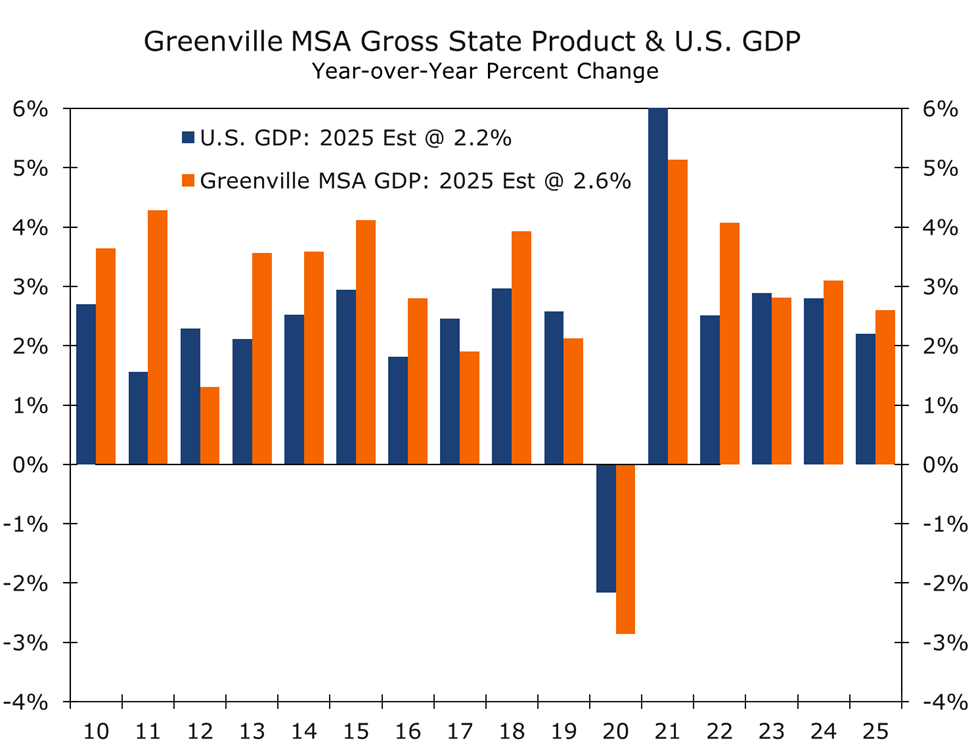
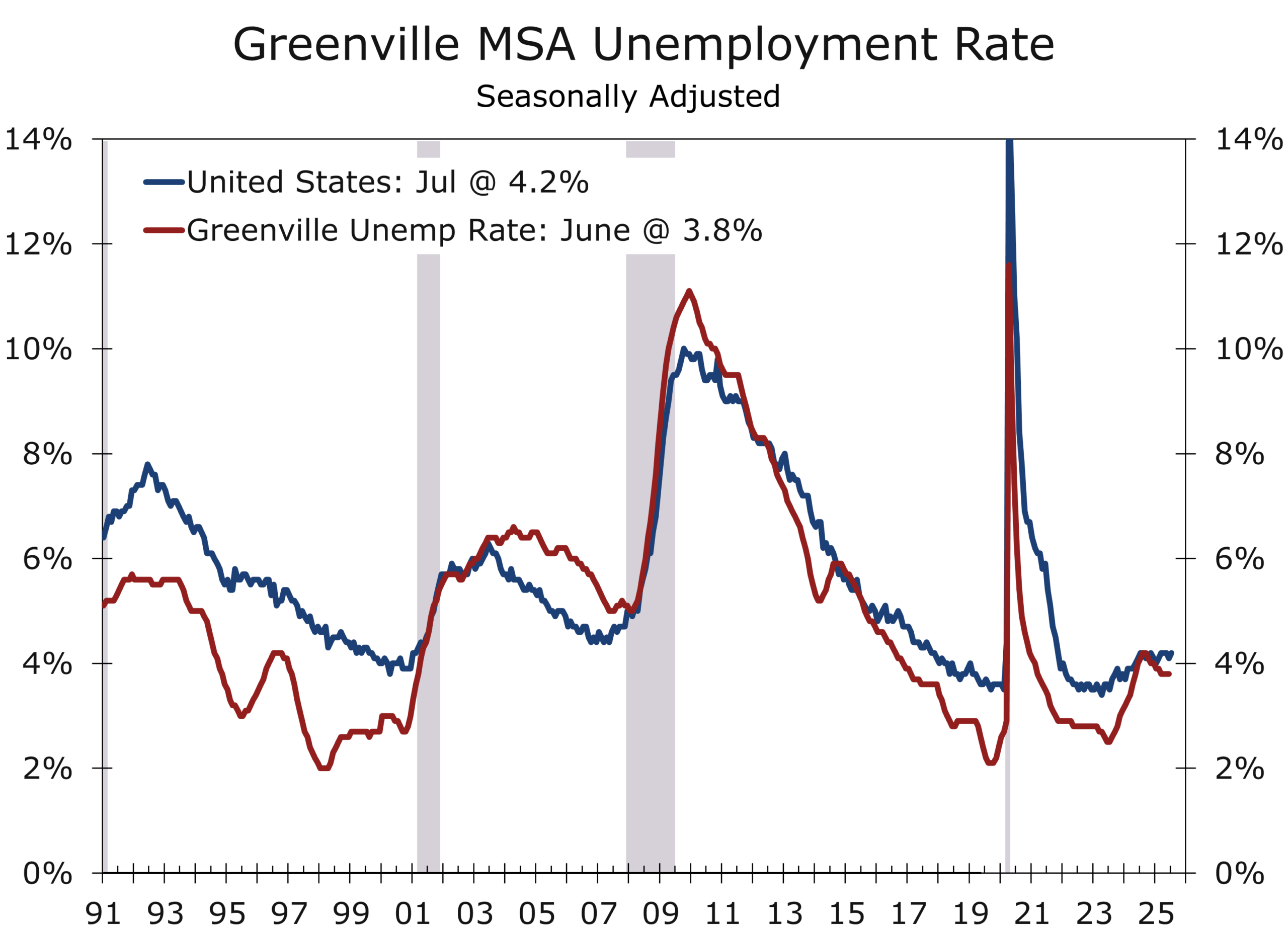
The Greenville–Anderson–Mauldin MSA, home to just shy of 1 million residents (Census pegged the MSA’s population at 997,000 residents in it latest July 1, 2024 estimate.) The region has undergone an enormous transformation from its textile roots into an industrial and innovation hub for the Southeast. When combined with the adjoining Spartanburg MSA, the two metros form a regional population of roughly 1.6 million, creating a consolidated labor market and industrial corridor that ranks among the most dynamic in the Southeast. The BMW plant sits near the border of these two metros, adjacent to Greenville-Spartanburg International Airport—a critical logistics gateway—and the Inland Port Greer, one of the fastest-growing inland ports in the U.S., offering direct rail connectivity to the Port of Charleston. This infrastructure synergy makes the Upstate one of America’s most competitive locations for advanced manufacturing and global trade.
The region’s competitive edge was forged in the 1970s with Michelin’s entry, which now anchors the tire industry with North American headquarters and over a dozen plants. That success paved the way for BMW’s Spartanburg plant, the automaker’s largest globally, representing $14 billion in investment, 11,000+ jobs, and a $30 billion annual economic impact. Advanced manufacturing extends into aerospace and energy: the South Carolina Technology and Aviation Center (SCTAC) houses GE Vernova’s gas turbine plant and Lockheed Martin’s F-16 production line, generating $6.1 billion in regional impact and supporting 17,900 high-wage jobs (average pay near $91,500).
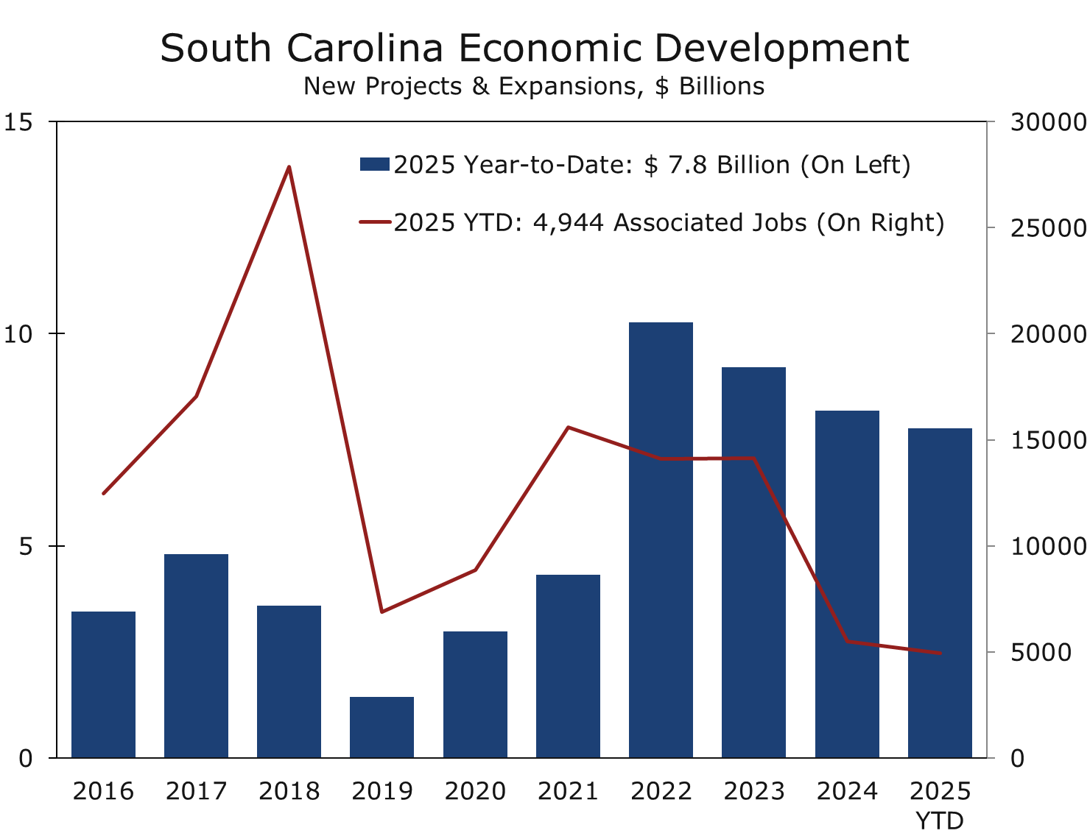
Recent Announcements Signal a New Wave of Capital Investment
Economic development in the Upstate has accelerated with major announcements spanning automotive, clean energy, and digital infrastructure. Isuzu North America will build a $280 million assembly facility in Greenville County for ICE and EV trucks, creating 700 jobs by 2027. EnerSys committed $500 million to a lithium-ion battery plant, and Eaton is investing $340 million in Union County to expand power management manufacturing. GE Vernova is adding $200 million in turbine capacity at SCTAC, while Magna International is investing $194 million in expansions plus a $216 million vehicle production site in Piedmont. Beyond the core metro, Cielo Digital Infrastructure is deploying $2.1 billion into a hyperscale data center campus in Cherokee County—cementing the Upstate’s role in supporting AI and cloud computing.
Outlook: High-Value Growth with Logistics Leverage
The Upstate economy is positioned for sustained above-trend growth over the next 24 months. Near-term performance will lean on automotive and aerospace exports, supported by strong global demand for EV components and aircraft systems. Longer term, the convergence of energy transition manufacturing, automotive electrification, and digital infrastructure creates a high-beta growth profile for Greenville-Spartanburg.
Clemson University’s CU-ICAR and Advanced Materials Innovation Complex provide an R&D backbone, while SCTAC’s $87 million infrastructure upgrades will expand testing and flight operations for next-gen platforms for cars, trucks and tires of all types. Crucially, Greenville-Spartanburg’s logistics ecosystem—airport + Inland Port Greer—offers a strategic advantage in supply chain resilience and speed-to-market, underpinning new investment across sectors. Risks remain centered on labor tightness, infrastructure strain, and global trade volatility, but the Upstate’s industrial depth and connectivity make it a strategic play on advanced manufacturing, energy transition, and digital commerce.
Louisiana State University (LSU)
Founded in 1860 as the Louisiana State Seminary of Learning and Military Academy, LSU began its academic life in Pineville under the leadership of William Tecumseh Sherman, who later became a prominent Union general during the Civil War. The school closed during wartime but reopened in Baton Rouge in 1886, moving to its current Mississippi River campus in 1926. LSU became coeducational in 1908, gradually expanding from its military roots into a flagship public research institution. Today, the university spans 4,925 acres, enrolls 42,016 students (34,502 undergraduates), and employs 6,500 staff. As an R1 research powerhouse, LSU manages more than 800 sponsored projects annually, contributing heavily to research in energy, coastal sciences, and engineering—core drivers of Louisiana’s economy.
Clemson University
Clemson was founded in 1889 as a land-grant agricultural college under the will of Thomas Green Clemson, a visionary who sought to modernize Southern agriculture through education. The school opened in 1893 as an all-male military college before transitioning to civilian governance and becoming coeducational in 1955. Situated on 1,400 acres near the foothills of the Blue Ridge Mountains, Clemson enrolls 29,077 students (23,401 undergraduates) and employs 6,639 staff. Today, Clemson is an R1 research institution and a national leader in automotive engineering, advanced materials, and applied sciences, anchored by initiatives like the CU-ICAR campus and the Advanced Materials Innovation Complex.
A Tiger Tale of Two Death Valleys
Tiger Stadium (Baton Rouge)
Known as “Death Valley” for its deafening roar, Tiger Stadium opened in 1924 with just 12,000 seats and has grown into a modern-day fortress seating 102,321 fans, ranking as the fifth-largest stadium in college football. LSU’s night-game atmosphere is legendary—loud enough to register on seismographs during the “Earthquake Game” in 1988. Its reputation as one of the most intimidating venues in sports reflects both its size and its fans’ unrelenting energy.
Memorial Stadium (Clemson)
Opened in 1942, Clemson’s Memorial Stadium—also dubbed “Death Valley”—started modestly with 20,000 seats but now accommodates 81,500, making it the largest stadium in the ACC. Named in honor of alumni who lost their lives in military service, it is famed for its traditions: rubbing Howard’s Rock and sprinting down The Hill, which has been called “the most exciting 25 seconds in college football.” Recent renovations have enhanced fan amenities and reinforced its status as one of the most iconic venues in the sport.
LSU: A Legacy Forged in the SEC
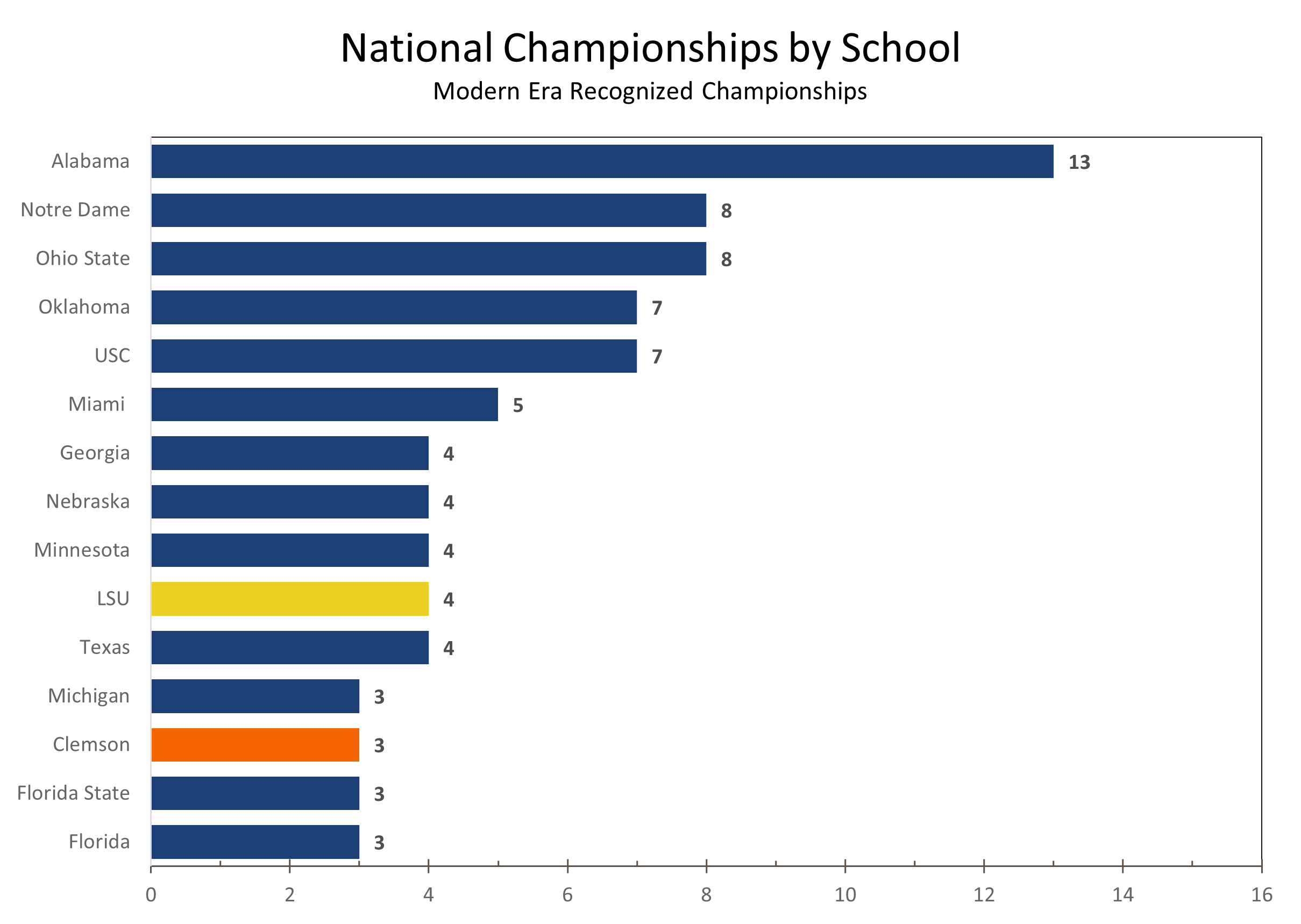
LSU played its first football game in 1893, defeating Tulane 34–0 and launching a rivalry that helped define Louisiana sports for decades. The Tigers became a founding member of the Southeastern Conference in 1933, aligning themselves with the nation’s most competitive league. Their rise to national prominence accelerated in 1958, when coach Paul Dietzel led LSU to its first national championship. The era’s defining figure was Billy Cannon, whose Halloween night punt return against Ole Miss in 1959 remains one of college football’s most iconic plays and earned him the school’s first Heisman Trophy.
LSU experienced its share of highs and lows in the subsequent decades but reclaimed elite status in the 21st century. Nick Saban’s 2003 championship restored the Tigers to national relevance, and Les Miles added another in 2007. The apex came in 2019 under Ed Orgeron, when Joe Burrow orchestrated one of the greatest seasons in college football history, setting passing records and winning the Heisman as LSU went 15–0 en route to a fourth national title. The Tigers added a third Heisman winner in Jayden Daniels (2023), signaling LSU’s evolution into a quarterback-driven program. Today, under Brian Kelly, LSU combines deep SEC recruiting pipelines with modern offensive innovation, positioning itself as a perennial contender in the College Football Playoff era.
Clemson football’s DNA has Auburn written into its earliest chapters. In 1896, Walter Merritt Riggs, an Auburn graduate, brought the sport to Clemson, importing Auburn’s playbook, coaching philosophy, and even its identity. Under Riggs, Clemson adopted the “Tigers” nickname and selected orange and purple as school colors, drawing inspiration from Auburn’s orange and the vibrant spirit of Southern football. This Auburn influence gave Clemson a foundation of tradition that still resonates more than a century later.
The Tigers’ competitive edge sharpened under John Heisman, who coached at Clemson from 1900–1903 and introduced innovative offensive strategies. Clemson matured into a Southern powerhouse under Frank Howard, an Alabama native who coached the program for over 30 years, embedding traditions such as rubbing Howard’s Rock and sprinting down The Hill, one of college football’s most iconic pregame rituals. The breakthrough came in 1981, when Danny Ford—a former Alabama lineman who began his career as an assistant at Auburn—guided Clemson to an undefeated season and its first national championship.
After intermittent success in the 1990s and early 2000s, Clemson surged to the top of the college football world under Dabo Swinney, who became head coach in 2008. From 2015 to 2020, Clemson reached six consecutive College Football Playoffs, claiming national titles in 2016 and 2018 with quarterbacks Deshaun Watson and Trevor Lawrence. Although Clemson has never produced a Heisman winner, it has developed an NFL talent pipeline, particularly at quarterback and defensive line, and stands as one of the sport’s most consistent and innovative programs. Today, Clemson represents the pinnacle of ACC football, challenging SEC dominance while honoring traditions that trace back to Auburn’s formative role.
LSU vs. Clemson – Death Valley Showdown Preview
High Stakes, Familiar Names
The Week 1 LSU-Clemson matchup delivers a heavy-weight clash with playoff implications. Both programs return starting quarterbacks—rare in this transition-heavy season—and both passers carry varying degrees of Heisman buzz. For LSU, Garrett Nussmeier steps fully into the spotlight after a strong bowl performance and an offseason of rising hype. He’s a gunslinger with an NFL-caliber arm, but his Heisman candidacy depends on efficiency behind a rebuilt offensive line. Across the field, Cade Klubnik enters his junior season as Clemson’s offensive centerpiece. While his 2024 campaign was solid rather than spectacular, Klubnik’s grasp of the playbook and leadership in big moments has fueled optimism—and put him in the outer orbit of Heisman discussions if Clemson runs the table.
Lines, Models & Market View
Oddsmakers favor Clemson slightly at -3.5 to -4, with the total at 57.5 points. Advanced models echo the razor-thin margin—ESPN SP+ projects Clemson 30, LSU 28, giving Dabo Swinney’s Tigers a 55% win probability. Home-field advantage looms large in Memorial Stadium, where Clemson has lost only three times since 2016. Clemson also plays with an SEC tempo, which LSU is well aware of.
Key Matchups & X-Factors
- Trenches Define Tempo: LSU’s offensive line faces an early litmus test against Clemson’s deep defensive front, which could dictate Nussmeier’s time to launch.
- New-Look Clemson Defense: First-year co-DC Tom Allen deploys a 4-2-5 scheme designed for speed and adaptability—a critical edge against LSU’s spread attack.
- QB Execution: Klubnik’s ability to extend plays vs. LSU’s secondary and Nussmeier’s deep-ball accuracy are the swing factors in a game that could turn on a single explosive play.
Game Script & Upset Path
Expect a tactical first half with Clemson leaning on a controlled pace and defensive pressure. For LSU, explosive passing and early turnover wins are the formula to tilt momentum. If Nussmeier settles in and LSU finds rhythm with its WR corps, an upset is live. Conversely, if Klubnik manages the clock and Clemson wins the line-of-scrimmage battle, the home team likely closes as the more complete unit.
August 27, 2025
Mark Vitner, Chief Economist
Southeast Economic Advisors
704-458-4000