

The Week Across the South
Southern voters flip Senate seats and put data center growth in play; mortgage rates threaten homebuilding, and the deal pipeline is now running at a record pace
Key takeaways
Our call: a firmer economy, sticky inflation and a Fed that hikes again. We expect real GDP growth of 2.3% in 2026 and 2.6% in 2027, headline CPI of 3.8% in the fourth quarter and the federal funds rate at 4.00% to 4.25% by year-end and 4.25% to 4.50% in the first quarter.
Higher mortgage rates are the main drag on the South. We see the 30-year rate at 7.2% in the fourth quarter, against 6.1% in the first, and residential investment falling in each of the next three quarters. The South accounts for more than half of single-family homebuilding, as well as the bulk of building products, furniture and home textiles.
The election will move data center development. Texas and Georgia now have Democratic governors pledging moratoriums on new approvals, and Virginia is tightening. Southern states with ready power, local control and welcoming governors stand to gain the projects that move.
Hiring beat expectations. October payrolls rose 165,000 against a consensus near 50,000 to 56,000. The South split, with Texas shedding jobs in September and the Carolinas adding them. Over the year to September, Charlotte added 25,400 jobs, the second largest gain among large metro areas that BLS classifies as statistically significant, behind Dallas-Fort Worth.
The deal pipeline is at a record pace. Southern Business & Development counted 207 large projects in the third quarter and 601 so far this year, and this week’s largest were Lockheed Martin’s $420 million missile expansion in Arkansas and BWXT’s $714.5 million plant in Tennessee.
Our Call: Sticky Inflation, a Hawkish Fed and a Housing Drag on the South
Exhibit 1. Piedmont Crescent Capital U.S. outlook, as of November 8, 2026
| Indicator | 2025 | 2026F | 2027F | Q4-26F |
|---|---|---|---|---|
| Real GDP, % annualized | 2.3 | 2.3 | 2.6 | 3.1 |
| Unemployment rate, % | 4.3 | 4.2 | 4.0 | 4.1 |
| Nonfarm payrolls, avg. monthly change (thous.) | 62 | 79 | 86 | 85 |
| CPI, % year over year | 2.6 | 3.4 | 2.6 | 3.8 |
| Core PCE deflator, % year over year | 2.8 | 3.1 | 2.7 | 3.2 |
| Fed funds target range, end of period | 4.00-4.25 | |||
| 10-year Treasury yield, % | 4.3 | 4.8 | 4.9 | 5.1 |
| 30-year mortgage rate, % | 6.6 | 6.7 | 6.95 | 7.2 |
| Housing starts (thous., annual rate) | 1,356 | 1,345 | 1,370 | 1,340 |
| New home sales (thous., annual rate) | 679 | 646 | 638 | 640 |
| Residential investment, % annualized | -2.7 | -1.8 | -1.1 | -4.0 |
| Brent crude, $/bbl (period average) | 68 | 94 | 88 | 105 |
Source: Piedmont Crescent Capital, using data from the Bureau of Labor Statistics, Bureau of Economic Analysis, Census Bureau, Federal Reserve and Energy Information Administration. Interest rates are annual averages or period-end values as shown in our forecast table. F = forecast.
We expect the U.S. economy to grow 2.3% in 2026 and 2.6% in 2027, with inflation staying high enough to keep the Federal Reserve tightening. Real GDP rose 3.4% in the third quarter on the advance estimate, and we expect 3.1% in the fourth, with business investment in equipment and structures growing more than 6% this year and 7% next. Higher oil prices are the reason inflation is not falling. We have Brent crude averaging $105 a barrel in the fourth quarter, which lifts headline CPI to 3.8% from year earlier and core PCE to 3.2%. We expect the Fed to raise rates at its December 9 meeting and again in the first quarter, which would put the target range at 4.25% to 4.50% and push the 10-year Treasury yield to 5.1% by year-end.
October CPI rose 0.4%, and BLS will not publish most 12-month changes. The consumer price index rose 0.4% on the month after 0.6% in September, and the core index rose 0.3% for the third straight month. Energy rose 0.7% after a 5.2% jump in September, shelter rose 0.3% and food rose 0.5%. BLS did not collect October 2025 survey data because of the 2025 lapse in appropriations, so it cannot publish year-over-year changes for October for most indexes. Our 3.8% fourth-quarter figure is a year-over-year rate, so the comparison will have to wait for November. The September South region CPI was up 0.5% on the month and 3.4% on the year, and we did not have the October regional detail at the time of writing. Source: U.S. Bureau of Labor Statistics, Consumer Price Index, October 2026 (released November 10); South region release for September (October 14).
Higher mortgage rates will weigh on the South more than on any other region. We have the 30-year mortgage rate rising to 7.2% in the fourth quarter from 6.1% in the first, and we expect housing starts to hover near 1.34 million, new home sales to slip to 646,000 in 2026 and 638,000 in 2027 and residential investment to fall in each of the next three quarters. The South is where the homebuilding is. The South Atlantic and West South Central divisions alone accounted for 53% of single-family starts in 2024, according to a National Association of Home Builders analysis, and East South Central adds to that. The region is also home to much of the building products, furniture and home textile industry, from North Carolina’s furniture clusters to Georgia’s carpet mills, so weaker housing shows up in factory orders and hiring here before it appears elsewhere. The other side of the ledger is that in-migration, a large share of the nation’s new job gains and the data center and manufacturing pipeline described below help offset the housing drag.
Exhibit 2. Building permits, January through September, 2026 versus 2025
| State | 1-unit 2026 | 1-unit 2025 | Change | Multi 2026 | Multi 2025 | Change |
|---|---|---|---|---|---|---|
| TX | 108,433 | 111,912 | -3.1% | 42,176 | 51,399 | -17.9% |
| FL | 85,496 | 86,021 | -0.6% | 38,915 | 51,321 | -24.2% |
| NC | 47,936 | 52,031 | -7.9% | 22,968 | 17,206 | +33.5% |
| GA | 33,403 | 34,397 | -2.9% | 13,161 | 12,030 | +9.4% |
| SC | 31,390 | 30,945 | +1.4% | 6,093 | 4,807 | +26.8% |
| TN | 24,429 | 24,557 | -0.5% | 8,785 | 8,752 | +0.4% |
| VA | 16,296 | 15,961 | +2.1% | 15,019 | 10,127 | +48.3% |
| AL | 13,385 | 11,687 | +14.5% | 2,676 | 2,155 | +24.2% |
| KY | 6,678 | 6,598 | +1.2% | 4,459 | 4,782 | -6.8% |
| OK | 8,912 | 8,848 | +0.7% | 1,969 | 2,991 | -34.2% |
| AR | 7,258 | 8,151 | -11.0% | 3,218 | 3,688 | -12.7% |
| MD | 6,142 | 7,500 | -18.1% | 3,990 | 2,766 | +44.3% |
| LA | 9,123 | 8,754 | +4.2% | 928 | 2,454 | -62.2% |
| MS | 6,082 | 5,564 | +9.3% | 429 | 634 | -32.3% |
| WV | 2,744 | 2,845 | -3.6% | 294 | 411 | -28.5% |
| 15 states | 407,707 | 415,771 | -1.9% | 165,080 | 175,523 | -5.9% |
Source: U.S. Census Bureau, Building Permits Survey, state files for September 2026 and September 2025 (year to date, not seasonally adjusted). Multifamily is total units less 1-unit permits. The 15 states are AL, AR, FL, GA, KY, LA, MD, MS, NC, OK, SC, TN, TX, VA and WV; Missouri, Delaware and the District of Columbia are excluded.
Permit weakness is concentrated in Texas and Florida multifamily and in North Carolina and Texas single-family. Single-family permits in the 15 states are down 1.9% from a year ago and multifamily permits are down 5.9%. Texas and Florida account for the multifamily decline (down 17.9% and 24.2%), while North Carolina and Texas account for most of the single-family decline. North Carolina’s single-family permits fell 7.9% while its multifamily permits rose 33.5%, and Virginia’s multifamily permits rose 48.3%. Alabama is the strongest single-family market at +14.5%, reflecting strengthening in-migration, and Arkansas (-11.0%) and Maryland (-18.1%) are the weakest. With the 30-year rate heading toward 7.2%, we expect single-family permits to weaken further this winter.
The Election Moved the South, and Data Centers Are Where It Will Show First
Democrats flipped Senate seats in Texas, North Carolina and South Carolina on November 3, and won governorships in Texas and Georgia. In Texas, State Representative James Talarico defeated Attorney General Ken Paxton and Gina Hinojosa defeated Governor Greg Abbott, and neither race was close. Former Governor Roy Cooper defeated Michael Whatley in North Carolina, the first Democratic Senate win in the state since 2008. Annie Andrews won in South Carolina, and Senator Graham conceded. Senator Jon Ossoff won in Georgia, where former Atlanta Mayor Keisha Lance Bottoms was elected governor, and Democrats took control of the Public Service Commission. Maryland’s Wes Moore was re-elected.
Republicans held the governorships they were defending in Florida, Alabama, South Carolina, Tennessee and Oklahoma. Byron Donalds won in Florida, Tommy Tuberville in Alabama, Alan Wilson in South Carolina and Marsha Blackburn in Tennessee, and Mike Mazzei is Oklahoma’s governor-elect. Kevin Hern won the Oklahoma Senate seat with 57.2%, Andy Barr in Kentucky with 55.0%, Bill Hagerty in Tennessee with 55.1%, Barry Moore in Alabama with 54.7% and Tom Cotton in Arkansas with 54.3%. In Mississippi, Democrat Scott Colom was leading Senator Cindy Hyde-Smith in a race that could be decided by mail ballots, which count if postmarked by Election Day and received within five business days.
Exhibit 3. Southern election results, November 3, 2026
| State | Office | Result | Status |
|---|---|---|---|
| Texas | U.S. Senate | Talarico (D) over Paxton (R) | Flip |
| Texas | Governor | Hinojosa (D) over Abbott (R) | Flip |
| North Carolina | U.S. Senate | Cooper (D) over Whatley (R) | Flip |
| South Carolina | U.S. Senate | Andrews (D) over Graham (R) | Flip |
| Georgia | U.S. Senate | Ossoff (D) re-elected | Won |
| Georgia | Governor | Bottoms (D) | Flip |
| Florida | Governor | Donalds (R) | Hold |
| South Carolina | Governor | Wilson (R) over Johnson (D), about 52% to 47% in early returns | Hold |
| Alabama | Governor | Tuberville (R) over Jones (D) by nearly 4 points | Hold |
| Tennessee / Oklahoma | Governor | Blackburn (R) / Mazzei (R) | Hold |
| Maryland | Governor | Moore (D) re-elected | Won |
| Mississippi | U.S. Senate | Colom (D) leading Hyde-Smith (R) | Uncalled |
| Alabama | U.S. Senate | Barry Moore (R) 54.7%, Wess (D) 45.3% | Hold |
| Arkansas | U.S. Senate | Cotton (R) 54.3%, Shoffner (D) 42.4% | Hold |
| Kentucky | U.S. Senate | Barr (R) 55.0%, Booker (D) 42.9% | Hold |
| Oklahoma | U.S. Senate | Hern (R) 57.2%, Thomas (D) 39.3% | Hold |
| Tennessee | U.S. Senate | Hagerty (R) 55.1%, Bradshaw (D) 42.9% | Hold |
Source: CNBC and CBS News; Associated Press via CNBC; Wikipedia 2026 election pages (as of Nov. 8); Data Center Scouts for the Florida, Alabama, South Carolina and Tennessee governor calls; NBC15 for the Alabama margin; RedState for South Carolina’s early-return margin. Vote shares are reported tallies and are not final. We could not confirm in time the Louisiana, West Virginia, Florida special Senate and Virginia results.
Data center development will migrate, and the map is becoming a ranking
Our view is that new data center projects will migrate toward the Southern states that keep approvals fast, and away from Texas, Georgia and Virginia. Cost of living decided the election, electricity bills are part of it, and voters in at least 29 jurisdictions across the country approved bans or restrictions on data centers on November 3, according to King & Spalding. The industry’s demand has not changed, so the question is which states take the projects that need a new home.
Texas has gone from the easiest place to build to the most uncertain. Abbott directed regulators on August 3 to audit proposed grid connections and on September 21 halted environmental permits until the grid operator finishes auditing its waitlist, which was expected to run until December. Hinojosa takes office January 19, after the Legislature convenes January 12, and she has pledged a moratorium on new approvals, union labor requirements, rules on water and nondisclosure agreements and an end to the sales tax break. Projects already under construction are unlikely to be stopped, but the pipeline is large, including the 1,820 megawatt Stargate Frontier campus in Shackelford County and the 6,400 megawatt Nexus Hubbard project, which MIT Technology Review reports is mostly for Anthropic. Lenders are already getting more selective. Texas counties generally lack zoning authority, and confirming Public Utility Commission appointees takes a two-thirds Senate vote, which limits how fast a new governor can reshape the regulator.
Georgia is the second state to tighten. Bottoms has said she will sign an executive order for a temporary moratorium on new approvals lasting from one month to six months or longer, and will review state and local incentive deals. Democrats Peter Hubbard and Shelia Edwards won the Public Service Commission, which gives Democrats a 3 to 2 majority and the first Democratic control in about three decades, and the new majority plans an affordability docket and a review of how data center costs are allocated. Georgia Power’s roughly 10,000 megawatt plan, about 80% of it for data centers, was approved in December 2025 and is unlikely to be reversed, and projects such as Google’s and QTS’s are expected to proceed under current deals. The commission does not decide siting, so Georgia’s risk is more about power terms and incentives than about permits. In Virginia, Governor Spanberger issued an executive order in September to hold data centers accountable and form an AI task force, and Loudoun County votes November 17 on a pause.
Exhibit 4. Where Southern governors stand on new data centers
| State | Governor | Stated position (as reported) | Our read |
|---|---|---|---|
| Texas | Hinojosa (D), Jan. 19 | Moratorium on new approvals, union labor, end sales tax break; Abbott’s permit halt in place | Constrained |
| Georgia | Bottoms (D) | Executive-order moratorium, review of incentives; PSC now 3-2 Democratic | Constrained |
| Virginia | Spanberger (D) | September order to hold centers accountable; Loudoun pause vote Nov. 17 | Constrained |
| Tennessee | Blackburn (R) | No pause; wants a ratepayer protection law and water disclosure; local communities decide | Likely beneficiary |
| South Carolina | Wilson (R) | Opposes a moratorium; centers must generate their own energy and pay their own way; communities approve | Likely beneficiary |
| Florida | Donalds (R) | No moratorium; local governments can block; 2026 law on power costs and local control | Parts of the state benefit |
| Oklahoma | Mazzei (R) | Position not retrieved; Century Aluminum cites broad support for industrial projects | Likely beneficiary |
| Arkansas | Sanders (R) | Position not retrieved; Entergy Arkansas is building batteries for Google’s West Memphis campus | Likely beneficiary |
| West Virginia | Morrisey (R) | Position not retrieved; recruiting Virginia employers; Nscale’s Monarch campus is planned in Mason County | Likely beneficiary |
| Alabama | Tuberville (R), Jan. 18 | No pause, but no abatements or incentives, highest property tax class and large users pay for power, substations and water | Cooler than assumed |
| North Carolina | Stein (D) | Charlotte paused new approvals through October 2027; Cooper is headed to the Senate | Mixed |
Source: Data Center Scouts; King & Spalding; MIT Technology Review; Texas Tribune; ABC13; WRDW; Cardinal News; Alabama Political Reporter; our earlier reporting for Charlotte, Arkansas and West Virginia. “Our read” is our judgment and not a forecast. Positions are as stated by the candidates and are not law.
The beneficiaries are the states with power, sites and local control, and the margin of safety is not equal. Tennessee’s governor-elect wants ratepayer protection, not a pause, though the xAI litigation in Memphis shows how local fights can still cost time. South Carolina’s Wilson opposes a moratorium and would let communities decide. Florida’s governor-elect leaves blocking power with local governments, so the benefit is concentrated in counties that want projects, and Edgewater’s ballot question shows where they do not. Arkansas, Oklahoma and West Virginia fit the profile on their records and on available power and sites, but we did not quantify their governors’ stated positions this week. Alabama is the exception to the list. Tuberville would deny tax breaks, tax centers in the highest property class and make users pay for infrastructure, so Alabama’s appeal would rest on site readiness and power and not on incentives. The Carolinas are mixed, with Charlotte’s pause through October 2027 against South Carolina’s open door.
Three things limit the migration. Power availability decides where large loads can connect, and no Southern state has Texas’s grid scale. Existing approvals proceed, so the effect comes first in new projects and in lenders’ selectivity. And the same voters are in every state: Tuberville’s plan and Blackburn’s ratepayer proposal show that Republican governors are also making data centers pay their way. We expect the winners to be the states that pair fast approvals with clear cost-allocation rules, and we will track the first projects that change their site announcements.
Other effects of the election across the South
The shift in Washington cuts both ways for Southern manufacturing. Century Aluminum’s CEO said on Thursday that the midterms should not harm its $4 billion Inola, Oklahoma smelter, calling reindustrialization “one of the few bipartisan issues out there.” Our read is that reshoring support, defense procurement and critical minerals have bipartisan backing, while tariff policy and clean-energy credits are where Democrats will push. This is our judgment and not a forecast with a probability attached.
Incentive packages will carry more conditions. Tuberville would require repayment if companies miss wage and hiring commitments, and Georgia’s new governor will review incentive deals, so we expect clawbacks, wage floors and local approval to spread across the region. The Texas Legislature, which convenes January 12, writes the incentive law, and the outcome will be negotiated.
Florida’s property tax vote hands its counties a budget problem. Voters approved Amendment 3 with about 62%, raising the non-school homestead exemption to $150,000 in 2027 and $250,000 in 2028 and cutting the assessment cap on non-homestead property to 5%. Local governments will lose billions of dollars of revenue, and counties that wrote incentive packages against future assessed values will have less to back them with. Gulfshore Business already reports that the tax relief is lifting the Charlotte County condo market, and homeowners over 65 are the largest beneficiaries.
Competition between neighbors continues. West Virginia Governor Patrick Morrisey has said he will recruit Virginia businesses and workers, citing Virginia’s tax and regulatory direction under Governor Spanberger, according to Fox News. We could not date that report and include it as context.
Seven Key Themes for the South
These are the seven themes we track for the South. This week the election put the first theme at the center, and the deal pipeline and the October jobs report supported several of the others.
| Theme | This week’s evidence |
|---|---|
| AI buildout | Texas and Georgia governors-elect pledged moratoriums, Georgia’s PSC turned Democratic and Virginia is tightening, while Tennessee, South Carolina and others keep the door open. Alabama’s governor-elect would deny tax breaks. Stargate Frontier (1,820 MW) and Nexus Hubbard (6,400 MW) in Texas are the projects at stake. |
| Energy infrastructure | Alabama’s governor-elect proposes a State Energy Bank with up to $1 billion of bonding authority to finance grid upgrades repaid by large users. Orlando Utilities Commission’s new demand-based pricing took effect in November. Texas’s PUC rule implementing SB 6 sets security requirements for loads of 75 MW or more. |
| Defense replenishment | Lockheed Martin will invest $420 million in Camden, Arkansas to expand PAC-3, THAAD and Precision Strike Missile capacity and add 650 jobs, and BWXT will invest $714.5 million in Jonesborough, Tennessee to produce depleted uranium for the NNSA. Secretary of State Rubio said the war with Iran is needed to address a nuclear threat, which keeps munitions demand in view. |
| Civilian aerospace / next-gen defense | Space employers and suppliers in Central Florida and the Space Coast added 5,000 jobs over the past year, lifting space-economy employment to more than 42,000 from 37,000. |
| Reshoring of critical industries | Manufacturing added 19,000 jobs in October and is up 101,000 since December 2025, and Texas manufacturing reached 990,600, the highest since 2001. Lockheed Martin ($420 million), BWXT ($714.5 million), ABB (227 jobs), SteelFab and Hwasung add to a pipeline Southern Business & Development counts at 601 big deals so far this year. Century’s $4 billion Oklahoma smelter is the test of local resistance. |
| New-era pharma investment | No new Southern pharma plant this week; Bracco’s $230 million, 200-job Sanford plant, covered in our last issue, is the latest. North Carolina’s Commerce Secretary met Fujifilm Biotechnologies and Hitachi Energy executives as states compete for a share of the $550 billion U.S.-Japan framework, which targets pharmaceuticals, semiconductors and critical minerals. Japan is more than 40% of North Carolina’s foreign direct investment. |
| Peak 65 labor drain and spending | Florida’s Amendment 3 expands the homestead exemption, which benefits older homeowners, and Alabama’s governor-elect proposes a property tax freeze for seniors. Collier County reports Canadian visits up nearly 28% in August. |
Examples drawn from this issue. Sources are cited in the sections above.
The Labor Market Surprised to the Upside, and the South Split
Payrolls rose 165,000 in October and the unemployment rate held at 4.1%. The Bureau of Labor Statistics also revised August up to +186,000 from +133,000 and September to +60,000 from +29,000, which adds 84,000 to the two months. Average hourly earnings rose 0.4% on the month and 3.1% over the year, which is still below the 3.6% PCE inflation rate we cited last week. Health care added 42,000 jobs; professional and business services and transportation and warehousing also gained, and manufacturing added 19,000 and is up 101,000 since its December 2025 low.
The report is well above the 50,000 to 56,000 consensus and our previous fourth-quarter average of 62,000, and it supports the earlier-hike case in our forecast. We expect payroll growth to average 85,000 a month in the fourth quarter, above our earlier 62,000 and well below October’s pace, and the unemployment rate to hold near 4.1%. The Federal Reserve meets December 9. Markets moved toward the hike after the report. Fed funds futures put the odds of a December quarter-point increase near 77%, the 2-year Treasury yield rose about 5 basis points to 4.52% and the 10-year yield rose about 3 basis points to roughly 4.87%, according to InvestmentNews. We did not refresh equity levels for this draft.
Exhibit 5. National snapshot, latest readings
| Indicator | Latest | Prior | Release |
|---|---|---|---|
| Nonfarm payrolls, monthly (Oct.) | +165,000 | +60,000 (Sept., rev.) | Nov. 6 |
| Unemployment rate (Oct.) | 4.1% | 4.2% (Sept.) | Nov. 6 |
| Average hourly earnings, 12 months (Oct.) | 3.1% | Nov. 6 | |
| Manufacturing payrolls, monthly (Oct.) | +19,000 | Nov. 6 | |
| Real GDP, annualized (Q3 advance) | 3.4% | 2.2% | Oct. 29 |
Source: U.S. Bureau of Labor Statistics; U.S. Bureau of Economic Analysis. The September unemployment rate and the 3.6% PCE inflation rate are as published in our November 2 issue. Q3 GDP is the advance estimate; the second estimate is due November 25.
September state data show a split South. Texas lost 11,100 jobs in the month, with 23 of 27 metros losing jobs, including Houston (14,600) and Dallas-Fort Worth (7,500). South Carolina added 12,500 jobs in the month, and its unemployment rate fell to 4.0% from 4.7% a year ago. Alabama’s unemployment rate rose to 3.5% from 2.8% a year ago, the highest since June 2021, as the labor force and household employment slipped. Florida’s rate eased to 4.4% from a high of 4.8% in May. The Dallas Fed expects Texas job growth of 0.9% in 2026, or about 134,000 jobs. Among metro areas, BLS reports Dallas-Fort Worth (+43,900, +1.0%), Charlotte (+25,400, +1.8%) and Raleigh (+17,400, +2.3%) as the only large Southern metros with statistically significant over-the-year gains in September, and Houston (+33,600) and Los Angeles (+30,200) were larger in raw terms but not significant. Without the significance test, Charlotte ranks fourth. Metro figures are not seasonally adjusted and are from the BLS Metropolitan Area Employment and Unemployment release.
Exhibit 6. State labor market indicators, September 2026
| State | Unemployment rate | Nonfarm payrolls, monthly change | Notes |
|---|---|---|---|
| Texas | 4.4% | -11,100 in the month | Manufacturing 990,600, the highest since 2001; 23 of 27 metros lost jobs |
| Florida | 4.4% | Sector detail pending the FloridaCommerce release | Rate eased from 4.8% in May |
| South Carolina | 4.0% | +12,500 in the month | Rate down from 4.7% a year ago |
| Alabama | 3.5% | Monthly change not in our sources | Highest rate since June 2021; up from 2.8% a year ago |
Source: U.S. Bureau of Labor Statistics (state unemployment rates, Table 1); Texas Labor Market Review; South Carolina Department of Employment and Workforce; Alabama Department of Workforce. Rates and monthly payroll changes are seasonally adjusted and preliminary. We omitted over-the-year payroll comparisons because the sources we could reach report them on a seasonally adjusted basis, and we use not seasonally adjusted data for year-over-year changes.
Unemployment rates range from 3.3% in Georgia and Mississippi to 4.7% in Kentucky and 5.6% in the District of Columbia. Texas and Florida are both at 4.4%, above the 4.2% national rate. Rates are higher than a year ago in 6 of the 16 states shown, led by Alabama (3.5% from 2.8%) and Oklahoma (4.2% from 3.6%), and lower in South Carolina (4.0% from 4.7%), North Carolina (3.4% from 3.9%) and Maryland (3.9% from 4.3%). October state data are due November 20.
Exhibit 7. Unemployment rate by state, September 2026
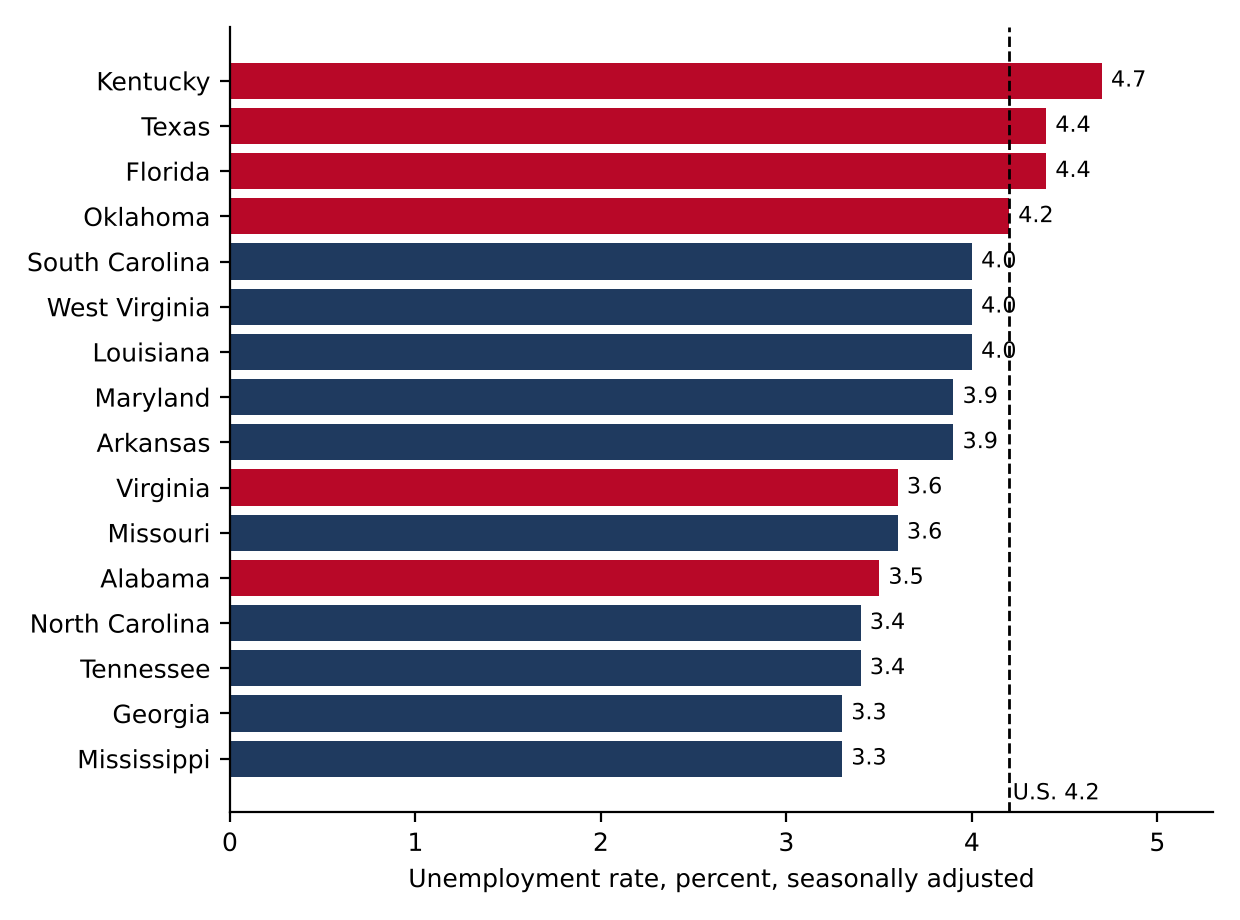
Source: U.S. Bureau of Labor Statistics, Local Area Unemployment Statistics, Table 1, September 2026 (preliminary), seasonally adjusted. Red bars mark states where the rate is above September 2025; blue bars mark states where it is at or below. The dashed line is the U.S. rate of 4.2%.
Economic Development: A Record Pace, with Politics Arriving at the Site
Southern Business & Development counted 207 large announcements in the South in the third quarter, a pace that keeps 2026 on track for a record. The magazine’s SB&D 100 criteria are 200 or more jobs or $30 million or more of investment. The first two quarters produced 394, against 119 in the first half of 2025, and the three quarters together total 601. The 34-year record is 730 projects in 2015. At about 200 a quarter, 2026 would reach roughly 800. The magazine will publish its full-year totals at its Southern Economic Development Roundtable December 10 to 12 at Rosemary Beach.
Exhibit 8. Selected Southern announcements not covered in our November 2 issue, October 27 to November 8, 2026
| Date | Company | Place | Investment | Jobs | Notes |
|---|---|---|---|---|---|
| Nov. 6 | BWXT | Jonesborough, Tenn. | $714.5M | 181 | High-purity depleted uranium for the NNSA |
| Nov. 3 | Lockheed Martin | Camden, Ark. | $420M | 650 | PAC-3, THAAD and PrSM missile capacity; jobs over five years |
| Nov. 5 | ABB | Selmer, Tenn. | $50M | 227 | Busway systems; moves to a new 120,000-sq-ft plant |
| Oct. 28 | Amick Farms | Edgefield Co., S.C. | $54.8M | 40 | Hatchery; operations April 2027 |
| Oct. 27 | SteelFab | Columbia, S.C. | $30M | 100 | Structural steel; reuses an existing building |
| Nov. 3 | ClearFlow Metalworks | Russellville, Ky. | $28M | 50 | Metalworking |
| Nov. 1 | Dominion Packaging | Henrico Co., Va. | $25M | More than 100 | Packaging |
| Nov. 5 | Robinson Carbon | Alexandria, La. | $16.3M | 42 | Carbon products |
| Nov. 1 | Nissin International Transport USA | Franklin Co., Ky. | $14.3M | 30 | Logistics |
| Oct. 29 | MAT Industries | Jackson, Tenn. | Not stated | 85 | New line for air compressors and pneumatic tools |
| Nov. 2 | Hwasung Group | Florence Co., S.C. | $5M | 32 | Electrical components; production January 2027 |
Source: Tennessee Department of Economic and Community Development; Arkansas Economic Development Commission via Area Development and Talk Business & Politics; South Carolina Department of Commerce; Area Development listings for the Kentucky, Virginia and Louisiana projects, which we did not confirm against the state releases. Dates are announcement or listing dates. Projects covered in our November 2 issue (Hyundai, Bracco, Brose Sitech, Helix Electric, Canfor and Vantive) are excluded.
Defense and nuclear projects set the tone this week, and they landed in Arkansas and Tennessee. Lockheed Martin will invest $420 million to expand capacity for PAC-3, THAAD and Precision Strike Missile systems at its Camden, Arkansas plant, with 650 jobs expected over five years. BWXT’s $714.5 million, 181-job project in Jonesborough, Tennessee will produce high-purity depleted uranium for the National Nuclear Security Administration on the company’s existing site, and ABB will move busway production in Selmer, Tennessee to a new 120,000-square-foot building and add 227 jobs for $50 million. Both defense projects come with long timelines, so the jobs arrive years after the capital.
The rest of the week’s announcements were smaller and spread across seven states. Kentucky (ClearFlow Metalworks and Nissin), Virginia (Dominion Packaging), Louisiana (Robinson Carbon) and Tennessee (MAT Industries, 85 jobs) added modest projects, and South Carolina’s were SteelFab, Amick Farms and Hwasung. Seven Scout Motors suppliers in the Upstate, named on October 14, account for more than $82 million and 200 jobs. SteelFab’s Columbia plant is its second South Carolina expansion this year, after a $38.9 million, 108-job naval steel plant in Florence County in July. Georgia’s governor’s office listed no new economic development announcements in the period, and the state’s large October projects were covered in earlier issues.
Century Aluminum said Thursday its $4 billion Inola, Oklahoma smelter is “moving forward on all fronts,” though local resistance is growing. The company and Emirates Global Aluminum have targeted a construction start by the end of 2026, and the CEO said financing, power contract and engineering talks are advancing. The Inola Town Council has imposed a moratorium on heavy industrial construction through April 7, 2027 and plans a spring referendum on banning aluminum smelting, the Tulsa-Rogers County Port Authority voted unanimously to sue the town, and the Cherokee Nation approved a resolution opposing the smelter that goes next to a full tribal council vote. Century has proposed cutting permitted fluoride emissions by 37% and is working with Tulsa Innovation Labs on workforce development. The CEO gave no updated timeline and will discuss the 2027 plan in February. The project would be the largest primary aluminum smelter in the country, and it shows how a federally backed industrial project can still stall at the town level.
Century’s third-quarter results were strong, and its South Carolina plant was the soft spot. Shipments rose to 173,483 metric tons from 130,632 in the second quarter, and sales were nearly $1 billion, as every Century plant ran at full capacity for the first time in more than a decade. Operations at Mt. Holly, South Carolina, were unstable after a July restart, and the CEO expects normal volume and product mix there through the fourth quarter. The company guides to fourth-quarter adjusted EBITDA of $275 million to $300 million. On the election, the CEO said he does not expect an adverse effect on the project and welcomed Mike Mazzei, Oklahoma’s governor-elect.
North Carolina is courting Japanese capital as costs and trade policy complicate greenfield projects. Commerce Secretary Lee Lilley met Japanese executives and JETRO officials at the Southeast U.S./Japan Association meeting in Nashville, Tennessee, as states compete for a share of the $550 billion U.S.-Japan investment framework, which targets semiconductors, energy infrastructure, critical minerals, pharmaceuticals and advanced manufacturing. Japan accounts for more than 40% of North Carolina’s foreign direct investment, with more than 180 Japanese-owned companies employing more than 30,000 workers and about $20.1 billion and 11,000 jobs committed since 2015, according to the state Commerce Department. Lilley met with Toyota Motor North America, GE Vernova Hitachi and Bridgestone, whose new CEO said the company is committed to its Wilson operation. Lilley said high inflation limits the firms’ ability to build greenfield plants, currency pressure matters and the executives want a stable trade relationship with Washington. Alabama sent a delegation to the same meeting.
Site readiness is the other thread. Alabama’s Growing Alabama program awarded more than $9.3 million to five industrial sites on October 30, led by $3.5 million for Dothan’s Westgate Super Site, and the Treasury approved 141 Alabama Opportunity Zone 2.0 tracts in 66 counties effective January 1. Kentucky opened a talent recruitment grant program offering up to $500,000 per applicant, and Louisiana’s Aclara Resources completed engineering for its heavy rare earths separation plant, “Project Dynamo.” In Southwest Florida, the Fort Myers panel backed up to $24 million in tax rebates for Midtown Yards, Cape Coral approved $10 million of incentives for a Costco and then fired its city manager, and Collier voters approved a sixth-penny tourist tax for a sports complex with 70.2%.
Manufacturing Dive counted more than 6,000 manufacturing layoffs announced in October. The items we could read were outside the South, led by Dakkota Integrated Systems in Detroit (nearly 400), Medline in Illinois (304), 3M in Minnesota (62), Lear in Michigan (67) and a temporary Fender shutdown in California (533). The article’s state-by-state table did not load, so we cannot say how many of the notices were Southern.
What We Are Watching
Nov. 10. The South region detail of the October CPI, due with the national release. Our fourth-quarter forecast is 3.8% for headline and 2.8% for core.
Nov. 10 to 12. Mississippi mail-ballot counting and the final Senate calls in Mississippi and Alaska.
Nov. 17. Loudoun County’s vote on a data center pause.
Nov. 20. BLS state employment and unemployment data for October.
Nov. 25. Second estimate of third-quarter GDP.
Dec. 4. The November Employment Situation report.
Dec. 9. The Federal Open Market Committee.
Dec. 10 to 12. Southern Business & Development’s full-year SB&D 100 totals.
December. Texas’s ERCOT audit of the data center waitlist is expected to finish.
Dec. 11. Federal spending authority expires.
Jan. 12. The Texas Legislature convenes. Hinojosa takes office Jan. 19 and Tuberville Jan. 18.
Georgia. Watch for Bottoms’s data center executive order and the Public Service Commission’s affordability docket after the new members are sworn in.
College Football: Two Unbeaten MEAC Teams Meet in Orangeburg
North Carolina Central and South Carolina State, both 3-0 in the Mid-Eastern Athletic Conference, meet Saturday at 1:30 p.m. Eastern in Orangeburg, S.C., with first place in the MEAC on the line. South Carolina State is 8-2 overall and North Carolina Central is 5-5. The game is one of seven national television windows South Carolina State was given this season, and the network had not been announced when the schedule was released in August. Each team plays a home game against a weaker opponent on November 21, South Carolina State against Delaware State (2-1 in the league, 6-4 overall) and North Carolina Central against Morgan State (0-3), so the winner should take the inside track to the MEAC championship game and a berth in the Celebration Bowl.
South Carolina State has been the power in HBCU football for two seasons, and it is the team North Carolina Central has to beat. The Bulldogs won the MEAC in 2024 and again in 2025, when they beat Delaware State 28-17 in the title game. They lost the 2024 Celebration Bowl and returned to win the 2025 game 40-38 over Prairie View A&M in a record four overtimes in Atlanta, which was their second Celebration Bowl title after 2021. The league’s coaches again picked them to win the MEAC this season. They have an offense that scores 41.3 points a game, second on ESPN’s team statistics page, and a rushing attack that averages about 214 yards. Their two losses were nonconference, 34-31 to The Citadel and 49-39 to Charleston Southern, and they beat Morgan State 51-10 on October 29 and Howard 35-28 on Thursday, November 5.
North Carolina Central has played better in league games than its record suggests. The Eagles lost five nonconference games, including 17-14 to William & Mary and 42-9 to East Carolina, and have won three straight MEAC games, 31-12 over Delaware State, 34-0 over Howard and 29-28 over Norfolk State. They score 25.5 points a game and allow 24.8. South Carolina State won the last meeting we found, 24-21 on October 31, 2024. We did not retrieve last season’s result.
Exhibit 9. The two programs and their communities
| North Carolina Central | South Carolina State | |
|---|---|---|
| Location | Durham, N.C. (Research Triangle) | Orangeburg, S.C. (Orangeburg County) |
| Founded | 1910 | 1896; South Carolina’s only public HBCU |
| 2026 record | 5-5 overall, 3-0 MEAC | 8-2 overall, 3-0 MEAC |
| Economic impact (UNCF, 2024) | $388.5 million; 3,411 jobs supported | $143.6 million; 1,385 jobs supported |
| Lifetime earnings, 2021 graduates | $4.9 billion | $1.3 billion |
| State unemployment rate, Sept. 2026 | 3.4% (North Carolina) | 4.0% (South Carolina) |
| County unemployment rate | Not retrieved | 6.0% in June 2026; 6.4% in 2025 |
Source: ESPN team pages (accessed Nov. 9, 2026); Carolina Panorama (Aug. 10, 2026); Andscape; UNCF HBCU Impact Report 2024 (dollar figures are as shown on the report pages, which omit the unit); South Carolina Department of Employment and Workforce, Orangeburg County community profile (updated July 24, 2026); U.S. Bureau of Labor Statistics. We could not confirm the stadium name or television network.
The two campuses sit in very different local economies, and each is a large local employer. Durham is in the Research Triangle, in a state with one of the lowest unemployment rates in the South at 3.4%, and North Carolina Central’s estimated impact of $388.5 million and 3,411 jobs is one piece of a diversified economy anchored by universities, health care and life sciences. Orangeburg is a small city in a county where the unemployment rate was 6.4% in 2025 against 4.5% for South Carolina, and the county’s largest employers include South Carolina State, Claflin University, Orangeburg Calhoun Technical College, the Medical University of South Carolina’s hospital, Cox Automotive, Bimbo Bakeries and Okonite. In a market that size, a university is a major employer and a game with a national television window is a significant event for local restaurants, hotels and vendors, though we did not find a game-day spending estimate. South Carolina State is also tied to one of the more tragic events in the city’s history, as the campus where three students were killed by state troopers in the 1968 Orangeburg Massacre.
Separation Saturday
Saturday was known as Separation Saturday because so many top 25 teams played one another. The SEC had ten teams ranked in the top 25 and eight of them played each other, and the four games were not close. No. 5 Alabama beat No. 14 LSU 31-13 in Baton Rouge, with Keelon Russell throwing for 206 yards and three touchdowns. No. 13 Tennessee beat No. 6 Kentucky 34-6 in Knoxville, and No. 2 Georgia beat No. 10 Ole Miss 42-7 in Oxford after leading 28-0 at halftime. No. 7 Texas beat No. 18 Missouri 34-20 and is 4-0 against ranked opponents this season.
The unbeaten list shrank. Notre Dame beat top-ranked Miami 31-24 in South Bend after leading 24-3 in the third quarter, so Miami is no longer unbeaten. Utah beat BYU 28-20 to stay unbeaten, and UCLA is 9-0. Elsewhere, Oklahoma beat No. 24 Florida 23-7, and Oregon beat Ohio State 41-28, which was the Buckeyes’ first back-to-back losses since 2011. Georgia’s win over Ole Miss was substantially more lopsided than we expected in our featured-game preview on November 2.
Source: NCAA.com live blog, Week 10 (Nov. 7, 2026); ESPN. Rankings are as reported in those accounts. The SEC ten-ranked, eight-played count is from Mark. Records for Georgia and Kentucky were not in the sources and are omitted.
Recent Research from Mark Vitner
| Date | Publication | Title |
|---|---|---|
| Nov. 8 | A View from the Piedmont | What the Midterms Changed, and What They Did Not |
| Nov. 6 | Economic Indicator Report: Employment | The Trend Was Higher All Along |
| Nov. 6 | College Football Week 10 | Georgia Heads to Oxford and the Grove to Face Ole Miss |
| Nov. 3 | Economic Indicator Report: ISM Manufacturing | Production Jumped as Factory Strength Broadened |
| Nov. 2 | The Week Across the South | Capital gets repriced on Wall Street, the Fed leans toward a hike and Southern voters head to the polls worried about prices |
| Nov. 1 | A View from the Piedmont | The Price of Capital Comes Due |
Piedmont Crescent Capital publications are available at piedmontcrescentcapital.com. College football reports are at southeasteconomy.com. The Week Across the South is published every Monday.
Sources: NCAA.com; ESPN; Carolina Panorama; Andscape; UNCF; U.S. Bureau of Labor Statistics (Employment Situation, Oct., Nov. 6; Local Area Unemployment Statistics, Sept.); U.S. Bureau of Economic Analysis; U.S. Census Bureau (Building Permits Survey); Texas Workforce Commission (Texas Labor Market Review); South Carolina Department of Employment and Workforce; Alabama Department of Workforce; InvestmentNews; Data Center Scouts; King & Spalding; MIT Technology Review; Texas Tribune; Area Development; Tennessee Department of Economic and Community Development; Arkansas Economic Development Commission; South Carolina Department of Commerce; Made in Alabama; Talk Business & Politics; National Association of Home Builders via Scotsman Guide; CNBC; CBS News; Associated Press; Wikipedia (2026 election pages); Southern Business & Development; Manufacturing Dive; Century Aluminum via Manufacturing Dive; Charlotte Business Journal; North Carolina Department of Commerce; Orlando Business Journal via Southern Business & Development; Louisiana Economic Development and Kentucky Cabinet for Economic Development via Southern Business & Development; Fox News; Piedmont Crescent Capital.
Southeast Economic Advisors | Mark P. Vitner, President and Chief Economist | Charlotte, North Carolina
This report is prepared for informational purposes only and reflects the views of Southeast Economic Advisors as of the date shown, which are subject to change without notice. It is not investment, legal or tax advice, and it is not an offer or solicitation to buy or sell any security or investment product. Information is drawn from sources we believe to be reliable, but we do not guarantee its accuracy or completeness. Forecasts and opinions are not guarantees of future results.