
The Week Across the South
Capital gets repriced on Wall Street, the Fed leans toward a hike and Southern voters head to the polls worried about prices
KEY TAKEAWAYS
- The price of capital came due on Friday. With the 10-year Treasury near 5%, the Nasdaq had its worst month since March 2025, and the Fed's hold on October 28 carried two dissents for a hike. We expect increases on December 9 and in March.
- Growth is strong and hiring is not. Third-quarter GDP rose 3.4% while payrolls gained 29,000 in September, and wages are rising more slowly than prices.
- Housing is cooling the South's inflation unevenly. Miami is the only large southern metro with home prices outrunning inflation, and 27 of 49 southern metros still have rents below a year ago.
- Dallas-Fort Worth added more jobs than any metro in the nation (43,900), while Washington lost 61,000.
- Capital keeps arriving, with few jobs attached. The South took 61% of the nation's announced reshoring and foreign investment jobs in 2025, U.S. Steel broke ground on a $1.9 billion plant in Arkansas, and Hyundai's $450 million Alabama project adds 53 jobs.
Capital Gets Repriced While Hiring Stalls, and the Fed Leans Toward a Hike
The Federal Reserve held the funds rate at 3.75%-4.00% on Wednesday, and two members wanted to raise it. Governor Lisa Cook and Cleveland Fed President Beth Hammack dissented in favor of a quarter-point increase, making the vote 10 to 2. The statement described economic activity as strong, and Chair Kevin Warsh offered no forward guidance at his press conference. The funds rate is unchanged since the September 16 increase. We expect a quarter-point increase to 4.00%-4.25% on December 9, a hold in January and a second increase in March that would take the range to 4.25%-4.50%. Futures put the odds of a December increase near 85%. Payrolls below zero in the October report on Friday would raise the odds of a growth scare, while a gain above 100,000 would support an earlier hike. The consensus is roughly 50,000 to 56,000, against our fourth-quarter average of 62,000.
The data in front of the Committee showed an economy running well above trend. Third-quarter GDP grew at a 3.4% annual rate, matching our forecast and up from 2.2% in the second quarter, and real final sales to private domestic purchasers rose 4.9%. The mix matters more than the headline, since private inventories and information-processing equipment drove the gain, government spending rose because the Strategic Petroleum Reserve sold less oil, and net exports subtracted as petroleum exports fell. Households carried less of the load, with personal income up 0.2% in September and spending up considerably more, which pushed the saving rate down to 3.8%. The PCE price index rose 0.5% on the month and is up 3.6% from a year ago, with the core measure at 3.1%, so real disposable income fell 0.3%. Wages and salaries in the Employment Cost Index rose just 3.1% over the year, the slowest annual gain since 2021 and well behind PCE inflation of 3.6%.
Wall Street repriced capital on Friday. The S&P 500 fell 1.83% to 7,578.97 and the Nasdaq Composite fell 2.84%, which leaves the Nasdaq 100 about 10% below its peak and October as the Nasdaq's worst month since March 2025. Alphabet fell 12.6% on Thursday, its worst day since its 2004 initial public offering, after search growth slowed and free cash flow turned negative, and Intel fell about 29% on Friday, its worst day since 1974. Cloud revenue is growing at the pace AI bulls promised, with Google Cloud up 103%, and what investors are repricing is the return on the money spent to get it. Hyperscaler capital spending is running near $725 billion this year, and with the 10-year Treasury at 4.92% on Friday after touching 5.04% intraday on Wednesday, capital is no longer inexpensive.
We read the selloff as a repricing and not yet a panic. Treasuries rallied and gold fell 3.6%, which looks like liquidation and a flight to safety with no sign of an inflation scare, and the economy beneath the earnings has not cracked. The South has a stake in how this resolves. Campuses such as Amazon and STACK's $18 billion plan in northwest Louisiana and Google's West Memphis site depend on hyperscaler budgets, and a slowdown in that spending would reach the contractors building them and the utilities planning for their load. Our tripwire is a 10-year Treasury close below 4.60% before December 9, which would cut our odds of a December hike to even.
Exhibit 1. National snapshot, latest readings
| Indicator | Latest | Prior | Release |
|---|---|---|---|
| Fed funds target range | 3.75%-4.00% | 3.50%-3.75% (before Sept. 16) | Oct. 28 |
| Real GDP, annualized (Q3 advance) | 3.4% | 2.2% | Oct. 29 |
| Real final sales to private domestic purchasers | 4.9% | 4.6% | Oct. 29 |
| PCE price index, 12 months (Sept.) | 3.6% | Oct. 29 | |
| Core PCE price index, 12 months (Sept.) | 3.1% | Oct. 29 | |
| Saving rate (Sept.) | 3.8% | Oct. 29 | |
| CPI, 12 months (Sept.) | 3.7% | 3.4% (Aug.) | Oct. 14 |
| Core CPI, 12 months (Sept.) | 2.6% | 2.4% (Aug.) | Oct. 14 |
| Nonfarm payrolls, monthly (Sept.) | +29,000 | +133,000 (Aug., rev.) | Oct. 2 |
| Unemployment rate (Sept.) | 4.2% | 4.1% (Aug.) | Oct. 2 |
| Initial claims, week ended Oct. 24 | 194,000 | 195,000 (Oct. 17, rev.) | Oct. 29 |
| Conference Board consumer confidence (Oct.) | 91.7 | 84.2 (Sept.) | Oct. 27 |
| University of Michigan sentiment, final (Oct.) | 48.0 | 48.1 (Sept.) | Oct. 23 |
| 10-year Treasury yield (Oct. 30 afternoon quote) | 4.92% | 5.04% (Oct. 28, intraday) | Oct. 30 |
| Brent crude, January contract (Oct. 30 settle) | $113.43 | Oct. 30 |
Source: U.S. Bureau of Economic Analysis; U.S. Bureau of Labor Statistics; U.S. Department of Labor; Federal Reserve; The Conference Board; University of Michigan; Piedmont Crescent Capital. Q3 GDP is the advance estimate; the second estimate is scheduled for November 25. Treasury yields and oil are Friday afternoon wire quotes and settlements, consistent with A View from the Piedmont; the Treasury's par yield curve put the October 30 close at 4.94%. The expiring December Brent contract settled at $117.64.
Households are covering higher prices by drawing down saving, with payrolls up 29,000 in September and the unemployment rate up to 4.2%. The South is running cooler on prices, with September CPI at 3.4% against 3.7% nationally, but gasoline was up 37.5% over the year in the South against 34.2% nationally. Brent crude near $113 a barrel, after tankers were hit by mines and explosives in the Strait of Hormuz in a war now in its ninth month, leaves energy as the main upside risk to the October CPI, due November 10.
Our latest forecast keeps the December and March increases, with CPI rising to 3.9% in the fourth quarter from 3.5% in the third, real GDP growth of 3.1% and payrolls rising 62,000 a month, up from 51,000.
Exhibit 2. Piedmont Crescent Capital U.S. economic outlook, November 1, 2026 vintage
| Indicator | Q3-26 | Q4-26F | Q1-27F | 2026F | 2027F |
|---|---|---|---|---|---|
| Real GDP, quarterly annualized | 3.4% | 3.1% | 2.2% | 2.3% | 2.6% |
| Final sales to private domestic purchasers | 4.9% | 3.5% | 2.6% | 2.9% | 2.9% |
| Nonfarm payrolls, average monthly change (thousands) | 51 | 62 | 68 | 67 | 76 |
| Unemployment rate | 4.1% | 4.1% | 4.1% | 4.2% | 4.0% |
| CPI, 12 months | 3.5% | 3.9% | 3.5% | 3.5% | 2.6% |
| Core PCE price index, 12 months | 3.1% | 3.2% | 2.9% | 3.1% | 2.7% |
| Fed funds target range, end of period | 3.75%-4.00% | 4.00%-4.25% | 4.25%-4.50% | ||
| Brent crude, dollars per barrel (average) | $91.27 | $105.00 | $91.67 | $93.62 | $87.67 |
Source: Piedmont Crescent Capital, U.S. Economic and Financial Outlook, November 1, 2026 vintage, drawing on BEA, BLS, Census, the Federal Reserve and EIA. The third-quarter GDP figure is the BEA advance estimate. F denotes forecast.
Seven Key Themes for the South
Capital commitments were smaller than last week's, led by U.S. Steel's $1.9 billion groundbreaking in Arkansas, while Friday's selloff turned attention to what the AI buildout earns and data center construction again produced the most political news. These are the seven themes we believe are producing the above-average real GDP growth in the national numbers.
| Theme | This week's evidence |
|---|---|
| AI buildout | Friday's selloff put hyperscaler capital spending, near $725B this year, under scrutiny. Charlotte, N.C. extended its data center pause to Oct. 18, 2027. Amazon and STACK raised their three-campus plan in Caddo and Bossier parishes, La., to $18B. Texas regulators suspended data center stormwater notices, and a judge let the NAACP's Clean Air Act suit against xAI proceed (reported Oct. 31). |
| Energy infrastructure | Entergy Arkansas filed to build two battery storage systems for Google's West Memphis campus (Oct. 30). Brent crude near $113 a barrel, with a war in its ninth month and mines reported in the Strait of Hormuz, keeps fuel costs elevated for the region's trucking and manufacturing. |
| Defense replenishment | The Pentagon is reportedly preparing options for Iran after Tuesday's election, which would add to demand for munitions and air defense if strikes resume. Last week's F-35 framework still depends on multiyear procurement authority and appropriations. |
| Civilian aerospace / next-gen defense | Bombardier's new Dallas project, announced last week, still has no dollar figure or date. |
| Reshoring of critical industries | The Reshoring Initiative counts 247,000 reshoring and foreign investment jobs announced in 2025, 61% of them in the South, and projects 309,000 for 2026. The USDA pledged $573M toward eight fertilizer projects, among them AdvanSix in Hopewell, Va., Peace Valley in Bartow, Fla., PCI Nitrogen in Pasadena, Tex. and TalusAG sites in Kentucky and Tennessee. U.S. Steel broke ground Oct. 30 on a $1.9B direct reduced iron plant in Osceola, Ark., with about 200 jobs. Hyundai (Montgomery, Ala., nearly $450M) and Brose Sitech (Columbia, S.C., $29.5M) added more. |
| New-era pharma investment | Bracco Imaging will invest $230M and add 200 jobs in Sanford, N.C., its first U.S. plant for injectable contrast media. Vantive will spend $100M on dialysis components in Mountain Home, Ark., with up to 175 jobs over four years. Chemicals, including pharmaceuticals, were 15% of the reshoring and foreign investment jobs announced in 2025. |
| Peak 65 labor drain and spending | Homeownership is 78.6% for households 65 and older against 35.2% for those under 35, per our October 26 Perspective. Florida votes on Amendment 3, a larger homestead exemption, Tuesday. |
Examples drawn from this issue.
Inflation in the South: Housing Is Doing the Cooling
Housing is where the South's inflation advantage comes from, and this week's price and rent data show the cooling is concentrated in a few markets. September CPI showed shelter costs up 2.3% in the South against 3.2% nationally, with rents up 1.8% against 2.8%. The home price and rent indexes published this week explain why, and they also show where the cooling has gone far enough to start doing damage. Mortgage rates stand high, with the Freddie Mac average at 7.32% on October 22.
Home prices: Miami pulls away, and most of the rest fall in real terms
The Case-Shiller and FHFA price indexes, both published Tuesday for August, show a national market that is firming and a South that is splitting. The national Case-Shiller index rose 2.1% over the year in August, up from 1.9% in July, and the 20-city composite rose 2.7%. FHFA's purchase-only index was up 2.4%. Against consumer inflation of 3.4%, the figure S&P used, S&P counts August as the fifteenth straight month in which home prices fell in real terms, though the gap is narrowing as nominal gains pick up.
Miami is the one southern metro in the index whose prices are rising faster than inflation, with a 4.2% gain over the year in August that accelerated from 2.3% in June and 3.5% in July. Washington improved to 2.2% from 1.7% in June even as the metro lost 61,000 jobs, a reminder that a housing market can hold up for a time on constrained supply after employment turns. At the other end, Dallas fell 0.8% over the year, the third weakest of the 19 cities with published data after Seattle and Las Vegas, and its decline has deepened from 0.7% in June. Tampa was down 0.4%, an improvement from a 1.2% decline in June. Atlanta rose 0.5% and Charlotte 0.6%, which is flat in nominal terms and a loss of roughly 3% after inflation.
Exhibit 3. Case-Shiller home price index, selected southern metros, 12-month change
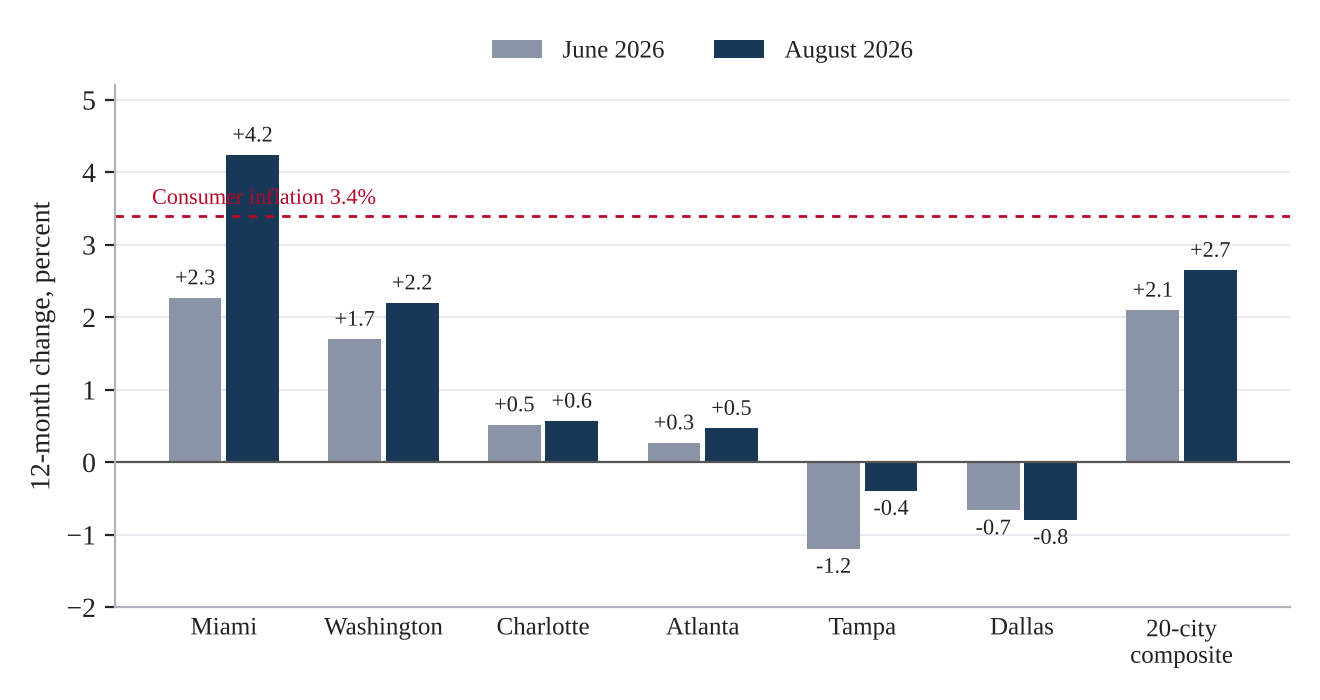
Source: S&P Cotality Case-Shiller Home Price Indices, releases of August 25 (June data) and October 27, 2026 (August data). Not seasonally adjusted, 12-month change. The dashed line is the 3.4% consumer inflation rate cited in the S&P release. Houston is not in the 20-city index.
Exhibit 4. Case-Shiller, selected southern metros, 12-month change and real change
| Metropolitan area | June | July | August | Real, Aug. | Month, Aug. (SA) |
|---|---|---|---|---|---|
| Miami | +2.3% | +3.5% | +4.2% | +0.8% | +0.2% |
| Washington | +1.7% | +2.2% | +2.2% | -1.2% | +0.3% |
| Charlotte | +0.5% | +0.3% | +0.6% | -2.8% | 0.0% |
| Atlanta | +0.3% | +0.3% | +0.5% | -2.9% | 0.0% |
| Tampa | -1.2% | -0.7% | -0.4% | -3.8% | -0.1% |
| Dallas | -0.7% | -0.4% | -0.8% | -4.2% | -0.1% |
| 20-city composite | +2.1% | +2.5% | +2.7% | -0.8% | +0.3% |
| U.S. National | +1.5% | +1.9% | +2.1% | -1.3% | +0.3% |
Source: S&P Cotality Case-Shiller Home Price Indices, June, July and August 2026. Real change is our calculation: the August 12-month change less 3.4% consumer inflation. The June national figure is as first reported; S&P later restated it to 1.6%. Detroit has no valid August value because of recording-office delays.
FHFA's August monthly index, released the same day, ranks the southern divisions differently. East South Central was up 3.9% over the year, well ahead of the nation's 2.4% and third best of the nine divisions, with a gain of 2.1% in the month alone, the largest of any division. West South Central rose 1.4% and South Atlantic 1.3%, and the South Atlantic index slipped 0.1% in the month. Missouri sits in West North Central, which was up 3.7%. In the quarterly report for June, East South Central was fifth at 2.07%, South Atlantic sixth at 1.61% and West South Central eighth at 0.83%, so the interior South and Texas have improved and the Atlantic coast has eased.
Exhibit 5. FHFA house price index by census division, 12-month change, August 2026
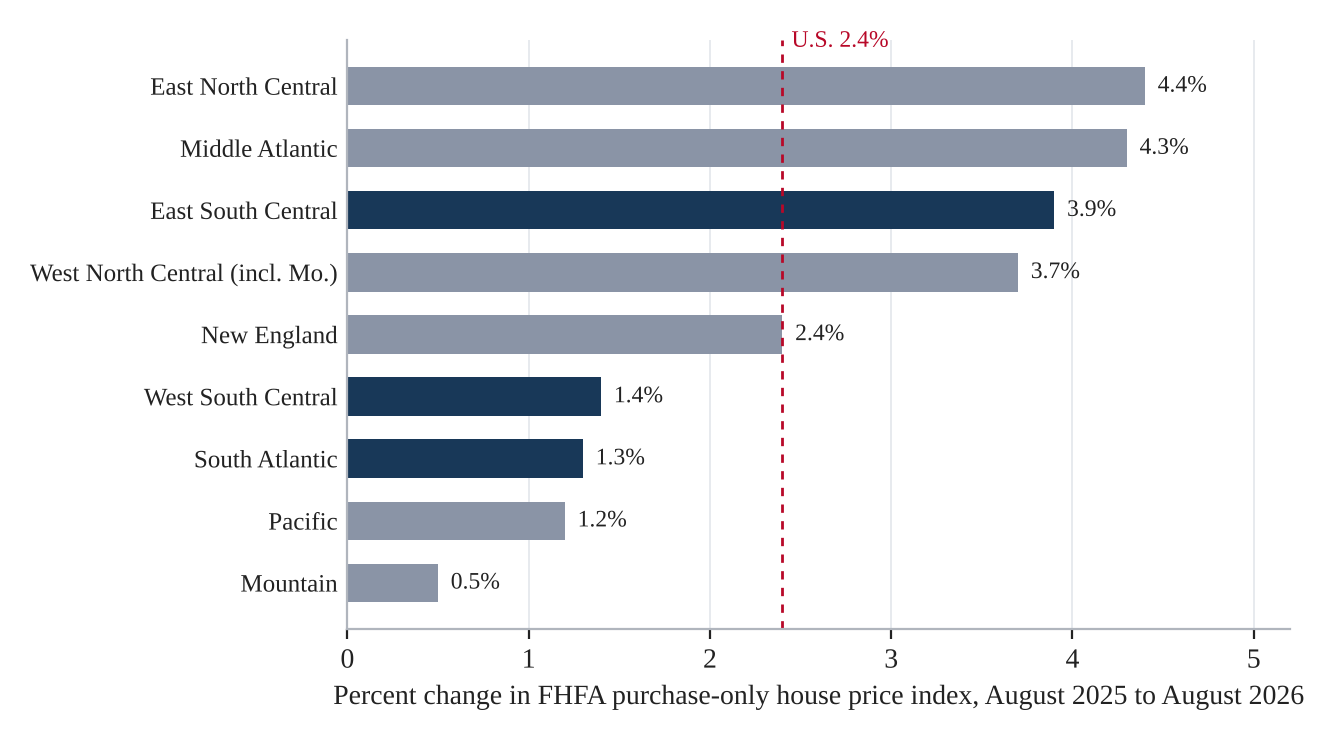
Source: Federal Housing Finance Agency, House Price Index monthly release, August 2026, released October 27, 2026. Purchase-only index, seasonally adjusted. The three southern divisions are shaded dark; Missouri is in West North Central. The dashed line is the U.S. change.
Put the two sources together and the pattern appears to be one of supply, metro by metro. Dallas added more jobs than any metro in the country over the year and its prices fell, while Charlotte (25,400 jobs, prices up 0.6%) and Tampa (16,200 jobs, prices down 0.4%) show the same weak link between hiring and prices in the markets that built the most. In the markets that built less, prices keep rising. A homeowner in Dallas is down about 4% in purchasing power over the year, and one in Atlanta or Charlotte about 3%, a pace we expect to persist in the heavily built metros until new supply slows.
Residential assessed values that are flat in nominal terms and falling in real terms are the base against which counties have written incentive packages and school bond plans, and voters are being asked on Tuesday to cut that base.
Apartments: national rents have turned up, but the Sun Belt is still paying renters to sign
Apartment List's national rent index rose 0.1% over the year in October, the first positive reading since May 2023, and most of the South did not come along. Rents on new leases are still below a year ago in 27 of the 49 southern metropolitan areas in the data, and the national vacancy rate has eased to 7.0% from a peak of 7.3% in February. The concession data says the recovery is narrower than the headline. Nationally, 32% of multifamily properties are offering at least a month of free rent, four points above a year ago, and the share has risen in 36 of the 48 southern metros with a year-ago comparison.
Exhibit 6. Rent change on new leases, 30 largest southern metros, 12 months to October 2026
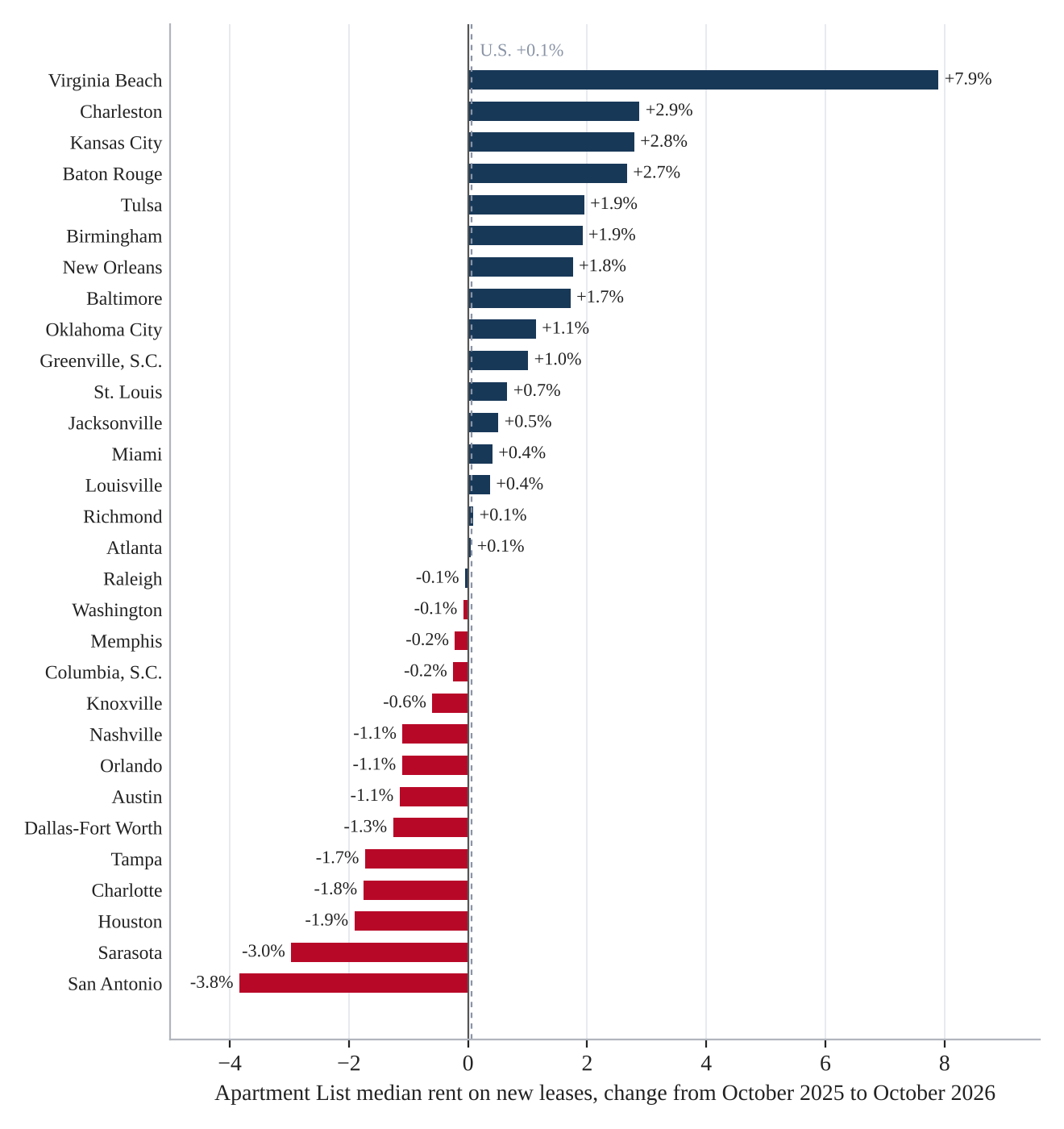
Source: Apartment List, Rent Growth (year over year) file, October 2026. Median rent on new leases, metropolitan areas, ranked by population. Red bars are declines. The dashed line is the national change.
Concessions are most common in Florida and Texas. Texas is at 44.6%, up 10.6 points from a year ago, the largest increase of any southern state. Florida is at 46.5%, the highest of the southern states, though it has eased from a spring peak near 48%. North Carolina is at 43.6% and Georgia at 41.6%. Virginia is at 26.2%, up from 17.2% and still well under the national share, while Tennessee and Alabama are both lower than a year ago. Twenty of the 49 southern metros now have at least 40% of properties offering concessions, and 12 have at least half.
Exhibit 7. Share of properties offering a month free, U.S. and selected states
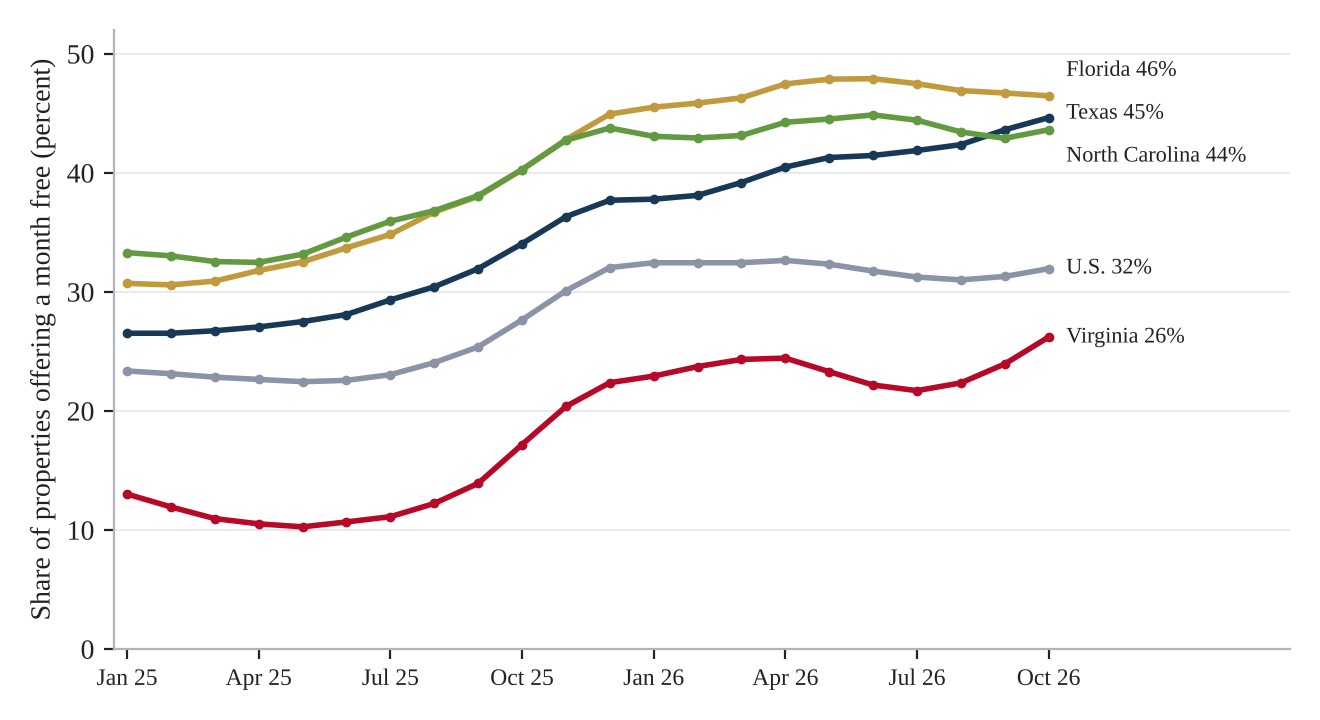
Source: Apartment List, Concession Rates file, January 2025 to October 2026. Share of apartment properties advertising at least one month of free rent on new leases.
Pressure is heaviest in Charlotte and the Texas metros, and highest of all in Florida. In the Charlotte metro, 53.4% of properties are offering concessions, up from 46.1% a year ago and the highest in Charlotte's series, and rents are down 1.8%. Vacancy there is 9.1%. Austin has 60.7% offering and rents down 1.1%, and San Antonio has 57.6%, a 15.6-point rise in a year and the largest among the 20 biggest southern metros, with rents down 3.8%. Houston's share jumped to 40.6% from 27.7%. The highest shares in the region are in Florida, where Cape Coral and Lakeland are at 70% and Sarasota at 67%, all with rents down roughly 3% to 4%. Savannah has the steepest rent decline of the 49 metros, at 5.6%, and a vacancy rate of 10.6%, the highest in the group.
Apartment List's Best Cities for Renters ranking, published October 15 on September data, shows the same split from the renter's side. Seven of its top ten cities are in the South, with Austin first and Charleston third, and Charlotte ranks second in the country on housing leverage, the ranking's measure of renters' bargaining power. A month free on a twelve-month lease is an 8.3% discount. At properties offering it, a new lease is worth materially less than the asking rent suggests, so the effective decline in Charlotte, Austin and San Antonio is larger than the rent index shows.
Exhibit 8. Concession share against rent change, 49 southern metros, October 2026
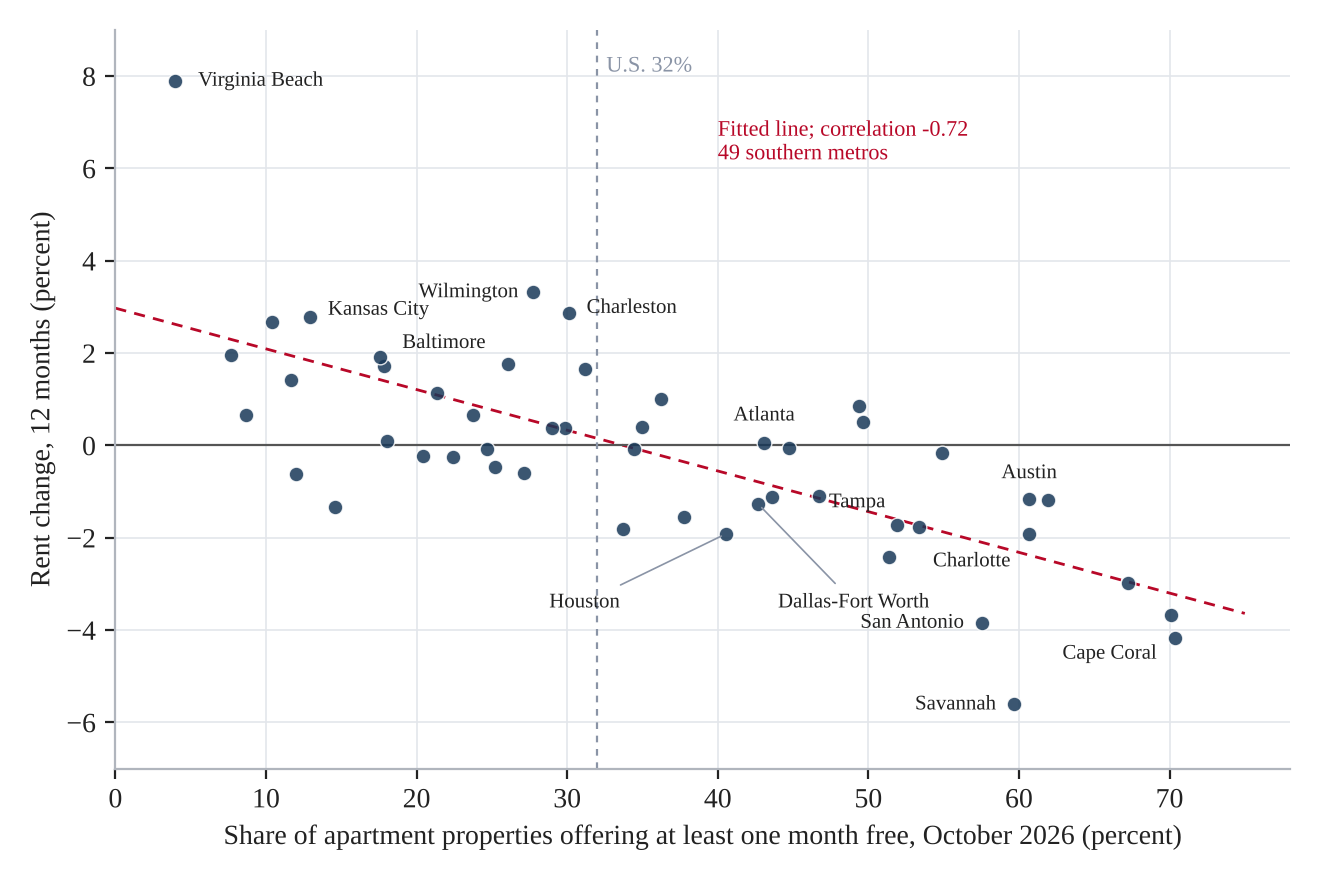
Source: Apartment List, Concession Rates and Rent Growth files, October 2026. Metropolitan areas in the South Atlantic, East South Central and West South Central divisions plus Missouri with data in both files; each metro is assigned to the first state in its name. The dashed vertical line is the national share. The fitted line is a simple linear regression.
The two measures move together. Across the 49 metros the correlation between the concession share and the 12-month rent change is -0.72: where more than half of properties are paying renters to sign, rents are falling, and where concessions are rare, rents are rising. Virginia Beach is the outlier at the other end, with rents up 7.9%, 4.0% of properties offering concessions and a vacancy rate of 3.6%. Kansas City, Baton Rouge, Tulsa and Baltimore also have firm rents and light concessions. Charleston and Wilmington, N.C. are the exceptions in the middle, with rents up 2.9% and 3.3% despite concession shares near 30%.
Exhibit 9. Apartment List indicators, 20 largest southern metros, October 2026
| Metropolitan area | Rent, 12-mo | Concession share | Change, pts | Vacancy rate | Change, pts |
|---|---|---|---|---|---|
| Dallas-Fort Worth | -1.3% | 42.7% | +8.3 | 8.7% | 0.0 |
| Houston | -1.9% | 40.6% | +12.9 | 8.4% | -0.2 |
| Washington | -0.1% | 34.4% | +6.8 | 6.3% | -0.2 |
| Miami | +0.4% | 35.0% | +4.0 | 6.4% | 0.0 |
| Atlanta | +0.1% | 43.1% | +4.8 | 7.2% | -0.3 |
| Tampa | -1.7% | 51.9% | +12.2 | 8.5% | +1.1 |
| Baltimore | +1.7% | 17.8% | +2.4 | 5.3% | -0.4 |
| St. Louis | +0.7% | 23.7% | +7.1 | 6.4% | -0.2 |
| Orlando | -1.1% | 43.6% | +3.9 | 7.2% | -0.1 |
| Charlotte | -1.8% | 53.4% | +7.3 | 9.1% | +0.1 |
| San Antonio | -3.8% | 57.5% | +15.5 | 8.8% | -0.6 |
| Austin | -1.1% | 60.7% | +13.1 | 9.0% | -0.7 |
| Kansas City | +2.8% | 12.9% | +2.1 | 6.9% | -0.2 |
| Nashville | -1.1% | 46.7% | +7.3 | 7.9% | -0.2 |
| Virginia Beach | +7.9% | 4.0% | -3.0 | 3.6% | -1.4 |
| Jacksonville | +0.5% | 49.7% | +6.9 | 7.1% | -0.3 |
| Oklahoma City | +1.1% | 21.4% | +6.0 | 6.1% | -1.2 |
| Raleigh | -0.1% | 44.7% | +0.2 | 8.1% | 0.0 |
| Memphis | -0.2% | 20.4% | -4.9 | 7.8% | -1.3 |
| Richmond | +0.1% | 18.0% | +1.8 | 7.1% | +0.5 |
Source: Apartment List, Rent Growth, Concession Rates and Vacancy Index files, October 2026. Ranked by population. Changes are from October 2025, in percentage points for concessions and vacancy. Concession share is the percent of properties offering at least one month free on new leases.
CoStar's analysis of Atlanta and Charlotte, published October 12, tests the supply explanation directly. Atlanta's annual asking rent growth turned positive in the third quarter, ending nearly three years of declines, even though the market absorbed only about 3% of its inventory over the past four quarters against nearly 6% in Charlotte. Completions over the past year equaled more than 5% of existing inventory in Charlotte and just over 2% in Atlanta, and Oxford Economics puts annual population growth at about 1.6% in Charlotte against 0.9% in Atlanta, so Charlotte has the stronger demand and the weaker rents. Concessions on newly completed units average 16% in Charlotte, effectively two months free on a twelve-month lease, against 12.2% in Atlanta, closer to six weeks. Apartment List's October data show the same ordering, with Atlanta rents up 0.1% and Charlotte's down 1.8%.
Our reading is that the pace at which new supply slows decides which markets recover first, and the Sun Belt metros with the largest pipelines, Charlotte, Austin and San Antonio, appear to be the furthest from a turn. For lenders and buyers, the practical conclusion is to underwrite from effective rents and not asking rents, and to treat the concessions line as the number that has to fall before those markets turn.
Labor Markets: Texas and the Carolinas Add Jobs, and Washington Keeps Shrinking
The September metro data, released Wednesday, show Texas, the Carolinas and the Gulf adding jobs at a healthy pace while the capital-region corridor keeps shrinking. Dallas-Fort Worth added 43,900 jobs over the year, more than any metropolitan area in the country, followed by Houston at 33,600 and Charlotte at 25,400. The fastest percentage gains were in smaller markets, led by Myrtle Beach at 3.6%, Baton Rouge at 2.7%, Greenville, S.C. at 2.5% and Raleigh at 2.3%. Charleston, Fayetteville, Ark. and Cape Coral each grew above 2%.
Exhibit 10. Nonfarm payroll growth, selected southern metropolitan areas, September 2026
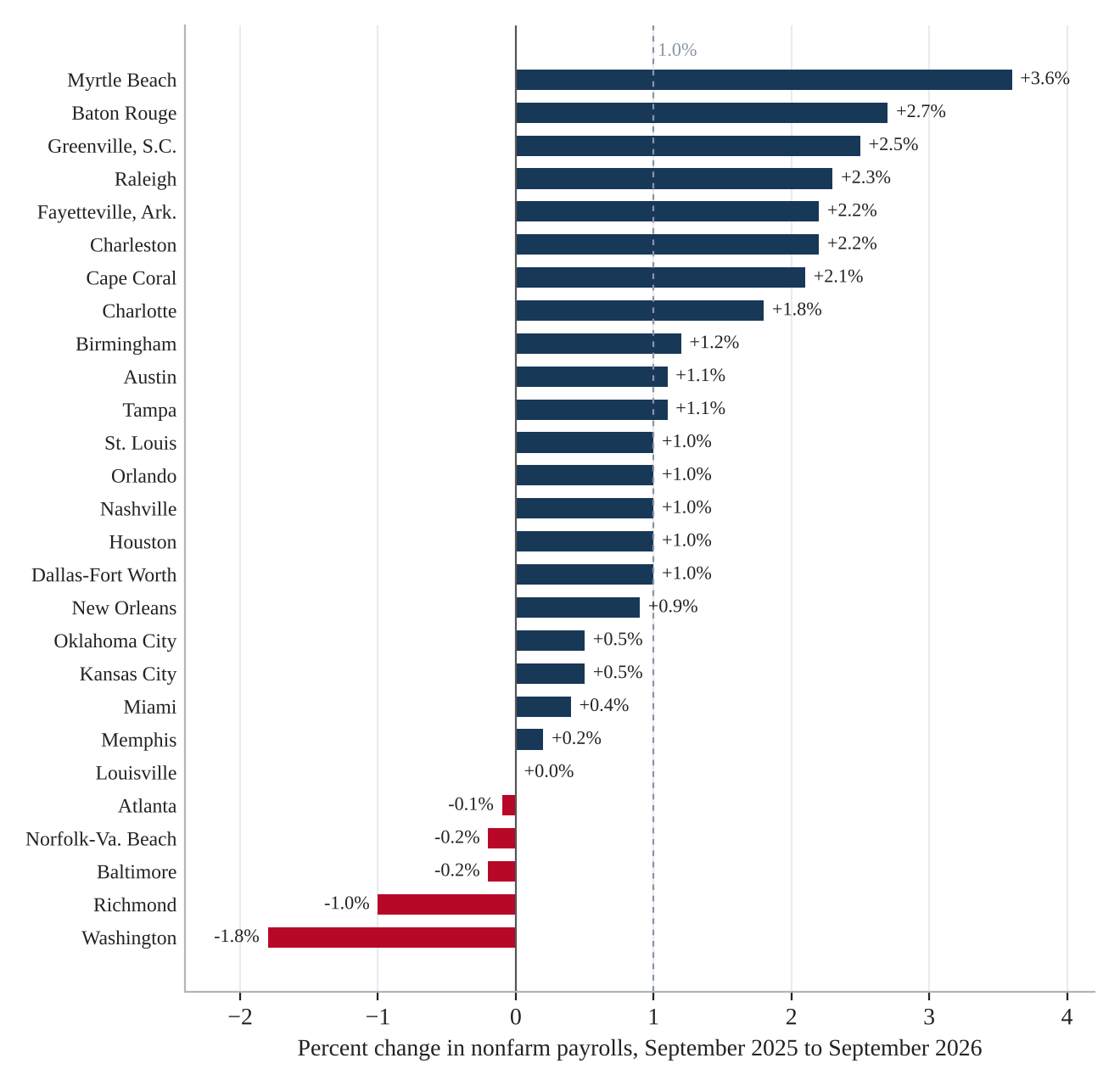
Source: U.S. Bureau of Labor Statistics, Metropolitan Area Employment and Unemployment, September 2026, released October 28, 2026. Over-the-year change in nonfarm employment, not seasonally adjusted, preliminary. Washington is the full metropolitan area (DC-VA-MD-WV). The dashed line marks 1.0%.
The contraction is concentrated and large. Washington lost 61,000 jobs, a decline of 1.8%, one of only three metropolitan areas in the nation with a statistically significant decrease, and the District's own payrolls fell 25,800 over the year, the only state-level decline in the country. Richmond lost 1.0% and Baltimore and Norfolk each lost 0.2%. These markets have heavy exposure to federal employment and federal contracting, and we expect Washington's payroll losses to continue into 2027 unless federal contracting stabilizes.
Atlanta's payrolls slipped 0.1% over the year while the labor force grew about 2%, which lifted the unemployment rate to 3.5% from 3.4%. A metro of 3.1 million jobs that has stopped adding them is a different story from the one the state tells, where Georgia's unemployment rate of 3.3% is tied with Mississippi's for the lowest in the region.
Exhibit 11. Unemployment rate and payroll change, selected southern metropolitan areas
| Metropolitan area | Sept. 2026 rate | Sept. 2025 rate | Payrolls, change | Payrolls, percent |
|---|---|---|---|---|
| Dallas-Fort Worth | 4.1% | 4.2% | +43,900 | +1.0% |
| Houston | 4.6% | 4.8% | +33,600 | +1.0% |
| Charlotte | 3.3% | 3.9% | +25,400 | +1.8% |
| Raleigh | 2.7% | 3.2% | +17,400 | +2.3% |
| Tampa | 4.3% | 4.2% | +16,200 | +1.1% |
| Nashville | 2.8% | 3.0% | +12,500 | +1.0% |
| Birmingham | 3.5% | 2.8% | +7,000 | +1.2% |
| Louisville | 4.4% | 4.0% | -200 | 0.0% |
| Atlanta | 3.5% | 3.4% | -2,700 | -0.1% |
| Baltimore | 3.5% | 4.3% | -2,300 | -0.2% |
| Richmond | 3.8% | 3.3% | -7,000 | -1.0% |
| Washington | 3.7% | 4.1% | -61,000 | -1.8% |
Source: U.S. Bureau of Labor Statistics, Metropolitan Area Employment and Unemployment, September 2026. Not seasonally adjusted; September 2026 figures are preliminary.
In Birmingham payrolls rose 1.2% but the unemployment rate climbed to 3.5% from 2.8% a year ago, and in Louisville the rate rose to 4.4% from 4.0% on flat payrolls. The tightest labor markets in the region are Raleigh at 2.7%, Nashville at 2.8% and Knoxville at 2.9%, and the loosest are in Florida's secondary markets, with Lakeland at 5.2% and Cape Coral at 4.8%.
Layoffs do not appear to be driving the slowdown, with initial claims of 194,000 for the week ended October 24 little changed from 195,000 the week before. Texas accounted for 14,755 of the unadjusted state total, ahead of Florida at 4,956 and Georgia at 3,569, so the softness appears to lie in hiring.
Capital Keeps Arriving, and the Jobs Come Later
Projects in Alabama, Arkansas and the Carolinas led a broad week of announcements, and the jobs attached to them were modest. Hyundai announced nearly $450 million at its Montgomery, Alabama engine plant for hybrid and extended-range powertrains, with 53 new full-time jobs at an average wage of $30.03 an hour. Bracco Imaging will put $230 million and 200 jobs into Sanford, North Carolina, its first U.S. plant for injectable contrast media, with a state Job Development Investment Grant of up to $2.9 million. Brose Sitech's first U.S. plant, in Scout Supplier Park in Richland County, South Carolina, carries $29.5 million and 330 jobs and will supply Scout Motors. Arkansas added Vantive's $100 million dialysis components expansion in Mountain Home, with up to 175 jobs over four years, and Canfor's $96 million upgrade of its El Dorado sawmill, which adds about 75 jobs and is expected to more than double output. Alabama also announced Helix Electric's $45.3 million, 160-job fabrication campus in Jackson County.
Georgia's release on Audi does not disclose an incentive package. It says only that the state bought and improved the megasite and that Georgia Quick Start will build a training facility, so the size of the public commitment is not yet known.
Capital per job runs from $8.5 million at Hyundai to $0.09 million at Brose Sitech (Exhibit 12), and the high end of that range is the employment-light expansion our national forecasts describe. Texas Instruments' third-quarter capital spending fell 61% to $463 million while revenue rose 28% to $6.06 billion, a reminder that the region's announcements arrive in lumps and spending on a project precedes employment on it.
Exhibit 12. Announced capital investment per direct job, selected projects
| Project | Investment | Direct jobs | Capital per job | Latest event |
|---|---|---|---|---|
| Eli Lilly API plant, Houston, Tex. | $6.5B | 600+ | $10.8M | Sept. 21, groundbreaking |
| U.S. Steel DRI plant, Osceola, Ark. | $1.9B | 200 | $9.5M | Oct. 30, groundbreaking |
| Hyundai, Montgomery, Ala. | Nearly $450M | 53 | $8.5M | Oct. 28 |
| Mitsubishi Power, Savannah, Ga. | $490M | 220+ | $2.2M | Oct. 23 |
| Canfor Southern Pine, El Dorado, Ark. | $96M | 75 | $1.3M | Oct. 27 |
| Bracco Imaging, Sanford, N.C. | $230M | 200 | $1.2M | Oct. 27 |
| Audi, Peach County, Ga. | $4.0B | 4,500 | $0.9M | Oct. 24 |
| Blue Bird, Peach County, Ga. | $300M | 375 | $0.8M | Oct. 21 |
| Vantive, Mountain Home, Ark. | $100M | up to 175 | $0.6M | Oct. 27 |
| Carrier, Fort Worth, Tex. | $600M+ | 1,500 | $0.4M | Oct. 22 |
| Saronic Port Alpha, Brownsville, Tex. | $3.0B+ | up to 10,000 | $0.3M | Sept. 30, groundbreaking |
| Helix Electric, Jackson County, Ala. | $45.3M | 160 | $0.3M | Oct. 27 |
| Brose Sitech, Richland County, S.C. | $29.5M | 330 | $0.09M | Oct. 28 |
Source: Georgia Governor's Office; Georgia Department of Economic Development; Alabama Governor's Office; Arkansas Economic Development Commission; Texas Governor's Office; SC Governor's Office; NC Governor's Office; Carrier; U.S. Steel; Talk Business & Politics. Direct permanent jobs as announced. U.S. Steel counts about 200 full-time positions plus 35 embedded contractors and about 2,000 peak construction jobs. Saronic's job count is the company's maximum. Hyundai's release gives nearly $450 million in its text and $412.9 million in a photo caption; we use the headline figure. Capital per job is our calculation.
Projects announced earlier are now breaking ground
U.S. Steel broke ground Friday on its $1.9 billion direct reduced iron plant at Big River Steel Works in Osceola, Arkansas. Governor Sarah Huckabee Sanders joined company executives at the ceremony. The plant sits next to Big River 2 and will feed hot iron directly to its two electric arc furnaces, with pellets supplied from Minnesota. The company counts about 200 full-time jobs, 35 embedded contractors and roughly 2,000 construction jobs at the peak, and calls it the first facility of its kind in the United States. The company has not published a production date, though local reports point to first output in early 2029 after a 32-month build.
Exhibit 13. Recent groundbreakings and construction starts of announced projects
| Project | Status | Date |
|---|---|---|
| Eli Lilly API plant, Generation Park, Houston | $6.5B, 600+ jobs; groundbreaking with Gov. Abbott. Announced September 2025 | Sept. 21 |
| Saronic Port Alpha shipyard, Brownsville | $3B+; initial capacity 150,000 gross tons; no opening date given | Sept. 30 |
| Helix Electric fabrication campus, Jackson County, Ala. | $45.3M, 160 jobs; the company has begun construction | Oct. 27 |
| U.S. Steel DRI plant, Osceola, Ark. | $1.9B, about 200 jobs; ground broken with Gov. Sanders; construction to begin late 2026 | Oct. 30 |
Source: Office of the Governor of Texas; Alabama Governor's Office; U.S. Steel; KAIT. Dates are announcement or event dates.
Exhibit 14. Earlier announcements without October milestones
| Project | Last milestone | Date |
|---|---|---|
| Samsung, Taylor, Tex. | Earlier reports put mass production in early 2027 | 2026 |
| xAI, Southaven, Miss. and Memphis | Fourth data center announced near Memphis; 69 turbines to be replaced by a 41-turbine, 1.2 GW plant by July 2027 under state conditions | July 29-31 |
| SpaceX Starbase, Vermilion Parish, La. | About $100B spaceport with ten launch pads announced; governor said some permits could come within months | Aug. 25-27 |
| Hyundai Metaplant, Ellabell, Ga. | Kia and hybrid models began production; a third model added | June |
| Siemens, Pendergrass, Ga. | $185M, 1,400+ jobs announced | Aug. 8 |
| Prysmian, Jackson, Tenn. | About $100M expansion and 100 jobs announced | Aug. 12-14 |
| Nscale Monarch campus, Mason County, W.Va. | 2 GW targeted by first half of 2028, with Microsoft renting 1.35 GW from 2027 | Mar. 17 |
| QTS data center, Bessemer, Ala. | Plans confirmed; five to seven year build-out | July 2 |
| Walmart fulfillment center, Carnesville, Ga. | $1.3B, 1.5 million square feet, 1,000 jobs | 2026 |
Source: Action News 5; Korea JoongAng Daily; WAFB; WALB; Rough Draft Atlanta; Georgia Department of Economic Development; WBBJ; Tennessee Lookout; Tech.eu; WBRC. None of these projects had a dated milestone in October.
Reshoring: the South took 61% of the jobs announced in 2025
The Reshoring Initiative counted about 247,000 manufacturing jobs announced through reshoring and foreign direct investment in 2025, and the South accounted for 142,828 of them, or 61%. The total essentially matched 2024, with reshoring by U.S. companies at about 153,000 jobs and foreign direct investment at about 94,000. On announcements through the first half of 2026, the group projects about 309,000 jobs this year, an increase of 25%. Annualized, the South's 2026 total rises to 158,347 jobs, but its share falls to 53% because very large announcements by Anduril, Micron and Skydio lift the West to second place ahead of the Midwest.
Texas led the nation with 31,910 jobs, followed by North Carolina with 21,387 and Georgia with 20,677. Georgia's total came from 46 cases averaging 453 jobs each, and its annualized share for 2026 is 1% against 9% in 2025, which shows how far a single year of very large announcements can move a state's share. Alabama, North Carolina, Tennessee and Florida are on pace to gain share this year, while Georgia gives up the most (Exhibit 15).
Exhibit 15. Announced reshoring and foreign direct investment jobs, southern states
| State | Jobs, 2025 | Cases, 2025 | Share of U.S., 2025 | Share of U.S., 2026* |
|---|---|---|---|---|
| South (Census definition) | 142,828 | 741 | 61% | 53% |
| Texas | 31,910 | 160 | 14% | 13% |
| North Carolina | 21,387 | 105 | 9% | 11% |
| Georgia | 20,677 | 46 | 9% | 1% |
| South Carolina | 12,587 | 78 | 5% | 4% |
| Tennessee | 10,326 | 50 | 4% | 5% |
| Louisiana | 9,520 | 29 | 4% | 4% |
| Virginia | 9,044 | 43 | 4% | 2% |
| Alabama | 6,945 | 56 | 3% | 5% |
| Kentucky | 5,376 | 42 | 2% | 1% |
| Maryland | 3,644 | 22 | 2% | - |
| Mississippi | 3,258 | 17 | 1% | 1% |
| Florida | 2,997 | 50 | 1% | 2% |
| Missouri | 2,757 | 27 | 1% | - |
| Arkansas | 2,074 | 24 | 1% | - |
| Oklahoma | 1,865 | 5 | 1% | - |
Source: Reshoring Initiative, 2025 Annual Report including 2026 first-half data (RI Master Data through the first half of 2026). Announced jobs are adjusted by the Reshoring Initiative for estimated underreporting. 2026* is annualized from first-half announcements, and a dash means the state was not among the top states the report lists. The South total follows the Census definition, which includes Delaware, the District of Columbia and West Virginia, not shown here, and excludes Missouri, which we show for coverage.
Transportation equipment was the largest industry in 2025 with 48,786 jobs, as investment shifted from battery plants toward complete vehicles, drones and ships, and its annualized share for 2026 is 30% against 20% in 2025. Computer and electronic products followed with 44,877 jobs, and chemicals, including pharmaceuticals, with 37,265. Manufacturing Dive reports that 36% of original equipment manufacturers in the group's survey have reshored or are actively doing so, up from 29% a year earlier. Policy uncertainty remains the main drag, with 57% of respondents to the 2026 National Reshoring Survey naming it their top challenge, and of 64 conditional announcements in 2025, 14 have converted to confirmed projects.
The U.S. Department of Agriculture pledged $573 million toward eight fertilizer projects on October 22, and four of them reach the South. The projects represent more than $1.3 billion of investment and about 1.1 million tons of annual capacity. Peace Valley would expand its Bartow, Florida plant to 250,000 tons a year ($19.9 million of a $50.6 million project), AdvanSix would expand ammonia capacity in Hopewell, Virginia, to 84,000 tons ($47.4 million of $98.1 million) and PCI Nitrogen would expand in Pasadena, Texas, and St. Helens, Oregon ($100 million of $200 million). Austin-based TalusAG would deploy modular ammonia units at 11 locations in seven states, including Kentucky and Tennessee ($99.8 million of $270.2 million). The USDA estimates the added capacity could lower nitrogen prices by 4.4% and potash prices by 5.3% once operating.
Data Center Politics
The backlash to data center construction reached more cities this week, while the largest buildouts kept advancing. Charlotte's City Council voted unanimously on October 26 to extend its pause on new data center approvals to October 18, 2027, ahead of the November 5 expiration of the original 150-day pause, and projects already approved are not affected. In Texas, the state environmental regulator took its stormwater filing system offline and suspended data center stormwater notices, and Public Citizen counts at least 17 suspended permits, though some air and gas-plant reviews appear to continue. In Louisiana, the governor announced a framework that attaches attestation requirements to the data center sales tax exemption, and Amazon and STACK's three-campus buildout in Caddo and Bossier parishes was reported at $18 billion, up from $12 billion in August, with Amazon paying for new energy infrastructure.
In Memphis, a judge has let the NAACP's Clean Air Act suit against xAI move forward, rejecting the company's motion to dismiss a complaint that alleges at least 35 unpermitted turbines, according to reports on October 31. Tuesday's ballots carry data center questions as well: Edgewater, Florida votes on a charter amendment that would bar new data centers, two seats on the Georgia Public Service Commission are on the ballot with Republicans holding three of the five seats, and data centers have figured in the Alabama governor's race. Loudoun County's vote on a pause is still set for November 17, and Louisiana regulators vote December 16 on Entergy's plan to power Meta's Hyperion campus.
The Mood Headed into Tuesday Is Gloomy, and It Is About Prices
Voters across the South are heading into the midterm worried about the cost of living and inclined to blame the party in power. The University of Michigan's final October sentiment index was 48.0, a touch below September's 48.1 and revised up from a preliminary 46.3. Current conditions fell to 46.7 from 50.9, expectations rose to 48.8 from 46.3, and one-year and long-run inflation expectations were 4.7% and 3.5%. The Conference Board index rose 7.5 points to 91.7 from a revised 84.2, but the present situation measure was 120.4 and the expectations index, at 72.6, sits below the 80 level that has signaled recession. The Conference Board survey leans toward jobs and Michigan's toward prices, and with layoffs near historic lows, households feel secure about work but unsure that their pay will cover the bills. Mentions of food, grocery and diesel prices rose in the Conference Board survey, and consumers plan to spend less on services and durable goods.
The gloom is uneven across the South. Conference Board data for the southern census divisions show the South Atlantic index at 99.0 in October and the West South Central at 97.7, both above the national 91.7, with expectations of about 80 in each against 72.6 for the nation. The East South Central division, which covers Kentucky, Tennessee, Alabama and Mississippi, is the weak spot at 89.5, below the nation and 18.5 points lower than a year ago, with its present situation index down from 163.4 to 114.3 over the year.
Exhibit 16. Conference Board consumer confidence, U.S. and southern census divisions
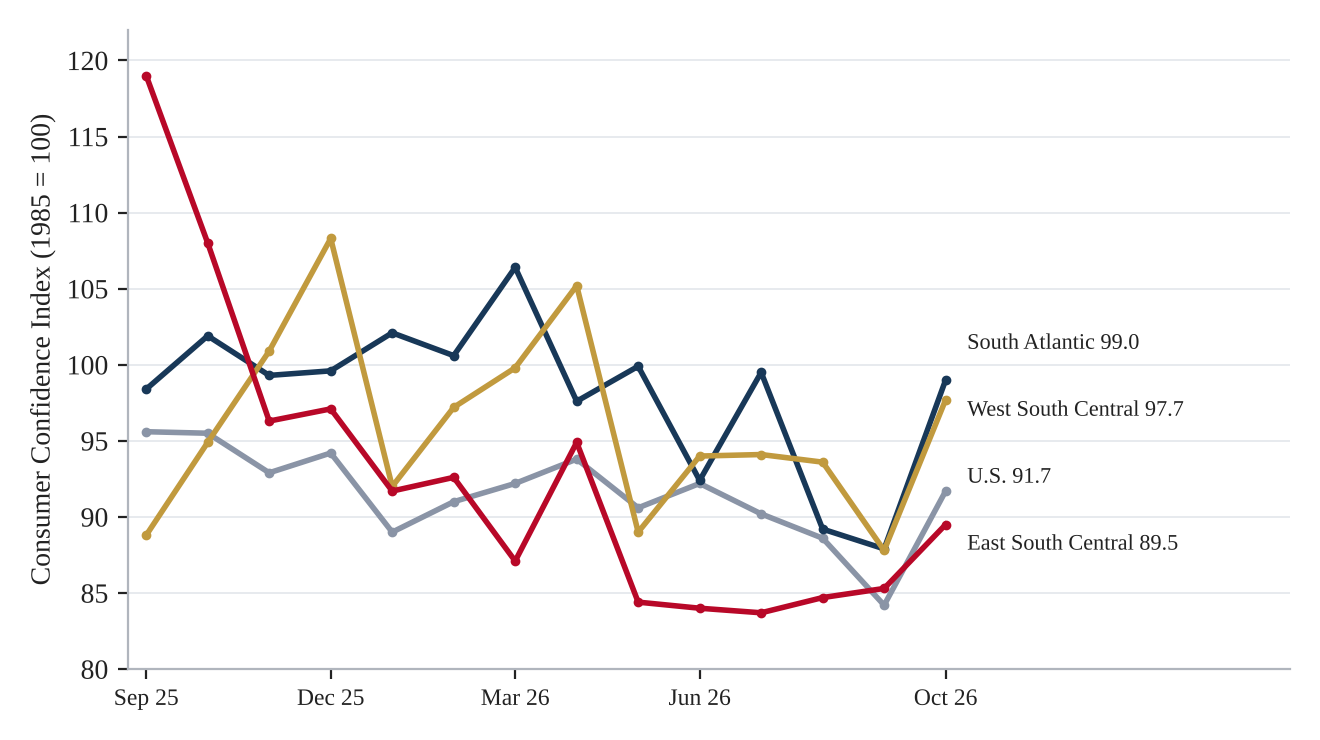
Source: The Conference Board, Consumer Confidence Index, via Macrobond, September 2025 to October 2026. The U.S. series is seasonally adjusted; the regional series are not flagged as seasonally adjusted in Macrobond, so the comparison with the national index is approximate. Regional samples are small and the series are volatile.
Among the two largest states, Texas confidence rose to 94.2 from 85.7 in September but is 5.2 points below a year ago, and Florida jumped to 119.1 from 90.3, with a present situation reading of 152.3 and expectations of 97.0. Florida's 28.8-point one-month swing suggests these small state samples are better read for direction than for level. The University of Florida's Florida Consumer Sentiment Index, which follows the Michigan survey's design, was 67.7 in September, up from 67.4 in August and about 20 points above Michigan's national reading of 48.1. The University of Florida had not published its October reading when we went to press.
Exhibit 17. Conference Board consumer confidence index, October 2026
| Area | Oct. 2026 | Sept. 2026 | Oct. 2025 | Present situation | Expectations |
|---|---|---|---|---|---|
| United States | 91.7 | 84.2 | 95.5 | 120.4 | 72.6 |
| South Atlantic | 99.0 | 87.9 | 101.9 | 127.6 | 80.0 |
| East South Central | 89.5 | 85.3 | 108.0 | 114.3 | 73.0 |
| West South Central | 97.7 | 87.8 | 94.9 | 124.0 | 80.2 |
| Texas | 94.2 | 85.7 | 99.4 | 119.3 | 77.6 |
| Florida | 119.1 | 90.3 | 120.0 | 152.3 | 97.0 |
Source: The Conference Board, Consumer Confidence Index, via Macrobond. The South Atlantic division includes Maryland, Delaware, the District, Virginia, West Virginia, the Carolinas, Georgia and Florida; the East South Central includes Kentucky, Tennessee, Alabama and Mississippi; the West South Central includes Texas, Oklahoma, Arkansas and Louisiana. Missouri is in the West North Central division and is not shown. Macrobond carries Conference Board state indexes only for Texas and Florida.
National polls point the same way. President Trump's approval is 31% in the Reuters/Ipsos poll that closed October 19, and Democrats lead the generic ballot 47% to 35%. In the Fox News poll fielded October 9 to 12, 74% rated the economy negatively, 60% named the cost of living as their top economic worry and only 6% named tariffs, while the President's approval on inflation stood at 22%. Pew found that 84% of registered voters call the economy very important to their vote, and 65% of adults say the President's policies have made economic conditions worse. The Federal Reserve's October Beige Book named tariffs and energy as the main sources of uncertainty. Richmond reported moderate growth and solid consumer spending despite higher gasoline prices, Atlanta modest growth and flat employment, Dallas moderate growth with strong manufacturing and prices, and Kansas City diesel and shipping costs as the top concern.
The University of Michigan's midterm survey of 2,129 consumers found 67% expecting a Democratic House and 52% a Democratic Senate, and 53% saying Democrats would be better for the economy against 17% for Republicans, which is a read on mood and not a seat forecast. The stakes are narrower than the volume suggests. Most legislation needs 60 Senate votes and the president can veto, so control of either chamber mostly lets Democrats block rather than enact. Goldman Sachs sees a Democratic House of about 236 seats and little change in fiscal policy, with new tariff increases after the election lifting the effective rate by a little under 2 points. The first fiscal tests are the December 11 expiration of spending authority, which Goldman expects to be pushed into February or March, and a debt limit that should bind in the first quarter.
Exhibit 18. Latest southern Senate polling, Democratic candidate's lead
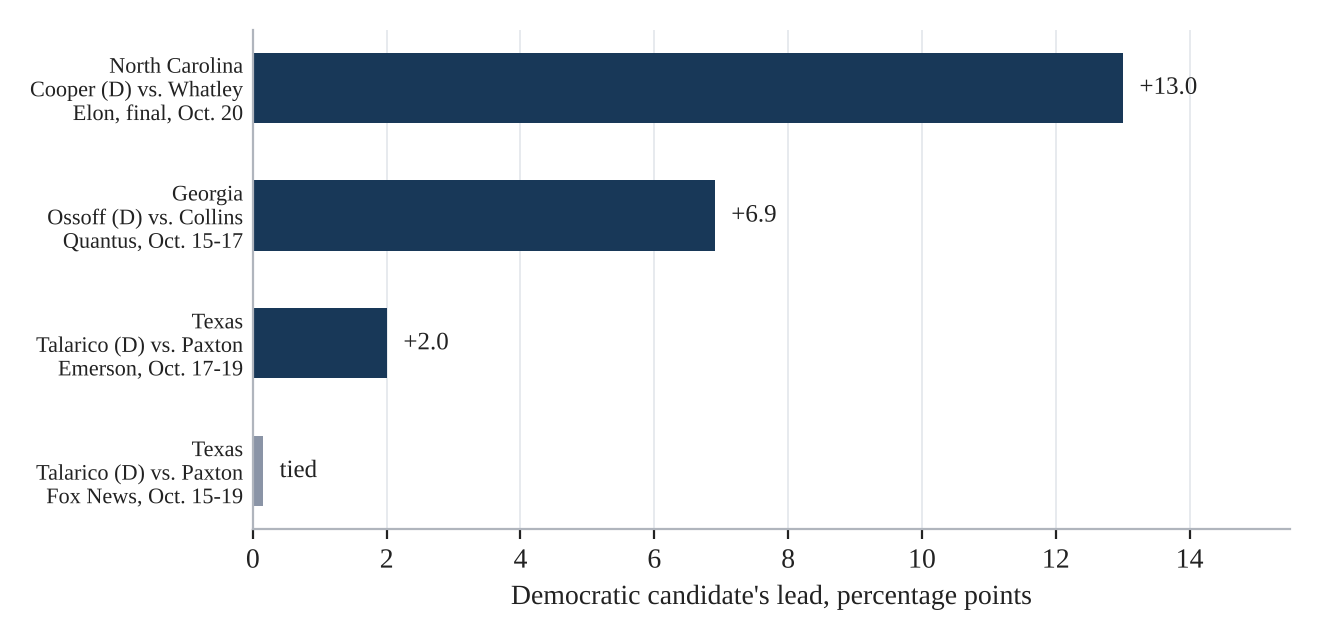
Source: Elon University Poll (final, October 20); Quantus Insights, via WRDW (October 15 to 17, 755 likely voters, margin of error 3.8); Emerson College Polling via Fox 4 (October 17 to 19, 1,000 likely voters, margin of error 3.1); Fox News (October 15 to 19, 1,398 registered voters, margin of error 2.5). Polls differ in population and method and are not directly comparable.
Late polling shows the cost of living working against the party in power across the South. In North Carolina, Elon's final poll has Roy Cooper ahead of Michael Whatley by 13 points, with 65% of respondents saying the economy is worse than two years ago and 76% saying living costs are worse, and a Quantus poll fielded October 24 to 25 had Cooper ahead 51 to 43. Cook rates that race Likely Democratic. In Georgia, Jon Ossoff leads Mike Collins by about 7 points in the Quantus poll and by 15 in Echelon's, and Cook and Sabato rate the seat Likely Democratic. Texas is a toss-up at Cook and the late polls disagree, with Emerson showing James Talarico two points ahead of Ken Paxton, Fox News a tie at 49 and CNN and SSRS a Talarico lead of 49 to 43, while InsiderAdvantage had Paxton ahead 49 to 48.
South Carolina is the surprise on the map. Cook and Inside Elections rate the race between Senator Darline Graham and Annie Andrews Lean Republican and Sabato rates it Likely Republican, and a New York Times and Siena poll fielded October 19 to 26 had the two tied at 48. Cook and Sabato now rate Mississippi Likely Republican, and a Democratic-aligned poll had Senator Cindy Hyde-Smith at 43 and her challenger Scott Colom at 40, while all three forecasters still rate Louisiana safe. Democrats need a net gain of four seats for Senate control, and prediction markets put their chances at 71% on Kalshi as of Sunday, against about 93% for the House. PredictIt has 72% and 91%. Those compare with 67% and 92% when we last cited the markets on October 26.
Property taxes are on the ballot in several states. Florida's Amendment 3 would raise the non-school homestead exemption from $25,000 to $150,000 in 2027 and $250,000 in 2028, then index it, and cut the non-homestead assessment cap from 10% to 5%. It needs 60% of the vote, and one September poll had it at 45%. Local governments and law enforcement have warned of service cuts. Tennessee's Amendment 2 would bar a state property tax, North Carolina, Georgia and Oklahoma have property tax measures of their own, and Louisiana has ten amendments, five of which touch property taxes. In May Louisiana voters rejected a business inventory tax amendment by two to one. In an Insurify survey, 65% of Florida respondents said rising premiums for home insurance make them more likely to vote.
Counties that have written incentive packages against future assessed value are now being asked by voters to cut the tax that funds them. If Amendment 3 reaches the 60% it needs, Florida's local governments will likely have to trim 2027 budgets or find other revenue, and if it falls short the same pressure carries into the next budget cycle.
Also on the Tape
Exhibit 19. Dallas Fed Texas Manufacturing Outlook Survey, September and October 2026
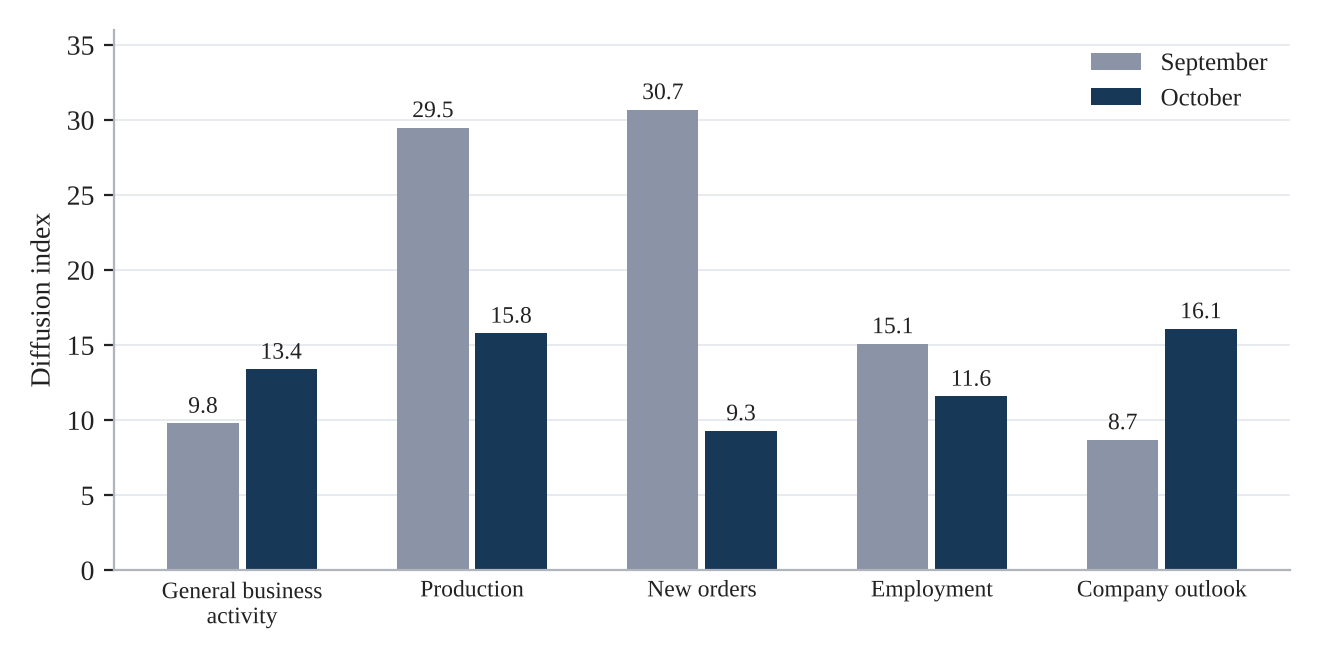
Source: Federal Reserve Bank of Dallas, Texas Manufacturing Outlook Survey, October 2026, released October 26. Positive readings indicate expansion; indexes are diffusion indexes.
- Texas factories. General business activity rose to 13.4 from 9.8, but production fell to 15.8 from 29.5 and new orders to 9.3 from 30.7. The six-month outlook jumped to 38.1 from 20.8 and the uncertainty index fell to 7.9 from 11.3. Raw material prices paid rose to 55.3, from 52.2 in September.
- Texas services. The Dallas Fed's October services survey, released October 27, showed revenue at 4.4 from -0.9 and general business activity at 4.0 from -1.8, while employment slowed to 2.8 from 4.1. Wages and benefits rose to 20.5, the highest since January 2023, and input prices stayed elevated at 41.7. Respondents pointed to data centers bidding up local wages and to high diesel prices, which one respondent tied to the lack of an agreement with Iran.
- Richmond and the Plains. The Richmond Fed's manufacturing composite was -2 in October, unchanged from September, with new orders at -8, backlogs at -21 and wages at 20. The Kansas City Fed's Tenth District composite, which includes Oklahoma and Missouri, eased to 11 from 14, but its six-month outlook rose to 22, the highest since July 2022, and prices paid held near 70.
- Agriculture. Arkansas leads the nation in Chapter 12 farm bankruptcy filings, with 12 in the third quarter, according to Talk Business & Politics.
- Oklahoma. Commerce unveiled its Opportunity Zones 2.0 map covering 104 census tracts on October 28.
College Football: Georgia Heads to Oxford
Miami stayed unbeaten by a field goal, beating North Carolina 38-35 to move to 8-0. The top-ranked Hurricanes survived an upset bid, and Utah (49-25 over Cincinnati) and UCLA (27-0 over Nevada) also won, so those three remain the only unbeaten teams in the FBS. Utah hosts BYU next week. In the SEC, third-ranked Georgia beat 17th-ranked Florida by more than two touchdowns, Ole Miss beat Auburn 45-15 and South Carolina beat Oklahoma 42-25. Texas Tech beat Arizona 34-26, and Syracuse upset 19th-ranked SMU 30-27. James Madison, which lost in overtime at Appalachian State the week before, lost again in overtime on Thursday, 24-21 to Troy.
Georgia at Ole Miss is our featured game of the week. The third-ranked Bulldogs (7-1) visit the Rebels (6-2), who were ranked 12th before beating Auburn, on Saturday at 7:30 p.m. Eastern on ABC. The teams are meeting for the fourth straight regular season, and the results have been close. Ole Miss won 28-10 in Oxford in 2024, Georgia won 43-35 in Athens last October, and Ole Miss took a College Football Playoff meeting 39-34 in January. Both of the Rebels' losses this year came on the road, at Florida and Texas, which leaves little room for error with the first playoff rankings due Tuesday. Monday's Wall Street Journal features an article on the Georgia Bulldogs highlighting their focus on developing players rather than landing new talent through the transfer portal.
Among the HBCU programs we followed last week, South Carolina State beat Morgan State 51-10 on Thursday, and North Carolina Central beat Howard 34-0 on Saturday to stay undefeated in the MEAC.
Recent Research from Mark Vitner
| Date | Publication | Title |
|---|---|---|
| Nov. 1 | A View from the Piedmont | The Price of Capital Comes Due |
| Oct. 29 | Economic Indicator Report: GDP | Third-Quarter Growth Accelerates to 3.4%, Right on Our Forecast |
| Oct. 27 | Economic Indicator Report: New Home Sales | September Held Up Before Rates Rose |
| Oct. 27 | Economic Indicator Report: Consumer Confidence | Confidence Rebounds to 91.7 |
| Oct. 26 | The Piedmont Perspective | The Great Decoupling and the Great Divide |
| Oct. 26 | A View from the Piedmont | Oil Is Pricing a War, Bonds a Slowdown |
| Oct. 26 | The Week Across the South | Georgia Has the Week, and Audi Has the Headline |
Piedmont Crescent Capital publications are available at piedmontcrescentcapital.com. The Week Across the South is published every Monday.
What We Are Watching
- Nov. 2. The ISM Manufacturing PMI for October and September construction spending.
- Nov. 3. Midterm elections, including Senate races in North Carolina, Georgia, Texas, South Carolina, Mississippi and Louisiana, and Florida's Amendment 3. September JOLTS and factory orders are also due.
- Nov. 4. Treasury quarterly refunding announcement, ADP employment, the trade balance and the ISM Services PMI.
- Nov. 5. Bank of England decision, third-quarter productivity and costs, and remarks from Cleveland Fed President Hammack, who dissented for a hike.
- Nov. 6. The October Employment Situation report, with consensus of roughly 50,000 to 56,000 against our fourth-quarter average of 62,000, and the preliminary November Michigan survey.
- Nov. 9. The Section 301 port-fee pause on China-built and China-operated vessels lapses absent formal USTR action, a direct exposure for Savannah, Charleston, Houston and the Gulf.
- Nov. 10. October CPI.
- Nov. 17. Loudoun County's vote on a data center pause.
- Nov. 20. BLS state employment and unemployment data.
- Nov. 25. Second estimate of third-quarter GDP.
- Dec. 9. The Federal Open Market Committee, where we expect a quarter-point increase. Federal spending authority expires two days later.
Sources: U.S. Bureau of Economic Analysis; U.S. Bureau of Labor Statistics (Metropolitan Area Employment, Sept., Oct. 28; State Employment, Oct. 20; Employment Situation, Oct. 2; CPI, Oct. 14); U.S. Department of Labor; Federal Reserve; S&P Cotality Case-Shiller; Federal Housing Finance Agency; Apartment List Research; The Conference Board and University of Michigan via Macrobond; University of Florida; Piedmont Crescent Capital (A View from the Piedmont, November 1, 2026); Reshoring Initiative (2025 Annual Report including 2026 first-half data); Manufacturing Dive; U.S. Department of Agriculture; Goldman Sachs Global Investment Research (via Piedmont Crescent Capital); Kalshi and PredictIt; TheStreet; The Wall Street Journal; Governors' offices and economic development agencies of Georgia, Alabama, Arkansas, North Carolina, South Carolina and Texas; Carrier; U.S. Steel; KAIT; WBTV; TechCrunch; Texas Public Radio; BIZ Magazine; CoStar; Oxford Economics; Arkansas Democrat-Gazette; Federal Reserve Banks of Dallas, Richmond and Kansas City; Elon University; Emerson College; Fox News; Quantus Insights; Ballotpedia; ESPN; CBS Sports; NCCU Athletics.
Southeast Economic Advisors | Mark P. Vitner, President and Chief Economist | Charlotte, North Carolina
This report is prepared for informational purposes only and reflects the views of Southeast Economic Advisors as of the date shown, which are subject to change without notice. It is not investment, legal or tax advice, and it is not an offer or solicitation to buy or sell any security or investment product. Information is drawn from sources we believe to be reliable, but we do not guarantee its accuracy or completeness. Forecasts and opinions are not guarantees of future results.