
This Week Across The South
A hot CPI print, a wavering Fed and the week the data-center fight reached the ballot box
Mark Vitner, Chief Economist | Monday, October 19, 2026 | southeasteconomy.com
The Buildout and the Backlash Hit the Same Gear
The AI buildout and the backlash against it both shifted into higher gear this past week, and for the first time the two appear to be moving at comparable speed. Meta was finally confirmed on October 15 as the company behind the roughly 2,000-acre hyperscale campus taking shape in Maysville, Kentucky, a project carrying an initial investment of around $15 billion, some 2,000 construction jobs and a guaranteed minimum of 400 permanent positions, with phased payments to Mason County and its schools rising to $42 million a year at full build-out. The great reveal came by way of a county development contract rather than a ribbon-cutting, however, and that tells you something about where this cycle has landed: what would be the largest data center in Kentucky arrived with lawyers rather than balloons.
The resistance, meanwhile, is institutionalizing. Manatee County, Florida adopted a 12-month moratorium on new data-center permits and rezonings on October 8, citing water and electricity demand and the absence of a data-center land-use definition in its code. Memphis postponed its own moratorium vote to October 20 after an October 6 council meeting dissolved into protests and an actual fistfight, while suburban Millington and the Shelby County commission advanced pauses of their own. Not every measure passes: Lee County, North Carolina rejected a 180-day moratorium 5-2 on October 6, and Forsyth County turned one back earlier this month. But the direction of travel is unmistakable, with one widely followed tracker counting 1,215 local jurisdictions with data-center measures as of October 5, up from 1,110 at the prior update, and San Antonio's council set to vote on citywide siting rules October 29.
Power is the hinge on which all of this swings. Entergy is asking Louisiana regulators to fast-track ten gas-fueled plants to serve Meta's Richland Parish campus, where a proposed substation would deliver 4,500 megawatts, roughly four times Entergy New Orleans' all-time single-day peak. Electricity bills have also migrated into electoral politics, with Georgia's open governor's race now featuring a Democratic call for a statewide pause on new data-center construction and a Republican counter that siting belongs to local officials, and with Virginia's new state energy plan modeling a 2050 peak load anywhere from 47 to 69 gigawatts depending on how much projected data-center demand actually shows up. The first crack in the pipeline may already be visible: Dodge's September Momentum Index showed commercial planning down 1.3% for the month and 3.0% from a year ago as data-center planning cools, even as construction in progress sits at record levels.
All of this played out against a hot inflation print and a Federal Reserve that spent the week arguing with itself. September CPI came in at 3.7%, briefly pushing market odds of an October rate hike above 50% before Chair Kevin Warsh talked them back down to the mid-teens on Friday. We look for the Fed to hold at 3.75% to 4.00% on October 28 and keep December live, a call that fails quickly if oil pushes another leg higher.
Seven Key Themes for the South
Kentucky's Meta reveal was the week's largest commitment among the seven themes we track, with aerospace and auto-supply reshoring close behind.
| AI buildout | Meta confirmed as the company behind the $15B, 2,000-acre Maysville, KY campus; Crusoe files for a $4.8B campus in Jayton, TX; Manatee County, FL adopts a 12-month moratorium; Memphis votes October 20 |
| Energy infrastructure | Entergy asks Louisiana regulators to fast-track ten gas plants for Meta's 4,500 MW Richland Parish load; DOE backs 84 TVA grid projects across eight states (about $741M and 4,300-plus MW with SPARK upgrades) |
| Defense replenishment | The Pentagon seeks a partner for a $4B Space Command headquarters and data center at Redstone Arsenal in Huntsville; Corvid Technologies adds $95M and 423 defense jobs in Mooresville, NC |
| Civilian aerospace / next-gen defense | Blue Origin commits $555M and 2,000-plus jobs to a satellite-network campus in Hutto, TX and $330M to expand Rocket Park at Cape Canaveral for New Glenn upper stages |
| Reshoring of critical industries | Hyundai Transys puts $560M of hybrid-transmission work in West Point, GA; seven Scout Motors suppliers invest $82M in Upstate SC; VDL Groep adds $77M of semiconductor-equipment capacity in Hall County, GA |
| New-era pharma investment | Reckitt's $432.6M, 289-job Mucinex campus in Wilson, NC anchors a $504M rural package; biotech Obatala Sciences opens its first East Coast operation in Charleston County, SC |
| Peak 65 labor drain and spending | Health care again led September payrolls (up 17,000), with ambulatory care (up 13,000) and hospitals (up 12,000) hiring while nursing & residential care shed 9,000 |
Examples drawn from announcements and data covered in this issue. Sources: company and state releases; U.S. Bureau of Labor Statistics; local press.
Inflation in the South
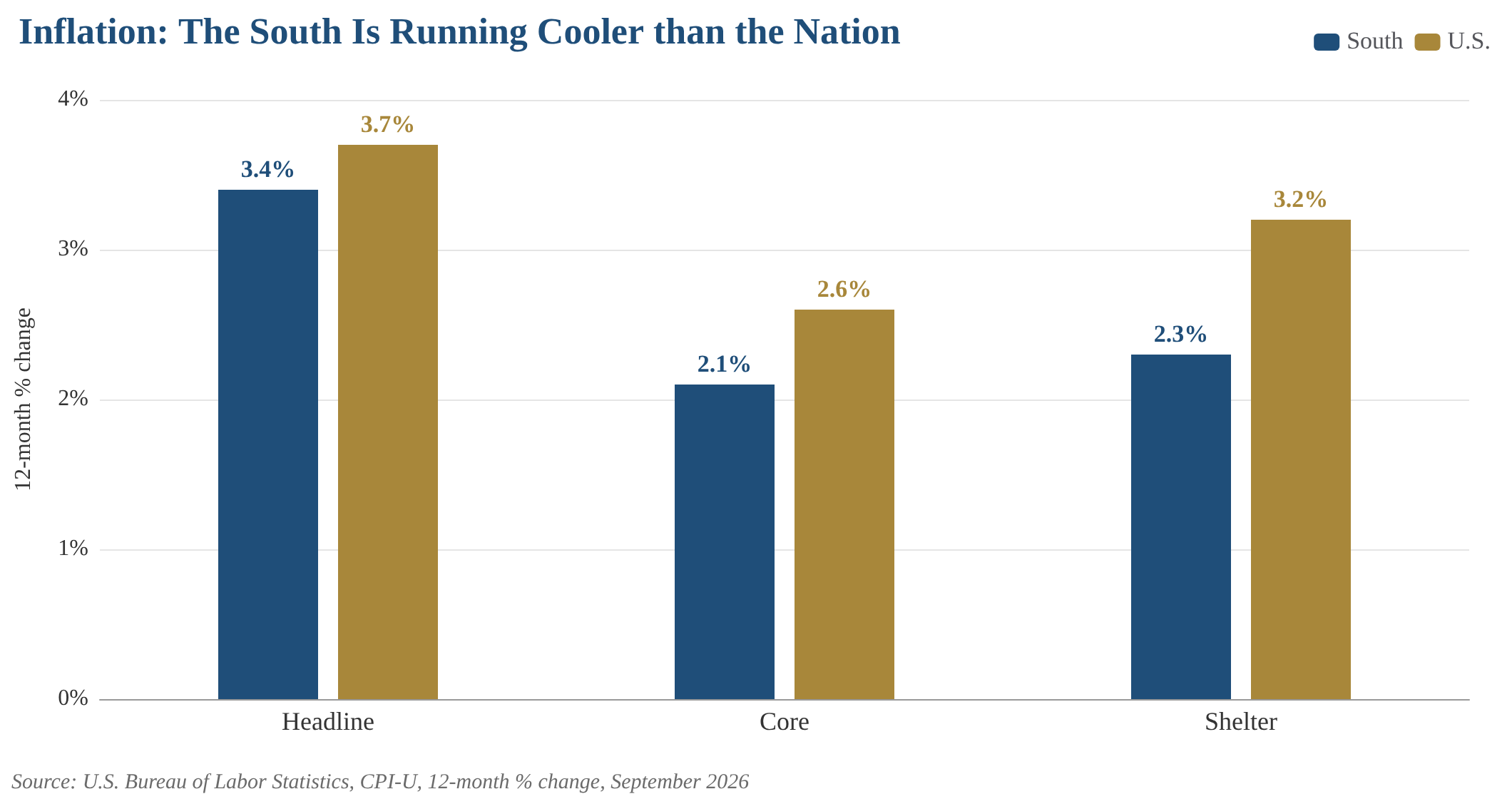
September inflation came in hotter than expected, but not so much so that it will impact the Fed's timetable. The South continues to run cooler than the nation. The national CPI rose 0.6% in September and 3.7% over the year (released October 14), with energy up 20.4% from a year ago doing most of the damage while core inflation held at 2.6%. The South's headline rate came in at 3.4%, a fourth consecutive month running about three tenths below the national pace, and the gap widens under the hood: Southern core inflation stands at 2.1% versus 2.6% nationally, and Southern shelter costs are up just 2.3% over the year against 3.2% for the country as a whole. Four years of elevated apartment completions across the Sun Belt are still paying a dividend at the kitchen table even as they bruise landlords.
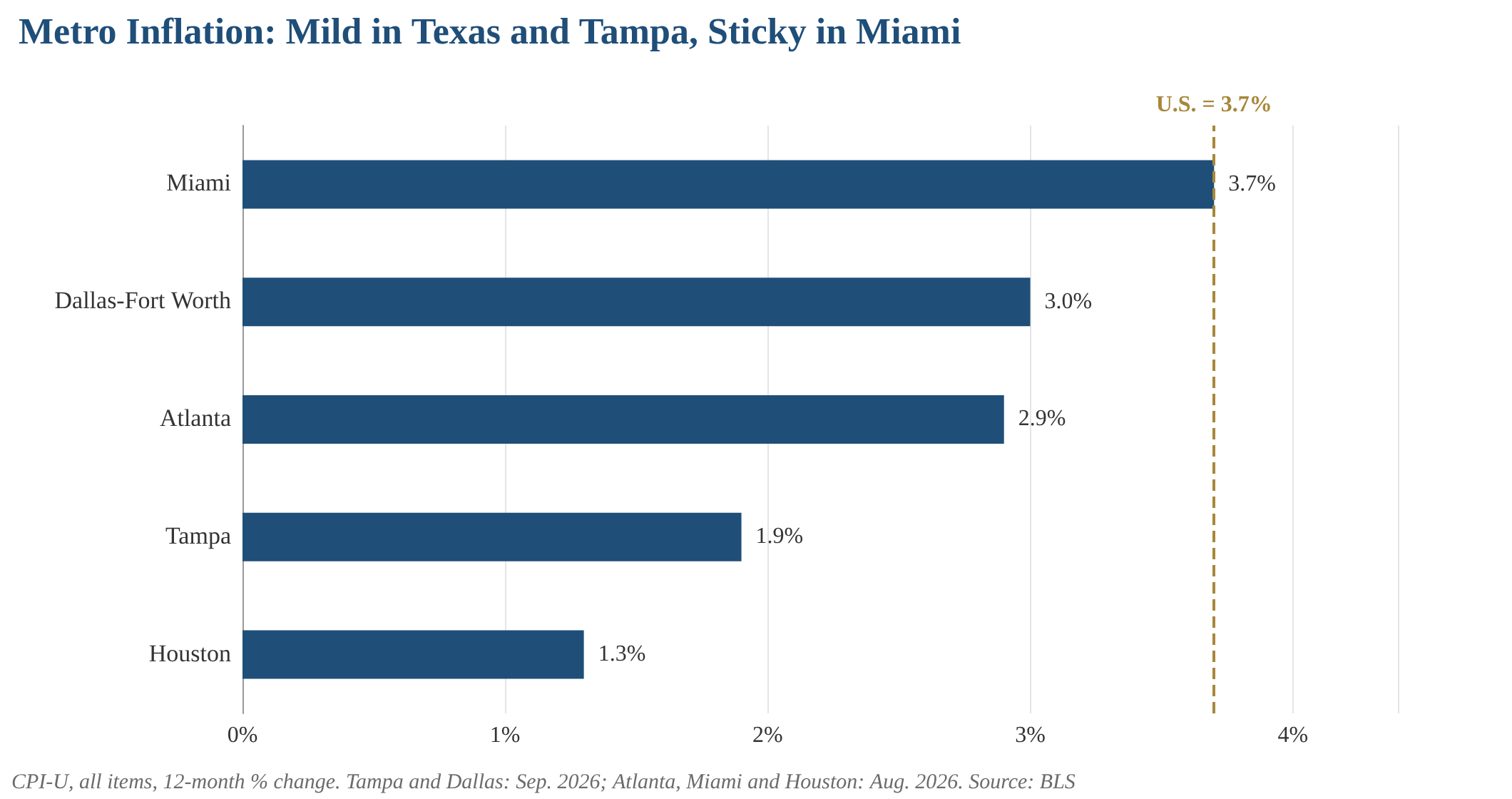
The metro detail shows how wide the range has become. Tampa's CPI rose just 1.9% over the year ending September, with shelter up a scant 0.2%, and Dallas-Fort Worth came in at 3.0%. Among the metros on an August cycle, Houston posted a 1.3% headline rate alongside outright declines in core prices (down 0.2%) and shelter (down 0.6%), while Atlanta registered 2.9% and Miami remained the region's sticky spot at 3.7%. Pump prices are the sour note, with the AAA national average at $4.30 a gallon as of October 18, though Southern drivers still pay the least in the country (Georgia at $3.84 and Texas at $3.87 in early October). We look for the South's inflation gap to persist into 2027 as shelter disinflation runs well ahead of the nation, with another energy spike the clearest threat to that call.
Labor Markets
The September jobs report confirmed that hiring has downshifted to stall speed. Nonfarm payrolls rose just 29,000 (released October 2), and the revisions stung, with July marked down to a 10,000 loss and August trimmed to 133,000, a combined 60,000 haircut. The unemployment rate held at 4.2% and average hourly earnings rose 3.0% over the year. Health care (up 17,000), construction (up 11,000), leisure & hospitality (up 10,000) and manufacturing (up 9,000) carried the month, while government shed 17,000 jobs and information and professional & business services continued to bleed.
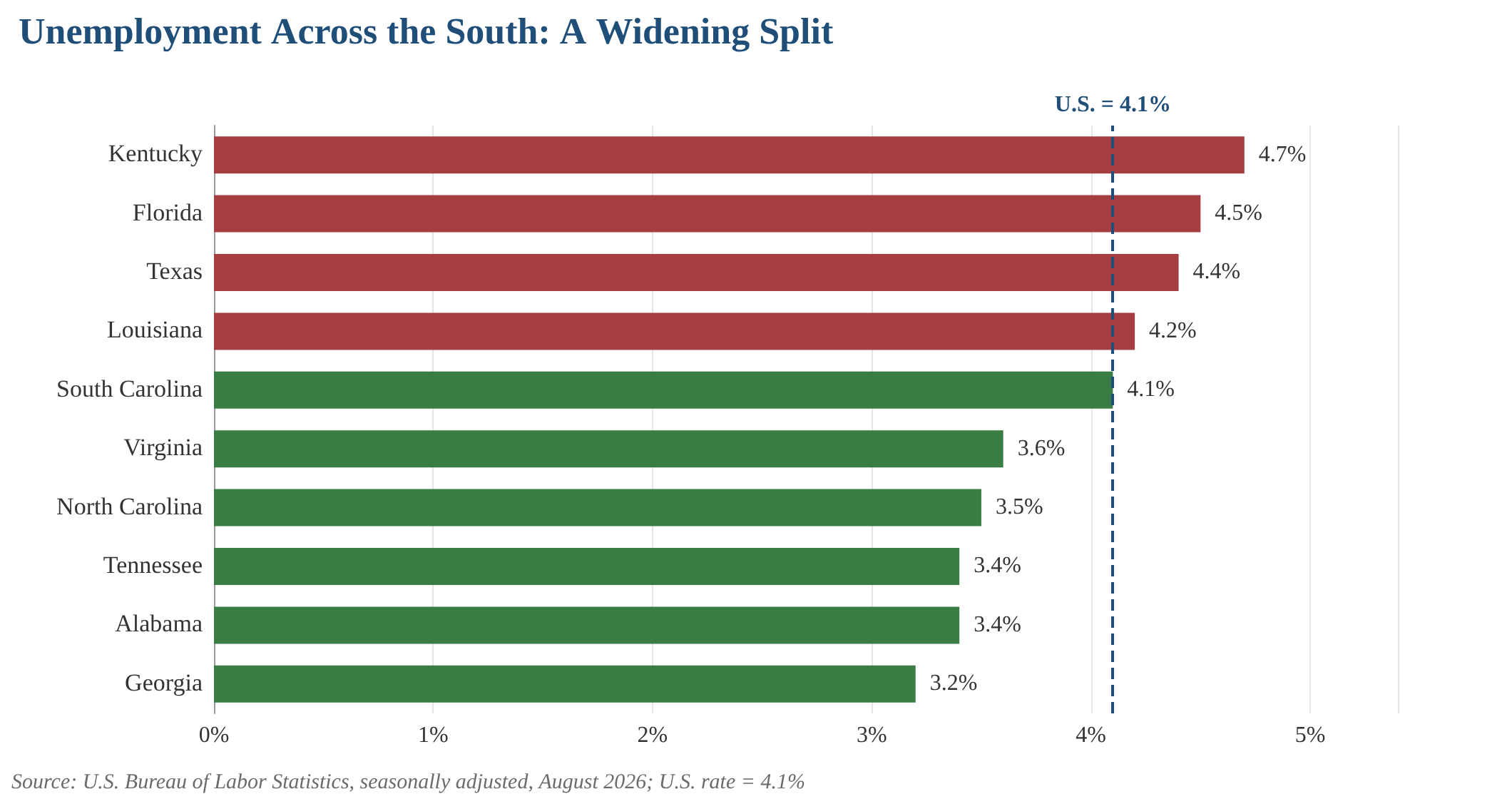
The state data, which run a month behind, still show the Southeast's core outperforming. Georgia posted the region's lowest unemployment rate in August at 3.2%, with Alabama and Tennessee at 3.4%, North Carolina at 3.5% and Virginia at 3.6%, all comfortably below the 4.1% national rate that month. The other side of the ledger has Florida at 4.5% (up from 4.0% a year earlier), Texas at 4.4% and Kentucky at 4.7%, the region's highest. South Carolina turned in the only statistically significant monthly payroll gain in the South (up 10,800), and over the year South Carolina and Louisiana led the region at 1.6% job growth while Texas added the most jobs outright (up 159,400). Washington, D.C. remains the country's one clear contraction story, down 27,000 jobs over the year, the only significant decline in the nation. September state figures arrive Tuesday.
Weekly claims remain remarkably quiet for an economy adding so few jobs. Initial filings came in at 199,000 for the week ending October 10, with the four-week average at 198,500, though Tennessee's unadjusted filings jumped 3,484, the second-largest increase in the country, a series worth watching with Memphis in the headlines. We look for the region's unemployment rates to drift up only slowly through year-end, a view that breaks if the Florida and Texas upcycles steepen in Tuesday's September release.
Policy Watch
The Fed spent the week caught between a hot CPI and a chairman preaching patience. The FOMC raised the funds rate a quarter point to 3.75% to 4.00% on September 16, the first hike since 2023, and the September CPI print briefly convinced futures markets a second was coming, with hike odds leaping from roughly 21% to 54% on October 14. Chair Warsh pulled them back to around 15% with October 16 remarks that he does not prejudge meetings and that the economy has broadly matched expectations since September. We look for a hold on October 28 paired with language that keeps a December move on the table.
The October 14 Beige Book read like a regional economy that is growing but paying more for everything. Most districts reported slight-to-moderate growth, and higher oil prices permeated all twelve reports. Atlanta described modest growth with largely flat employment and persistent input-cost pressure. That is an apt description of Florida and Georgia, the two largest economies in the Atlanta Fed district, while growth has been stronger in Alabama, Mississippi and Louisiana. Richmond noted port volumes slightly up with East Coast ocean spot rates up 200% since February, and Dallas flagged accelerating Texas manufacturing alongside strong price growth and a September drought that early-October rains only partly relieved.
Trade policy delivered one piece of relief and one looming deadline for Southern ports. The U.S.-China truce was extended to January 10, 2027 at the late-September summit, and Chinese state buyers booked roughly 20 soybean cargoes from Gulf and Pacific Northwest ports last week, the first purchases of the season, though commercial soybeans still face a tariff disadvantage against Brazil and private Chinese crushers remain absent. The unresolved item is the Section 301 port-fee pause on China-built and China-operated vessels, which lapses November 9 absent formal USTR action, a direct exposure for Savannah, Charleston, Houston and the Gulf. The 25% Section 232 tariffs on autos and parts remain in place, a standing cost for the South's assembly corridor.
Markets head into the FOMC meeting priced for patience but braced for more mayhem in the energy sector. The two-year Treasury stood at 4.77% and the ten-year at 5.10% as of October 15, the Atlanta Fed's GDPNow estimate for third-quarter growth sat at 3.6% as of October 15 (next update October 20), and Brent crude traded near $108 with WTI around $96 to $101 after a 10% weekly jump tied to Middle East supply disruptions. We look for the ten-year to hold above 5% through the meeting, and a formal extension of the port-fee pause is the week's most important piece of unfinished business.
Commercial Real Estate Across the South
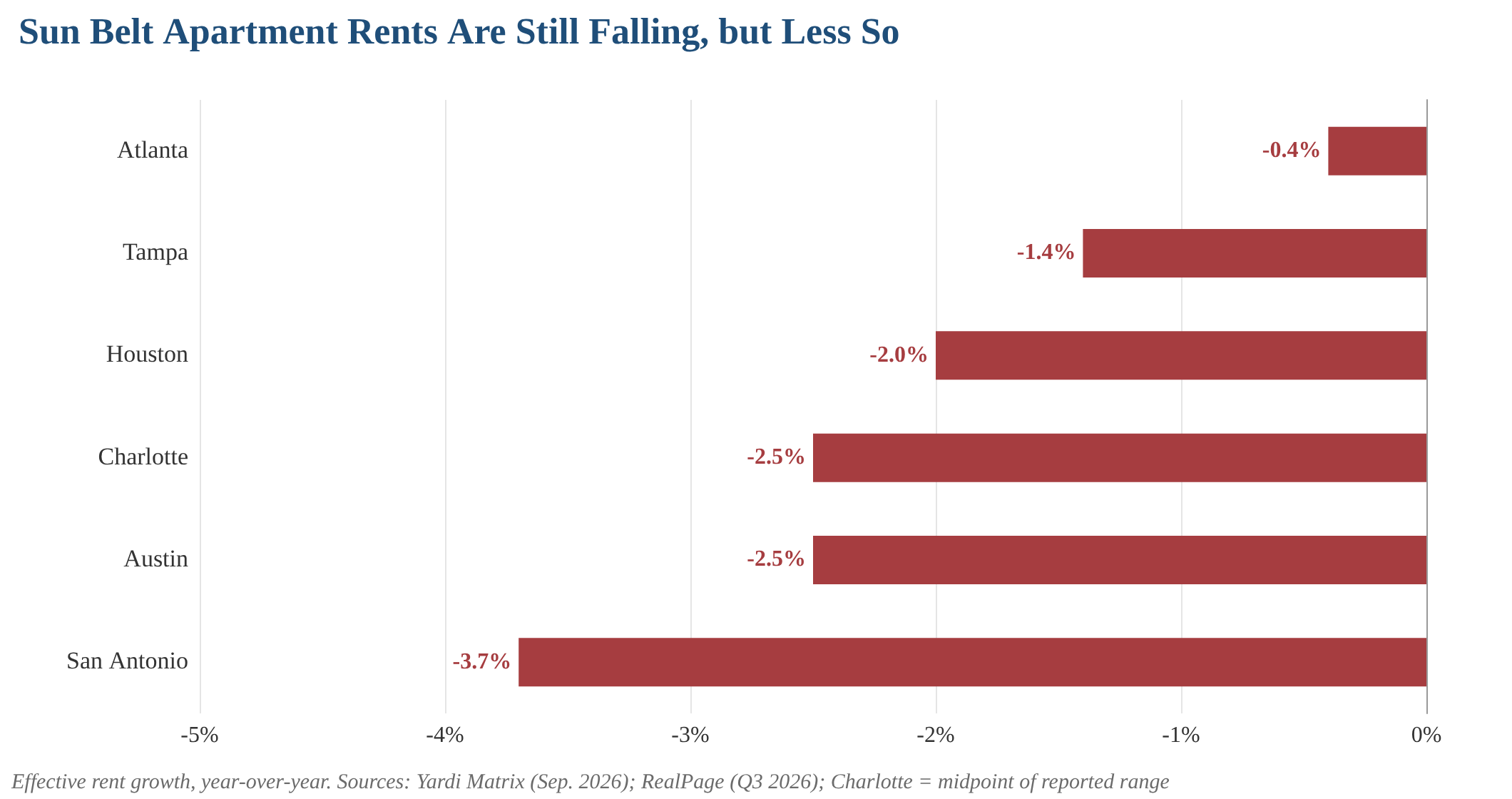
Multifamily. National effective rents rose 0.9% over the year in RealPage's third-quarter data (published October 6), the first annual gain since mid-2025, with occupancy steady at 95.4%. The South was the lone region still posting annual rent cuts, with San Antonio down 3.7%, Austin down 2.5%, Houston down 2.0%, Tampa down 1.4% and Atlanta down 0.4%, but the bottom is clearly forming: completions are down 46% from the late-2024 peak, absorption nearly matched supply over the past year and RealPage's new forecast shows no top-50 market with falling rents over the next four quarters. We look for Sun Belt rents to turn positive by spring, unless the lease-up overhang in Texas proves stickier than the forecasters assume.
Industrial. Cushman & Wakefield's third-quarter figures (published October 12) put national vacancy at 6.8%, down 20 basis points from the late-2025 peak, on 76.6 million square feet of quarterly absorption, with asking rents up about 4% and data-center-related users taking more than 8% of new leasing this year. The port markets are healing, with Savannah's vacancy down to 10.0% on 1.5 million square feet of absorption and a 45% jump in leasing, Charleston down to 11.6% from 13.3% a year ago and Houston tight at 6.3%. Dallas-Fort Worth carries the nation's largest pipeline at 33.9 million square feet under construction, which is where we would watch for renewed slack.
Office. National vacancy eased to 19.8% in the third quarter, the third straight annual improvement, with sublease availability at its lowest since 2020 and completions tracking a thirty-year low. JLL reports Sun Belt leasing running above 95% of 2019 levels, and vacancy fell over the year in Charlotte, Dallas and Phoenix. The recovery remains a starvation story rather than a surge in new leases (see our recent report, “Charlotte Is Getting Tighter by Subtraction”).
Retail. Colliers' third-quarter data show national vacancy at a tight 4.3% with 10.5 million square feet of absorption, the strongest quarter since 2023, and rents inching up 0.7%. Texas dominates the 58.1 million square foot national construction pipeline, with Dallas-Fort Worth (7.2 million), Houston (5.1 million) and Austin (3.2 million) the three largest markets.
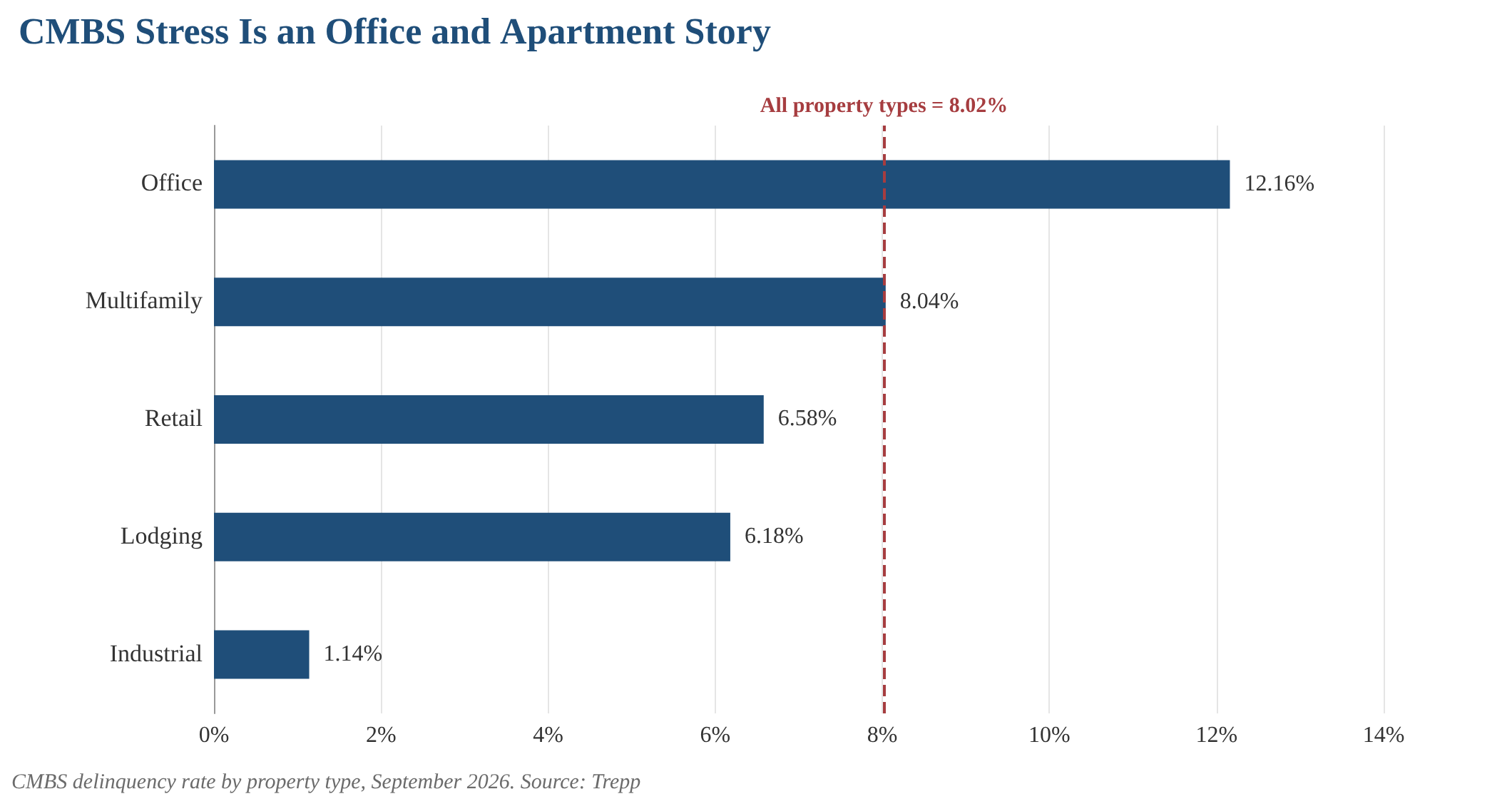
Capital markets. The credit picture is the soft spot, with Trepp's CMBS delinquency rate climbing an eighth straight month in September to 8.02%, the highest since late 2020, led by office at 12.16% and multifamily at 8.04% (versus 6.59% a year ago). MSCI's August data showed a record month of entity-level volume on the Equity Residential-AvalonBay merger even as individual asset sales fell 28% from a year earlier, though they remain up 12% year to date. With the ten-year above 5%, we look for cap rates to drift higher into 2027, and only a decisive Fed pivot changes that arithmetic.
Development Wins of the Week
Carolinas & Virginia. North Carolina had the week's best run: Reckitt will put $432.6 million and 289 jobs into a Mucinex manufacturing campus in Wilson (October 15), the anchor of a $504 million rural package announced by Governor Stein, defense firm Corvid Technologies will invest $95 million and add 423 jobs in Mooresville (October 13) and Utili-Serve will spend $24.8 million and hire 105 in Conover, in Catawba County (October 14), a grid-equipment win squarely in the wheelhouse of our recent Hickory-metro work. In South Carolina, seven Scout Motors suppliers committed a combined $82 million and roughly 200 jobs in the Upstate (October 14), and Norfolk, Virginia landed a $5 million, 40-job ship-repair expansion from Walashek (October 9).
Georgia, Alabama, Tennessee & Kentucky. Hyundai Transys will invest about $560 million and create 320 jobs in West Point, Georgia building hybrid transmissions (October 8), Dutch manufacturer VDL Groep is adding $77 million and 120 jobs in Hall County, Georgia (October 13), Godwin's truck-body operation brings $17 million and 65 jobs to Floyd County in eastern Kentucky (October 12) and REAMCO announced a $13.8 million, 72-job electrical-equipment plant in Shelby County, Alabama (October 9).
Florida, Gulf Coast & Texas. Blue Origin had announcements on both ends of the Gulf, a $555 million, 2,000-job manufacturing campus in Hutto, Texas (October 8) and a $330 million expansion of its Rocket Park complex near Kennedy Space Center to build New Glenn upper stages (October 16). Alo Yoga will put a national fulfillment center in Southaven, Mississippi, investing about $176 million and creating more than 400 jobs (October 12). The week's pattern was space, auto supply chains and grid equipment, which is about as clean a snapshot of the South's current growth model as a single week can offer.
The Week Ahead
Tuesday, October 20: BLS state employment and unemployment for September (10:00 a.m.), the first read on how far the Florida and Texas upcycles ran; Atlanta Fed GDPNow update (3:00 p.m.); Memphis City Council data-center moratorium vote
Thursday, October 22: Initial jobless claims, week ending October 17; Tennessee's spike the prior week bears watching
Tuesday-Wednesday, October 27-28: FOMC meeting (decision 2:00 p.m. Wednesday); we look for a hold at 3.75% to 4.00%
Thursday, October 29: San Antonio City Council vote on data-center siting rules; the staff proposal includes 500-foot setbacks and industrial-only zoning
Monday, November 9: Section 301 port-fee suspension lapses absent formal USTR action, a direct exposure for Savannah, Charleston, Houston and the Gulf
Tuesday, November 10: October CPI (8:30 a.m.), the last inflation report before the December FOMC meeting
Recent Research
Our latest work is up at southeasteconomy.com. The Catawba County and Hickory Metro Economic Outlook takes a close look at one of the South's quiet manufacturing comeback stories (this week's Utili-Serve announcement adds another data point), and our new report “Beyond the Beltlines: The Carolinas’ Economy Outside the Major Metros” turns to the Carolinas beyond their big-city cores. Readers can also follow our college football series, which each week breaks down a key matchup across the South and the markets the teams hail from. All are available now, with more metro work to follow this fall.
Sources & Notes
Sources: Bureau of Labor Statistics (CPI, Employment Situation, state employment); U.S. Department of Labor (weekly claims); Federal Reserve Board (Beige Book, H.15); Federal Reserve Bank of Atlanta (GDPNow); CME FedWatch as reported by CNBC and Benzinga; AAA; EIA; RealPage; Yardi Matrix; Cushman & Wakefield; CBRE; JLL; Colliers; Trepp; MSCI Real Assets; Dodge Construction Network; state governors’ and commerce department releases; local press reports.
Notes: CPI figures are for September 2026 (Atlanta, Miami and Houston metro CPIs are for August, their latest bimonthly reading). State labor data are for August 2026; September state figures are released October 20. Commercial real estate figures are Q3 2026 unless noted. Treasury yields and GDPNow are as of October 15; oil and gasoline prices are as of October 16-18. Fed funds futures odds are market readings reported by third parties and move daily.
The Week Across the South is published weekly by Southeast Economic Advisors, an affiliate of Piedmont Crescent Capital. The information herein is drawn from sources we believe to be reliable but is not guaranteed, and nothing in this report constitutes investment, legal or tax advice. Figures are subject to revision by the issuing agencies.
© 2026 Southeast Economic Advisors | Piedmont Crescent Capital | southeasteconomy.com