
SOUTHEAST ECONOMIC ADVISORS
Sports Economics | Regional Report
Two Sets of Tigers, Two Death Valleys
Clemson Visits LSU in Baton Rouge
A Week One preview and economic outlook for the South Carolina Upstate and Baton Rouge
Clemson visits LSU on Saturday at 7:30 p.m. Eastern time in Tiger Stadium, on ABC, in the second leg of a home-and-home that LSU won 17-10 in Clemson last August. Both programs finished 7-6 a year ago and neither finished ranked, which is not a sentence anyone expected to write about this pairing three years ago. LSU opens at No. 11 and a 10.5-point favorite, and Clemson enters unranked in the preseason poll for the first time since 2011.
Both stadiums are called Death Valley, and Clemson’s claim on the name is the older one by eleven years. Presbyterian coach Lonnie McMillian, whose teams had been beaten badly at Clemson through the 1940s, used the phrase publicly in 1948, and Clemson’s sports information office put it into print in 1956. LSU students were calling Tiger Stadium “Deaf Valley” in the 1950s for the crowd noise, and LSU fans took the harder version only after LSU beat Clemson 7-0 in the Sugar Bowl on January 1, 1959, capping the school’s first national championship. Saturday’s crowd of up to 102,321 will likely be the largest either team plays in front of this season.
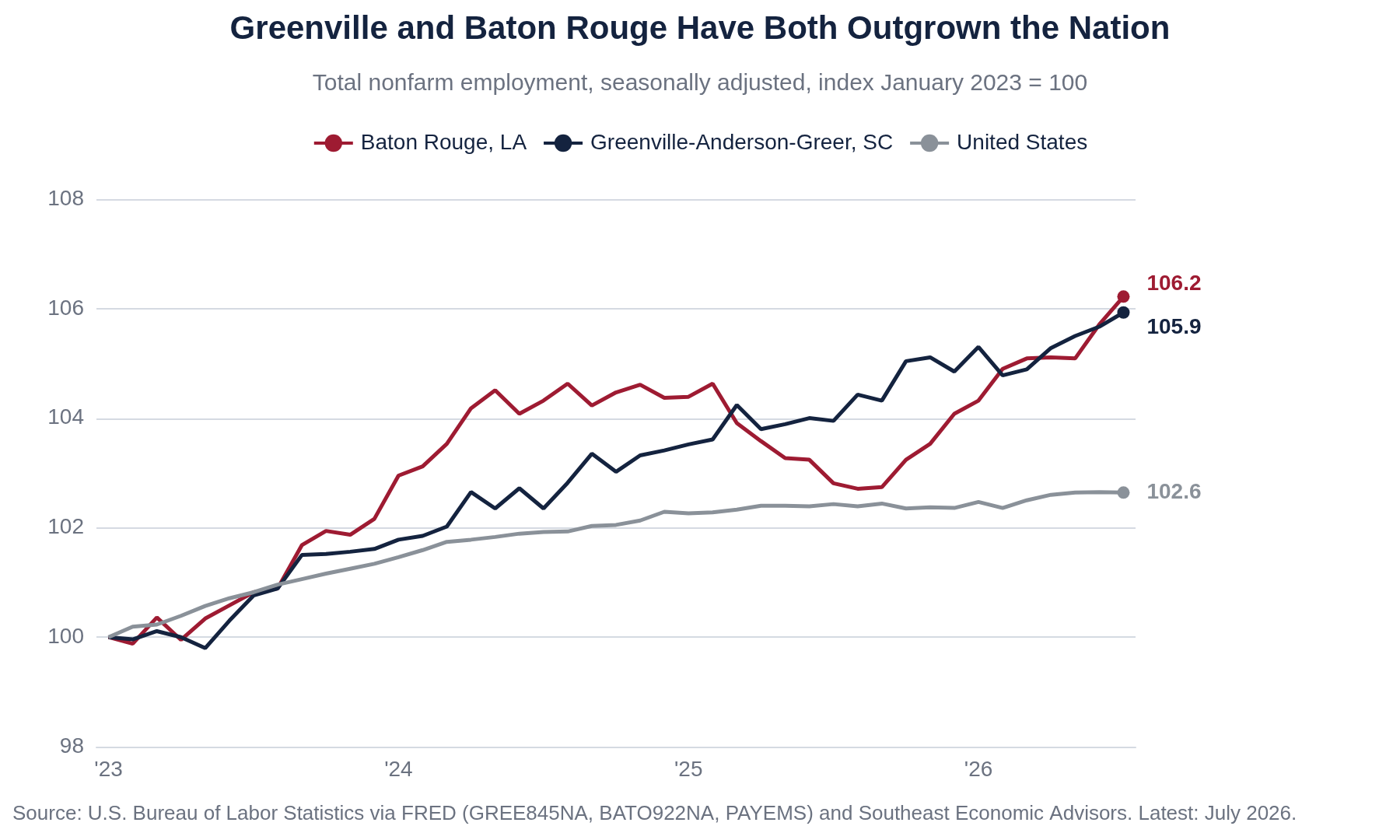
Greenville and Baton Rouge have each added roughly six percent to their payrolls since the start of 2023, against 2.6 percent for the country. The two communities that host these universities are the real subject of this report, and they differ in what is producing that growth and in what each is paying per job to get it.
At a Glance
- Week Zero. North Carolina beat TCU 15-10 in Dublin as a 7.5-point underdog and Memphis won 27-21 at UNLV, where the Rebels were favored by 3.5 to 5.5 points, the weekend’s two upsets on an eight-game slate. Two programs played their first games in the Football Bowl Subdivision.
- The game. LSU is a 10.5-point favorite with the total at 50.5. It is Lane Kiffin’s first game as LSU’s head coach and Clemson’s first preseason unranked appearance since 2011.
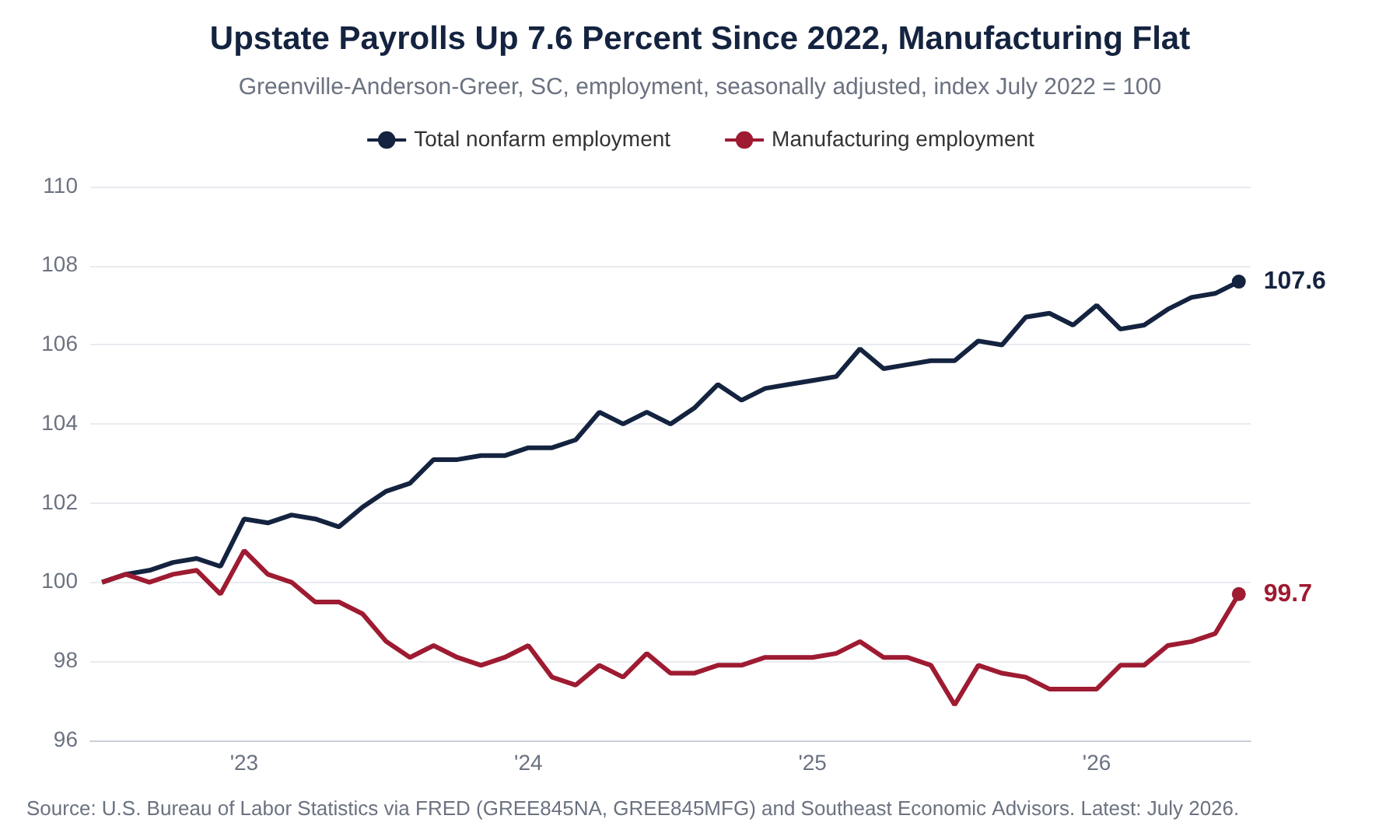
- The Upstate. Payrolls rose 1.9 percent over the year to July while manufacturing employment, at 61,800, is where it stood in the summer of 2022. BMW Spartanburg’s export share has fallen from 70 percent of output to roughly half, which is how slower global growth reaches the Upstate.
- Baton Rouge. Payrolls rose 3.3 percent over the year to July, double the next fastest Louisiana metro, in a state that has lost roughly 40,000 residents since 2020. Construction is up 27 percent and supplied four-fifths of the metro’s unadjusted job gain.
- What capital buys. Two Upstate data centers committed $4.9 billion for 57 permanent jobs. Two Ascension Parish plants committed roughly $10 billion for about 1,400. At most $1.13 million of announced capital now stands behind each job South Carolina announces, against $284,000 in 2017.
- Affordability. The median Baton Rouge home sold for $249,875 against $387,906 in Greenville County. Louisiana homeowners insurance averaging $5,986 a year, against $2,974 in South Carolina, gives part of that back.
- Our call. LSU by a touchdown, inside the number. LSU is 112-15 in Saturday night games in Tiger Stadium since 2000, and Clemson won the turnover battle in this matchup a year ago and still lost by seven.
Week Zero: Two Upsets, and One of Them Was Ours
Week Zero delivered eight games involving Football Bowl Subdivision teams, two programs playing their first game in the subdivision and two outright underdog winners, one of which was the game we previewed. North Carolina beat TCU 15-10 in Dublin as a 7.5-point underdog, and Memphis won 27-21 at UNLV, where the Rebels had been favored by 3.5 to 5.5 points depending on the book. Every other favorite on the slate won, and the only other game with a Power Four team on both sides was a rout.
We wrote last week that we expected the line to hold near a touchdown into kickoff, and it did, but the game did not go with it. The condition we attached to that call was whether North Carolina’s rebuilt front would give Jaden Craig less time than TCU’s defense gave the Tar Heels a year ago, and something close to that happened. Xavier Lewis, North Carolina’s defensive lineman, accounted for 4.5 tackles for loss and two sacks by himself, against six and three for the entire Tar Heel defense. The call on the spread was wrong and the read on where the game would turn was closer.
Neither team scored a touchdown after the first quarter, and North Carolina won with 15 points from an offense that averaged 19.3 a game a year ago. Billy Edwards Jr. went 16 of 28 for 232 yards with no touchdowns and no interceptions in his first start for the Tar Heels, and Jaden Craig went 20 of 32 for 175 yards in the first start of his FBS career. TCU took eleven penalties for 89 yards against three for 20 on North Carolina, went 1 for 5 on fourth down and lost its last two possessions at or inside the North Carolina 10. Its ground game gained 111 yards in the first half and 26 in the second, finishing at 106 net of sack losses.
Dublin announced a crowd of 40,457, which answers the economic question we raised last week. That is 6,769 below the 47,226 the 2025 game drew, and organizers who promoted a third consecutive sellout last year have made no such claim this time. Roughly 14,000 American visitors were expected, against the 22,910 Grant Thornton Ireland counted in 2025. Grant Thornton has published its impact estimate in February in prior years, so the 2026 figure will not arrive until well into next year, and we would not assume that last year’s €132 million repeats.
| Game | Result | Note |
|---|---|---|
| North Carolina vs. TCU, Dublin | North Carolina 15, TCU 10 | The bigger of the weekend’s two upsets; UNC won outright as a 7.5-point underdog |
| San Jose State at No. 14 USC | USC 42, San Jose State 26 | The only ranked team in Week Zero action |
| NC State at Virginia | Virginia 34, NC State 8 | The most lopsided result, and the relocated Rio de Janeiro game |
| Jacksonville State at North Dakota State | North Dakota State 33, Jacksonville State 7 | North Dakota State’s first game as an FBS program |
| Sacramento State at Eastern Michigan | Eastern Michigan 28, Sacramento State 17 | Sacramento State’s first game as an FBS program, and its first in the Mid-American Conference |
| Hawai’i at Stanford | Stanford 37, Hawai’i 27 | Hawai’i led 27-23 with four minutes left before Stanford scored twice |
| New Mexico State at Florida State | Florida State 34, New Mexico State 17 | |
| Memphis at UNLV | Memphis 27, UNLV 21 | The weekend’s other upset; 31,384 at Allegiant Stadium in Charles Huff’s Memphis debut |
Table 2. Week Zero results, Saturday, August 29, 2026. Sources: ESPN, the Associated Press, CBS Sports, school athletics and Southeast Economic Advisors. Closing spreads are consensus.
Two programs played their first games as members of the Football Bowl Subdivision. North Dakota State, which won ten Football Championship Subdivision national titles in the fourteen seasons from 2011 through 2024, opened its Mountain West era by beating Jacksonville State 33-7 in front of 18,573 at the Fargodome and extended its home-opener winning streak to 28 games. Sacramento State made the same jump, into the Mid-American Conference, and lost 28-17 at Eastern Michigan. Week Zero has grown from four games involving FBS teams in 2024 to five in 2025 and eight this year, and the standalone national television window is now worth more to these programs than a September home date.
| Clemson Tigers | LSU Tigers | |
|---|---|---|
| Conference | ACC | SEC |
| Head coach | Dabo Swinney (19th season) | Lane Kiffin (1st season) |
| 2025 record | 7-6, lost Pinstripe Bowl | 7-6, lost Texas Bowl |
| Final 2025 AP poll | Unranked | Unranked |
| 2026 preseason AP poll | Unranked (112 points) | No. 11 (988 points) |
| 2026 starting quarterback | Christopher Vizzina | Sam Leavitt (Arizona State transfer) |
| Home stadium | Memorial Stadium (81,500) | Tiger Stadium (102,321) |
| Last meeting | Lost 17-10 (2025, at Clemson) | Won 17-10 (2025, at Clemson) |
| All-time series | 1-4 | 4-1 |
| Saturday | Visiting team, 10.5-point underdog | Home team, 10.5-point favorite |
Table 3. The tale of the tape. Sources: ESPN, the Associated Press preseason poll of August 17, 2026, school athletics, VegasInsider and Southeast Economic Advisors. Records reflect the completed 2025 season. The betting line was captured September 3, 2026. No in-season Associated Press poll has been published; the first arrives Sunday, September 6.
Saturday Night in Baton Rouge
The markets make LSU a 10.5-point favorite with the total at 50.5, and the spread has not moved since it opened at the same number in January. Books are split between 10 and 10.5 points, and LSU is roughly a 4-to-1 moneyline favorite at -380 to -385, in from -453 at the open. A spread that sits still for seven months usually means the books saw no reason to move it, which in this case means neither the coaching change in Baton Rouge nor Clemson’s offseason changed anyone’s estimate of the gap. The total has been the livelier number, opening at 50.5, trading up to 51.5 in late August and settling back where it started.
Lane Kiffin coaches his first game for LSU on Saturday, having been hired on November 30 after Brian Kelly was relieved of his duties on October 26 following a home loss to Texas A&M. Kelly left with a 34-14 record across parts of four seasons, which is the kind of record that gets a coach fired only at a program with LSU’s expectations. Sam Leavitt, an Arizona State transfer, takes over at quarterback after Lisfranc surgery and a follow-up procedure in April to remove the pins, and says he has been at full health for months.
Dabo Swinney is in his nineteenth season and has brought back Chad Morris, his offensive coordinator from 2011 through 2014. Christopher Vizzina won the quarterback job in fall camp over freshman Tait Reynolds, and Clemson was the leading vote-getter outside the Top 25 with 112 points. Clemson lost safety Polo Anderson and linebacker Joseph Roberto II to season-ending knee injuries in camp, while LSU reports no injuries of consequence. We expect the number to hold near double digits into kickoff.
Clemson has more at stake on Saturday than it did a year ago, and the roles have reversed entirely. Last season began at No. 4 in the preseason poll and ended 7-6 and unranked, the program’s lowest win total since 2010. Last August Clemson was No. 4 and a 4.5-point home favorite against No. 9 LSU and lost 17-10; this time it is unranked and taking 10.5 points on the road, and it needs the win rather than another close loss.
How We See It
We expect LSU to win, and the case starts with the building more than the rosters. LSU has gone 112-15 in Saturday night games in Tiger Stadium since 2000, a .882 clip, and 284-72-4 at night since 1958 against 50-28-3 in the daylight. The stadium averaged 101,575 last season, better than 99 percent of capacity, through a 7-6 year in which the head coach was fired in October. Lane Kiffin has lost in this building three times as a visitor, including a 29-26 overtime game in 2024, and LSU head coaches have won their first game 22 times in 33 tries.
The number looks fair, which is why our call sits inside it. SP+ projects LSU 28, Clemson 18 and the Football Power Index gives LSU a 75.3 percent chance, both of which land on the market’s 10 to 10.5. Against that, LSU returns 34 percent of its production, 89th in the country and among the lowest in the SEC, while Clemson returns 53 percent overall and 61 percent of its defense. The line has already moved a half point toward Clemson and the moneyline from -453 to -380. Over 27 seasons an underdog getting 10 to 10.5 has won outright roughly one time in four to one time in five.
Clemson has to play mistake-free football and turn takeaways into points, and last August is the warning about how hard that is. Clemson forced two LSU fumbles in its own Death Valley, won the turnover battle 2-1 and lost 17-10 anyway, because it ran for 31 yards on 20 carries, converted 3 of 13 third downs and held the ball for 22 minutes and 50 seconds against 37 minutes and 10 seconds. Clemson intercepted nine passes over the whole 2025 season, its fewest since 1998, with six of the nine coming from one player, while Sam Leavitt threw nine interceptions in twenty games at Arizona State against 34 touchdowns. The takeaways this call requires are more than the defense produced last year, from a quarterback who has not been giving them away.
Everything on Clemson’s side runs through Christopher Vizzina, who has thrown 105 passes in his career and started once. That start was a good one, 29 of 42 for 317 yards and three touchdowns against SMU, and he has thrown a single interception in three seasons, so there is no turnover history to read in either direction. He has also never taken a meaningful snap on the road, and Dabo Swinney said on Monday that a true freshman playing behind him is probably likely. Kickoff is at 7:30 Eastern in 93-degree heat that should fall into the upper 70s by the fourth quarter, with the rain risk mostly gone by evening. We expect LSU by a touchdown, inside the number. Clemson covering would mean it finally ran the ball, having gained 31 yards on the ground in this matchup a year ago and 124.5 a game for the season.
The Upstate: Four Years of Growth Without the Factory Floor
The Greenville-Anderson-Greer metropolitan area crossed one million residents on July 1, 2025, reaching 1,014,101 and growing 9.25 percent since the 2020 Census. Payrolls reached 487,500 in July, up 9,100 (1.9 percent) over the year on a seasonally adjusted basis, and the unemployment rate was 3.7 percent against 4.4 percent nationally on the same unadjusted basis. Clemson University sits inside this metro area, in Pickens County, and enrolls 29,545 students.
Manufacturing employment rose 2.8 percent over the past year, to 61,800, which only returns it to where it stood in the summer of 2022. The metro has added 34,400 jobs since July 2022 and manufacturing has accounted for none of them, having peaked at 62,500 in January 2023 and bottomed at 60,100 last July. The past year’s growth came from leisure & hospitality (+4,700), education & health services (+2,900) and financial activities (+1,200), against +1,700 in manufacturing. The announcements are real. They have simply not yet shown up in factory payrolls, because this is a capital-intensive, employment-light expansion and the capital committed per job announced has risen sharply.
The swing factor is BMW, and the swing has turned negative. Plant Spartanburg completed a $1.7 billion investment in its South Carolina operations on June 30, covering both the Spartanburg expansion and the new Plant Woodruff battery assembly facility, and will begin building the iX5, its first fully electric American-assembled model, late this year. BMW Group cut its 2026 guidance on June 16, however, taking its automotive margin corridor from a range of 4 to 6 percent down to 1 to 3 percent, citing accelerating deterioration in the Chinese market and the conflict in the Middle East. The plant employs more than 12,000 people on site.
The plant’s export share has fallen from 70 percent of output to roughly half, which is how slower global growth and trade disputes reach the Upstate. BMW shipped 287,700 of the 411,171 vehicles it built in Spartanburg in 2016, and a slightly larger share in 2017. Last year it exported about 200,000 of 412,799, and export value fell to $9.0 billion from $10.1 billion in 2024. Output held up, and last year’s build was the plant’s third highest in 32 years. BMW has never explained the decline in any of its annual export releases, although its own plant page now says more than half of Spartanburg’s vehicles are exported where it once said around seven in ten.
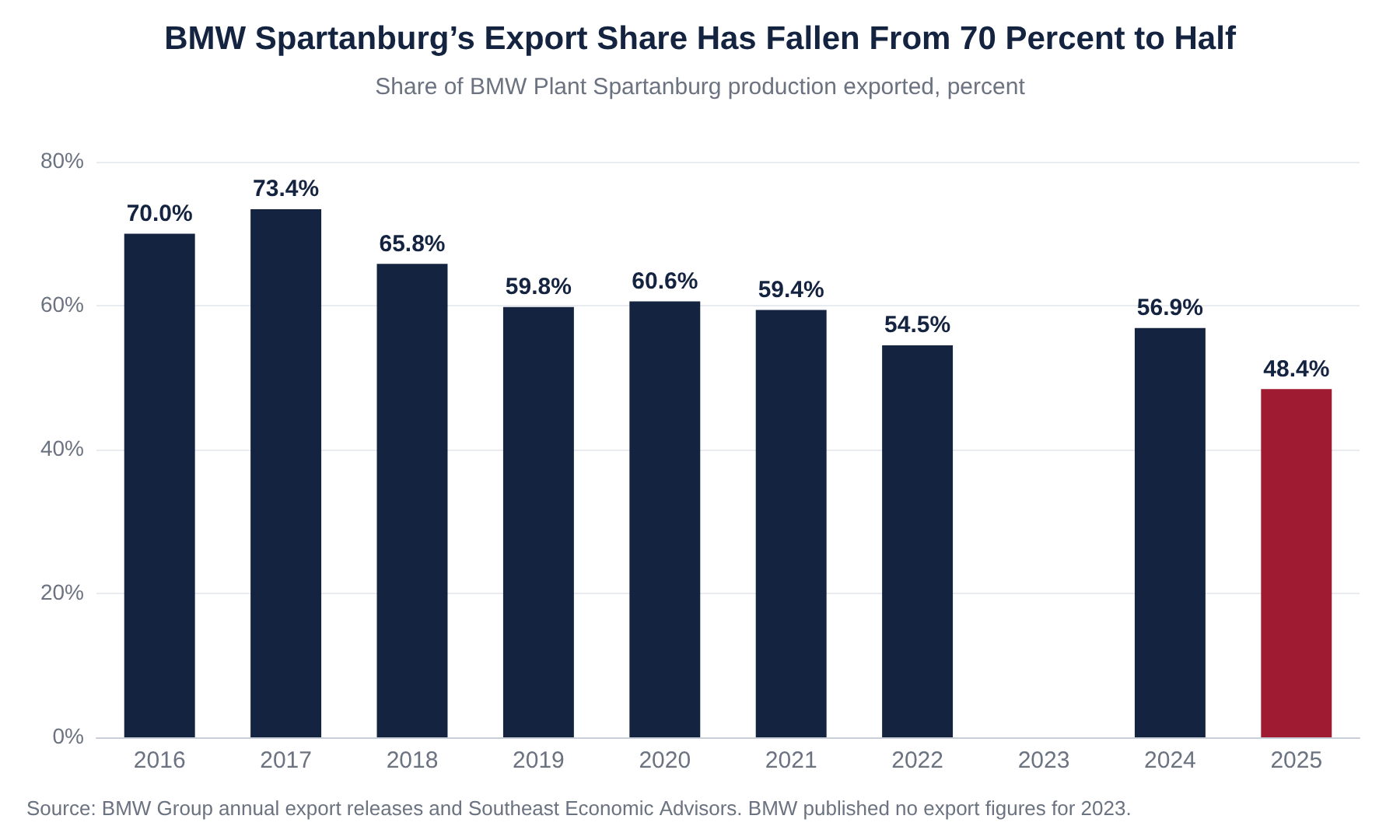
China explains most of the decline, and the most durable piece of it is the one least discussed. China was Spartanburg’s largest export destination at 24.1 percent of shipments in 2021, and BMW Group’s deliveries there have fallen 26 percent since then, to 625,527 last year, with the first half of 2026 down another 20 percent. China also placed 40 percent retaliatory tariffs on American-built vehicles in July 2018, after which Spartanburg’s exports fell 21 percent over four months. Demand and tariffs can both turn, however, and the third piece cannot. BMW moved the long-wheelbase X5 to Shenyang in April 2022 and said at the time that the freed Spartanburg capacity would go to American and global demand, which turns export volume into domestic sales permanently. BMW describes the Chinese market as extremely competitive for domestic and foreign manufacturers alike, so the share Chinese brands have taken from the German premium three, which outside estimates put at roughly half their 2020 position, is not a claim the company makes.
South Carolina has led the country in completed passenger vehicle exports for eleven straight years, which is why this shows up in the state’s numbers. It held 18 percent of all U.S. passenger vehicle export sales in 2025. Vehicle exports through the Port of Charleston fell 8.8 percent last year and loaded export containers 3.6 percent, declines that local reporting attributes to retaliatory tariffs and global trade uncertainty. State export sales still reached a seven-year high of $38.5 billion, up 1.5 percent, but on a 31 percent increase in aerospace exports out of North Charleston, and that is a Lowcountry gain set against an Upstate loss.
What BMW built around itself is the more durable asset. The plant draws on more than 500 South Carolina suppliers, 90 percent of them in the Upstate, and the region counts more than 250 automotive companies. After BMW and Michelin the largest are ZF’s transmission plant at Gray Court, Magna, Draexlmaier, AFL and Eaton, each employing more than a thousand people in the Upstate. Clemson opened its International Center for Automotive Research in Greenville in 2003, a 250-acre campus with more than twenty corporate partners that houses BMW’s Information Technology Research Center and the first automotive engineering degree programs in the country, which have granted more than a thousand degrees since 2007. The Clemson Composites Center works on lightweight transportation materials on the same campus, on a $5.8 million Department of Energy grant and under an endowed chair named for Bosch.
Michelin has run its North American on-vehicle test site at Laurens since 1977, and the cluster is rotating rather than shrinking. The proving ground covers roughly 3,300 acres and more than a dozen wet, dry and off-road tracks, and other vehicle manufacturers and Michelin’s own competitors rent it for cars, light trucks, heavy trucks and electric vehicles. Michelin has been headquartered in Greenville since 1985 and employs about 9,500 people in South Carolina across five plants. The Upstate did lose three automotive operations last year, a PPG coatings plant in Greenville, a Yokohama TWS tire plant in Spartanburg and part of the former Proterra battery works in Greer, roughly 295 jobs between them. Isuzu chose Greenville County in February 2025 for a $280 million commercial truck plant with more than 700 jobs, due to start production in 2027.
The largest new commitment in years is a rare earth plant, which is an industrial-policy story more than an automotive one. USA Rare Earth announced $1.2 billion and about 490 jobs at Bailey Park in Blacksburg, in Cherokee County, on June 3, producing neodymium magnets and refined rare earth metals, with operations targeted for April 2028. Suniva committed $350 million and 564 jobs in Laurens County in April. Neither sits along the established automotive corridor that runs from the BMW plant through Greenville-Spartanburg Airport and the Inland Port down I-85 toward Anderson and Clemson, and the Cherokee County site sits outside the Greenville-Anderson-Greer metropolitan area altogether, so it will never register in the payroll figures above.
Clemson has a new president after an unusual false start. We congratulate our friend Benjamin Ayers, who was previously the provost at the University of Georgia. Ayers was named president on July 9 and began on August 1 as Clemson’s sixteenth president, after Kevin Guskiewicz was selected in May and withdrew forty days later. Clemson’s most recent economic impact study, prepared by Econsult Solutions and presented to the trustees in February 2025, put the university’s statewide impact at $6.4 billion supporting 37,100 jobs, with $4.9 billion and 27,900 jobs in the Upstate itself.
Sources: U.S. Bureau of Labor Statistics, the U.S. Census Bureau, the South Carolina Department of Commerce, the Office of the Governor of South Carolina, the South Carolina Ports Authority, the South Carolina Department of Employment and Workforce, BMW Group, Michelin, Clemson University, the Upstate SC Alliance, Econsult Solutions, Redfin and Southeast Economic Advisors. Metropolitan and manufacturing totals are seasonally adjusted; the remaining industry detail and the unemployment rate are not. The Greenville County median is Redfin’s rolling three-month figure for the period ending June 2026.
Baton Rouge: The Fastest-Growing Metro in a Shrinking State
Baton Rouge payrolls reached 442,400 in July, up 14,200 (3.3 percent) over the year, double the pace of any other metropolitan area in Louisiana. Lafayette grew 1.6 percent over the same twelve months, Shreveport-Bossier City 0.4 percent, Houma-Bayou Cane-Thibodaux 0.3 percent and New Orleans-Metairie 0.2 percent. Construction employment rose 27.0 percent over the year, to 58,400, which is 12,400 of an unadjusted metro job gain of 15,600, so four-fifths of Baton Rouge’s growth over the past year is a single industry.
Louisiana lost roughly 40,000 residents between 2020 and July 2025, about 0.9 percent of its population, and only 14 of its 64 parishes gained. Baton Rouge is the exception, and the growth is suburban. Livingston Parish is up 9 percent since 2020, the fastest in the state, and Ascension Parish is up 7 percent, while East Baton Rouge Parish itself holds 456,180 residents, slightly below its 2020 count, though it has resumed adding people after pandemic-era declines.
The capital behind the job growth is concentrated in Ascension Parish, where roughly $10 billion of announced industrial investment is now going into the ground against a reported pipeline of about $24 billion. Hyundai Steel is building a $5.8 billion electric-arc-furnace mill in Donaldsonville with capacity of 2.7 million metric tons a year and more than 1,300 direct jobs at an average salary of $95,000, its first steel plant in North America. CF Industries, JERA and Mitsui broke ground on Blue Point One at Modeste on August 26, a $4.25 billion project counting the $3.7 billion joint venture and $550 million of shared infrastructure from CF, which will be the world’s largest low-carbon ammonia plant by nameplate capacity at 1.4 million metric tons a year, with about 3,900 construction jobs over four years and 103 permanent positions averaging $110,000.
The state’s two largest recent projects are nowhere near Baton Rouge, and both get attributed to it anyway. Meta’s data center campus in Richland Parish now exceeds $50 billion and five gigawatts, and the liquefied natural gas buildout is in Cameron and Plaquemines parishes. Richland Parish sits in the northeastern corner of the state and belongs to no metropolitan area at all, although some job gains from it might be booked at engineering firms and staffing companies operating in Baton Rouge.
Government employment fell 4.7 percent over the year through July, with state government down 7.3 percent, which is a real headwind in a capital city. Louisiana homeowners insurance averages $5,986 a year, moreover, the second-highest in the country behind Florida and more than double South Carolina’s $2,974, which gives back part of the difference between a median Baton Rouge home price of $249,875 and Greenville County’s $387,906. The $3,012 gap in annual premiums is $251 a month, real money against a price gap of $138,031. We expect Baton Rouge to keep outgrowing the rest of Louisiana while the Ascension Parish construction cycle runs, and the risk to that call is the completion of those projects without a follow-on pipeline behind them.
Sources: U.S. Bureau of Labor Statistics via FRED, the U.S. Census Bureau, Louisiana Economic Development, CF Industries, Insure.com, Redfin and Southeast Economic Advisors. Metropolitan totals are seasonally adjusted; industry detail is not. Insurance figures are Insure.com’s July 2026 quoted-rate estimates for a standard $300,000 dwelling policy, not average premiums paid. The Baton Rouge median is Redfin’s rolling three-month figure for the period ending July 2026.
What Five Billion Dollars Buys
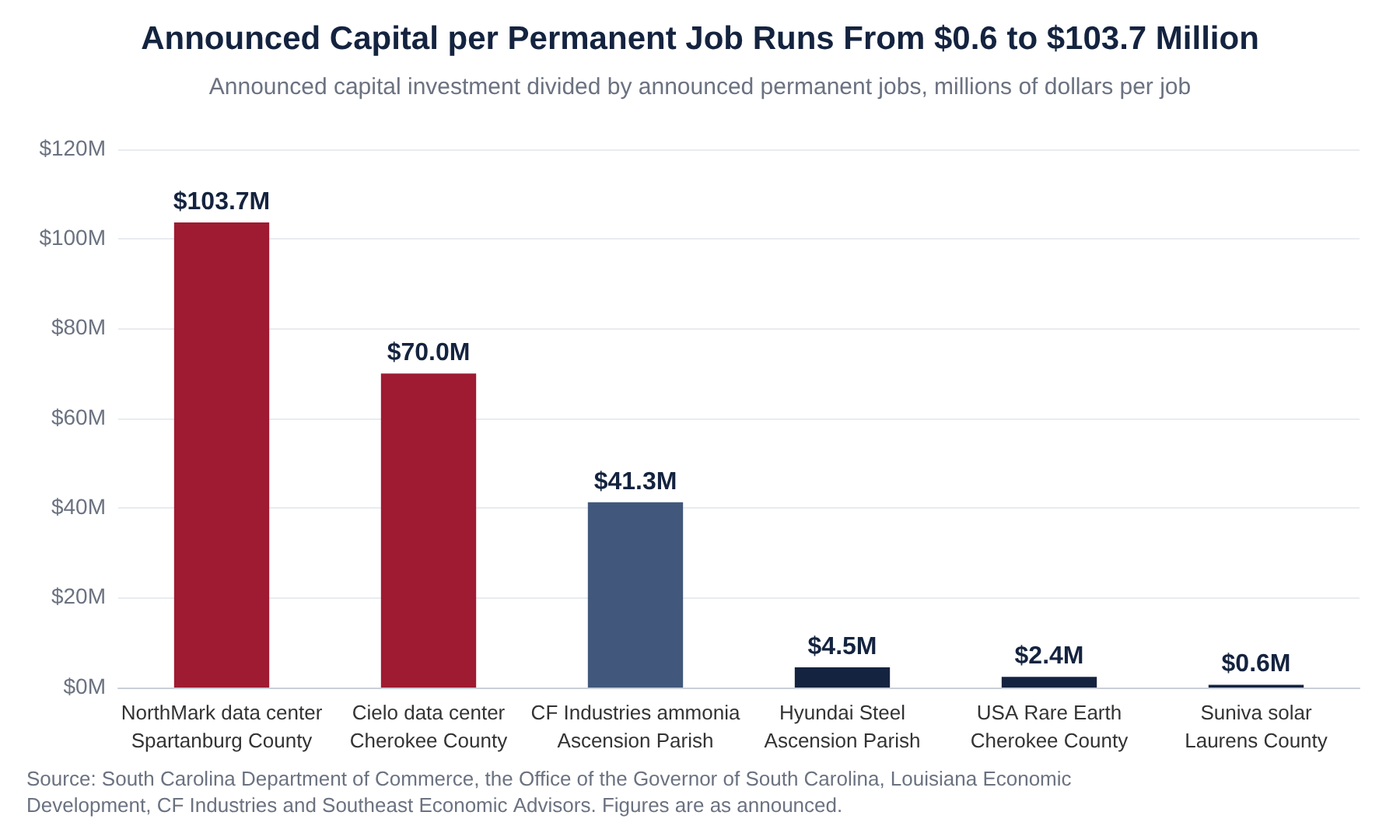
The two markets are competing for the same capital, and inside each of them the announced price of a permanent job now spans more than a hundredfold. Two data centers announced in the Upstate since the spring of 2025 committed $4.9 billion between them for 57 permanent positions. NorthMark Strategies is investing $2.8 billion in Spartanburg County for 27 jobs, in what the state calls a high-performance computing center, and Cielo Digital Infrastructure $2.1 billion in Gaffney for 30. That is $103.7 million and $70.0 million of announced capital per job respectively.
The manufacturing announcements in both markets sit at the other end of the range. USA Rare Earth’s Cherokee County plant works out to about $2.4 million per job and Suniva’s Laurens County solar plant to roughly $600,000. Hyundai Steel’s mill in Ascension Parish comes to about $4.5 million per direct job. CF Industries sits in between at $41.3 million, because a modern ammonia plant is enormously capital-intensive and runs with very few people, and it pays those few well, $110,000 on average against $95,000 at the steel mill.
The rise in capital per job is not confined to these six projects, and South Carolina’s own announcement totals show it plainly. The state announced $5.24 billion of capital investment and 18,445 jobs in 2017, which works out to $284,000 per announced job, and $5.40 billion against 15,457 jobs in 2013, or $349,000. At most $1.13 million now stands behind each announced job, on $9.12 billion and more than 8,100 jobs in 2025. The project count moved the same way, from 153 projects in 2021 to 81 in 2023 for 62 percent more capital. Spending on manufacturing structures roughly tripled nationally between 2019 and 2024, from $81 billion a year to $244 billion, while manufacturing employment averaged 12.79 million in 2024 against 12.78 million in 2019.
| Year | Announced capital | Announced jobs | Capital per announced job |
|---|---|---|---|
| 2013 | $5.40 billion | 15,457 | $349,000 |
| 2017 | $5.24 billion | 18,445 | $284,000 |
| 2020 | $4.00 billion | 11,147 | $359,000 |
| 2021 | $5.70 billion | More than 18,000 | Less than $317,000 |
| 2022 | $10.27 billion | 14,083 | $729,000 |
| 2023 | $9.22 billion | 14,120 | $653,000 |
| 2024 | $8.19 billion | More than 5,500 | Less than $1,489,000 |
| 2025 | $9.12 billion | More than 8,100 | Less than $1,126,000 |
Table 4. South Carolina’s announced industry recruitment. Figures are the state’s own totals at the time of announcement and are not reconciled to jobs actually created. Where the state reported jobs as “more than,” the per-job figure is an upper bound. Years shown are those for which both figures are published. Sources: South Carolina Department of Commerce, the Office of the Governor of South Carolina and Southeast Economic Advisors.
A data center’s capital shows up in the tax base rather than in payrolls, which does not make it a bad outcome. A data center brings a durable, high-value property assessment and a large electricity load, and in a county with a thin commercial tax base that is worth having. It is not an employment strategy, however, and a region that reports investment totals without reporting jobs alongside them is measuring the wrong thing. We expect announced capital in both markets to keep outrunning announced employment.
Note: capital and job figures are as announced by the companies and the state economic development agencies, and permanent job counts exclude construction employment. Announced projects do not always reach the announced totals. Sources: South Carolina Department of Commerce, the Office of the Governor of South Carolina, Louisiana Economic Development, CF Industries and Southeast Economic Advisors.
Two Economies, Side by Side
The two host economies are close in size and far apart in cost, and the table below sets the measures that matter side by side. Greenville-Anderson-Greer is the larger metro by population and payrolls and the more expensive place to own a house; Baton Rouge is growing twice as fast and sits in the core of a parish whose output is nearly eight times that of Clemson’s.
| Indicator | Greenville-Anderson-Greer, SC | Baton Rouge, LA |
|---|---|---|
| Nonfarm employment (July 2026) | 487,500 | 442,400 |
| Employment change, year ago | +9,100 (+1.9%) | +14,200 (+3.3%) |
| Unemployment rate (July 2026) | 3.7% | 4.1% |
| Metro population | 1,014,101 (2025) | 888,699 (2025) |
| Anchor county GDP (2024) | $6.019 billion (Pickens) | $47.132 billion (East Baton Rouge) |
| Median home sale price | $387,906 (Greenville County, three months through June 2026) | $249,875 (Baton Rouge, three months through July 2026) |
| Anchor university enrollment | 29,545 (Clemson, 2025-26) | 43,385 (LSU, fall 2025) |
| A note on comparability. These are not matched pairs. Clemson sits in Pickens County, a small county inside a metropolitan area anchored by Greenville, while LSU sits in East Baton Rouge Parish, which is the core of its own metro area, so the county GDP figures measure very different things. Metropolitan employment is seasonally adjusted and unemployment rates are not. The two home price medians are Redfin rolling three-month figures covering different geographies and different periods. The two universities’ economic impact studies are also not comparable: Clemson’s was prepared by an outside consultant and presented in February 2025, while LSU’s was prepared by its own economics department using fiscal 2021-22 data, published in March 2023, and covers the entire LSU System. | ||
Table 5. The two host economies. Sources: U.S. Bureau of Labor Statistics via FRED, U.S. Bureau of Economic Analysis, U.S. Census Bureau, Insure.com, Redfin, Clemson University, LSU and Southeast Economic Advisors.
The Bottom Line
Two programs that were 7-6 a year ago meet in a stadium that holds 102,321, and the more interesting divergence is inside the numbers behind them. Greenville and Baton Rouge have added employment at almost exactly the same pace since the start of 2023, roughly six percent each against 2.6 percent for the country, and they got there by different routes. Baton Rouge is running on an industrial construction cycle in Ascension Parish that supplied most of its job growth over the past year. The Upstate has added 34,400 jobs since the summer of 2022 with a manufacturing base 0.3 percent below where it started.
Both markets are also learning that announced capital and announced jobs have come apart. $4.9 billion of Upstate data center investment will directly employ just 57 people, and a $4.25 billion ammonia plant in Ascension Parish will employ 103. At most $1.13 million of announced capital now stands behind each announced job in South Carolina, against $349,000 in 2013 and $284,000 in 2017. The change in what industrial recruitment delivers is real, and it argues for economic developers reporting payroll outcomes next to investment totals rather than in place of them.
We expect Baton Rouge to keep outpacing the rest of Louisiana while the Ascension Parish projects are under construction, and the Upstate to keep growing on services while its manufacturing base holds flat. That first call ends with the construction cycle unless a second wave of projects is permitted behind it. The second turns on BMW, whose export share has already fallen from 70 percent of output to half and whose June guidance cut is the clearest risk either market carries into 2027.
Mark Vitner
Chief Economist, Southeast Economic Advisors
About this report
This Week One preview is published by Southeast Economic Advisors and pairs an on-field preview with an economic outlook for the two communities that host the participating universities. Economic figures come from the U.S. Bureau of Labor Statistics, the U.S. Bureau of Economic Analysis, the U.S. Census Bureau and the sources cited in each section, and are subject to revision. Metropolitan employment totals are seasonally adjusted; industry detail and unemployment rates are not. Football statistics reflect the completed 2025 season and the Week Zero games of August 29, 2026. Polls and betting lines are as of September 3, 2026 and move daily; the Associated Press publishes its first in-season poll on Sunday, September 6.
This material is provided for informational and educational purposes only and does not constitute investment, legal, tax or financial advice, nor a recommendation regarding any security or wagering market. Opinions reflect our judgment as of the publication date and are subject to change. Figures are drawn from sources we believe to be reliable, but their accuracy and completeness are not guaranteed.
© 2026 Southeast Economic Advisors. All rights reserved.