
SOUTHEAST ECONOMIC ADVISORS
Sports Economics | Regional Report
Two Washingtons
The Boeing Apple Cup Opens a Season for the First Time
A Week One preview and economic outlook for Pullman and Seattle
Washington State visits Washington at Husky Stadium on Sunday, September 6 at 1:00 p.m. Pacific time on NBC, the first time in the rivalry’s 117-year history that these two schools have opened a season against one another. The Apple Cup has traditionally been a Thanksgiving-week finale, which is roughly seven of every ten meetings. It was moved to Sunday of Labor Day weekend as a national television lead-in, and Washington is favored by between 22.5 and 23.5 points depending on the book.
The game is at Husky Stadium rather than Lumen Field, which hosted the rivalry only in 2024 and 2011. The current agreement runs through at least 2028, with Seattle hosting in even years and Pullman in odd ones. Washington leads the all-time series 77-34-6, is 44-18 in the games played for the Apple Cup itself since 1963, and won 59-24 in Pullman last September.
The economic distance between these two schools is now a distance between two conference media contracts, and it runs straight into the two towns. Washington received $46.7 million from the Big Ten in fiscal 2025 as a half-share member. Washington State’s rebuilt Pac-12 is projected at less than half of what Washington collects even at a reduced share. Pullman is the fastest-shrinking city in the state and Seattle is a metro that has added almost no jobs in three years, which we will discuss separately from the matchup.
The game’s title sponsor is carrying more of this report than a sponsor usually does. Boeing extended its title sponsorship of the rivalry for five more years in June 2024, and it is the one large employer in the region adding factory jobs this fall. It is also five weeks from a possible strike by the engineers and technical staff who design its airplanes, which is the single largest risk to the Seattle forecast in this report.
At a Glance
- Labor Day. Pullman took its name from George Pullman in 1881. His company town outside Chicago produced the strike of 1894, and Labor Day became a federal holiday in the middle of it, six days before the troops went in.
- Week Zero. North Carolina beat TCU 15-10 in Dublin as a 7.5-point underdog, the only upset on an eight-game slate. Two programs played their first games in the Football Bowl Subdivision.
- The game. Sunday, not Saturday, and at Husky Stadium rather than Lumen Field. Washington is favored by 22.5 to 23.5 points with the total at 50.5. Kirby Moore coaches his first game for Washington State.
- The money gap. Washington collected $46.7 million from the Big Ten in fiscal 2025 against a full-share average of $79.7 million. Washington State’s rebuilt Pac-12 is projected at $8 million to $12 million a school.
- Both departments. Washington State moved $20 million of university money into athletics in March. Washington is covering a $19 million cash-flow gap with a Big Ten advance and a loan from the university’s capital assets pool.
- Pullman. The city lost 520 residents (1.5 percent) in the year to April, the largest decline of any city in Washington. Washington State Pullman enrollment is down 22 percent from its 2019 peak.
- Seattle. Metro payrolls have risen 0.9 percent since January 2023 against 2.6 percent nationally. Downtown office vacancy is near 35 percent, the weakest major market in the country.
- The contrast. Government is 34.4 percent of Whitman County’s (Pullman) real output and 5.7 percent of King County’s (Seattle). Both universities are under financial stress and only one county can handily absorb it.
Pullman, the Strike and the Holiday This Game Is Played On
The visiting team comes from a town named for a Chicago railcar magnate, and the game is played on the weekend of a holiday his company had a hand in creating. The settlement at the confluence of Missouri Flat Creek, Dry Creek and the South Fork of the Palouse River was known as Three Forks until 1881, when a group of local men settled on the name Pullman, after George M. Pullman, whose Palace Car Company was then the most famous manufacturer in American railroading. The post office application went in that September, the town incorporated on April 11, 1888 with 250 to 300 residents, and the state put its land-grant college there two years after that.
One local legend is that Pullman sent $50 toward a Fourth of July celebration and a grateful town renamed itself, but that story has never been verified. HistoryLink, the state’s historical encyclopedia, finds that George Pullman had nothing to do with the town in 1881 or at any time afterward, and that the name was chosen to attract business and a railroad. It was an inducement rather than a thank-you, and it did not work in the way its authors intended.
Thirteen years later the name acquired a second meaning, and a worse one. In the spring of 1894 the Pullman Palace Car Company cut wages at its model company town south of Chicago without cutting the rents it charged those same workers to live there, and on May 11 they walked out. The American Railway Union under Eugene Debs took up a national boycott of Pullman cars on June 26. President Cleveland sent federal marshals and roughly 12,000 Army troops into Chicago on July 3 and 4, over the objection of Illinois Governor John Peter Altgeld. About 30 strikers were killed in Chicago and the strike collapsed by July 20.
Labor Day became a federal holiday in the middle of that episode rather than after it, which is where the usual telling goes wrong. Congress passed the bill and Cleveland signed it on June 28, 1894, two days after the boycott began and five days before the troops reached Chicago. Twenty-three states had already adopted the holiday by then, Oregon first in 1887, and Cleveland had preferred a September date since that year, in part because May 1 carried the memory of Haymarket. The holiday was largely intended as conciliation toward organized labor, which had at times been treated harshly, though the familiar version in which it followed the suppression of the strike has the sequence backwards.
The coincidence is worth a paragraph because this report ends up in the same place by a different route. A preview of a game in a town named for the most famous labor dispute in American industrial history spends its second half on an aerospace contract that expires on October 6, and on a chart measuring what the last Puget Sound walkout cost the state’s largest metro. Neither the name nor the timing was planned.
Sources: HistoryLink.org, the city of Pullman, the U.S. Department of Labor and Southeast Economic Advisors.
Week Zero: How the Season Opened
Week Zero delivered eight games, two programs playing their first game in the Football Bowl Subdivision and exactly one upset, which happened to be the game we previewed. North Carolina beat TCU 15-10 in Dublin as a 7.5-point underdog. Every other favorite on the slate won, and the only other game with a Power Four team on both sides was a rout.
We wrote last week that we expected the line to hold near a touchdown, and it did not. The condition we attached to that call was whether North Carolina’s rebuilt front would give Jaden Craig less time than TCU’s defense gave the Tar Heels a year ago, and something close to that happened, though the pressure came from the other side of the ball. Xavier Lewis recorded 4.5 tackles for loss and two sacks, and TCU gained 111 rushing yards in the first half and 26 in the second.
Neither team scored a touchdown after the first quarter, and North Carolina won with 15 points from an offense that averaged 19.3 a game a year ago. Billy Edwards Jr. went 16 of 28 for 232 yards with no touchdowns and no interceptions in his first start for the Tar Heels, and TCU took eleven penalties for 89 yards against North Carolina’s 20. No attendance figure was announced for Dublin, where the 2025 game drew 47,226 and organizers promoted a third consecutive sellout, and we would not assume that last year’s €132 million impact estimate repeats.
| Game | Result | Note |
|---|---|---|
| North Carolina vs. TCU, Dublin | North Carolina 15, TCU 10 | The only upset; UNC won outright as a 7.5-point underdog |
| San Jose State at No. 14 USC | USC 42, San Jose State 26 | The only ranked team in Week Zero action |
| NC State at Virginia | Virginia 34, NC State 8 | The most lopsided result; the relocated Rio de Janeiro game |
| Jacksonville State at North Dakota State | North Dakota State 33, Jacksonville State 7 | North Dakota State’s first game as an FBS program |
| Sacramento State at Eastern Michigan | Eastern Michigan 28, Sacramento State 17 | Sacramento State’s first game as an FBS program |
| Hawai’i at Stanford | Stanford 37, Hawai’i 27 | Hawai’i cut a 16-point deficit before Stanford closed it |
| New Mexico State at Florida State | Florida State 34, New Mexico State 17 | |
| Memphis at UNLV | Memphis 27, UNLV 21 | 31,384 at Allegiant Stadium; Charles Huff’s debut at Memphis |
Table 2. Week Zero results, Saturday, August 29, 2026. Sources: ESPN, the Associated Press, school athletics and Southeast Economic Advisors.
Two programs played their first games as members of the Football Bowl Subdivision, which is the structural story of the weekend. North Dakota State, which won nine national championships across 22 seasons in the Football Championship Subdivision, opened its Mountain West era by beating Jacksonville State 33-7 and extended its home-opener winning streak to 28 games. Sacramento State made the same jump and lost 28-17 at Eastern Michigan. Week Zero has grown from four games in 2024 to five in 2025 and eight this year, and we expect it to keep growing as long as programs value a standalone national television window more than a September home date.
A Sunday Apple Cup
| Washington State Cougars | Washington Huskies | |
|---|---|---|
| Conference | Pac-12 (rebuilt, launched July 2026) | Big Ten |
| Head coach | Kirby Moore (1st season) | Jedd Fisch (3rd season) |
| 2025 record | 7-6, won Famous Idaho Potato Bowl | 9-4, won LA Bowl |
| 2026 preseason AP poll | Unranked | No. 17 |
| 2026 starting quarterback | Caden Pinnick (UC Davis transfer) | Demond Williams Jr. |
| Home stadium | Martin Stadium (32,952) | Husky Stadium (70,138) |
| Last meeting | Lost 59-24 (2025, at Pullman) | Won 59-24 (2025, at Pullman) |
| Sunday | Visiting team, 22.5-point underdog | Home team, 22.5-point favorite |
Table 3. The tale of the tape. Sources: ESPN, the Associated Press preseason poll of August 17, 2026, school athletics and VegasInsider. The consensus betting line was captured September 2, 2026. No in-season Associated Press poll has been published yet; the first follows this weekend.
Washington opens at No. 17 and a favorite of between 22.5 and 23.5 points depending on the source, with the total at 50.5, which is the widest Apple Cup spread in recent memory and a fair reflection of where the two programs now sit. The number has held within a point since it was posted. Washington went 9-4 last season including a 38-10 win over 2026 Pac-12 favorite Boise State in the LA Bowl, and Jedd Fisch returns quarterback Demond Williams Jr. for a third season together.
Washington State is coming off a 7-6 season and is breaking in a new head coach, its third in three seasons. Kirby Moore took over after Jimmy Rogers left for Iowa State following a single year in Pullman, and Caden Pinnick, a UC Davis transfer, was named the starting quarterback the week of August 24. Thirty-seven players left through the transfer portal after last season, roughly a dozen of them following Rogers to Iowa State.
Washington will play the opener without its center, which is the one roster change of consequence since the line was posted. Landen Hatchett, a senior captain who broke his snapping wrist against Illinois last October, was ruled out on September 1 and is the only Washington player unavailable. Kolt Dieterich, a transfer from Sam Houston State, starts in his place, and Fisch expects Hatchett back at some point in September. A new center on one side and a quarterback who has never taken a snap in the Football Bowl Subdivision on the other is the sort of detail that decides whether three touchdowns is the right number.
The rivalry survived realignment on a five-year continuation the two schools signed in November 2023, which runs through at least 2028 and was not a given when Washington joined the Big Ten in 2024 and left Washington State behind. We expect the line itself to hold near three touchdowns into Sunday, and the condition that would break that view is a Washington State defense that keeps the game inside two possessions into the fourth quarter.
Key Players to Watch
Washington returns its quarterback and almost nothing else on offense, because both of its 2025 statistical leaders are gone. Denzel Boston, who caught 62 passes for 881 yards and 11 touchdowns, declared for the NFL draft, and Jonah Coleman, who ran for 758 yards and scored 17 total touchdowns, is off the roster. The leading returning rusher has four carries to his name.
Washington State is starting over more completely than that, with a first-year head coach, a new coordinator staff and 37 players who left through the transfer portal after last season. Kirby Moore arrived from Missouri, where he was the offensive coordinator, on a five-year deal signed December 12. His defensive coordinator, Trent Bray, is the former head coach at Oregon State. Caden Pinnick, who has never taken an FBS snap, starts at quarterback.
| Player | Team | Why Sunday matters |
|---|---|---|
| Demond Williams Jr., QB | Washington | Threw for 3,065 yards with 25 touchdowns and 8 interceptions in 2025 and added 611 rushing yards. He signed a reported $4 million agreement with the university on January 2, entered the transfer portal on January 6 and withdrew on January 8. |
| Caden Pinnick, QB | Washington State | Threw for 3,206 yards and 32 touchdowns at FCS UC Davis as a redshirt freshman. Sunday is his first start at the FBS level, and his fall camp was uneven, including a scrimmage with three interceptions. |
| Kolt Dieterich, C | Washington | The Sam Houston State transfer starts in place of Landen Hatchett, who was ruled out on September 1. A new center calling protections against the pass rush that dominated Washington State’s fall camp is the game’s quietest matchup. |
| Dezmen Roebuck, WR | Washington | Caught 42 passes for 560 yards and 7 touchdowns as a true freshman with one drop on 59 targets. He moves to the slot this season and is now the leading returning receiver. |
| Alex McLaughlin, S | Washington | Roughly 90 tackles, two interceptions and six pass breakups in 2025, with 23 career starts, and a 2026 captain. No Washington defender made the Bednarik preseason watch list this year. |
| Jacob Manu, LB | Washington | The defense’s signal-caller and a fifth-year captain who posted a Pac-12-high 116 tackles with 9.5 for loss and 6.5 sacks at Arizona in 2023. |
| Kirby Vorhees, RB | Washington State | Washington State’s leading returning rusher with 576 yards and 5 touchdowns, plus 19 catches, and the third-highest offensive grade on the team. He entered the portal in January and returned. |
| Tony Freeman, WR | Washington State | 54 catches for 590 yards in 2025 and the highest-graded Cougar on offense. With Joshua Meredith out of eligibility, he is Pinnick’s most established target. |
| McLain and Zunk, EDGE | Washington State | The transfer pass rush and the standouts of fall camp. Matyus McLain had 4.5 sacks and 13.5 tackles for loss at Idaho, and Linus Zunk had 5 sacks at Vanderbilt. |
| Quaid Carr, RB | Washington | Atop the depth chart with four career carries, replacing a back who scored 17 touchdowns. Washington is expected to rotate four backs, including Oregon transfer Jayden Limar. |
Table 4. Key players to watch. Sources: ESPN, Pro Football Focus, the Spokesman-Review, school athletics and Southeast Economic Advisors. Statistics reflect the completed 2025 season. Depth charts were published September 1, 2026.
The Rest of Week One: The Top Ten Is Playing Almost Nobody
Only one game on the Week One slate pairs two ranked teams, and it is Louisville against Ole Miss on a neutral field in Nashville on Sunday night. Opening weekend a year ago carried three such matchups. Louisville is ranked in the preseason for the first time since the Lamar Jackson era, and Ole Miss at No. 9 draws a schedule with few early tests, which makes a 7-point spread the tightest meaningful line of the weekend.
Six of the preseason top ten open against opponents they are favored to beat by four touchdowns or more. Ohio State hosts Ball State as a 50.5-point favorite, Oklahoma hosts UTEP by 41.5, Texas A&M hosts Missouri State by 40.5 and Indiana hosts North Texas by 40.5. Only Oregon, Notre Dame, Miami and Ole Miss face opponents of consequence. The guarantee game is a straightforward transaction, in which a Power Four program buys a seventh or eighth home date and the visiting athletic department books a fee it cannot earn any other way, and the expanded playoff has made the schedule-strength cost of that transaction smaller than it used to be.
| Game | Day and time | TV | Line |
|---|---|---|---|
| No. 7 Miami at Stanford | Friday, 9:00 p.m. | ESPN | Miami -24.5 |
| Fresno State at No. 14 USC | Friday, 9:00 p.m. | FOX | USC -22.5 |
| Toledo at Michigan State | Friday, 8:00 p.m. | FS1 | Michigan State -9.5 |
| Baylor vs. Auburn, Atlanta | Saturday, 3:30 p.m. | ABC | Auburn -7.5 |
| Boise State at No. 2 Oregon | Saturday, 3:30 p.m. | CBS | Oregon -24.5 |
| Clemson at No. 11 LSU | Saturday, 7:30 p.m. | ABC | LSU -10.5 |
| Washington State at No. 17 Washington | Sunday, 4:00 p.m. | NBC | Washington -23.5 |
| No. 24 Louisville vs. No. 9 Ole Miss, Nashville | Sunday, 7:30 p.m. | ABC | Ole Miss -7 |
| Wisconsin vs. No. 4 Notre Dame, Green Bay | Sunday, 7:30 p.m. | NBC | Notre Dame -20.5 |
| No. 19 SMU at Florida State | Monday, 7:30 p.m. | ESPN | SMU -3.5 |
Table 5. Selected Week One games, September 4 through 7, 2026. All times Eastern. Sources: VegasInsider, College Football News, the Associated Press preseason poll of August 17, 2026 and Southeast Economic Advisors. Betting lines are the Las Vegas board as of September 2, 2026, move daily and differ by a point or so across books.
Two of these games will reorder narratives by Monday morning, beginning with Clemson, which enters unranked for the first time in fifteen years and is a 10.5-point underdog at LSU. A Clemson win reorders the Atlantic Coast Conference immediately and a blowout confirms the voters. And Notre Dame plays Wisconsin at Lambeau Field, which is the sort of neutral-site arrangement that has replaced the traditional home-and-home for programs with national followings. We expect the Louisville and Ole Miss result to move the Associated Press poll more than any other game this weekend, unless one of the four ranked-versus-unranked games with a spread inside two touchdowns goes the other way.
The Money Gap Is the Whole Story
Washington received $46.7 million from the Big Ten in fiscal 2025 as a half-share member, against a full-share average of $79.7 million. That is a gap of roughly $30 million a year and about $180 million across the six-year phase-in, and full shares are expected to clear $100 million in fiscal 2026. Washington is, in other words, still the poor relation inside the richest conference in the country, and it is about to stop being one.
Washington State’s rebuilt Pac-12 launched on July 1 and its media arrangement is now partly public, though the money is not. The CW is the primary broadcast partner in a five-year package running through the 2030-31 season, carrying 13 regular season football games a year alongside a basketball slate, with CBS and CBS Sports Network taking additional games and everything simulcast on the ESPN app. The conference has not disclosed the value, and press projections put it at $8 million to $12 million a school, which should be read as estimates rather than published terms. Washington State’s College Football Playoff distribution does rise from about $350,000 to $3.6 million a year for 2026 through 2028, a tenfold increase that still leaves it a fraction of the roughly $22 million that Southeastern Conference and Big Ten schools collect.
The consequence arrived in March, when Washington State’s regents approved diverting $20 million of university money to close an athletics shortfall. The gap opened when the Pac-12 dissolution settlement funds ran out and the replacement media deal came in materially lower, and it followed a $9 million athletics budget reduction in 2025 that produced 32 layoffs. An athletic department that needs a transfer from the academic side is a cost to the university rather than a contributor to it, and that is a new condition in Pullman.
The half share is not only Washington State’s problem, because Washington’s athletic department is running a deficit of almost exactly the same size. Washington projected roughly $19 million of negative cash flow in fiscal 2026, the second consecutive year of a shortfall that size, and it is bridging the gap with a $10 million interest-free advance against future Big Ten distributions and borrowing of up to $17.7 million from the university’s capital assets pool. Both athletic departments are now drawing on money that is not theirs. What separates them is what happens next. Washington is borrowing against a distribution scheduled to roughly double, with playoff revenue alone rising above $21 million a year from fiscal 2027 against a $5.5 million baseline. Washington State is spending university money against a media contract that is not going to grow.
| Washington State | Washington | |
|---|---|---|
| Conference | Pac-12 (rebuilt) | Big Ten (half share through the phase-in) |
| Conference media revenue | $8 million to $12 million a school, projected | $46.7 million in fiscal 2025, against a $79.7 million full-share average |
| Playoff distribution | About $3.6 million a year for 2026 through 2028, up from about $350,000 | Above $21 million a year from fiscal 2027, against a $5.5 million baseline |
| The shortfall | $20 million, approved by the regents in March 2026 | About $19 million of negative cash flow projected for fiscal 2026 |
| How it is covered | A transfer of university money, after a $9 million budget cut and 32 layoffs in 2025 | A $10 million interest-free Big Ten advance and up to $17.7 million borrowed from the university’s capital assets pool |
| What changes it | Nothing on the schedule | Full Big Ten shares at the end of the phase-in |
Table 6. Two athletic departments, two kinds of shortfall. Sources: conference financial reports, Sportico, the Spokesman-Review, university budget documents and Southeast Economic Advisors. Pac-12 per-school media figures are press projections, not disclosed contract terms.
Pullman: The Fastest-Shrinking City in Washington
Pullman lost 520 residents in the year to April 1, a decline of 1.5 percent to 33,860, the largest of any city in Washington. Whitman County fell 450 to 49,000, also the state’s largest county-level loss. The county carried 19,190 nonfarm jobs in July with an unemployment rate of 4.0 percent, and the average annual wage was $64,503 in 2024.
The cause is enrollment, which has fallen 22 percent from its peak. Washington State enrolled 16,248 students on the Pullman campus in the fall of 2025 against 20,976 in the fall of 2019, a loss of 4,728. Systemwide enrollment fell from 31,607 to 25,477 over the same period. The decline is decelerating, with Pullman off only about 200 in the most recent year, but a university town does not recover its lost population until the university recovers its students.
Washington State trimmed its core fund budget by $17 million, or 4.1 percent, for fiscal 2026, and must find about $12 million more for fiscal 2027, with Washington State Vancouver alone assigned a cut of more than $6 million. That is cutting into muscle rather than fat. Resident undergraduate tuition and fees of $13,888 are the highest among Washington’s public universities, and state support has fallen from 66 cents to 56 cents per dollar of assessed need.
The offsetting local capital is a hospital rather than an employer of scale, and Pullman Regional is building a $45 million to $50 million expansion across three phases targeting 2027, funded by a $27.5 million bond voters approved in 2022. It employs more than 600 people as the region’s third-largest employer. Schweitzer Engineering Laboratories, the employee-owned grid protection manufacturer headquartered in Pullman, is the only significant private counterweight in the county.
We expect Whitman County employment to stay roughly flat while Washington State’s enrollment stabilizes, and we would change that call on a further round of budget cuts deep enough to reach instructional staffing. The state legislature spared the university the worst this year, cutting roughly $1 million against a proposed 3 percent reduction, but the university’s own math still requires $12 million from somewhere in fiscal 2027.
Sources: the Washington Office of Financial Management and Employment Security Department, the U.S. Bureau of Economic Analysis, Washington State University, the Spokesman-Review and Southeast Economic Advisors.
Seattle: A Large Economy That Has Stopped Adding Jobs
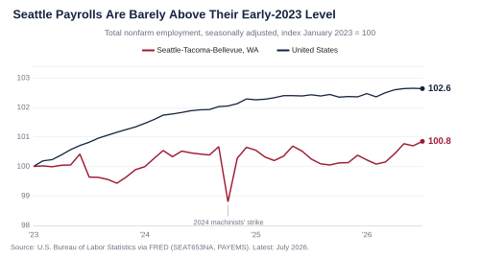
Seattle metropolitan payrolls reached 2,136,900 in July, up 12,800 (0.6 percent) over the year, and they have risen only 0.9 percent since the start of 2023 against 2.6 percent for the country. For an economy that spent two decades as one of the fastest-growing large metros in America, three years of essentially flat employment is the more important fact than any single company’s headcount.
The state as a whole had a better July than its largest metro. Washington’s unemployment rate fell to 5.0 percent from 5.2 percent in June and the state added 21,100 jobs, a third consecutive monthly gain, with private employment up 22,500 and government down 1,400. The largest gains were in education & health services, leisure & hospitality, professional & business services and retail trade. That is a service-economy list rather than a technology one, which is the pattern of a state growing around its signature industries rather than through them.
The University of Washington has overtaken Amazon as Seattle’s largest employer, which is a statistic about Amazon rather than about the university. The university employs more than 50,000 people in the city. Amazon’s Seattle headcount has fallen below 50,000 from a peak of 60,000 in 2020, its Bellevue headcount has more than quadrupled to 15,000, and its total Washington employment declined in 2025 for the first time in the company’s history.
Layoffs have been concentrated in the firms that define the region, and Amazon has cut 30,000 positions since October including 16,000 corporate roles, of which 2,198 were in Washington. Microsoft cut 4,800 globally on July 6, including 600 in Washington, after roughly 15,000 the year before. Downtown office vacancy reached a record 34.7 percent in the fourth quarter of 2025 on CBRE’s measure, roughly five times the pre-pandemic rate and the weakest major market in the country, and Kidder Mathews put total vacancy in the Seattle central business district at 34.9 percent in the second quarter of this year, with Class A asking rents down to $40.29 a square foot from $40.60. The two firms do not measure the same footprint and the levels are not strictly comparable, but the direction is the same in both. The city has cut its payroll expense tax forecast by more than $50 million over three years.
The University of Washington is absorbing a federal research shock that would be existential almost anywhere else. It receives more federal research support than any other public university in the country, about $1.4 billion in 2025 and roughly 80 percent of its total research funding. In the year through June, UW Medicine’s federal funding fell nearly 20 percent, new health research awards fell 50 percent and cash actually received fell 74 percent, and doctoral admissions at UW Medicine are down about a third for a second consecutive year.
Two things are still expanding and both are physical: the Federal Aviation Administration approved a 737 MAX production increase from 42 to 47 aircraft a month on May 27, and Boeing opened a $1 billion final assembly line in Everett in July. Boeing has been recruiting roughly 140 factory workers a week to staff it. The artificial-intelligence investment cycle, meanwhile, is landing across the lake in Bellevue rather than in Seattle.
The risk to that one expanding piece of the economy is a labor dispute, and it is five weeks away. The Society of Professional Engineering Employees in Aerospace represents about 17,000 Boeing white-collar workers, roughly 13,000 engineers and scientists and 4,000 technical staff, most of them in the Puget Sound region. They rejected the company’s best-and-final offer on August 21, by 64.3 percent in the professional unit and 71.9 percent in the technical unit, and authorized a strike by 87.9 and 89.7 percent. The contract expires October 6 and a walkout could begin October 7. Talks resume September 8. Figure 1 shows what the last Puget Sound aerospace strike did: the machinists’ walkout in the autumn of 2024 pulled the Seattle payroll index more than a point below its January 2023 level in a single month.
We expect Seattle payroll growth to stay below one percent through 2027, and the condition that would change that view is a return of net corporate hiring at Amazon and Microsoft rather than further AI capital spending. Washington’s repeal of its data center tax preference on July 1 and its new 9.9 percent tax on household income above $1 million, effective in 2028 and already under constitutional challenge, both cut against that recovery at the margin. A long engineers’ strike would push that forecast lower rather than change its shape, because the payroll losses in an aerospace walkout come back when the workers do.
Sources: U.S. Bureau of Labor Statistics via FRED, the Washington Employment Security Department, CBRE, Kidder Mathews, GeekWire, Leeham News, the Spokesman-Review, the University of Washington, Redfin and Southeast Economic Advisors. The Seattle median sale price is Redfin’s June reading.
One County Has an Absorber and One Does Not
| Indicator | Whitman County, WA | King County, WA |
|---|---|---|
| Total nonfarm jobs | 19,190 (July 2026) | 1,488,200 (July 2026) |
| County GDP (2024) | $3.378 billion | $477.154 billion |
| Government share of real output (2024) | 34.4% | 5.7% |
| University employees | About 5,000 | More than 50,000 |
| University share of county jobs | About a quarter to 30% | About 3 to 4% |
| Population | 49,000 (April 2026) | 2,424,700 (April 2026) |
| Students as a share of city population | 48% | 6.4% |
| A note on comparability. The government share of real output is the cleanest of these measures, because it comes from the Bureau of Economic Analysis and avoids the definitional question of who counts as a university employee. The state’s published figure that 30 percent of Whitman County employment is at Washington State appears identically in its current profile and its March 2022 edition, so we use a range against a bottom-up estimate of 26 percent. The two universities’ impact studies are also not comparable, being four years apart in vintage and prepared by different consultants. | ||
Table 7. Two counties, two dependencies. Sources: U.S. Bureau of Economic Analysis, the Washington Employment Security Department, the Washington Office of Financial Management, Washington State University, the University of Washington and Southeast Economic Advisors.
The Bottom Line
Both of these universities are under financial stress, and the difference between the two towns is not the severity of the stress but whether anything else is there to absorb it. Washington State’s is local and revenue-driven: enrollment down 22 percent, an athletic department that needed a $20 million transfer from the academic side, and a city shrinking faster than any other in the state. Washington’s is federal and sectoral: a 20 percent cut to UW Medicine’s federal funding and half as many new health research awards.
King County can take that hit because the university is 3 to 4 percent of its jobs and government is 5.7 percent of its output. Whitman County cannot, because the university is roughly a quarter of its jobs and government is 34.4 percent of its output. That is the whole argument, and it is why a conference realignment decision made in 2023 shows up in Washington’s April population estimates.
We expect Whitman County employment to stay roughly flat and Seattle payroll growth to stay below one percent through 2027. The first call breaks on a Washington State enrollment recovery and the second on net corporate hiring returning at Amazon and Microsoft. Neither is visible in the data yet. The nearer question is the one on Boeing’s calendar rather than the football schedule: the title sponsor of Sunday’s game has five weeks to settle with the people who design its airplanes.
The Outlook for Sunday: What Would Make This a Game
A point spread and a total are two equations in two unknowns, and this pair solves to Washington 36.5, Washington State 14. That is the market’s expectation, not a prediction of the final score, but it frames the question correctly. Washington State does not have to win on Sunday for the afternoon to mean something. It has to make the second half matter, which last year’s 59-24 in Pullman never did.
We think this game will be closer than the number, though not for the reason usually given, which is tempo. Kirby Moore’s offenses at Missouri finished 9th, 20th and 44th nationally in scoring and played fast, and tempo is the identity he was hired to bring to Pullman. Tempo buys possessions, however, and every additional possession is one more chance for the better team to be the better team. An underdog is helped by a small sample rather than a large one. Moore will have to decide early whether he is coaching the season or coaching this game, and the case for Washington State on Sunday rests on the pass rush and on how little Washington knows about this offense.
| Key | Why it matters | What to watch |
|---|---|---|
| Pressure with four | Washington starts a transfer center in place of its captain, and Demond Williams Jr. ran for 611 yards last season. Blitzing a mobile quarterback opens the throwing lanes that blitzing was meant to close. | Sacks and hurries generated without a fifth rusher, and whether Trent Bray keeps a spy on Williams |
| Make Washington run it | Denzel Boston and Jonah Coleman are gone and the leading returning rusher has four career carries. A four-back rotation on opening day is a tryout Washington has not had time to settle. | Washington yards per carry in the first quarter, and how quickly Jedd Fisch abandons the run |
| Give the ball away zero times | Caden Pinnick makes his first start in the Football Bowl Subdivision on the road in front of 70,138. He threw 10 interceptions at UC Davis and had a three-interception scrimmage in camp. | Turnover margin at halftime, and Washington State’s starting field position |
| Shorten the game | The total is 50.5. Fewer possessions compress the range of outcomes, which is the only mechanism available to a three-touchdown underdog. | Third-down conversion rate, time of possession, and whether Tre Hill Jr. gets carries alongside Kirby Vorhees |
Table 8. Four keys for Washington State. Sources: ESPN, Pro Football Focus, the Spokesman-Review, school athletics and Southeast Economic Advisors.
The pass rush is the one place where Washington State arrives with more than Washington does. Matyus McLain had 4.5 sacks and 13.5 tackles for loss at Idaho and Linus Zunk had 5 sacks at Vanderbilt, the pair were the standouts of fall camp, and Ben Beatty and Malachi Wrice give the rotation a second wave. They meet an offensive line missing Landen Hatchett, with Kolt Dieterich making the protection calls in his first game for the school. Early downs are where that matchup pays or does not: get Washington into third and long and the edge rushers decide the afternoon, and let Washington stay on schedule and they never touch the quarterback.
Washington’s corresponding weakness is that nobody knows what its running game is. The Huskies lost a back who scored 17 touchdowns and a receiver who caught 11, and the depth chart at running back begins with a player who has four career carries and includes an Oregon transfer. Washington State’s interior, Kaden Beatty and Paul Hutson III, needs only to make Washington one-dimensional early enough that Williams has to throw the Huskies to a comfortable margin himself, against a secondary that returns its safeties.
The information asymmetry runs in Washington State’s favor, and only this week. Washington has last year’s film on almost nobody who will matter: a new head coach, a new coordinator staff, a quarterback with no FBS snaps and a receiving group rebuilt around transfers from Oregon State, Florida and UCLA. Ryan Walters, Washington’s coordinator, said his defense is as prepared as it will be and has seen everything, which is what a coordinator says when the opponent has shown him nothing. That advantage is worth something in the first quarter and nothing after halftime.
We expect Washington to win by about two touchdowns, a full touchdown inside the number. The condition that makes this a game is Washington State getting to Williams with four rushers on early downs while the Washington backfield is still an audition, with the Cougars even or better in turnovers at the half. The condition that leads to a repeat of last year’s lopsided game is a giveaway inside the first quarter on the road, because a first-time starter cannot cover three touchdowns from short fields going the wrong way. Either way the more consequential deadline in this report is October 6, and it is not on the football schedule.
Mark Vitner
Chief Economist, Southeast Economic Advisors
About This Report
This Week One preview is published by Southeast Economic Advisors and pairs an on-field preview with an economic outlook for the two communities that host the participating universities. Economic figures come from the U.S. Bureau of Labor Statistics, the U.S. Bureau of Economic Analysis, the Washington Office of Financial Management, the Washington Employment Security Department and the sources cited in each section, and are subject to revision.
Enrollment figures are for the fall of 2025, because fall 2026 census dates fall in mid-to-late September. Football statistics reflect the completed 2025 season. Depth charts, polls and betting lines are as of September 2, 2026 and move daily.
This material is provided for informational and educational purposes only and does not constitute investment, legal, tax or financial advice, nor a recommendation regarding any security or wagering market. Opinions reflect our judgment as of the publication date and are subject to change. Figures are drawn from sources we believe to be reliable, but their accuracy and completeness are not guaranteed.
© 2026 Southeast Economic Advisors. All rights reserved.