
Warsh tilts toward a hike, Georgia clears a 3.2-GW Open AI campus and SpaceX goes big in Louisiana.
Download the full report (PDF)
The last week of August delivered the two forces that have defined the Southern economy this year in their purest form: a Fed chair telling Jackson Hole that inflation is still the job, and a hyperscale campus drawing as much power as three Vogtle reactors clearing its final regulatory hurdle outside Savannah. Kevin Warsh's keynote on Friday cited PCE inflation of 3.7% over the past year and 4.1% at a six-month annualized rate, and said that unless underlying inflation is moving toward target "clearly and at sufficient speed" the Committee has "work to do." The futures market took him at his word, lifting the probability of a quarter-point hike at the September 15-16 meeting to 59% from about 35%, and the two-year Treasury yield jumped 14 basis points on the day to 4.34%.
The Georgia decision is the largest single load commitment yet made by a Southern utility, and it came with strings attached. Public Service Commission staff signed off on Georgia Power's contract to serve OpenAI's roughly $20 billion Effingham County campus, a 3,200-megawatt load that would make the site the state's single-largest electricity user. Staff barred recovery of any shortfall from residential and small-business customers if a large customer walks away, and Georgia Power lifted its promised residential bill relief for 2029-31 to at least $15 a month. The sign-off came from staff under the contract-review rule rather than a vote of the elected commissioners, however, which is why the Sierra Club is calling it a secret contract and why the distinction will matter in November.
The tally of local pushback grew faster than at any point this year. In eight days Durham County adopted a nine-month moratorium, Fredericksburg's council rejected a one-million-square-foot I-95 project 7-0, Anniston and Westover in Alabama adopted 12- and six-month pauses, Madison County, Arkansas imposed a three-year ban and Martin and Palm Beach counties in Florida each started the clock on one-year moratoriums. Regulators are moving as well: TVA's board created a separate rate class for loads of five megawatts and up (about a 10% increase phased in from October 1), Virginia's SCC ordered Dominion to bill large loads directly for the transmission upgrades they trigger and ERCOT is auditing a 474-gigawatt interconnection queue at Governor Abbott's direction.
None of this is slowing the capital. Nvidia reported $96.2 billion in quarterly revenue on Wednesday, up 106% from a year earlier, with data-center revenue of $89 billion, and ConstructConnect counted $81.5 billion of data-center construction starts through June, more than all of 2025, with North Carolina above $10 billion. The week's biggest development announcement had nothing to do with AI: SpaceX and Louisiana Economic Development unveiled a $100 billion commercial spaceport at Pecan Island in Vermilion Parish, with 3,000 direct jobs at an average salary of $92,600, by our count the largest capital commitment ever announced in Louisiana. We look for the data-center buildout to keep rolling through 2027 because the money is committed and the power contracts are signed, but the sites will increasingly be chosen by which counties still say yes, and the legislatures that convene in January are where the terms get rewritten.
Inflation in the South
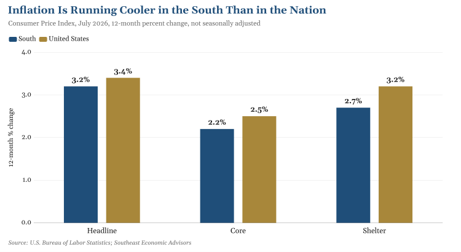
The South is still running cooler than the nation, and the gap widened in July. The CPI for the South rose 3.2% over the year to July against 3.4% nationally, with core prices up 2.2% versus 2.5% and shelter up 2.7% versus 3.2%. Energy is doing the damage: gasoline in the South is up 26.4% from a year earlier and energy overall 14.6%, a direct read on the Middle East supply shock and Brent crude that settled Friday at $89.31, while food is up 2.7% and electricity just 1.9%. Retail diesel at $5.65 a gallon, up 52% from a year ago, is the sharpest cost squeeze on the region's truckers, and the pressure did not end with the week: U.S. forces struck IRGC launchers on Larak Island in the Strait of Hormuz on Sunday, Iran answered against U.S. positions in Jordan and crude opened the week higher. Metro readings run from Washington's 4.0% and Miami's 3.4% down to Tampa's 1.9% and Houston's 0.8%, with Atlanta at 2.8% and Dallas-Fort Worth at 2.9%.
The underlying gauges we favor tell a calmer story than the headline. The Cleveland Fed's median CPI is running 2.7% over the past year and the Dallas Fed's trimmed-mean PCE 2.3%, against headline PCE of 3.7% and core PCE of 3.3%. A full point of daylight between core and trimmed-mean PCE says the pressure is concentrated in a handful of energy-sensitive categories rather than spread across the basket, and our own trend estimate continues to run near 2.9%. We look for the South's headline CPI to hold in the low 3% range through year-end as gasoline base effects turn favorable in the fourth quarter; a renewed spike in crude out of the Gulf is what would break it.
Labor Markets
July's national report was the weakest of the expansion, and the revisions were worse than the headline. Nonfarm payrolls fell 23,000, May and June were revised down a combined 103,000 and the unemployment rate held at 4.1%. Government shed 53,000 jobs, leisure & hospitality fell 40,000 and health care added just 22,000 against a 36,000 monthly average over the prior year. Friday's preliminary benchmark revision then cut the March 2026 payroll count by another 79,000, against a consensus that looked for an upward revision near 138,000, trimming average monthly job growth over the revision year to roughly 18,000. Layoffs are still not the story: initial claims were 203,000 in the week of August 22 and continuing claims 1.78 million, the profile of a low-hire, low-fire market.
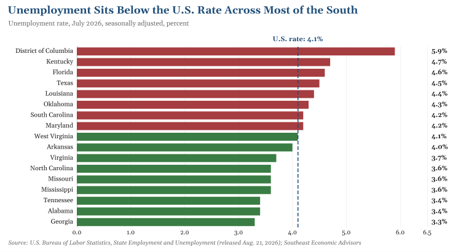
The July state data split cleanly between the states adding jobs and the ones tied to the federal payroll. Texas (+165,600, or 1.2%), North Carolina (+51,600), South Carolina (+32,100) and Louisiana (+26,800) were four of the six states nationally with statistically significant job gains over the year, while Virginia (-47,900, or 1.1%) and the District of Columbia (-31,500, or 4.2%) were the only significant decliners in the country. Georgia and Florida were essentially flat. Unemployment sits at 3.3% in Georgia, 3.4% in Alabama and Tennessee and 3.6% in North Carolina, all well below the 4.1% national rate. Florida is the state to watch: its rate has climbed 0.7 point over the year to 4.6%, and all four of its large metros were up 0.6 to 0.7 point in June.
Friday's August employment report is the last major data point before the September FOMC meeting. The consensus looks for a gain of roughly 45,000 to 55,000 jobs and an uptick in the unemployment rate to 4.2%. We look for a print near 50,000 with unemployment at 4.2%, enough to keep the Committee focused on prices; a payroll number below 25,000, landing on top of the freshly lowered benchmark, is what would take a September hike off the table regardless of what Jackson Hole signaled.
Policy Watch
Warsh's first Jackson Hole address ended any doubt about where the new chair's priorities lie. He said the Fed's "predominant focus right now should be on prices," argued that the current 3.50% to 3.75% target range is not restricting activity and rejected forward guidance as "a discipline, not a decision." Three participants (Hammack, Kashkari and Logan) had already dissented in favor of a quarter-point hike in July. We have held all year that there would be no cut in 2026 and that the next move under Warsh would be a hike, and we continue to look for a hold on September 16 with the first quarter-point increase in the first quarter of 2027, though the weight we put on a late-2026 move is rising. A core CPI print of 0.3% or more on September 11, particularly with core goods above 0.4%, is what would make a September hike our base case.
Wednesday's Beige Book will be the first read on how the region handled the summer. The July edition described growth at a slight to moderate pace in eleven of twelve Districts, with the Atlanta Fed reporting flat to slightly lower employment as firms let attrition run, softer auto sales and row-crop farmers under "severe financial strain" as tariffs depressed soybean prices. The new book covers mid-July through late August.
The G20 comes to the mountains this week. Finance ministers and central bank governors meet today and tomorrow at the Grove Park Inn in Asheville, with Treasury Secretary Bessent hosting and Chair Warsh co-hosting three days after Jackson Hole and four days before the FOMC blackout begins. We expect headlines rather than a communique, with Iran policy the live subject and any language on Treasury market functioning the one output markets would trade on. Bessent picked Asheville to put the Helene recovery on display, which by our count has delivered about $9.7 billion of federal aid against roughly $60 billion of damage.
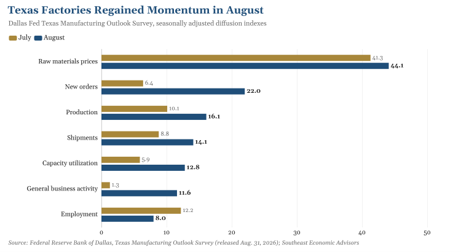
Texas factories opened the week with the month's strongest survey. The Dallas Fed's Texas Manufacturing Outlook Survey, released this morning, showed general business activity climbing to 11.6 in August from 1.3 in July, with new orders jumping to 22.0 from 6.4, production rising to 16.1 and capacity utilization doubling to 12.8. The price signal has not gone away: raw materials prices rose to 44.1 as finished-goods prices slipped to 22.7, the same margin squeeze the July Beige Book flagged, and a primary metals respondent credited Section 232 aluminum tariffs with onshoring business while warning that transshipment could undo it. Producers put the six-month outlook for activity at 37.2, so the sector that anchors the region's largest state economy enters the fall with orders improving and costs still climbing.
Trade policy turned north this week, and the retaliation list reads like a directory of Southern mills. Section 338 tariffs of 50% on roughly $20 billion of Canadian dairy, alcohol and motor vehicles took effect August 22, and Ottawa answered with counter-tariffs of 15% to 50% on C$27.6 billion of U.S. goods effective September 8, covering steel, lumber, pulp and paper, textiles & apparel, plastics, appliances and furniture. Savannah handled 503,739 TEUs in July, up 5.7% from a year earlier, while Houston slipped 6% with steel tonnage down 18% year to date. The Atlanta Fed's GDPNow estimate for the third quarter stood at 4.6% as of August 26, after second-quarter growth was left at 1.5%. We look for third-quarter growth closer to 2.5% as inventories and net exports normalize; a repeat of July's 0.4% gain in personal income through the quarter is the condition that would prove the nowcast right.
Commercial Real Estate Across the South
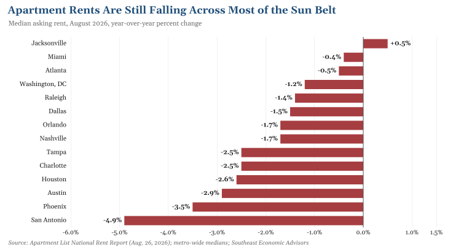
Multifamily. National effective rents turned positive in July for the first time in more than a year, and the South is the reason it took so long. RealPage puts same-store effective rents up 0.4% from a year earlier with occupancy at 95.5%, while the South was still down 1.9% at mid-year, the only region with falling rents and the only one with occupancy below 95%. The region took delivery of more than 170,000 units over the past year, better than half the national total. Apartment List's August data show San Antonio (-4.9%), Austin (-2.9%), Houston (-2.6%), Charlotte and Tampa (both -2.5%) still cutting, with Jacksonville (+0.5%) the lone gainer among the Southern metros we track. Yardi Matrix sees completions bottoming near 444,000 in 2027, down from about 490,000 this year. We look for Southern rents to turn positive by mid-2027 as deliveries fall; a 20% rebound in first-half starts is the risk that refills the pipeline for 2028.
Industrial. First-half absorption was the strongest since 2023, and the South accounts for half of what is under construction. Cushman & Wakefield puts national vacancy at 6.9% with 62.1 million square feet absorbed in the quarter, 305 million square feet underway and asking rents up 2.9% from a year ago. The South's vacancy rate is 7.8%, with Dallas-Fort Worth at 8.1% on 9.0 million square feet of absorption, Houston at 6.3%, Atlanta at 8.5%, Nashville at 5.3% and Richmond at 3.8%. Port markets are the soft spot, with Savannah at 10.5% and Charleston at 12.9%. Parts Town's 538,450-square-foot lease in Pendergrass, Georgia, signed last week, keeps Atlanta's pipeline moving.
Office. The office recovery is broadening, but the South's largest markets are still carrying vacancy in the mid-20s. CBRE's national vacancy rate fell 30 basis points to 18.3%, the largest quarterly decline since 2015, and Cushman & Wakefield puts the South at 20.0%. Austin (26.9%), Atlanta (24.9%), Dallas (24.9%), Houston (24.7%) and Charlotte (23.9%) all sit well above Nashville (16.3%), Miami (14.6%) and Richmond (11.1%).
Retail. Retail is the tightest sector, and the South is where the new space is. Cushman & Wakefield puts shopping-center vacancy at 6.0% nationally against a 7.4% long-run average, with rents up 2.2% from a year ago and Southern rents up 3.3%, the strongest of any region. Vacancy rose in 20 of 34 Southern markets as new projects lease up, a supply story rather than a demand story.
Capital markets. Deal volume is back, distress is rising and the two are not contradictory. MSCI counted $74.4 billion of July transactions, up 78% from a year earlier, but $33.8 billion of it was data-center deals and apartment volume fell 16%. Trepp's CMBS delinquency rate jumped 51 basis points in July to 7.86%, with office at 11.91% and multifamily at 7.69%. The ten-year Treasury closed Friday near 4.73% and the 30-year mortgage rate sits at 6.66%. We look for cap rates to drift higher through year-end with the two-year yield above 4.3%; a Fed that holds through December is the condition that keeps them anchored.
Development Wins of the Week
Carolinas. ProVia will build a $120 million, 400-job window and door plant in Mocksville, Davie County (August 25); Boater's World will put 179 jobs into a boat plant in Chocowinity, Beaufort County (August 26); and Great Southern Wood picked Scotland County for a $40 million lumber-treatment plant (August 24). South Carolina had a quiet week.
Georgia & Florida. Walmart's $1.3 billion fulfillment center in Carnesville, Franklin County, will employ 1,000 (August 27), and the OpenAI campus in Effingham County cleared its power contract review (August 26). Florida's action ran through the First Coast: a private group led by Blasen Capital Markets Group and entertainment entrepreneur Kyle Kane is shopping The Grounds, a privately financed $120 million, 50,000-capacity outdoor entertainment campus, with Jacksonville's Cecil Commerce corridor the provisional front-runner among nine competing markets ahead of an October 1 site decision; sponsor projections of 4,500 to 6,500 workers at maturity are planning figures rather than certified impacts. Taylor Morrison paid $45.4 million for 415 acres in St. Johns County for a 400-home Esplanade community opening for sales in mid-2027, and the Margaritaville hotel at Beachwalk drew a $10.5 million construction permit.
Alabama, Mississippi & Louisiana. SpaceX's $100 billion Vermilion Parish spaceport (August 25) leads the nation. Mississippi landed Solero Technologies' $14 million, 86-job plant in Water Valley (August 20) and Ocean Aero's 45-job operation at the Port of Gulfport (August 28).
Tennessee & Kentucky. Dometic will add more than 90 jobs in Sparta, White County (August 20), and Anthro Energy broke ground on its $40 million, 110-job Louisville battery plant (August 18).
Texas, Oklahoma & Arkansas. Amazon confirmed a multi-billion-dollar robotics plant in Austin with 300 to 500 jobs and no incentives (August 19), and Google was revealed as the end user of the 506-acre Project Clydesdale campus in Tulsa County.
Virginia, Maryland & DC. No new corporate projects cleared our verification bar; the corridor's news was Fredericksburg's denial and Henry County's new data-center ordinance.
The Week Ahead
- Mon.-Tue.
- G20 finance ministers and central bank governors meet in Asheville, N.C. Dallas Fed Texas Manufacturing Outlook Survey (August): general business activity 11.6, up from 1.3; new orders 22.0 (released).
- Tue., Sept. 1
- ISM Manufacturing (August; prior 55.6); JOLTS (July; prior 7.4 million openings); Fed Governor Barr speaks; GDPNow update.
- Wed., Sept. 2
- ADP employment (August); Beige Book, 2:00 p.m.; BLS metro area unemployment (July).
- Thu., Sept. 3
- Initial jobless claims; international trade (July); ISM Services (August; prior 54.1); Fed Governor Waller interview.
- Fri., Sept. 4
- Employment Situation (August), 8:30 a.m.: consensus roughly +45,000 to +55,000 payrolls, 4.2% unemployment.
- Mon., Sept. 7
- Labor Day; markets closed.
- Tue., Sept. 8
- Canadian counter-tariffs on C$27.6 billion of U.S. goods take effect.
- Sept. 10-11
- Producer Price Index (August); Consumer Price Index (August), with metro CPI for Atlanta, Miami and Houston.
- Sept. 15-16
- FOMC meeting with Summary of Economic Projections; state employment (August) follows on September 18.
Recent Research
Football season opened this weekend, and our sports economics series opened with it. The Economics of College Football: 2026 Edition sizes up the sport's $21.3 million salary cap, its $4.5 billion player market and our Cinderella watch, and Carolina Blue vs. Horned Frog Purple: UNC and TCU Open 2026 in Dublin previewed the opener in which the Tar Heels pulled off the upset. This week the series turns to Clemson vs LSU, pairing the game with the economies of South Carolina's Upstate and the Baton Rouge and broader Louisiana boom chronicled above, then steps outside the region for Washington State vs Washington and a look at Seattle's tech economy alongside rural Washington's wheat and hydropower country. All of it posts at southeasteconomy.com.
Elsewhere on our desk this week: the latest A View from the Piedmont, "The Turn You Cannot See at the Time," makes the companion case to this report's inflation section, that every gauge stripping the shocks is already at or below target, and the new Piedmont Perspective essay "What Counts as a Job Now" examines the blind spots in the claims data cited at Jackson Hole. The Catawba County and Hickory Metro Economic Outlook and "My Hickory Story" remain posted as well.
Sources & Notes
Sources: U.S. Bureau of Labor Statistics; U.S. Bureau of Economic Analysis; Federal Reserve Board (July 29 statement, August 19 minutes, Chair Warsh's August 28 remarks, July 15 Beige Book); Federal Reserve Banks of Atlanta (GDPNow), Cleveland (median CPI) and Dallas (trimmed-mean PCE; Texas Manufacturing Outlook Survey, August 31); U.S. Department of Labor; U.S. Treasury; CME FedWatch as reported by TheStreet and FXStreet; Georgia Power, Georgia PSC, Atlanta Journal-Constitution, The Current, Texas Tribune, Virginia Mercury and local news outlets covering each county action; Nvidia; ConstructConnect; RealPage, Yardi Matrix, Apartment List, CBRE, Cushman & Wakefield, Trepp via MBA NewsLink, MSCI via Bisnow, U.S. Census Bureau, Freddie Mac; Georgia Ports Authority, Port Houston; state economic development agencies in Louisiana, Georgia, North Carolina, Mississippi, Tennessee and Kentucky; Amazon; Piedmont Crescent Capital (A View from the Piedmont, August 30); Federal Reserve Bank of Dallas (Texas Manufacturing Outlook Survey, August 31); Jacksonville-area development items from client-compiled clippings.
Notes: CPI figures are 12-month changes, not seasonally adjusted; metro CPI is bimonthly and the latest month is shown. State data are July 2026 preliminary; metro unemployment is June, not seasonally adjusted. Brokerage data are second quarter 2026; rent and delinquency figures are as noted. Market levels are Friday, August 28 closes pending the Fed's H.15 posting; GDPNow is the August 26 vintage. Market levels predate Sunday's Middle East escalation. Forecasts are those of Southeast Economic Advisors and Piedmont Crescent Capital.
Download the full report (PDF)
© 2026 Southeast Economic Advisors, a Piedmont Crescent Capital company. For informational purposes only; not investment advice.