
Still Rising: Why Atlanta’s Growth Engine Hasn’t Run Out of Gas
• A recent Wall Street Journal article spotlighting modest domestic outmigration from the Atlanta MSA in 2024 misses the broader story—Atlanta’s growth engine hasn’t stalled, it’s evolving. Economic momentum is shifting outward geographically and diversifying across industries.
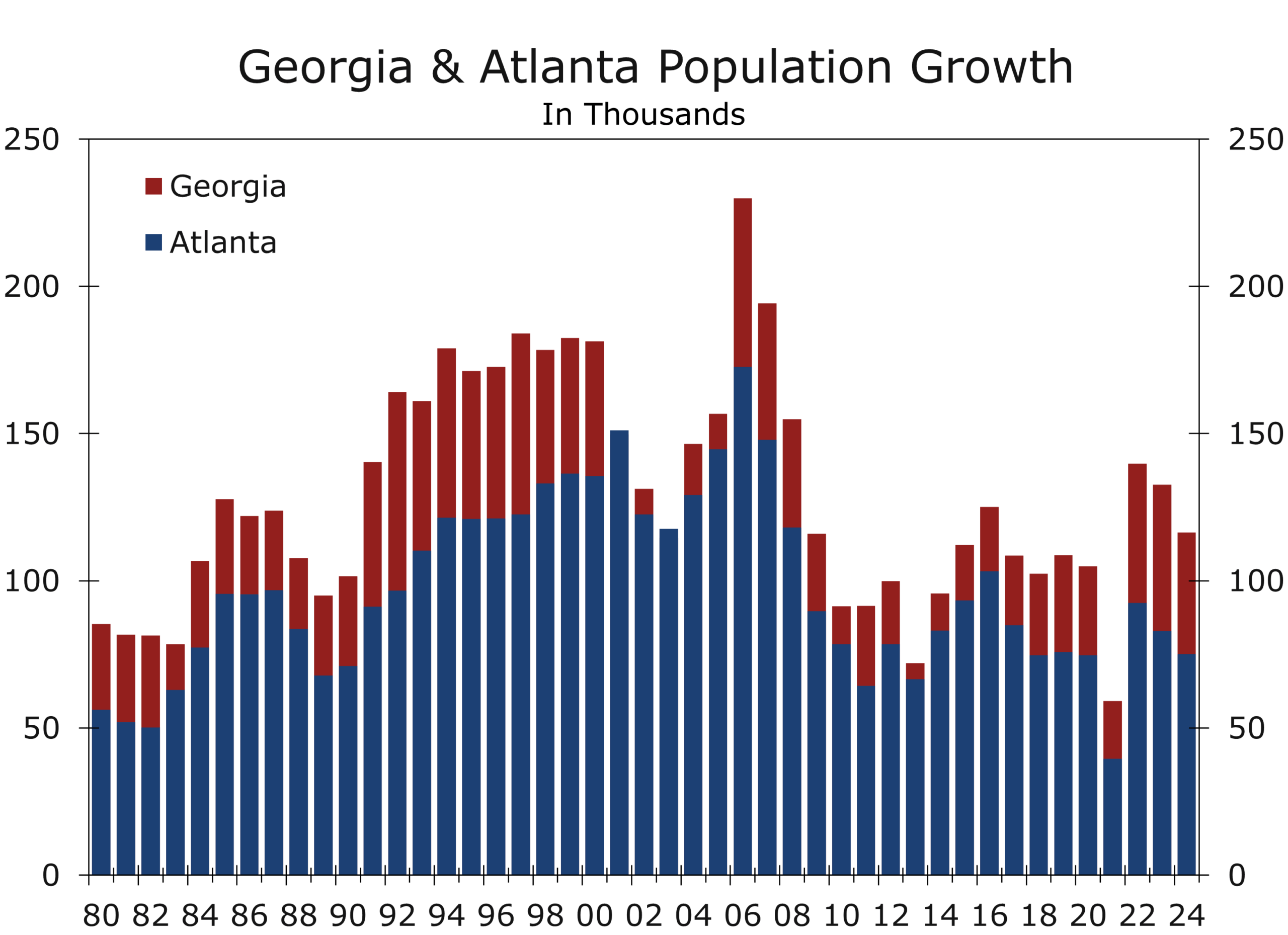
• Atlanta’s population is still growing—the metro area added 75,134 residents in 2024, with all the gain coming from international migration and natural increase (more births than deaths).
• International migration has accelerated as Atlanta emerges as a global gateway. Many immigrants initially settle in the metro before relocating within the region, contributing to household churn—not regional decline. They are then counted as domestic out-migrants.
• Many out-migrants are moving to counties just beyond the official MSA but within the broader Combined Statistical Area (CSA). The Atlanta CSA posted a modest gain in domestic net migration.
• Growth is accelerating across an arc from I-20 East (Covington), through Athens and Gainesville, and on to Dahlonega and Rome.
• Housing constraints are shifting demand—not collapsing it.
• Recent “speed bumps” tied to federal layoffs and a cooling film sector are cyclical, not structural.
• Some households are relocating to nearby metros like Charlotte, Nashville, Greenville, and Chattanooga—but remain economically and culturally tied to Atlanta.
The Numbers Tell One Story. The Region Tells Another.
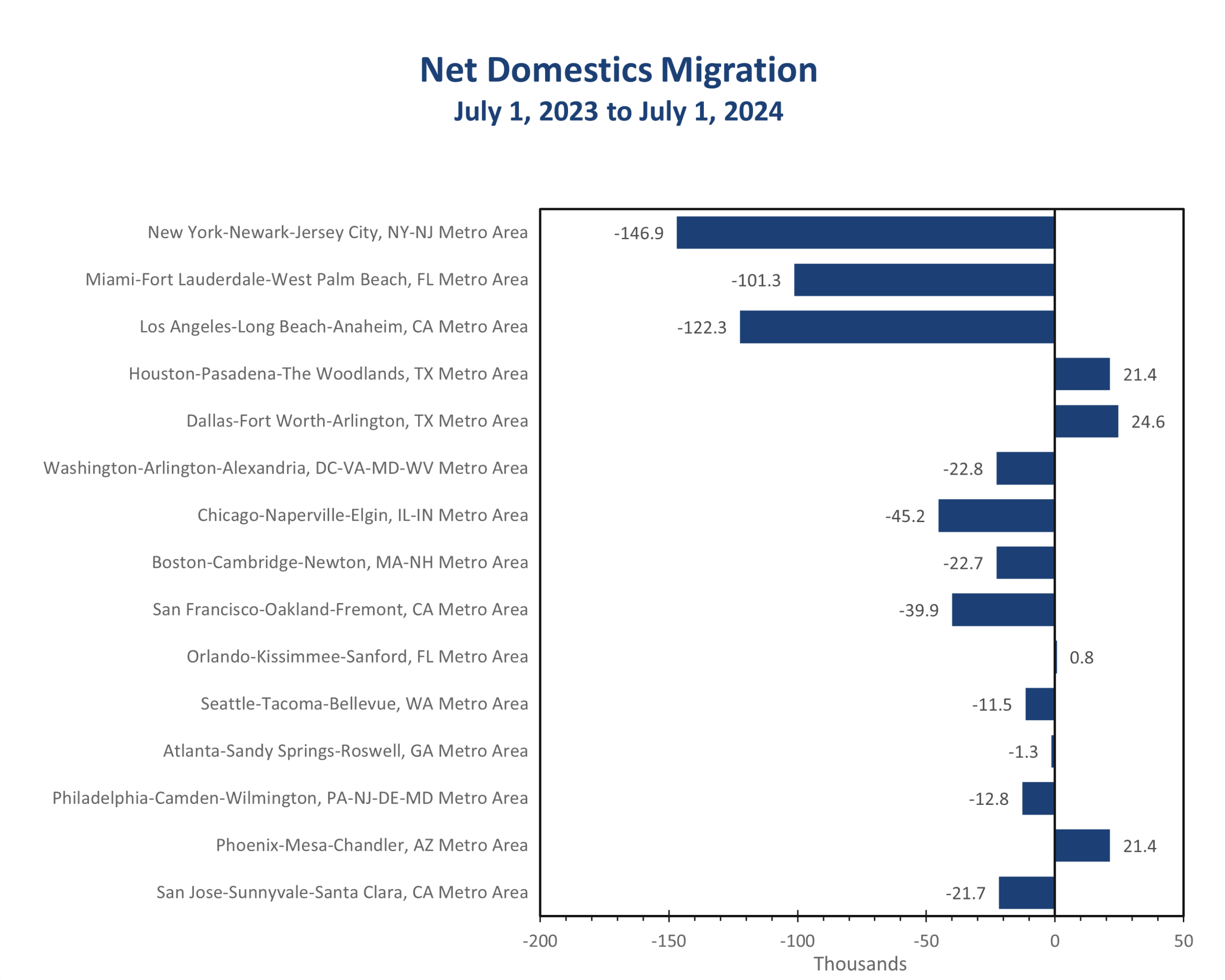
Census estimates show metro Atlanta posted a modest net domestic outflow of just 1,330 residents between mid-2023 and mid-2024—prompting concern that the region’s long population boom may be reversing. But that interpretation lacks context.
The 29-county Atlanta–Sandy Springs–Alpharetta MSA added 75,134 residents in 2024 and 304,344 since 2020. The region’s total population reached 6.41 million in 2024. The broader 40-county Atlanta–Athens–Clarke County–Sandy Springs CSA added 88,125 people in 2024, including 6,559 domestic in-migrants, and 362,735 new residents since 2020, bringing the total population to 7.34 million.
Metropolitan Statistical Areas (MSAs) and Combined Statistical Areas (CSAs) are official classifications used by the U.S. Office of Management and Budget to define regional labor markets based on commuting patterns. An MSA centers on an urban core of 50,000+ residents and includes surrounding counties where at least 25% of workers commute to or from the core. CSAs link two or more adjacent metro or micropolitan areas—smaller urban centers of 10,000 to 50,000 people—when there is moderate economic integration, defined by a 15% employment interchange. While MSAs capture single metro economies, CSAs reflect broader, multi-core regions with shared labor forces and infrastructure.
Atlanta is not declining—it’s transitioning. The region is becoming more geographically dispersed, fueled by strong international migration, solid natural increase, steady domestic inflows, and growing integration with adjacent metros such as Athens, Gainesville, and Rome, as well as formerly outlying micropolitan areas like Calhoun, Cedartown, and Cornelia.

Speed Bumps, Not Roadblocks
Federal layoffs struck a nerve in 2024. Roughly 2,400 workers, primarily at the Centers for Disease Control and Prevention, were let go as part of a Department of Health and Human Services reorganization. The disruption weighed on consumer activity, commercial leasing, and housing in key submarkets.
At the same time, Atlanta’s once-booming film and entertainment sector has plateaued. Studio production and film permit issuances fell more than 40% from peak levels in 2024, mirroring a national retrenchment in content creation. Thousands of jobs in Atlanta are tied to the industry, amplifying the local effect.
But these are cyclical corrections following outsized pandemic-era gains—not signs of systemic weakness.
From Gateway to Launchpad: Atlanta’s International Surge
Often overlooked is Atlanta’s position as one of America’s most dynamic international gateways. Nearly 30 years after the 1996 Olympics, Atlanta is now a magnet for global migration. Hartsfield–Jackson International Airport remains the world’s busiest, offering nonstop service to six continents.
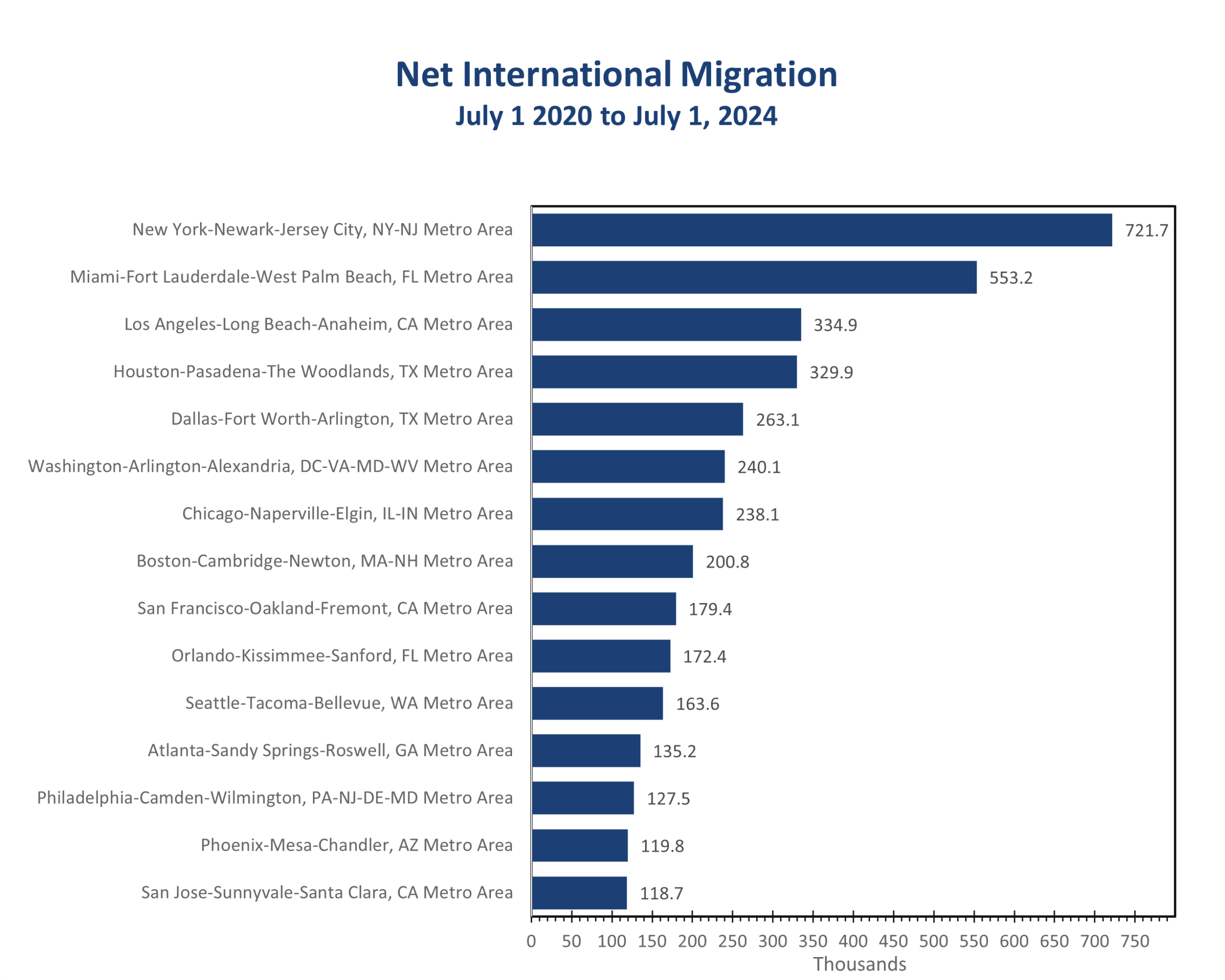
Net international migration—encompassing foreign-born arrivals, inbound government personnel (primarily military), and net inflows from U.S. territories—continues to rise. Many new arrivals initially settle in inner-ring counties such as Gwinnett, DeKalb, Fulton, and Cobb, which together have accounted for 62% of Georgia’s net international migration over the past four years. When these residents later relocate elsewhere in the region—whether to Jackson County along I-85 (part of the Athens MSA) or to Hall County, home to Gainesville—their moves are classified as domestic outmigration, even though the greater Atlanta area retains both the population and the long-term economic value.
This is not attrition—it’s upward mobility. It’s a distortion visible in most gateway metro’s data, but particularly evident in Atlanta, with its multitude of relatively small counties. Georgia has 159 counties—second only to Texas with 254—a legacy of the state’s emphasis on local governance and its early goal of making every county seat reachable within a day’s ride on horseback. By contrast, Florida and Pennsylvania each have 67 counties.
Atlanta posted the 12th largest net international migration of any MSA from 2020 to 2024. Eleven of the top 15 gainers over that period saw net domestic outmigration this past year, with the exceptions being Houston, Dallas-Worth, Phoenix and Orlando, which eked out a domestic migration gain of 779 persons.
The Arc of Growth: Stretching Farther, Pulling Wider
The Atlanta region is expanding along a geographic arc that spans from I-20 East (Covington) through Athens, up to Gainesville, and out toward Cornelia, Dahlonega, and Rome. These communities are seeing rapid growth in housing demand, infrastructure investment, and commercial development—fueled by the need for space and affordability.
Some households are relocating farther—into Chattanooga, Nashville, Greenville, and Charlotte—but remain within Atlanta’s economic orbit. And yes, they’re still Braves fans, even in a down year.
The shift reflects regional diffusion, not abandonment. North Georgia, Western North Carolina, and central Alabama from Huntsville to Birmingham are emerging as new frontier zones.

Affordability Pressure = Demand, Not Decay
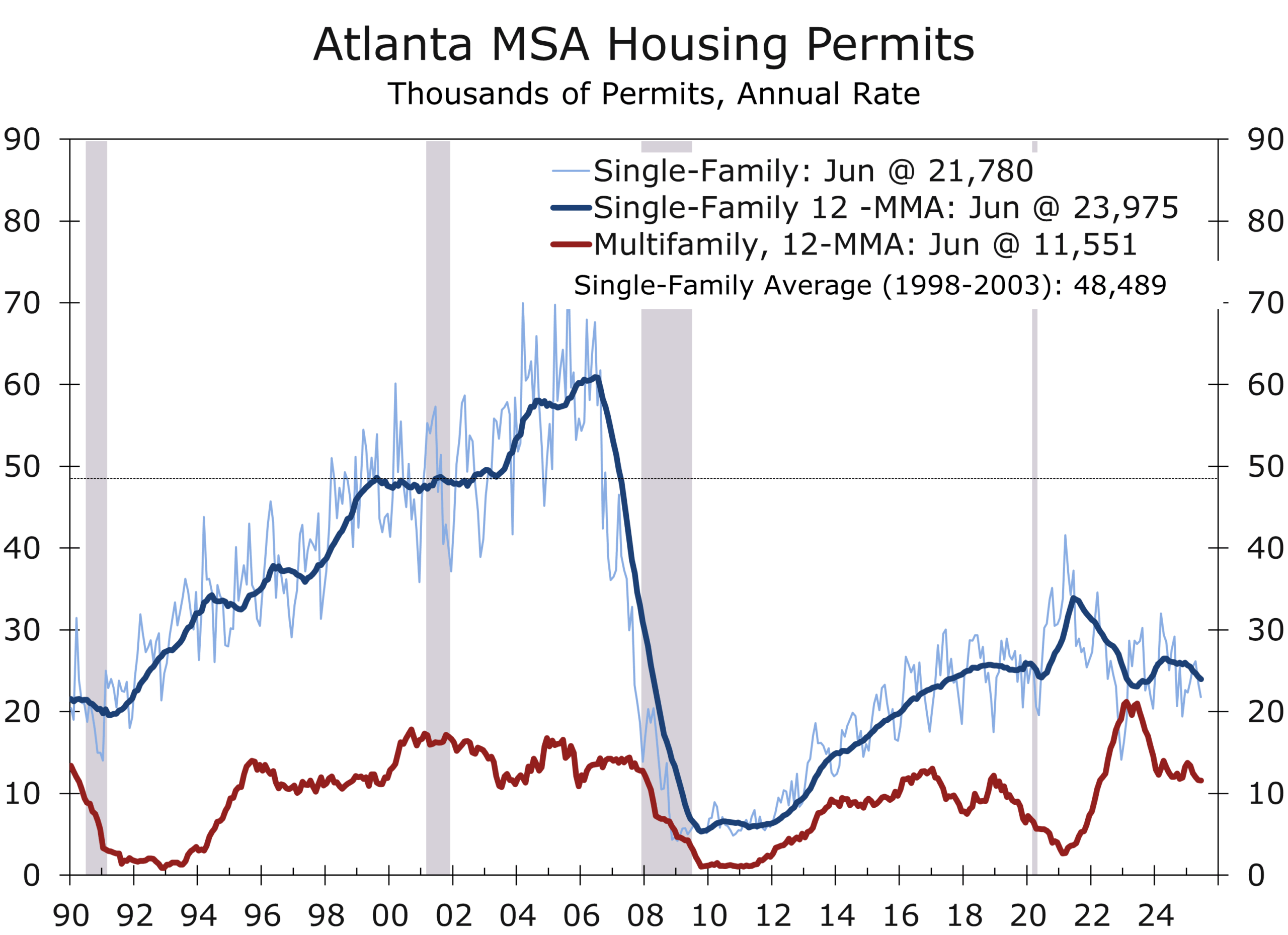
Since 2012, Atlanta’s home prices have tripled, although they have softened more recently, with the median now around $380,000. New home construction has failed to keep pace with population growth. Single-family starts remain below their prior peak, and growing land competition from industrial and data center developers is further tightening supply.
Financial-crisis memories still lingers: homebuilders have consolidated, and lenders remain cautious. As a result, more buyers are looking beyond the traditional suburbs.
The shift to Jackson, Hall, Barrow, and Lumpkin counties reflects both affordability pressures and continued confidence in the region’s long-term strength. These residents still commute to Atlanta. They remain part of the region’s labor force. They still belong to metro Atlanta—and they are a big reason why the phrase “Atlanta is always an hour away from Atlanta” rings so true.
Natural increase, more births than deaths, is also contributing to population growth. The metro posted 29,916 more births than deaths in 2024, and 95,222 over the last four years. The increase is driving demand for homes in outlying areas.
Economic Fundamentals Remain Strong
Despite recent softness in select sectors, Atlanta’s economic core remains healthy. Logistics, fintech, health sciences, advanced manufacturing, and corporate services continue to drive job growth. Companies are scaling along the I-75 and I-85 corridors, and data center investment in the southern and western suburbs is lifting long-term infrastructure needs.
While Microsoft paused its Westside development, many firms continue to expand. Atlanta remains a top destination for corporate relocation thanks to its air connectivity, labor pool, and cost advantage.
It also ranks among the best U.S. metros to start a business, launch a career, and raise a family.
Still Rising, Just Widening the Footprint
Atlanta’s growth has not ended—it has matured, dispersed, and expanded. The pandemic surge has cooled, and recent headlines reflect legitimate—but temporary—headwinds.
The bigger story: this is a region redefining what a modern metro looks like. The Atlanta MSA has recently been divided into two official metropolitan divisions:
- Atlanta–Sandy Springs–Roswell
- Marietta
Meanwhile, new housing frontiers are opening in all directions. Smyrna, home of the Braves, symbolizes how the region’s center of gravity continues to shift.
Atlanta may be “an hour from Atlanta,” as the joke goes—but those who’ve moved beyond the metro haven’t moved on from it. They remain connected, invested, and essential to Atlanta’s next chapter.
July 25, 2025
Mark Vitner, Chief Economist
Southeast Economic Advisors
704-458-4000