
🏈 Georgia vs. Florida 2025: The Rivalry and the Regional Economy

Our college football series returns this week with one of our favorite matchups: fifth-ranked Georgia facing off against Florida. While the Gators have endured a disappointing season, history reminds us that records mean little in this rivalry. The underdog often thrives, and the series is filled with stunning upsets.
Upsets have become the theme of the 2025 college football season—a reminder that in the transfer-portal era, no roster, reputation, or ranking is safe. Programs once viewed as immovable pillars—Ohio State, Texas, and Penn State among them—entered the season with championship aspirations, only to find that the new dynamics of player movement, NIL incentives, and evolving rules have reshaped college football’s competitive landscape.
Rule changes aimed at improving player safety and accelerating the pace of play have shortened games and narrowed the margin for error. Expanded substitution flexibility has rewarded programs with depth and balance over pure star power. The result has been a season defined by parity—one where even the most stable programs have struggled to find rhythm.
The data tell the story. By late October, 11 of the 25 teams that began the year ranked in the AP Top 25 had dropped out—a 44% turnover rate, the highest in the modern polling era. A few examples illustrate how quickly momentum can evaporate:
- Texas Longhorns (6–2): The preseason No. 1, led by Arch Manning, opened the year poised for dominance. Instead, losses to Ohio State and Florida revealed inconsistency on both sides of the ball.
- Clemson Tigers (3–4): Once a College Football Playoff fixture, Clemson’s offense has sputtered, and the Tigers have fallen from the rankings for the first time in years.
- Penn State Nittany Lions (3–4): Ranked No. 2 in August, Penn State unraveled with four straight losses, including a shocking defeat to previously winless UCLA.
Other early favorites—North Carolina, Kansas State, and LSU—have also fallen from the Top 25, proof that roster churn has leveled the playing field.
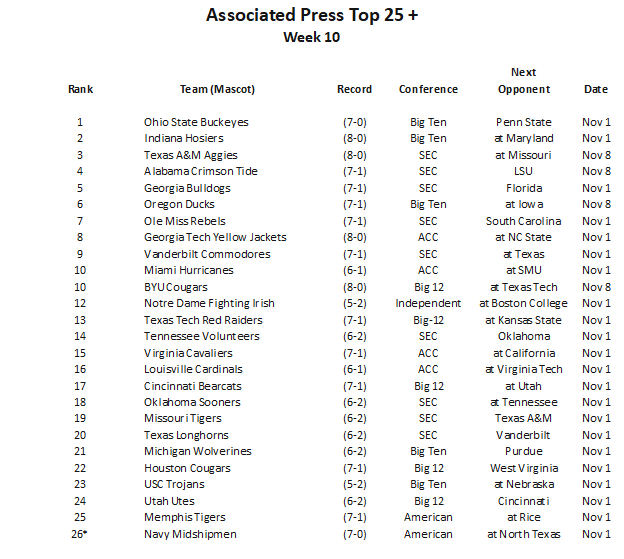
On the other side of the ledger, Georgia Tech extended its unbeaten streak to 8–0 after a convincing win over Syracuse, while Miami stayed in the ACC title race with a defensive victory over Louisville. The new AP rankings capture a sport in transition: traditional powers on the outside looking in, while overlooked programs seize the spotlight.
Week 10: Playoff Implications Across the SEC
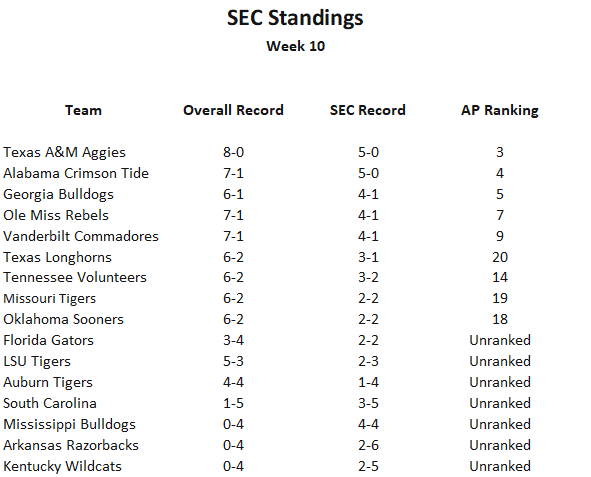
This weekend brings a slate of de facto elimination games for the College Football Playoff—particularly within the SEC. Texas (6–2) hosts ninth-ranked Vanderbilt (7–1); Tennessee (6–2) faces Oklahoma (6–2); and Missouri (6–2) welcomes undefeated, third-ranked Texas A&M. Other notable matchups include eighth-ranked and undefeated Georgia Tech at NC State, and Ohio State hosting a reeling but dangerous Penn State squad.
Our focus, however, is on a neutral-site rivalry that has long shaped the SEC and national title races. The annual Florida–Georgia showdown—affectionately dubbed the World’s Largest Outdoor Cocktail Party—returns to Jacksonville’s EverBank Stadium for its final appearance until 2028, as the venue undergoes major renovations.
With roots dating back to 1904, this storied rivalry carries cultural and economic weight across north Florida and south Georgia. Fans fill hotels from Ponte Vedra Beach to Sea Island, fueling one of the Southeast’s most anticipated weekends.
Legendary Moments: 50 Years of Florida–Georgia Drama
Few rivalries have produced as many unforgettable moments as Florida vs. Georgia. Played almost every year since 1933, the annual Jacksonville clash has defined entire seasons with moments of brilliance, heartbreak, and chaos.
Georgia leads the all-time series 56–44–2, having won six of the past eight matchups. Yet, as history shows, rankings and records rarely dictate the outcome.
Defining Moments
- 1975 – Appleby to Washington: Georgia tight end Richard Appleby threw an 80-yard touchdown to Gene Washington, stunning No. 11 Florida and sparking Larry Munson’s legendary call.
- 1980 – “Run, Lindsay, Run!” Buck Belue’s 93-yard strike to Lindsay Scott turned defeat into triumph, propelling Georgia toward a national championship.
- 1984 – Kerwin Bell’s 96-Yard Bomb: Florida’s freshman walk-on QB shocked No. 8 Georgia with a 96-yard touchdown, sealing a 27–0 upset.
- 1993 – Judd Davis’ Last-Second Kick: Davis’ 32-yard field goal as time expired lifted the Gators 33–26.
- 1997 – Dawgs Stun the Head Ball Coach: Georgia snapped Florida’s seven-game streak, 37–17, behind Mike Bobo and Robert Edwards.
- 2002 – Florida Spoils Georgia’s Dream Season: Unranked Florida derailed Georgia’s national title hopes, 20–13.
- 2007 – The “Gator Stomp”: Georgia’s entire team celebrated Knowshon Moreno’s opening TD, sparking a 42–30 victory.
- 2008 – Tebow’s Four-TD Revenge: Florida responded with a 49–10 rout on its way to the national title.
- 2012 – Jarvis Jones’ Goal-Line Punch: A late forced fumble preserved Georgia’s 17–9 win.
- 2021 – Florida’s Two-Minute Meltdown: Three Georgia touchdowns in just over two minutes before halftime turned a 3–0 game into a 24–0 rout and sealed Dan Mullen’s fate.
By the Numbers: Florida–Georgia Through the Years
| Category | Statistic / Note |
| First Meeting | 1904 (Georgia 52 – Florida 0) |
| Total Meetings | 102 (as of 2024) |
| Series Record | Georgia leads 56–44–2 |
| Games in Jacksonville | 89 (played annually since 1933, except 1994–95) |
| Largest Margin of Victory | Georgia 75–0 (1942) |
| Longest Win Streak – Georgia | 7 straight (1941–48) |
| Longest Win Streak – Florida | 7 straight (1990–96 under Spurrier) |
| Most Combined Points | 82 (Georgia 44 – Florida 38, 2020) |
| Most Recent Game (2024) | Georgia 43 – Florida 20 |
| Games with Both Teams Ranked | 29 |
| Top-10 Matchups | 10 (most recent 2021, #1 UGA vs. #10 UF) |
| Average Attendance | Approx. 82,000 (split 50/50 by school) |
| Economic Impact on Jacksonville | Approx. $30–35 million in local spending annually |
| Next Scheduled Game | Nov 1, 2025 – EverBank Stadium (Jacksonville, FL) |
Georgia’s Drive for Dominance
Georgia enters this year’s meeting ranked #5 with a 6–1 record (4–1 SEC) and is seeking its fifth straight win over Florida—the longest streak in four decades.
Under Kirby Smart, Georgia continues to combine defensive discipline with offensive versatility. Quarterback Gunner Stockton has thrown for 1,500 yards and 10 touchdowns with only one interception, while adding seven rushing scores.
Georgia’s 43–35 win over Ole Miss two weeks ago tested its resilience after star receiver Colbie Young suffered a season-ending leg injury. Stockton responded with four TD passes, three to tight end Lawson Luckie, in a breakout performance. Georgia’s depth remains a strength, with targets Zachariah Branch, Dillon Bell, London Humphreys, and Noah Thomas stepping up.
Injuries remain a concern. WR Colbie Young is out for the season; TE Ethan Barbour, WR Talyn Taylor, and DB Kyron Jones remain sidelined. Two defensive backs will also miss the first half due to targeting calls against Ole Miss. The offensive line has been steady but lacks depth.
Florida’s Fight for Stability
Florida’s season has been marked by transition and turbulence. The Gators (3–4, 2–2 SEC) dismissed head coach Billy Napier after a narrow win over Mississippi State—a move some viewed as premature. Their four losses (Texas A&M, Miami, LSU, and South Florida) have all come to teams still in the playoff conversation, while their wins (LIU, Texas, Mississippi State) have been uneven.
Interim coach Billy Gonzales now leads a roster rich in young talent but short on cohesion.
At the center of Florida’s rebuild is sophomore quarterback DJ Lagway, the five-star recruit from Willis, Texas. Lagway has thrown for nearly 1,700 yards and 14 touchdowns and added 300 rushing yards and four scores. His dual-threat capability evokes memories of Anthony Richardson, though his decision-making under pressure remains inconsistent.
Injuries have taken a toll. Florida’s offensive line has been reshuffled repeatedly, while receivers Vernell Brown III and Aidan Mizell are sidelined. Running backs Treyaun Webb and Ja’Kobi Jackson are also out, leaving Lagway to carry much of the load. A depleted secondary will be tested by Georgia’s balanced offense.
Consensus expectations point to a Georgia victory, with typical forecasts in the range of 34–20. Even so, rivalry games are seldom predictable—particularly when tradition and emotion converge on the banks of the St. Johns River.
📈 Economic Barometer: Florida’s Momentum
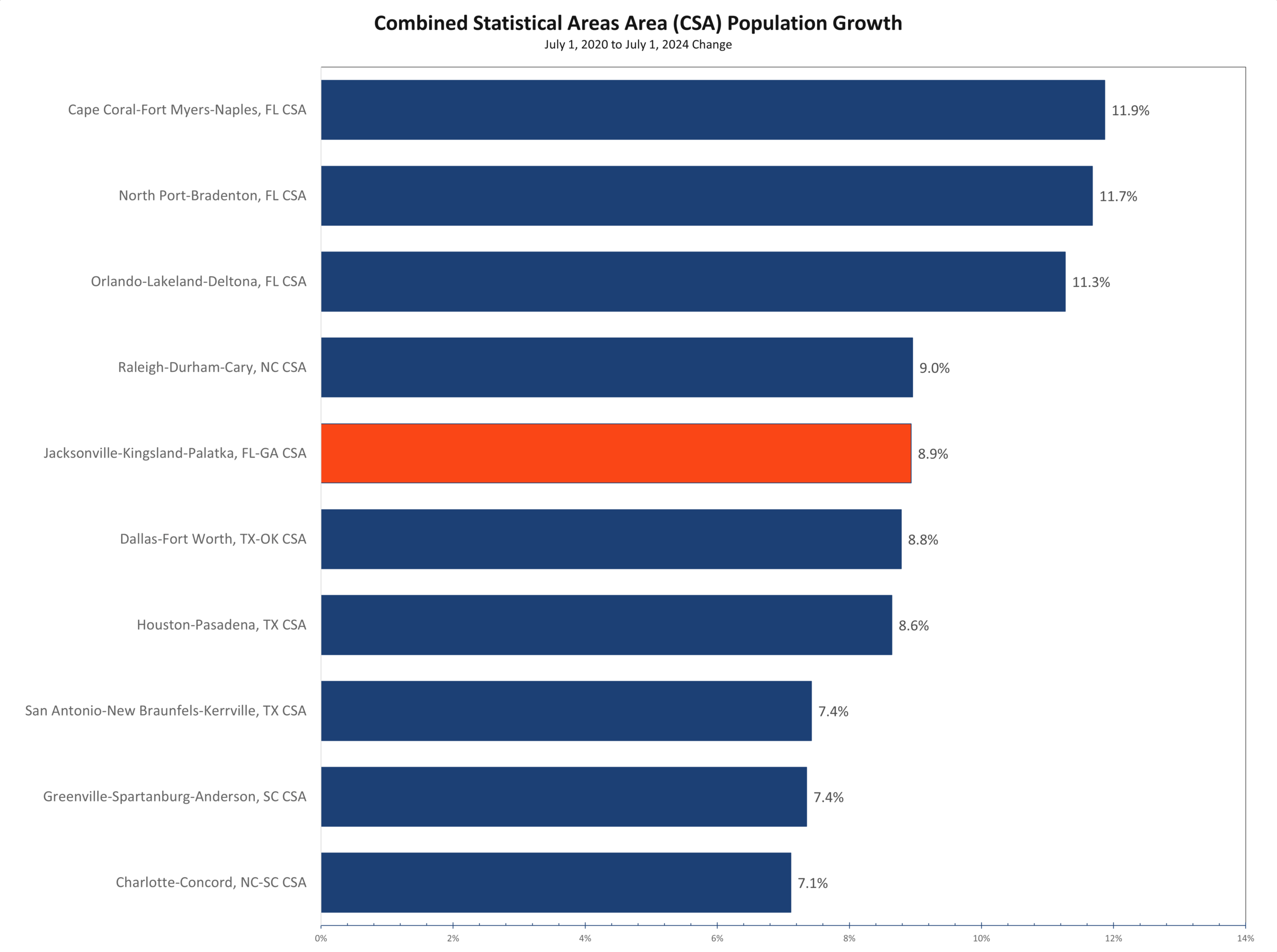
Jacksonville’s economy matches the game’s intensity. With a metro population of 1.8 million, it ranks among the nation’s fastest-growing regions, powered by logistics, health care, fintech, and port expansion.
- Diversified Growth: Unlike much of Florida, Jacksonville’s growth is driven by jobs, not tourism or retirees.
- Ports & Logistics: JAXPORT set new container records this year as Asian trade expanded; transportation and warehousing jobs are up 4.8% year-over-year.
- Defense: Mayport Naval Station, NAS Jacksonville, and Kings Bay Submarine Base together support 12,000 active-duty personnel and a robust civilian defense sector.
- Finance: Home to FIS, Florida Blue, EverBank, and Fidelity National Financial, Jacksonville remains the state’s financial hub.
- Healthcare & Education: Anchored by Baptist Health, the Mayo Clinic, UF Health Jacksonville, and Ascension St. Vincent’s, health services added about 7,000 jobs over the past year.
Universities Driving Innovation
The University of Florida’s new $300 million graduate campus in downtown Jacksonville will open in 2026, focusing on biotechnology and digital health—anchoring the city’s innovation ecosystem.
Other key institutions include:
- Jacksonville University (JU): Offering over 100 programs, JU’s new College of Law will graduate its first class in 2025.
- University of North Florida (UNF): With 17,000 students and strong engineering and business programs, UNF fuels workforce development.
- Edward Waters University (EWU): Florida’s oldest HBCU, founded in 1866, continues to expand its graduate programs in business, public policy, and life sciences.
- Flagler College (St. Augustine): A growing liberal arts college known for strong student outcomes and historic charm.
Together, these schools form a powerful higher-education cluster driving northeast Florida’s economic and cultural ascent.
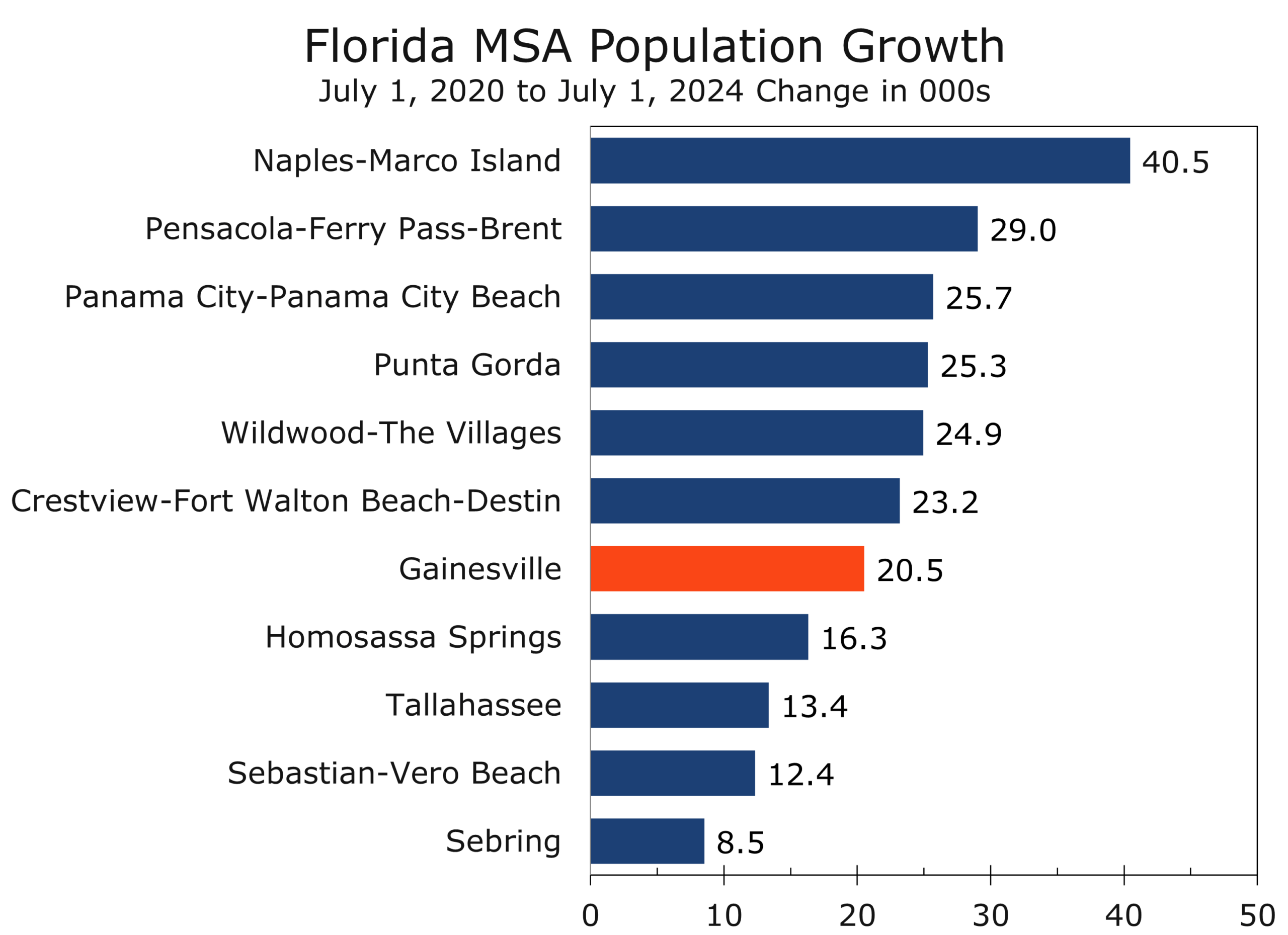
Meanwhile, Gainesville, UF’s main campus, continues its surge in research, reporting $1.33 billion in R&D expenditures last year—led by biomedical and engineering innovation. UF Health’s new NCI designation has accelerated life-science investment and tightened the local housing market.
🏛️ Georgia’s Research and Logistics Hubs
Across the state line, Georgia’s economy continues to outpace the nation, driven by manufacturing, logistics, cybersecurity, and health care.
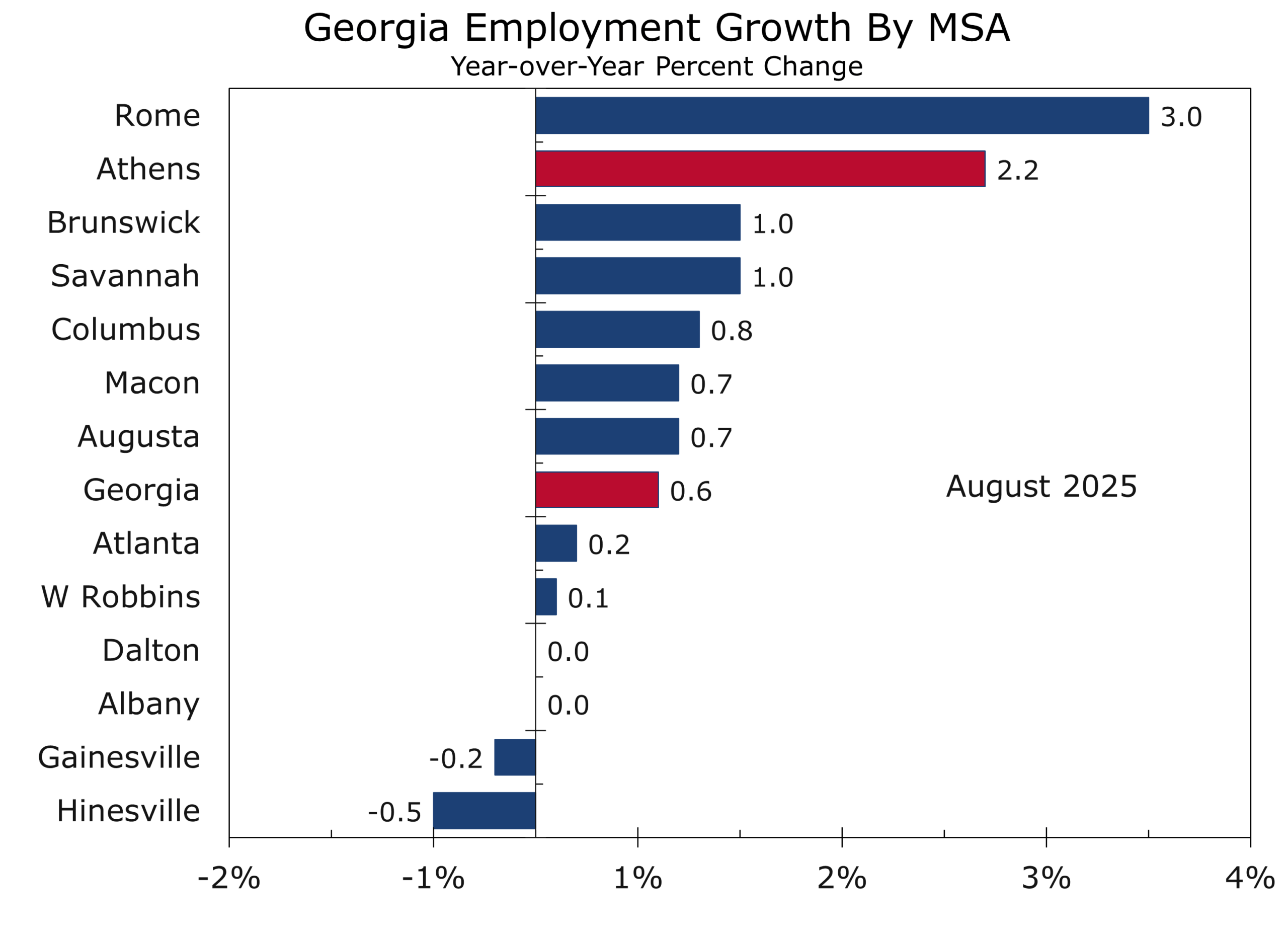
- Athens: Anchored by the University of Georgia, Athens is expanding its role in innovation and workforce training. The Highway 316 corridor has become a critical technology link to Atlanta. UGA’s new medical school, opening in 2026, will further expand the region’s “eds and meds” ecosystem.
- Atlanta Metro: The Southeast’s financial and logistics capital continues to lead in trade and professional services. While the film and entertainment sectors have cooled, the city’s studio infrastructure is adapting to streaming and game-show production.
- Northeast Georgia: Growth is spreading through Athens, Gainesville, Commerce, and Tiger—home to Georgia QB Gunner Stockton.
- Gainesville, GA: The “Poultry Capital of the World” is diversifying into advanced manufacturing and cold-chain logistics, supported by the new Northeast Georgia Inland Port and expanded warehouse capacity.
Together, these regions illustrate Georgia’s balanced economic model—research-driven, export-ready, and resilient to cyclical headwinds.

Final Whistle
In 2025, the Florida–Georgia game once again doubles as both a sporting and economic barometer for the Southeast.
On the field, Georgia’s depth, continuity, and adaptability make it the clear favorite—but as history reminds us, rivalry games are rarely predictable.
Off the field, the vibrancy of Florida’s and Georgia’s economies—anchored by the host city of Jacksonville, which sits just 25 miles south of the Georgia border, along with Gainesville, home to the University of Florida, and Athens, home to the University of Georgia—offers a vivid illustration of the South’s ongoing transformation. From ports and logistics to research parks and life sciences, these communities embody the region’s shift toward innovation-driven growth. Together, they showcase a Southern economy that is more dynamic, diversified, and globally connected than ever before—where football traditions and economic momentum continue to move in lockstep.
October 30, 2025
Mark Vitner, Chief Economist
Southeast Economic Advisors
704-458-4000